



When planning to install air conditioning in a new home, one of the most critical decisions homeowners' faces is choosing between inverter and non-inverter AC units. This choice impacts not only your comfort but also your electricity bills, environmental footprint, and long-term maintenance costs. In India, where summer temperatures can soar above 45°C in cities like Delhi and Bangalore, understanding the differences between these two technologies is essential for making an informed investment.
Understanding the Basics: How Inverter and Non-Inverter ACs Work
To appreciate the differences between inverter and non-inverter air conditioners, it helps to understand how each system operates at a fundamental level.
Build cost · Bengaluru, May 2026
Non-Inverter AC Technology
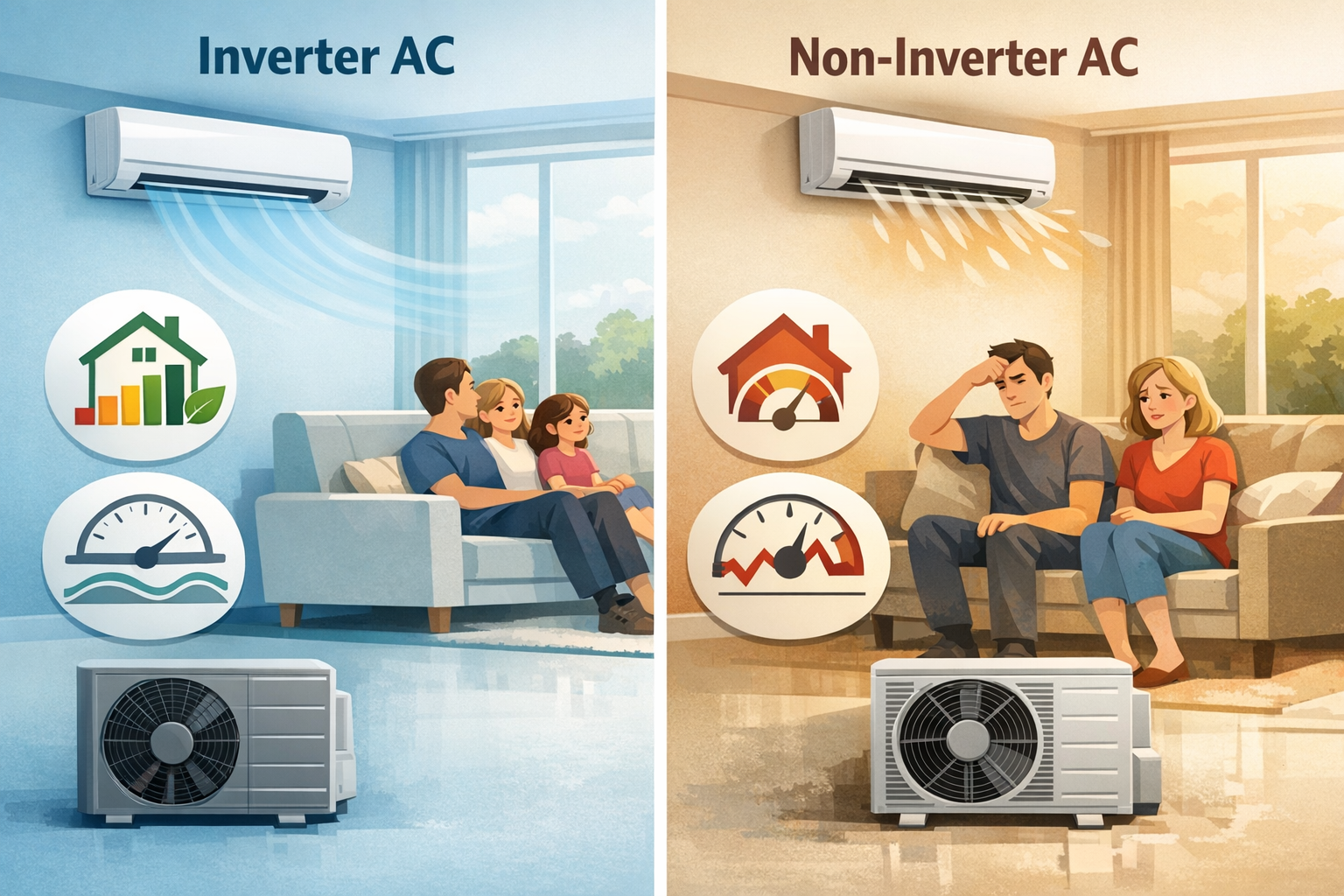
Non-inverter ACs, also called fixed-speed compressors, operate on a simple on-off principle. The compressor runs at full capacity to cool the room, and once the desired temperature is reached, it switches off completely. When the temperature rises again, the compressor kicks back on at full power. This cycle repeats throughout the day, creating a constant stop-start pattern.
Think of it like a light switch—it's either fully on or completely off. This means the compressor always operates at maximum power consumption whenever it's running, regardless of whether you need maximum cooling or just a slight temperature adjustment.
Inverter AC Technology
Inverter ACs use variable-speed compressors that adjust their operating frequency based on the cooling demand. Instead of switching on and off, the compressor modulates its speed continuously, delivering just the right amount of cooling needed to maintain your desired temperature.
Using the same analogy, an inverter AC is like a dimmer switch—it can operate at any level between minimum and maximum, adjusting in real-time to match your cooling requirements. This intelligent adjustment is what makes inverter technology more efficient.
Energy Efficiency: The Most Significant Difference
The most compelling reason many homeowners in India are switching to inverter ACs is their superior energy efficiency. This difference translates directly into lower electricity bills, which is particularly important in a country where air conditioning costs can constitute 40-60% of a household's summer electricity consumption.
Frequently asked
Power Consumption Comparison
A typical 1.5-ton non-inverter AC consumes approximately 1500-1800 watts when running at full capacity. Since it operates at this maximum level whenever active, your energy consumption remains constant regardless of actual cooling needs.
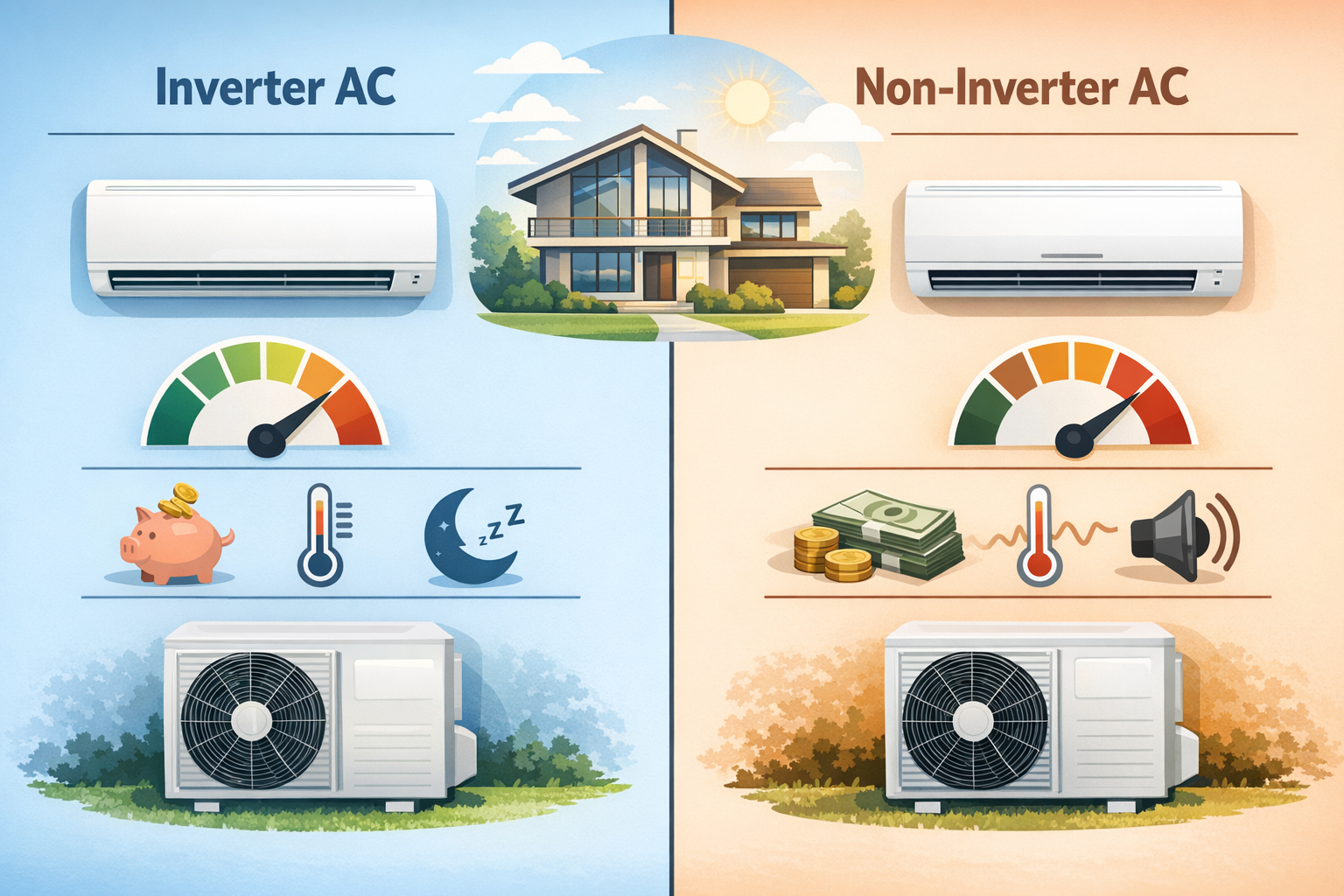
In contrast, a 1.5-ton inverter AC starts at around 400-500 watts during low-demand periods and can reach up to 1500 watts only when maximum cooling is required. On average, inverter ACs consume 30-50% less electricity than their non-inverter counterparts, depending on usage patterns and ambient conditions.
Real-World Cost Impact in India
Let's look at practical numbers. Suppose you run a 1.5-ton AC for 8 hours daily during the summer months (May to September, approximately 150 days). With an average electricity rate of ₹8 per unit in Indian metros:
Non-inverter AC: 1.5 kW × 8 hours × 150 days = 1,800 kWh annually = ₹14,400 per year
Inverter AC: 0.9 kW (average) × 8 hours × 150 days = 1,080 kWh annually = ₹8,640 per year
This translates to an annual saving of approximately ₹5,760 with an inverter AC. Over a 10-year lifespan, that's ₹57,600 in electricity savings alone, which more than offsets the higher initial purchase price of inverter models.
Initial Cost Considerations
While inverter ACs offer significant long-term savings, they do come with a higher upfront cost. This is an important factor to consider when budgeting for your new home.
Price Differential
A non-inverter 1.5-ton AC typically costs between ₹25,000 to ₹35,000, while an equivalent inverter model ranges from ₹38,000 to ₹55,000. The price difference varies based on brand, features, and seasonal demand. During peak summer months in cities like Mumbai and Hyderabad, prices tend to be higher.
Return on Investment (ROI)
Despite the higher initial investment, inverter ACs offer a clear ROI. Based on the electricity savings calculated above, an inverter AC pays for itself within 3-4 years. After that period, you're essentially running the AC for free from an electricity cost perspective. For a new home where you plan to stay for many years, this makes inverter ACs the more economical choice.
Environmental Impact and Sustainability
If you're building a new home with sustainability in mind, inverter ACs align better with eco-conscious living. By consuming less electricity, inverter units reduce your carbon footprint and decrease demand on the electrical grid—a significant consideration in India, where peak summer demand strains power infrastructure.
Lower energy consumption also means less reliance on fossil fuels for electricity generation, contributing to environmental conservation. For homeowners in environmentally sensitive areas around Bangalore, Pune, or Goa, choosing inverter ACs is a responsible decision.
Cooling Performance and Comfort
Beyond energy efficiency, inverter ACs offer superior comfort characteristics that enhance your living experience.
Temperature Stability
Non-inverter ACs create temperature fluctuations. The room cools rapidly when the compressor is on, then gradually warms as it cycles off. This creates a "sawtooth" temperature pattern that some people find uncomfortable, particularly during sleep.
Inverter ACs maintain remarkably stable temperatures by continuously adjusting compressor speed. The room stays within ±0.5°C of your desired temperature, creating a more comfortable environment. This is especially valuable in Indian homes where temperature variations can be extreme.
Faster Cooling
Inverter ACs can boost to maximum capacity instantly when you first turn them on, cooling your room faster than non-inverter models. Once the desired temperature is reached, they maintain it efficiently at lower speeds. This combination of rapid initial cooling and efficient maintenance is ideal for India's intense heat.
Reduced Noise Levels
Because inverter compressors don't constantly switch on and off, they operate more quietly. Non-inverter ACs produce noticeable noise during startup, which can be disruptive, especially in bedrooms. Inverter models run with a softer, more consistent hum that's less intrusive.
Durability and Maintenance Requirements
The mechanical differences between these technologies affect long-term durability and maintenance needs.
Compressor Lifespan
Non-inverter compressors experience significant stress during startup, as they engage at full power from a standstill. This repeated high-stress cycling accelerates wear and reduces lifespan. Most non-inverter compressors last 8-10 years with proper maintenance.
Inverter compressors operate more smoothly without sudden power surges, resulting in less mechanical stress. They typically last 12-15 years, sometimes longer. This extended lifespan is a crucial advantage in India, where AC replacement represents a substantial expense.
Maintenance Costs
Both types require regular maintenance—cleaning filters, checking refrigerant levels, and servicing the outdoor unit. However, inverter ACs generally require less frequent repairs due to reduced mechanical stress. In cities like Delhi and Mumbai where dust accumulation is significant, the more robust design of inverter compressors proves beneficial.
Voltage Fluctuation Tolerance
This is a particularly relevant consideration for many Indian homes, where voltage fluctuations are common, especially in areas with unstable power supply.
Non-Inverter AC Stability
Non-inverter ACs are relatively tolerant of voltage fluctuations. Since they operate at fixed speeds, voltage variations have less impact on their performance. However, extreme fluctuations can still damage the compressor.
Inverter AC Sensitivity
Inverter ACs require stable voltage to function optimally. Significant voltage fluctuations can damage the electronic components that control the variable-speed compressor. If your area experiences frequent power fluctuations, you may need to install a voltage stabilizer (₹3,000-8,000) alongside an inverter AC.
However, modern inverter ACs from reputable brands include built-in voltage stabilizers that handle fluctuations up to ±15%, which covers most Indian conditions. When purchasing an inverter AC, confirm that this protection is included.
Space and Installation Considerations
For new home construction, installation requirements are worth considering.
Outdoor Unit Size
Inverter ACs typically have slightly larger outdoor units due to additional electronic components. If your new home has limited outdoor space (common in urban apartments in Bangalore, Pune, or Delhi NCR), this might be a constraint. However, most modern homes can accommodate standard inverter outdoor units without issues.
Electrical Infrastructure
Both types require dedicated electrical circuits. Inverter ACs don't demand higher electrical capacity, but they do require proper grounding and stable power supply. During the construction phase of your new home, ensure your electrical layout includes dedicated AC circuits with proper earthing.
Which Should You Choose for Your New Home?
The decision depends on several factors specific to your situation.
Choose Inverter AC If:
You plan to stay in your home for 5+ years (you'll recover the investment)
Your area has stable electricity supply
You prioritize comfort and temperature stability
You want to minimize your environmental impact
Your home has adequate outdoor space for the unit
You value quieter operation
Consider Non-Inverter AC If:
Your budget is extremely tight and you need immediate cost reduction
Your area experiences frequent, severe voltage fluctuations without stabilizers
You're renting (though this is rare for new home construction)
You only need AC for 2-3 months yearly
Finding Quality AC Installation Services
Whichever option you choose, proper installation is crucial for optimal performance and longevity. When building a new home, connect with experienced HVAC professionals who understand local climate conditions and building requirements. AECORD can help you find qualified AC installation specialists in your city who can assess your specific needs and recommend appropriate solutions. Whether you're in Mumbai, Bangalore, Hyderabad, or any other Indian city, AECORD connects you with vetted professionals who can ensure your AC system is properly installed and configured.
Final Recommendation
For most new homes in India, inverter ACs represent the smarter long-term investment. The combination of 30-50% energy savings, superior comfort, longer lifespan, and reduced maintenance costs justify the higher initial expense. With electricity costs rising annually in India, this advantage will only increase over time.
The only scenario where a non-inverter AC makes sense is if you're extremely budget-constrained and can upgrade to an inverter model within 3-4 years. For new home construction, where you're already making substantial investments, spending the extra ₹15,000-20,000 for an inverter AC is a decision you'll appreciate every month when your electricity bill arrives.
As you plan your new home's cooling system, consider consulting with HVAC professionals on AECORD who can provide site-specific recommendations based on your location, climate, and budget. The right AC choice today ensures comfort and savings for decades to come.
Frequently Asked Questions
What is the main difference between inverter and non-inverter AC units?
Non-inverter ACs operate on a simple on-off principle, running at full capacity until the desired temperature is reached, then switching off completely. Inverter ACs use variable-speed compressors that continuously adjust their operating frequency to match cooling demand, similar to a dimmer switch versus a light switch.
How much electricity can an inverter AC save compared to a non-inverter AC?
Inverter ACs consume 30-50% less electricity than non-inverter models depending on usage patterns. For example, a 1.5-ton inverter AC uses an average of 0.9 kW versus 1.5 kW for non-inverter models, potentially saving around ₹5,760 annually in India.
Is an inverter AC worth the higher initial cost?
Yes, inverter ACs typically pay for themselves through electricity savings. Over a 10-year lifespan, the energy savings (approximately ₹57,600 in India) more than offset the higher upfront purchase price of inverter models.
How do inverter ACs maintain temperature better than non-inverter ACs?
Inverter ACs continuously adjust compressor speed to maintain your desired temperature, preventing the temperature fluctuations that occur with non-inverter ACs' stop-start cycles. This results in more consistent cooling and improved comfort.
What is the power consumption of a 1.5-ton inverter AC versus a non-inverter AC?
A 1.5-ton non-inverter AC consumes approximately 1500-1800 watts at full capacity, while a 1.5-ton inverter AC starts at 400-500 watts during low-demand periods and reaches up to 1500 watts only when maximum cooling is needed.