Choosing the right cement for house construction is one of the most critical decisions you'll make as a homeowner or builder in India. Among the various types of cement available, Ordinary Portland Cement (OPC) and Portland Pozzolana Cement (PPC) are the two most commonly used. While both are excellent choices, they have distinct differences in composition, performance, cost, and suitability for different climatic conditions.
This comprehensive guide will help you understand the differences between PPC and OPC cement, their advantages and disadvantages, and which one is better suited for your house construction project in India. Whether you're building in humid coastal areas like Mumbai and Chennai or in dry regions like Delhi and Jaipur, this information will guide your decision-making process.
Understanding Cement Types: OPC vs PPC
Build cost · Bengaluru, May 2026
What is Ordinary Portland Cement (OPC)?
Ordinary Portland Cement (OPC) is the most widely used cement in India and globally. It's a fine powder made by grinding clinker (produced by heating limestone and clay to high temperatures) with gypsum. OPC contains approximately 95% clinker and 5% gypsum.
OPC is classified into three grades in India:
OPC 33 Grade: Compressive strength of 33 MPa at 28 days (rarely used now)
OPC 43 Grade: Compressive strength of 43 MPa at 28 days (commonly used)
OPC 53 Grade: Compressive strength of 53 MPa at 28 days (high strength, premium option)
OPC is known for its rapid strength development and is ideal for projects that require quick construction timelines.
What is Portland Pozzolana Cement (PPC)?
Portland Pozzolana Cement (PPC) is a blended cement that combines Portland cement clinker with pozzolanic materials like fly ash. The composition is typically 85-95% clinker and 5-15% pozzolanic material. Pozzolanic materials are siliceous or siliceous-aluminous materials that react with calcium hydroxide to form compounds with cementitious properties.
PPC is available in one grade in India:
PPC 43 Grade: Compressive strength of 43 MPa at 28 days
PPC is increasingly popular in India due to its environmental benefits and superior long-term durability, especially in challenging climates.
Key Differences Between OPC and PPC
Frequently asked
Composition and Manufacturing
The primary difference between OPC and PPC lies in their composition. OPC is made purely from Portland cement clinker and gypsum, while PPC incorporates fly ash (a byproduct of thermal power plants) or other pozzolanic materials. This difference in composition affects their performance characteristics significantly.
The manufacturing process for PPC is more environmentally friendly as it utilizes industrial waste (fly ash), reducing the need for raw materials and lowering overall carbon emissions.
Strength Development
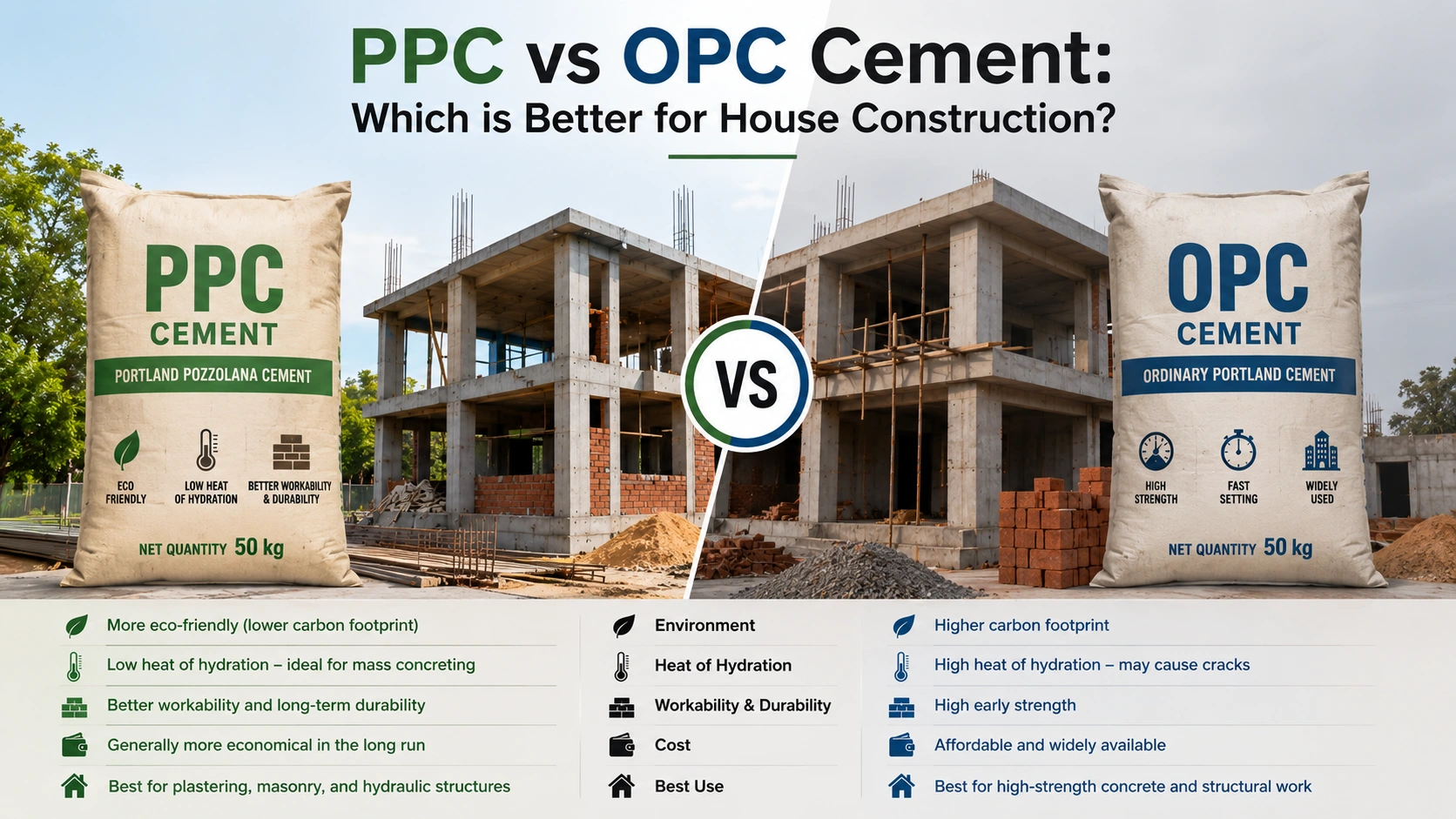
OPC: Develops strength rapidly in the early stages (first 7-14 days). OPC 53 grade achieves approximately 70% of its 28-day strength within 7 days. This rapid strength gain makes it ideal for projects with tight timelines.
PPC: Develops strength more slowly initially but continues to gain strength over a longer period. PPC typically achieves 50-60% of its 28-day strength within 7 days but can continue strengthening beyond 28 days, sometimes reaching higher ultimate strengths than OPC.
Heat of Hydration
Heat of hydration refers to the heat released during the cement hydration process. This is crucial for large concrete structures and in warm climates.
OPC: Generates higher heat of hydration, which can be problematic in massive concrete pours and in hot climates like Rajasthan or parts of Maharashtra. Excessive heat can cause thermal cracking.
PPC: Produces lower heat of hydration due to the presence of pozzolanic materials. This makes it more suitable for large structures and regions with high ambient temperatures.
Durability and Chemical Resistance
OPC: While durable, OPC is more susceptible to chemical attacks, particularly from sulfates and chlorides. In coastal areas like Goa, Mumbai, or Chennai where salt spray is prevalent, OPC may deteriorate faster.
PPC: Offers superior resistance to chemical attacks and sulfate corrosion due to the pozzolanic reaction. The fly ash fills micro-pores in the concrete, creating a denser matrix that resists water and chemical ingress. This makes PPC ideal for coastal constructions and areas with aggressive environmental conditions.
Cost Comparison: PPC vs OPC
In India, cement prices vary by location and brand, but generally:
OPC 43 Grade: Approximately ₹450-550 per 50 kg bag
OPC 53 Grade: Approximately ₹500-600 per 50 kg bag
PPC 43 Grade: Approximately ₹400-500 per 50 kg bag
PPC is typically 5-15% cheaper than OPC 53 grade, making it an economical choice. However, the cost difference varies by region and brand. Major cement manufacturers in India like Ultratech, Ambuja, Shree Cement, and Dalmia offer both types, with competitive pricing.
While the per-bag cost might be slightly lower for PPC, the total project cost depends on various factors including concrete mix design, water-cement ratio, and curing requirements.
When to Use OPC Cement
Ideal Scenarios for OPC
Fast-track construction projects: If you need quick strength development and rapid construction progress, OPC 53 grade is your best choice. Projects in cities like Bangalore, Hyderabad, and Pune often use OPC for faster project completion.
Low-rise residential buildings: For standard 3-4 storey residential buildings in non-aggressive environments, OPC 43 grade provides adequate strength and durability.
Dry climate regions: In areas with low rainfall and low humidity like Jaipur, Delhi, Lucknow, and parts of Madhya Pradesh, OPC performs well without significant durability concerns.
Repair and maintenance work: OPC's quick setting time makes it suitable for repair work where you need to restore functionality rapidly.
Plastering and finishing: OPC is traditionally preferred for plaster mixes and finishing works due to its quick strength gain.
Limitations of OPC
Higher heat of hydration unsuitable for massive concrete sections
Lower long-term durability in aggressive environments
More susceptible to chemical attacks and sulfate corrosion
Higher cost compared to PPC
Not environmentally friendly (no waste utilization)
When to Use PPC Cement
Ideal Scenarios for PPC
Coastal construction projects: For buildings in Mumbai, Chennai, Goa, Kochi, and other coastal areas where salt spray and high humidity are concerns, PPC is superior. The enhanced sulfate resistance protects reinforcement from corrosion.
Large concrete structures: For dams, bridges, tunnels, and massive concrete foundations where heat of hydration is a concern, PPC is preferable.
Long-term durability focus: If you're building a structure meant to last 50+ years with minimal maintenance, PPC's superior durability justifies the choice.
High-rise buildings: Modern high-rise construction in metropolitan areas like Mumbai, Delhi, and Bangalore increasingly uses PPC for its durability and lower heat generation.
Underground structures: Basements, underground parking, and tunnels benefit from PPC's resistance to water penetration and chemical attack.
Environmentally conscious projects: If sustainability is a priority, PPC's use of fly ash (industrial waste) makes it the eco-friendly choice.
Advantages of PPC
Superior long-term durability and strength
Better resistance to chemical attacks and sulfates
Lower heat of hydration
Denser concrete microstructure reducing permeability
More economical than OPC 53 grade
Environmentally sustainable
Better workability and finishability
Regional Considerations for Indian Construction
Coastal Regions (Mumbai, Chennai, Goa, Kochi)
Recommendation: PPC
Coastal areas experience high humidity, salt spray, and chloride-rich environments. PPC's superior sulfate and chloride resistance makes it the clear choice. Buildings using OPC in these regions often show reinforcement corrosion and structural deterioration within 15-20 years.
Metropolitan Areas (Delhi, Bangalore, Hyderabad)
Recommendation: PPC for residential, OPC 53 for fast-track projects
In these rapidly developing cities, PPC is increasingly preferred for residential buildings due to durability and cost-effectiveness. However, commercial projects with tight timelines might use OPC 53.
Dry Climate Regions (Jaipur, Jodhpur, Lucknow)
Recommendation: OPC 43 or PPC (both acceptable)
In low-humidity regions with minimal chemical exposure, both OPC and PPC perform adequately. Cost and construction timeline become deciding factors.
High-Rainfall Areas (Konkan Coast, Western Ghats, Northeast India)
Recommendation: PPC
High rainfall increases water penetration risks. PPC's lower permeability and better durability in wet conditions make it preferable.
Practical Tips for Choosing Between PPC and OPC
Assess Your Project Requirements
Determine your location and climate conditions
Identify the structure type (residential, commercial, industrial)
Evaluate your timeline requirements
Consider the expected lifespan of the structure
Check local building codes and regulations
Consult with Structural Engineers
Before finalizing your cement choice, consult with a qualified structural engineer or architect. They can recommend the most suitable cement based on your specific project requirements, soil conditions, and environmental factors. On AECORD, you can find experienced structural engineers and architects who can provide personalized recommendations for your project.
Quality and Certification
Regardless of whether you choose OPC or PPC, ensure that the cement meets Indian Standards (IS 269 for OPC and IS 1489 for PPC). Purchase from reputable manufacturers and verify the ISI mark on bags.
Storage and Handling
Both OPC and PPC should be stored in dry conditions. Exposure to moisture can reduce their effectiveness. Use cement within 3 months of purchase for optimal results.
Cost-Benefit Analysis
While PPC might be slightly cheaper per bag, the long-term cost-benefit analysis often favors PPC:
Initial cost: PPC is 5-15% cheaper than OPC 53
Maintenance cost: PPC structures require less maintenance and repair
Durability: PPC structures last longer with minimal deterioration
Resale value: Buildings constructed with PPC in coastal areas command better resale values
For a typical 2,000 sq ft residential building requiring approximately 80-100 bags of cement, the initial savings with PPC might be ₹3,000-5,000, while long-term savings in maintenance and durability could be significantly higher.
Conclusion: Making the Right Choice
The choice between PPC and OPC cement depends on your specific circumstances:
Choose OPC if: You're in a dry climate, have a tight construction timeline, and are building a structure with a 20-30 year lifespan.
Choose PPC if: You're in a coastal or high-rainfall area, prioritize long-term durability, want better cost-effectiveness, or are environmentally conscious.
For most residential construction projects in India today, PPC 43 grade is the recommended choice due to its superior durability, cost-effectiveness, and environmental benefits. However, specific project requirements may warrant OPC 53 grade.
To ensure you make the best decision for your project, connect with experienced structural engineers, architects, and construction professionals on AECORD. AECORD's marketplace brings together verified AECO professionals who can assess your project requirements and provide expert recommendations tailored to your location and needs. Whether you need guidance on cement selection, structural design, or complete project execution, AECORD connects you with the right professionals to ensure your construction project's success.
Remember, the cheapest option isn't always the best value. Investing in the right cement today ensures a durable, low-maintenance structure that stands the test of time and protects your investment for decades to come.
Frequently Asked Questions
What is the main difference between PPC and OPC cement?
The primary difference is composition: OPC (Ordinary Portland Cement) is made from Portland cement clinker and gypsum, while PPC (Portland Pozzolana Cement) is a blended cement that incorporates fly ash or other pozzolanic materials. This composition difference affects their strength development, heat generation, and durability characteristics.
Which cement is better for house construction in India?
Both are suitable for house construction, but the choice depends on your location and timeline. OPC is better for quick construction projects due to rapid strength development, while PPC is superior for long-term durability and is ideal for humid coastal areas like Mumbai and Chennai due to its resistance to chloride and sulfate attacks.
Does PPC or OPC develop strength faster?
OPC develops strength much faster, with OPC 53 grade achieving approximately 70% of its 28-day strength within 7 days. PPC develops strength more slowly initially, reaching only 50-60% of its 28-day strength within 7 days, but continues strengthening beyond 28 days.
Is PPC cement more environmentally friendly than OPC?
Yes, PPC is more environmentally friendly because it incorporates fly ash, an industrial byproduct from thermal power plants, reducing the need for raw materials and lowering overall carbon emissions during manufacturing.
Which cement produces less heat during hydration?
PPC produces significantly less heat of hydration compared to OPC, making it the better choice for large concrete pours and in hot climates like Rajasthan. Excessive heat from OPC can cause thermal cracking in massive concrete structures.