

Architectural drawings are the visual language of construction. Whether you're a homeowner overseeing a renovation, a contractor managing a project, or an engineer coordinating building systems, the ability to read and interpret architectural drawings is essential. These technical documents communicate every detail of a building's design, from room dimensions to material specifications. In India, where construction standards are evolving and regulatory requirements are becoming increasingly stringent, understanding how to read architectural drawings accurately can save time, money, and prevent costly mistakes.

This comprehensive guide will walk you through the fundamentals of reading architectural drawings, helping you decode the symbols, scales, and notations that architects use to communicate their vision.
Understanding the Basics of Architectural Drawings
Architectural drawings are two-dimensional representations of three-dimensional spaces. They serve as the blueprint for construction, showing everything from floor plans to elevations, sections, and details. These drawings follow standardized conventions that allow professionals across the construction industry to communicate effectively.
Build cost · Bengaluru, May 2026
What Are the Main Types of Architectural Drawings?
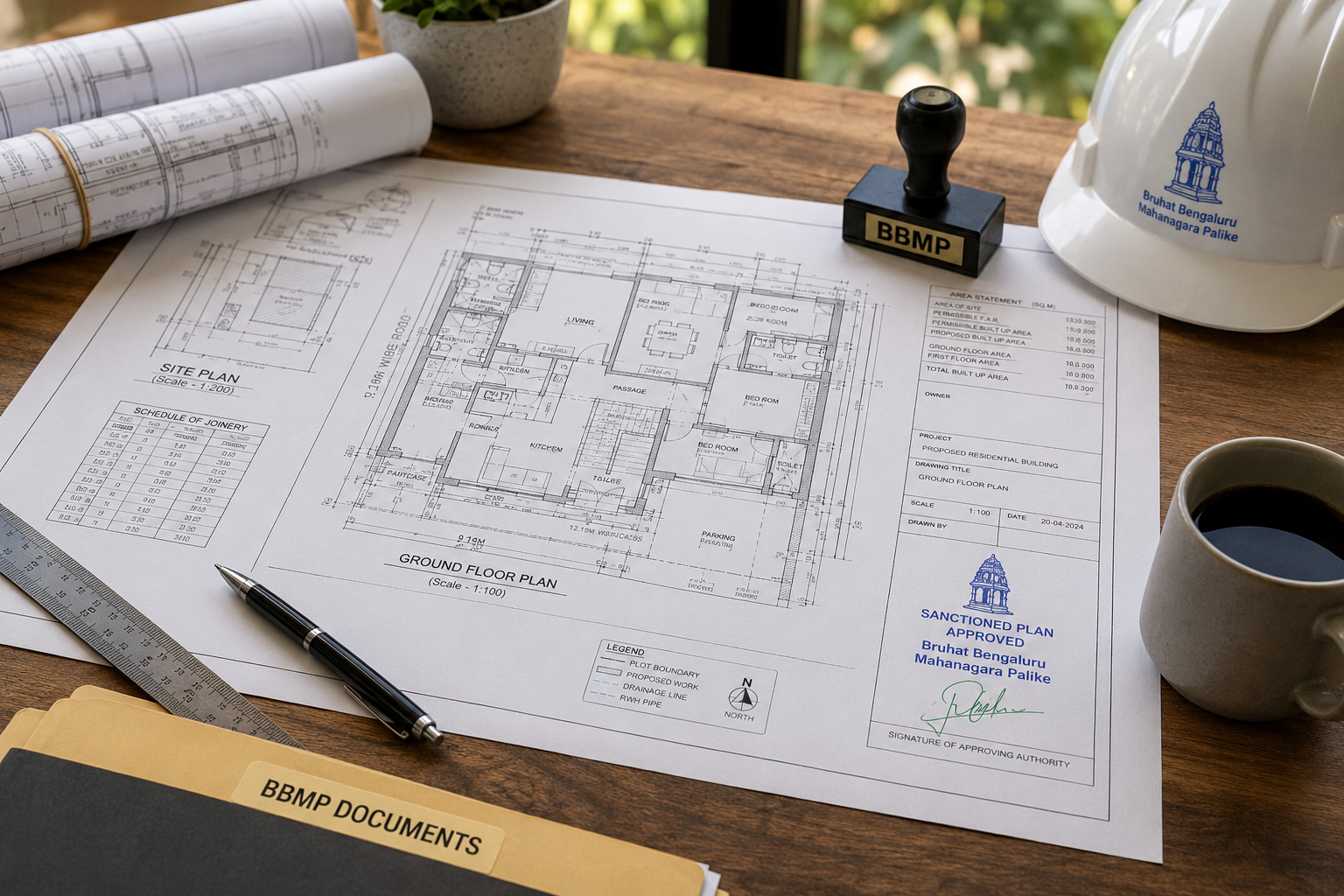
Floor Plans are the most commonly used drawings. They show a top-down view of a building or room at a specific height, typically 1.5 meters above the floor. Floor plans display the layout of spaces, door and window locations, wall thickness, and room dimensions. In Indian residential projects, floor plans also indicate areas in square feet or square meters, which is crucial for property valuation.
Elevations show the exterior or interior vertical faces of a building. Front elevations, side elevations, and rear elevations depict how the building looks from different angles. These drawings are essential for understanding the building's aesthetic appearance and how it relates to surrounding structures in Indian cities like Mumbai, Bangalore, or Delhi.
Sections are vertical slices through a building that show the relationship between different levels, ceiling heights, and structural elements. A section through a multi-story building in Bangalore, for example, would show how each floor relates to the others and how the building's profile changes.
Site Plans show the building's location on its plot of land, including access points, parking areas, landscaping, and the relationship to neighboring properties. In India, site plans must also show setbacks as per local building bylaws—typically 3 meters from the front in residential areas and varying distances based on city regulations.
Detail Drawings are enlarged views of specific areas, such as how a door frame connects to the wall, or how a staircase is constructed. These drawings are crucial for contractors to understand the exact construction methodology.
Learning to Read Scales and Dimensions
One of the most critical skills in reading architectural drawings is understanding scale. Architectural drawings are scaled representations of actual buildings, and the scale is always indicated on the drawing.
Common Scales Used in India
In Indian architectural practice, the most common scales are:
1:100 – Used for floor plans, elevations, and sections of entire buildings. This means 1 unit on the drawing represents 100 units in reality.
1:50 – Used for more detailed drawings of building sections and larger room layouts.
1:20 – Used for detailed construction drawings showing specific building components.
1:10 – Used for very detailed drawings of door frames, window details, or joinery work.
1:1 – Full-size drawings used for specific details like decorative elements.
Always verify the scale before taking measurements from a drawing. Using an architectural scale ruler (a triangular ruler with different scales) ensures accuracy. Never measure with a regular ruler, as printed drawings may have slight variations in size.
Frequently asked
Reading Dimensions
Dimensions on architectural drawings are shown with dimension lines, which are thin lines with arrows or slashes at the ends. The actual measurement is written above or beside the dimension line. In India, dimensions are typically shown in meters and centimeters (e.g., 3.5 m or 350 cm).
When reading dimensions, always check:
Whether measurements are to the center of walls or to the faces of walls
The overall dimensions versus individual room dimensions
Height dimensions for ceilings, lintels, and other vertical elements
Cumulative dimensions to ensure they add up correctly

Decoding Architectural Symbols and Notations
Architectural drawings use a standardized set of symbols to represent different building elements. Understanding these symbols is crucial for interpreting drawings correctly.
Wall and Door Symbols
Walls are typically shown as thick lines on floor plans. In Indian construction, external walls are usually 200-250 mm thick (brick with plaster), while internal walls might be 100-150 mm. Doors are shown as rectangles with an arc indicating the direction the door swings. Double-headed arrows on door arcs indicate double doors.
Different line styles indicate different wall types:
Solid thick lines represent load-bearing walls
Dashed lines may indicate demolished walls or walls to be removed
Thin lines represent non-load-bearing partition walls
Window Symbols
Windows are shown as breaks in walls with small perpendicular lines indicating the window sill. The size of the break indicates the window width. Window schedules (detailed tables) on the drawing provide information about window types, sizes, materials, and specifications.
Plumbing and Electrical Symbols
Architectural drawings often include symbols for plumbing fixtures and electrical elements:
A circle with a dot typically represents a light fixture
Circles with lines indicate switches
Squares represent outlets or receptacles
Toilets, sinks, and bathtubs have specific symbolic representations
Lines with small perpendicular marks indicate water pipes
For complex projects in Indian cities, separate electrical and plumbing drawings may be provided alongside architectural drawings.
Staircase Symbols
Staircases are shown with parallel lines representing individual steps. An arrow indicates the direction of ascent. The number of steps and the rise-and-run dimensions should be clearly marked. In India, staircase designs must comply with National Building Code (NBC) requirements, which specify minimum step heights (170-190 mm) and tread depths (250-300 mm).
Understanding Levels and Heights
Multi-story buildings require clear indication of different floor levels. These are typically shown as:
Finished Floor Level (FFL) – The height of the completed floor surface. In Indian buildings, ground floor FFL is often 0.6-1.0 meters above natural ground level to account for drainage and dampness prevention.
Structural Floor Level – The height of the structural slab before finishing.
Plinth Level – The level of the building's base, typically 0.45-0.6 meters above natural ground in India.
Sections and elevations clearly show these levels with horizontal dashed lines and elevation markings. Understanding level differences is crucial for coordinating different trades during construction.
Reading Schedules and Legends
Architectural drawings include several schedules and legends that provide detailed information about building components.
Door Schedule
A door schedule is a table that lists every door in the building with information such as:
Door mark or identifier (D1, D2, etc.)
Location (which room or space)
Size (width × height)
Material and finish
Hardware specifications
Fire rating (if applicable)
In commercial buildings in India, fire-rated doors are mandatory in certain locations as per building bylaws.
Window Schedule
Similar to door schedules, window schedules provide:
Window mark or identifier (W1, W2, etc.)
Location
Size (width × height)
Type (casement, sliding, fixed, etc.)
Material and finish
Glass specifications (clear, tinted, safety glass, etc.)
Legend
A legend or key explains all the symbols used in the drawings. Always refer to the legend when encountering unfamiliar symbols.
Interpreting Sections and Details
Sections provide a crucial understanding of how a building is constructed vertically. A section drawing shows:
Floor-to-ceiling heights
Structural elements (beams, columns, slabs)
Roof construction and slope
Foundation details
How different materials layer together
Detail drawings zoom in on specific areas, showing construction methodology. For example, a detail drawing might show exactly how a window frame connects to the wall, including the thickness of the frame, the sealant, the insulation, and the fastening method.
When reviewing architectural drawings for a project in Delhi or any Indian city, pay special attention to details related to:
Waterproofing (especially important in monsoon regions)
Thermal insulation (increasingly required in energy codes)
Fire safety measures
Accessibility compliance (as per Accessible India Campaign guidelines)
Checking for Consistency Across Drawings
A complete set of architectural drawings should be internally consistent. When reviewing drawings, verify that:
Dimensions match across different sheets
Dimensions in floor plans match what's shown in sections and elevations
Door and window sizes are consistent where they appear on multiple drawings
Room labels and identifiers match throughout the set
Structural elements align with architectural elements
Discrepancies should be flagged immediately and clarified with the architect before construction begins. This is especially important in India, where construction timelines are often tight and changes during construction can be expensive.
Understanding Coordination with Other Drawings
Architectural drawings are part of a larger set of construction documents. You'll typically also have:
Structural Drawings – Show the building's structural framework, including column and beam locations, reinforcement details, and load paths.
MEP Drawings – Mechanical, Electrical, and Plumbing drawings show the building's systems. These should coordinate with architectural drawings, with no conflicts between architectural elements and MEP runs.
When using AECORD to find professionals for your project, ensure that architects, structural engineers, and MEP consultants are coordinating their drawings to avoid costly conflicts during construction.
Common Mistakes When Reading Architectural Drawings
Avoid these common errors:
Ignoring the scale – Always verify the scale before making measurements or assumptions.
Assuming standard sizes – Door and window sizes vary; always check the schedule.
Overlooking notes – Architects often include important notes on drawings that specify materials, finishes, or construction methods.
Not checking revision marks – Drawings are often revised. Always use the latest version, as indicated by revision clouds or revision marks.
Misinterpreting symbols – When in doubt, refer to the legend or ask the architect for clarification.
Tips for Effective Drawing Review
When reviewing architectural drawings:
Print or view at full size – Digital viewing should be at 100% zoom to avoid errors.
Use a scale ruler – For verification purposes, always use an architectural scale ruler.
Cross-reference multiple drawings – Check floor plans against elevations and sections.
Understand the project context – Know the building type, location, and regulatory requirements for your city.
Ask questions – If something is unclear, contact the architect immediately.
In India, where building bylaws vary significantly between cities, understanding how local regulations are reflected in the drawings is crucial. For example, setback requirements in Bangalore differ from those in Mumbai, and these should be clearly shown on site plans.
The Role of AECORD in Your Project
Whether you're a homeowner, contractor, or project manager, understanding architectural drawings is essential for project success. If you need professional assistance interpreting drawings, coordinating between disciplines, or finding qualified architects and engineers, AECORD connects you with verified AECO professionals across India. Through AECORD's platform, you can find experts who can review drawings, provide clarifications, and ensure that your project meets all regulatory requirements.
Conclusion
Reading architectural drawings is a skill that improves with practice. By understanding the basic principles—scales, symbols, dimensions, and drawing types—you'll be able to interpret most architectural drawings confidently. Remember to always verify information across multiple drawings, refer to schedules and legends, and ask for clarification when something is unclear.
Whether you're planning a home renovation in Mumbai, overseeing a commercial project in Bangalore, or managing construction in any Indian city, the ability to read architectural drawings accurately is invaluable. If you need expert guidance or professional assistance with your architectural drawings, visit AECORD to connect with qualified architects, engineers, and construction professionals who can help bring your vision to life.
Frequently Asked Questions
What are the main types of architectural drawings I need to understand?
The main types are floor plans (top-down view showing layout and dimensions), elevations (vertical views of building facades), sections (vertical slices showing floor relationships), site plans (showing building location on land), and detail drawings (enlarged views of specific construction elements). Each serves a different purpose in communicating the complete building design.
How do I read and interpret architectural drawing scales?
Architectural scales are indicated on drawings and show the ratio between the drawing size and actual building size. Common scales in India include 1:100 for overall plans, 1:50 for detailed sections, 1:20 for construction details, and 1:10 for specific components like door frames. Always check the scale notation before taking measurements from a drawing.
What is a floor plan and what information does it show?
A floor plan is a top-down view of a building or room typically shown at 1.5 meters above floor level. It displays the layout of spaces, door and window locations, wall thickness, room dimensions, and area measurements in square feet or meters—all essential information for understanding how spaces are organized and for property valuation.
Why are architectural sections important in construction?
Sections are vertical slices through a building that show the relationship between different floor levels, ceiling heights, and structural elements. They help contractors and engineers understand how the building is constructed vertically and how different components connect, which is crucial for accurate construction execution.
What details should I look for in a site plan?
A site plan shows the building's location on its plot, including access points, parking areas, landscaping, and relationships to neighboring properties. In India, it must also indicate setbacks according to local building bylaws, which typically require 3 meters from the front in residential areas and vary by city regulations.