

Best Cement Brands in India for House Construction: A Complete Buyer's Guide
Cement is the backbone of any residential construction project in India. Whether you're building a 2 BHK apartment in Bangalore or a villa in Pune, choosing the right cement brand can significantly impact the durability, strength, and longevity of your structure. With dozens of brands available across the country, making an informed decision requires understanding cement grades, regional availability, pricing, and performance standards.
This comprehensive guide covers India's most reliable cement brands, helping you select the best option for your house construction needs.
For a deeper look, see our guide on GST on Construction Materials India 2026 Guide.
For a deeper look, see our guide on Best Exterior Paint Brands India 2026.
For deeper context, see Construction Material List for House Building.
Build cost · Bengaluru, May 2026
Understanding Cement Grades and Types
Before diving into specific brands, it's essential to understand cement classifications. In India, cement is primarily categorized by strength grades:
OPC 33 Grade: Ordinary Portland Cement with 33 MPa compressive strength – used for non-structural work
OPC 43 Grade: Standard cement with 43 MPa strength – most common for residential construction
OPC 53 Grade: High-strength cement with 53 MPa strength – ideal for high-rise buildings and heavy-duty applications
PPC (Portland Pozzolana Cement): Contains pozzolanic materials, offers better durability and lower heat of hydration
PSC (Portland Slag Cement): Blended cement with blast furnace slag, excellent for water resistance
For typical house construction in India, OPC 43 Grade and PPC are the most commonly used options.
Top Cement Brands in India
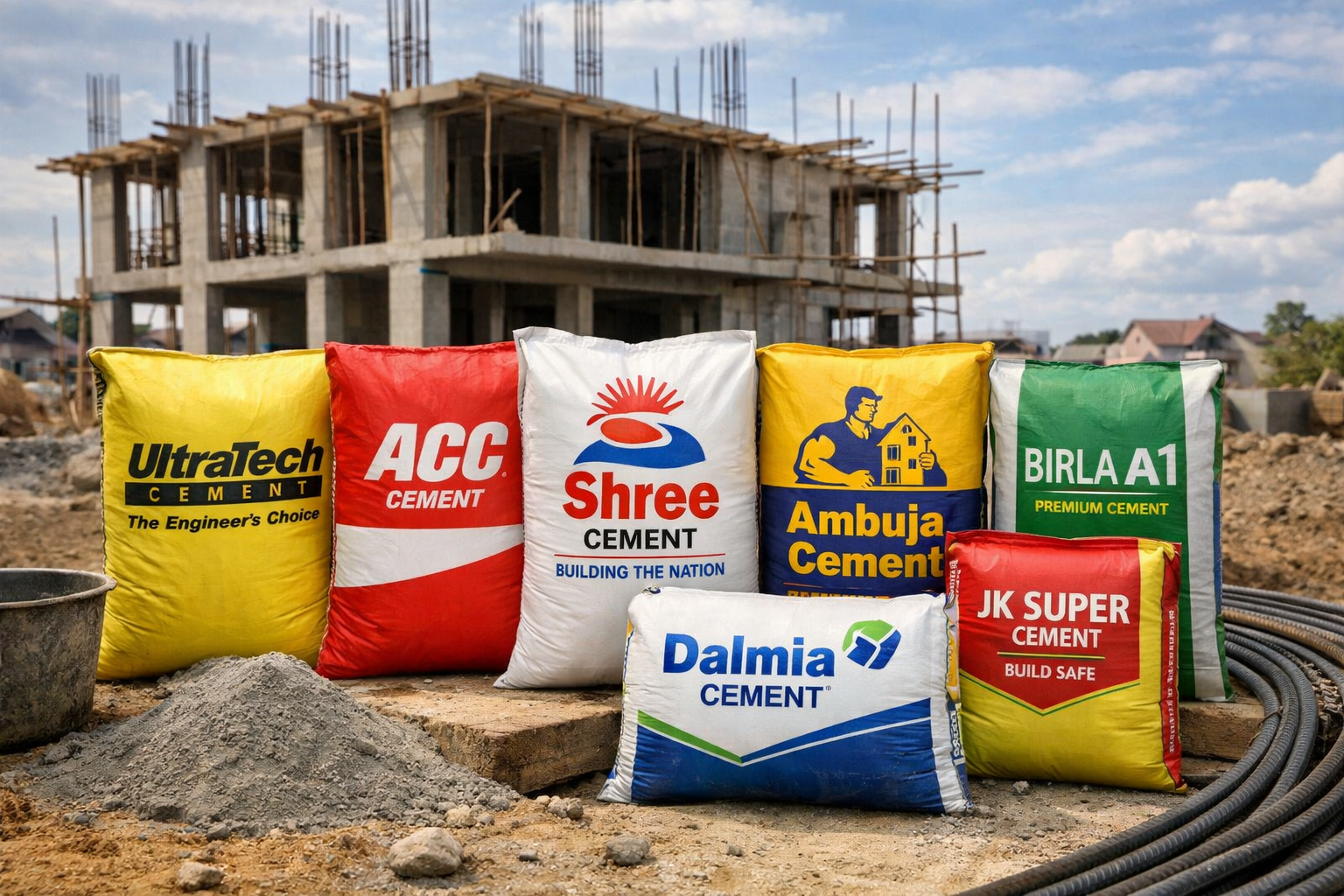
1. Ultratech Cement
Ultratech is India's largest cement manufacturer by capacity and holds approximately 23% market share. With manufacturing plants across major states including Maharashtra, Karnataka, Rajasthan, and Tamil Nadu, Ultratech ensures pan-India availability.
You may also find our guide on AAC Blocks vs Red Bricks India helpful.
Product Range: Ultratech offers OPC 33, OPC 43, OPC 53, PPC, and specialized products like Ultratech Concrete and Ultratech White Cement
Price Range: Approximately ₹350-450 per 50 kg bag, varying by region and grade
Strength & Quality: Consistently meets Indian Standards (IS 269, IS 455), with strong compressive strength and durability
Availability: Available across all major cities and towns through an extensive distribution network
Special Features: Enhanced water resistance, reduced heat of hydration, excellent workability
Ultratech's widespread availability and consistent quality make it a preferred choice for residential projects across metros like Delhi, Mumbai, Bangalore, and Hyderabad.
Frequently asked
2. Ambuja Cement
Ambuja Cement, owned by Holcim, is another major player with significant market presence in India. The brand is particularly strong in western and northern regions.
Product Range: OPC 33, OPC 43, PPC, and specialized variants
Price Range: ₹340-430 per 50 kg bag
Strength & Quality: Meets IS 269 and IS 455 standards, known for consistent quality and high early strength
Regional Strength: Particularly strong in Maharashtra, Gujarat, Rajasthan, and North India
Special Features: Superior binding strength, excellent weather resistance, reduced permeability
Ambuja's "Ambuja Cement Plus" variant is popular for residential construction due to its enhanced durability properties.
3. ACC Cement
ACC (Associated Cement Companies) is one of India's oldest and most trusted cement brands, with a history spanning over a century. The company operates multiple plants across India.
Product Range: ACC OPC 33, OPC 43, PPC, and specialty cements
Price Range: ₹360-450 per 50 kg bag
Strength & Quality: Consistently high quality with excellent compressive strength, meets all Indian standards
Availability: Strong presence in South India, Eastern India, and metros
Special Features: High early strength, superior durability, excellent for coastal areas
ACC is particularly recommended for projects in coastal regions due to superior resistance to marine environments.
For a side-by-side comparison, see our guide on AAC Blocks vs Red Bricks.
4. Shree Cement
Shree Cement is a leading manufacturer with strong presence in North and Central India. Known for aggressive pricing and good quality, it's becoming increasingly popular for residential construction.
Product Range: OPC 33, OPC 43, PPC variants
Price Range: ₹320-400 per 50 kg bag (competitive pricing)
Strength & Quality: Meets IS standards, good compressive strength and consistency
Regional Strength: Dominant in Rajasthan, UP, MP, and gradually expanding to other regions
Special Features: Cost-effective without compromising on quality, good workability
5. Dalmia Cement
Dalmia Cement operates multiple plants and has strong presence across India, particularly in eastern and central regions.
Product Range: OPC 33, OPC 43, PPC, and specialty products
Price Range: ₹330-420 per 50 kg bag
Strength & Quality: Good quality with consistent performance, meets Indian Standards
Availability: Well-distributed across eastern India, gradually expanding nationally
Special Features: Good heat resistance, suitable for various climatic conditions
6. India Cement
India Cement is a major player with strong presence in South India and gradually expanding nationally.
Product Range: OPC 33, OPC 43, PPC, and blended cements
Price Range: ₹340-430 per 50 kg bag
Strength & Quality: Reliable quality, good compressive strength
Regional Strength: Very strong in Tamil Nadu, Telangana, and South India
Special Features: Excellent for warm climates, good water resistance
7. JK Cement
JK Cement has been gaining market share with focus on quality and innovation.
Product Range: OPC 33, OPC 43, PPC, and specialty products
Price Range: ₹340-430 per 50 kg bag
Strength & Quality: High-quality cement with excellent durability
Availability: Increasingly available across India
Special Features: Good workability, reduced water requirement, excellent for RCC work
Regional Availability and Pricing Considerations
Cement prices in India vary significantly by region due to transportation costs and local manufacturing capacity. Here's a general breakdown:
North India (Delhi, NCR, Punjab): ₹340-420 per 50 kg bag – Competitive market with multiple brands
South India (Bangalore, Chennai, Hyderabad): ₹350-430 per 50 kg bag – Strong local manufacturers
West India (Mumbai, Gujarat): ₹330-400 per 50 kg bag – Ambuja and Ultratech dominance
East India (Kolkata, Patna): ₹340-410 per 50 kg bag – Dalmia and Lafarge strong presence
For a typical 1500 sq ft house requiring approximately 300-350 bags of cement, budget ₹1,05,000 to ₹1,50,000 for cement alone, depending on location and brand selection.
Choosing the Right Cement for Your Project
Factors to Consider
Climate and Location: For coastal areas (Mumbai, Chennai, Goa), choose PSC or PPC for superior water resistance. For dry regions (Rajasthan, Gujarat), OPC 43 works well. For areas with moderate rainfall, PPC is ideal.
Construction Type: For load-bearing structures and high-rise buildings, OPC 53 or OPC 43 is recommended. For typical residential construction, OPC 43 or PPC is sufficient.
Budget Constraints: While premium brands like Ultratech and ACC command higher prices, mid-range brands like Shree Cement and Dalmia offer good value. Never compromise on cement quality to save costs – it's the foundation of your structure.
Local Availability: Choose brands with strong local presence to ensure consistent supply and reduce transportation costs. Check with your contractor about locally preferred brands in your area.
Verification and Standards: Always verify that the cement bag displays IS 269 or IS 455 certification. Check the manufacturing date – cement loses strength with age, so prefer bags manufactured within 3 months.
Quality Checks Before Purchase
Verify the cement bag has clear branding and manufacturing date
Check for IS certification marks
Inspect bags for any damage or moisture
Request a sample for strength testing if purchasing in bulk
Buy from authorized dealers to avoid counterfeit products
How AECORD Can Help Your Cement Selection
AECORD, India's leading B2B2C AECO marketplace, simplifies the process of sourcing quality cement for your construction project. Through AECORD's platform, you can:
Compare prices from multiple verified suppliers across your region
Access detailed product specifications and certifications
Read verified reviews from contractors and builders who've used specific brands
Get bulk pricing quotes directly from manufacturers and distributors
Track delivery and ensure on-time supply to your project site
Access expert guidance on cement selection based on your specific project requirements
AECORD's network includes authorized dealers of all major cement brands, ensuring you get authentic products at competitive rates with transparent pricing.
Common Mistakes to Avoid
Buying Counterfeit Cement: Counterfeit cement is a significant problem in India. Always purchase from authorized dealers and verified suppliers. Cheap cement that seems too good to be true usually is.
Ignoring Storage Conditions: Cement absorbs moisture and loses strength. Store bags in dry conditions, away from ground moisture. Stacked bags should not exceed 10-12 bags in height.
Using Old Stock: Cement strength decreases over time. Avoid using cement older than 3 months from manufacturing date.
Compromising on Grade: Using lower-grade cement to save money can compromise structural integrity. Invest in appropriate grades for your construction type.
Not Considering Local Conditions: A cement suitable for Delhi may not be ideal for Chennai due to different climatic conditions and moisture levels.
Cost Analysis for a Sample House Project
For a typical 1500 sq ft, G+1 residential construction in Bangalore:
Estimated cement requirement: 320 bags (50 kg each)
Ultratech OPC 43: 320 × ₹390 = ₹1,24,800
Ambuja OPC 43: 320 × ₹380 = ₹1,21,600
Shree Cement OPC 43: 320 × ₹350 = ₹1,12,000
Dalmia PPC: 320 × ₹360 = ₹1,15,200
Cement typically accounts for 8-12% of total construction costs. While premium brands cost ₹30,000-40,000 more for a project, the enhanced durability often justifies the investment, especially for long-term property value.
Conclusion
Selecting the right cement brand for house construction in India requires balancing quality, cost, regional availability, and specific project requirements. Ultratech, Ambuja, and ACC remain the safest choices due to their proven track record and pan-India availability. However, brands like Shree Cement and Dalmia offer excellent value without compromising quality.
Always prioritize quality over cost savings, verify authenticity, and consider your local climate and construction type. Using AECORD's platform can help you source cement from verified suppliers at competitive rates while ensuring consistent quality across your project timeline.
Remember: cement is literally the binding force of your home. Investing in the right brand today ensures your structure remains strong and durable for decades to come.
Frequently Asked Questions
What's the difference between OPC 43 and OPC 53 cement for residential construction?
OPC 53 has higher compressive strength (53 MPa vs 43 MPa) and achieves strength faster. However, for typical residential construction, OPC 43 is sufficient and more economical. OPC 53 is preferred for high-rise buildings, heavy-load structures, and projects requiring early strength development. OPC 53 also generates more heat during hydration, which can be a concern in large concrete pours.
How much cement is needed for a typical 1500 sq ft house?
A typical 1500 sq ft, G+1 residential construction requires approximately 300-350 bags of 50 kg cement, depending on the foundation depth, wall thickness, and concrete specifications. For a more accurate estimate, consult with your structural engineer or contractor who can calculate based on your specific design and local building codes.
Is it safe to use local or lesser-known cement brands?
While some local brands may be genuine, the risk of counterfeit cement is higher. Always verify IS certification (IS 269 or IS 455) and purchase from authorized dealers. Stick with established national brands available through verified channels like AECORD to ensure quality and authenticity. The small premium for trusted brands is worth the peace of mind.
What's the best cement for coastal areas in India?
For coastal construction (Mumbai, Chennai, Goa, Kochi), PSC (Portland Slag Cement) or PPC (Portland Pozzolana Cement) is recommended due to superior water and salt resistance. ACC and India Cement are particularly strong in coastal regions. Avoid OPC in coastal areas as it's more susceptible to salt attack and corrosion.
How do I verify if cement is counterfeit?
Check for: clear brand name and logo, manufacturing and expiry dates, IS certification marks, bag integrity without moisture, consistent color and texture, and purchase from authorized dealers only. You can also request a sample for laboratory testing if purchasing in large quantities. Counterfeit cement often has poor printing quality, missing certifications, and incorrect weight.
```