The architecture, engineering, and construction (AEC) industry in India is undergoing a digital revolution. Two technologies that often get mentioned in the same breath are Building Information Modeling (BIM) and Digital Twins. While they're related and sometimes used together, they serve different purposes and operate at different stages of a building's lifecycle. Understanding the distinction between these two powerful tools is essential for professionals looking to optimize their projects and stay competitive in today's market.
Understanding BIM: The Foundation
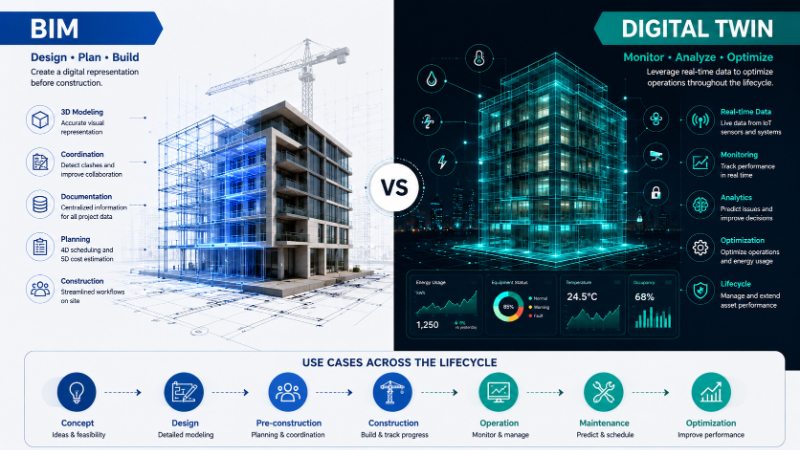
Building Information Modeling (BIM) is a methodology and technology that creates a comprehensive digital representation of a building's physical and functional characteristics. In India, BIM adoption has been growing steadily, particularly in major metropolitan areas like Mumbai, Delhi, Bangalore, and Hyderabad, where large-scale infrastructure projects demand sophisticated planning and coordination. /blog/understanding-digital-twins-the-future-of-smart-buildings-and-energy-efficiency
BIM fundamentally changes how architects, engineers, and contractors collaborate on projects. Instead of working with separate 2D drawings that often contain conflicting information, all stakeholders work with a single, integrated 3D model that contains detailed information about every component of the building.
Build cost · Bengaluru, May 2026
Key Characteristics of BIM
Comprehensive Data Repository: BIM models contain not just geometric information but also material specifications, cost data, scheduling information, and maintenance requirements
Collaborative Platform: Multiple disciplines can work simultaneously on the same model, reducing coordination issues and rework
Project-Focused: BIM is primarily used during the design, planning, and construction phases of a project
Clash Detection: The technology automatically identifies conflicts between building systems (MEP clashes, structural conflicts) before construction begins
Cost and Schedule Integration: BIM can be linked with project management tools to track costs and timelines in real-time /blog/the-evolution-of-bim-smarter-faster-and-more-connected
In India, BIM adoption is being driven by major government initiatives and private developers. The Ministry of Housing and Urban Affairs has been promoting BIM for government projects, and many state governments have made BIM mandatory for public construction projects. For instance, the Delhi Development Authority (DDA) and various municipal corporations have started requiring BIM submissions for large projects.
BIM Tools and Applications in India
Popular BIM software used by Indian professionals includes Autodesk Revit, ArchiCAD, Tekla Structures, and Navisworks. These tools help professionals create detailed models that can be used for visualization, quantity takeoffs, and construction planning. The typical cost for BIM software licenses in India ranges from ₹50,000 to ₹5,00,000 annually depending on the tool and organizational size.
Understanding Digital Twins: The Next Evolution
A Digital Twin is a virtual replica of a physical asset or system that continuously updates with real-world data throughout the asset's entire lifecycle—from design through operation and maintenance. While BIM is primarily a design and construction tool, a Digital Twin is a living, breathing digital representation that reflects the current state of the building.
Digital Twin technology is still in its early adoption phase in India, but progressive organizations in Bangalore's tech sector and major real estate developers in Mumbai are beginning to implement it for smart buildings and facilities management.
Frequently asked
Key Characteristics of Digital Twins
Real-Time Data Integration: Digital Twins continuously receive data from IoT sensors, building management systems, and other monitoring devices
Lifecycle-Long Relevance: While BIM is most valuable during design and construction, Digital Twins become increasingly valuable during operations and maintenance
Predictive Capabilities: By analyzing real-time data, Digital Twins can predict maintenance needs, identify inefficiencies, and optimize building performance
Simulation and Testing: Changes can be simulated in the digital environment before being implemented in the physical building
Performance Monitoring: Energy consumption, occupancy patterns, structural health, and other metrics can be continuously monitored and optimized
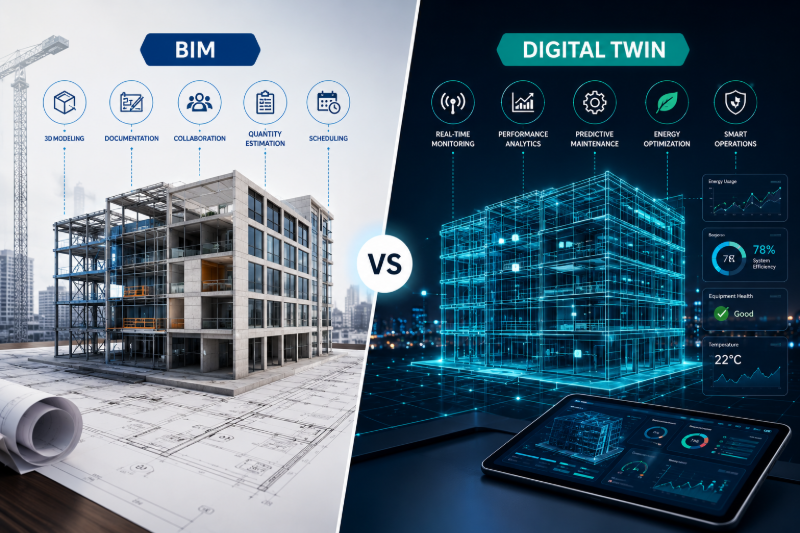
The Key Differences Between BIM and Digital Twins
Purpose and Application
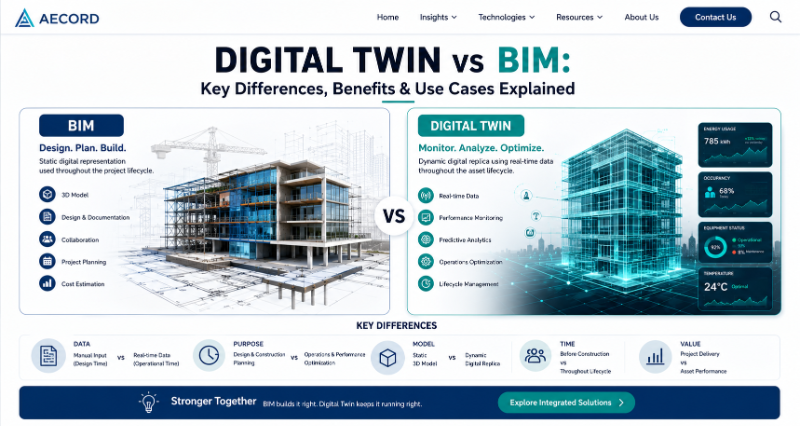
BIM is primarily a design and construction tool. It's used to plan, design, and construct buildings with greater accuracy and efficiency. Architects and engineers use BIM to solve problems before construction begins, reducing costly rework on-site.
Digital Twins, on the other hand, are operational tools. They're used to monitor, manage, and optimize buildings throughout their operational life. A facility manager in a Bangalore tech park might use a Digital Twin to monitor energy consumption across 500,000 square feet of office space in real-time.
Timeline and Lifecycle Stage
BIM's Value Cycle: BIM is most valuable during the design phase (0-5% of project timeline) and construction phase (5-30% of timeline). Its value diminishes once the building is handed over to the client, though some organizations maintain BIM models for reference.
Digital Twin's Value Cycle: A Digital Twin's value increases over time. While it may be created from the BIM model at project completion, its true value emerges during the operational phase (70-95% of building lifecycle). A 50-year-old building with a well-maintained Digital Twin can optimize energy consumption, predict maintenance needs, and improve occupant satisfaction.
Data Sources
BIM relies on data entered by design professionals—specifications, materials, dimensions, and construction sequencing. The data is static and based on design intent.
Digital Twins integrate data from multiple sources including sensors, building management systems (BMS), occupancy tracking systems, energy meters, and maintenance logs. This data is dynamic and continuously updated.
Stakeholder Focus
BIM primarily serves design and construction teams—architects, structural engineers, MEP engineers, contractors, and project managers.
Digital Twins primarily serve facility managers, operations teams, building owners, and increasingly, occupants who can access information about their working environment.
How BIM and Digital Twins Work Together
Rather than being competitors, BIM and Digital Twins are complementary technologies that work best when integrated. A well-executed BIM model can serve as the foundation for a Digital Twin.
The Integration Process
In a typical workflow, the BIM model created during design and construction is handed over to the operations team. This model is then enriched with sensor data, IoT connections, and operational parameters to create a Digital Twin. For example, a BIM model of a commercial complex in Gurgaon might include detailed HVAC specifications. Once operational, sensors connected to the HVAC system feed real-time performance data into the Digital Twin, allowing facility managers to optimize energy consumption and predict maintenance needs.
Real-World Indian Example
Consider a large IT office complex in Bangalore spanning 2 million square feet. During design and construction, the project team uses BIM to coordinate between 15+ different contractors, identify 2,000+ clashes before construction, and reduce rework by an estimated 20-30%. This saves approximately ₹50-100 crores during the construction phase.
Once operational, the BIM model is converted into a Digital Twin. Sensors throughout the building track energy consumption, occupancy, air quality, and equipment performance. The facility management team can now:
Reduce energy consumption by 15-20% through real-time optimization
Predict HVAC failures 2-4 weeks in advance, preventing costly emergency repairs
Optimize space utilization based on actual occupancy patterns
Provide better occupant experience through real-time environmental controls
Over a 30-year operational period, these optimizations could save ₹200+ crores in operational costs—far exceeding the initial investment in BIM and Digital Twin technologies.
Current State of BIM and Digital Twin Adoption in India
BIM Adoption
BIM adoption in India has accelerated significantly over the past 5 years. Major cities like Mumbai, Delhi, Bangalore, and Hyderabad have seen increased adoption, particularly among:
Large real estate developers
Government infrastructure projects
Commercial and IT office spaces
Healthcare and educational institutions
However, adoption rates vary significantly. While tier-1 cities and large projects may have 60-70% BIM adoption, smaller cities and residential projects still rely heavily on traditional 2D drawings.
Digital Twin Adoption
Digital Twin adoption in India is still in its infancy, with adoption primarily limited to:
Smart buildings in major metros
Large commercial complexes with sophisticated facility management needs
Industrial facilities requiring predictive maintenance
Data centers requiring precise environmental controls
The market for Digital Twin technology in India is expected to grow significantly, particularly as IoT adoption increases and facility managers recognize the value of data-driven operations.
Challenges in Implementation
BIM Challenges in India
High Initial Investment: Software licenses, training, and workflow changes require significant upfront investment
Skill Gap: There's a shortage of BIM professionals in India, particularly in smaller cities
Resistance to Change: Traditional construction practices are deeply ingrained, and changing workflows takes time
Standardization Issues: Lack of consistent BIM standards across projects and organizations
Digital Twin Challenges in India
High Implementation Cost: Setting up sensor networks, IoT infrastructure, and data management systems requires substantial investment
Data Privacy and Security: Concerns about data collection and cybersecurity remain significant
Lack of Expertise: Few professionals in India have experience implementing and managing Digital Twins
Integration Complexity: Connecting legacy building systems with new digital infrastructure is technically challenging
Future Outlook and Recommendations
Emerging Trends
Several trends are shaping the future of BIM and Digital Twins in India:
Cloud-Based Collaboration: Cloud platforms are making BIM more accessible to smaller firms and distributed teams
AI and Machine Learning: These technologies are enhancing predictive capabilities in Digital Twins
Regulatory Mandates: Government initiatives are increasingly requiring BIM for public projects
Sustainability Focus: Both BIM and Digital Twins are being leveraged for energy efficiency and sustainability goals
Recommendations for Organizations
If you're considering BIM and Digital Twin adoption for your projects:
Start with BIM: Begin with BIM for your design and construction processes before moving to Digital Twins
Invest in Training: Develop internal expertise or partner with experienced consultants
Plan for Integration: Design your BIM workflows with future Digital Twin implementation in mind
Start Small: Pilot projects can help you understand benefits and challenges before large-scale implementation
Partner with Experts: Collaborate with experienced BIM and Digital Twin consultants who understand the Indian market
Finding the Right Professionals for Your Project
Implementing BIM and Digital Twin technologies requires expertise across multiple disciplines. Whether you need BIM coordinators, Digital Twin specialists, facility management consultants, or technology integration experts, finding the right professionals is crucial for project success.
AECORD, India's leading B2B2C marketplace for AECO professionals, connects project owners, architects, engineers, and contractors with vetted specialists in BIM and Digital Twin technologies. On AECORD, you can find professionals with proven experience in:
BIM modeling and coordination
Digital Twin implementation and management
IoT and sensor integration
Facility management systems
Data analytics and optimization
Rather than searching through countless consultants or relying on recommendations, AECORD provides verified profiles, past project portfolios, and client reviews to help you make informed decisions. Whether you're in Mumbai, Delhi, Bangalore, or any other Indian city, AECORD connects you with the right expertise for your specific needs.
Conclusion
BIM and Digital Twins represent two complementary but distinct approaches to managing buildings through technology. BIM optimizes the design and construction process, while Digital Twins optimize operations and maintenance. The most successful organizations are those that implement both—using BIM to build buildings right the first time, and then leveraging Digital Twins to operate them efficiently throughout their lifecycle.
As India's construction industry continues to modernize, understanding the differences and synergies between these technologies becomes increasingly important. The investment in BIM and Digital Twins today will translate into significant cost savings, improved quality, and better building performance for decades to come.
Ready to implement BIM or Digital Twin technology for your next project? Explore AECORD to connect with experienced professionals who can guide you through the implementation process and help you maximize the benefits of these transformative technologies.
Frequently Asked Questions
What is the main difference between BIM and Digital Twin?
BIM is a methodology used primarily during design, planning, and construction phases to create a comprehensive 3D model with building information, while a Digital Twin is a living virtual replica that continuously updates with real-world data throughout the building's entire lifecycle, from operation to maintenance.
Is BIM mandatory for construction projects in India?
Yes, BIM has become mandatory for government projects in India, with the Ministry of Housing and Urban Affairs promoting its adoption and state governments like Delhi Development Authority (DDA) and various municipal corporations requiring BIM submissions for large projects.
What information does a BIM model contain?
A BIM model contains geometric information, material specifications, cost data, scheduling information, maintenance requirements, and can automatically detect clashes between building systems before construction begins.
How much does BIM software cost in India?
BIM software licenses in India typically cost between ₹50,000 to ₹5,00,000 annually, depending on the tool used and organization size, with popular options including Autodesk Revit, ArchiCAD, and Tekla Structures.
What are Digital Twins used for in buildings?
Digital Twins are used for smart building management and facilities operations by continuously integrating real-time data from IoT sensors and building management systems to monitor and optimize building performance throughout its operational lifecycle.