



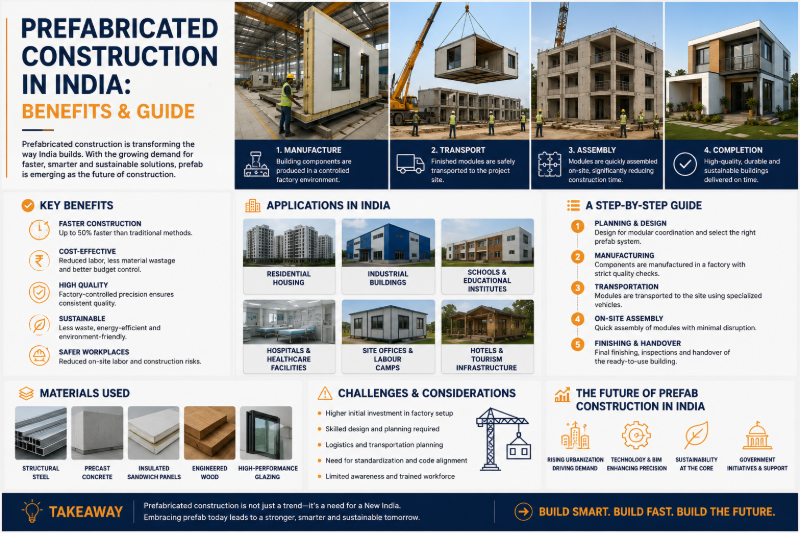
Prefabricated construction is revolutionizing the building industry in India, offering faster timelines, better quality control, and significant cost savings. As urbanization accelerates and labor shortages persist, prefab construction has emerged as a practical solution for residential, commercial, and industrial projects across the country.
This comprehensive guide explores how prefabricated construction works, its benefits for Indian developers and contractors, current challenges, and future prospects in the AECO sector.
What is Prefabricated Construction?
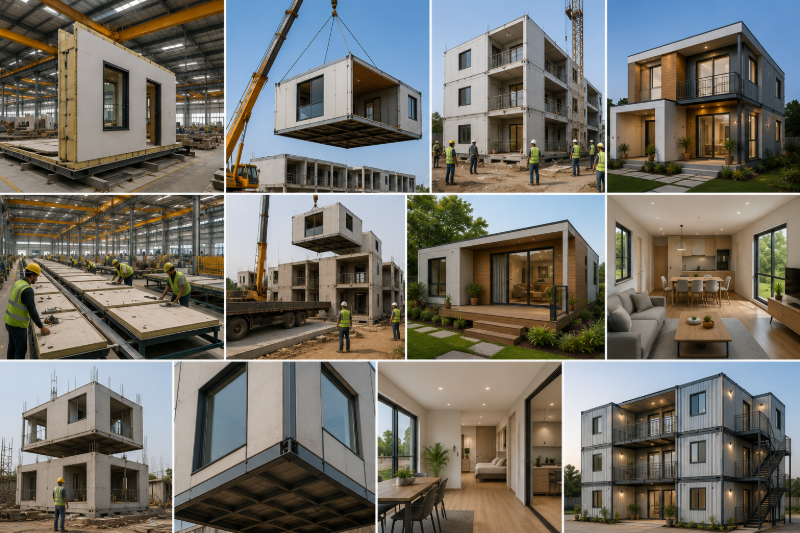
Prefabricated construction, or "prefab," involves manufacturing building components in a controlled factory environment before transporting them to the construction site for assembly. Unlike traditional on-site construction, prefab reduces on-site labor and weather-related delays.
Components manufactured off-site typically include:
Structural elements (columns, beams, wall panels)
Volumetric modules (complete rooms or units)
MEP (mechanical, electrical, plumbing) systems
Facade and cladding elements
Roof trusses and floor systems
In India, prefab construction is gaining traction in metro cities like Bangalore, Hyderabad, Mumbai, and Delhi-NCR, where rapid urbanization and real estate demand are high. Several developers are now partnering with specialized prefab manufacturers to deliver projects faster and more efficiently.
Build cost · Bengaluru, May 2026
Key Advantages of Prefabricated Construction
1. Faster Project Completion
One of the most compelling benefits of prefab construction is speed. Traditional construction in India typically takes 24-36 months for a mid-sized residential project. Prefabricated construction can reduce this timeline by 30-40%./blog/igbc-certification-benefits
Why? Because manufacturing happens simultaneously with site preparation and foundation work. A 500-unit residential complex that would take 30 months conventionally might be completed in 18-22 months using prefab methods.
2. Cost Efficiency
Prefab construction typically reduces overall project costs by 15-25% through:
Labor savings: Reduced on-site labor requirements (approximately 30-40% fewer workers needed)
Material waste reduction: Factory-controlled manufacturing minimizes wastage to 5-10%, compared to 15-20% in traditional construction
Faster cash flow: Earlier project completion means faster revenue realization
Lower financing costs: Reduced project duration means lower interest burden on construction loans
For a ₹100 crore residential project in Bangalore, prefab construction could save ₹15-25 crores in direct and indirect costs.
Frequently asked
3. Superior Quality Control
Factory environments offer consistent quality standards. Components are manufactured under controlled conditions with:
Precision machinery ensuring dimensional accuracy
Regular quality checks at multiple production stages
Consistent material sourcing and testing
Reduced defects and rework requirements
This is particularly valuable in India, where weather conditions and labor skill variations can impact traditional construction quality.
4. Weather Independence
India's monsoon season significantly impacts traditional construction schedules. Prefab manufacturing happens in controlled factory environments, unaffected by weather. Only assembly and finishing work occurs on-site, which can be scheduled around monsoon periods.
5. Sustainability Benefits
Prefabricated construction aligns with India's green building initiatives:
Reduced material waste (5-10% vs. 15-20%)
Lower carbon footprint from reduced on-site activities
Better energy efficiency through precision manufacturing
Easier integration of sustainable materials and systems
Projects targeting LEED or IGBC certifications benefit significantly from prefab construction's inherent sustainability advantages.
Current State of Prefab Construction in India
Market Growth and Adoption
India's prefab construction market is still in early stages compared to developed nations, but growth is accelerating. Major factors driving adoption include:
Government initiatives promoting affordable housing (e.g., Pradhan Mantri Awas Yojana)
Rising labor costs and skilled labor shortages
Increasing demand for faster project delivery
Growing investor focus on operational efficiency
Currently, prefab adoption is highest in:
Bangalore: Tech-driven market with IT companies investing in office spaces and worker housing
Hyderabad: Rapid urbanization and industrial growth
Mumbai: High land costs driving demand for efficient construction
Delhi-NCR: Government housing projects utilizing prefab methods
Key Players and Manufacturers
Several Indian and international companies now offer prefab solutions:
Large construction companies developing in-house prefab facilities
Specialized prefab manufacturers focusing on specific components
International companies establishing Indian operations
Startups innovating in modular and volumetric construction
Challenges and Barriers to Adoption
1. High Initial Capital Investment
Setting up prefab manufacturing facilities requires significant upfront investment (₹50-150 crores for a comprehensive facility). This barrier is particularly challenging for smaller contractors and developers.
2. Regulatory and Compliance Issues
India's building codes and regulations were developed for traditional construction. Prefab components must still comply with local building bye-laws, which vary by state and municipality. This creates:
Approval delays for new prefab methodologies
Need for testing and certification of prefab components
Varying standards across different states
3. Transportation Constraints
Moving large prefab components across India faces challenges:
Road infrastructure limitations in many regions
Restrictions on vehicle dimensions and weights
Logistics costs can offset manufacturing savings
Limited specialized transport availability
Projects within 200-300 km of manufacturing facilities are most economical.
4. Skilled Labor Gap
Prefab construction requires different skills than traditional methods. India currently lacks sufficient trained workers for:
Prefab component assembly
Precision fitting and connection work
Quality control and inspection
Specialized equipment operation
5. Client and Industry Perception
Many Indian developers and clients still perceive prefab as lower quality or less prestigious. Changing mindsets requires:
Successful project demonstrations
Industry education and awareness
Regulatory recognition and standards
Case studies showing long-term performance
Types of Prefabricated Construction Methods
Component-Based Prefabrication
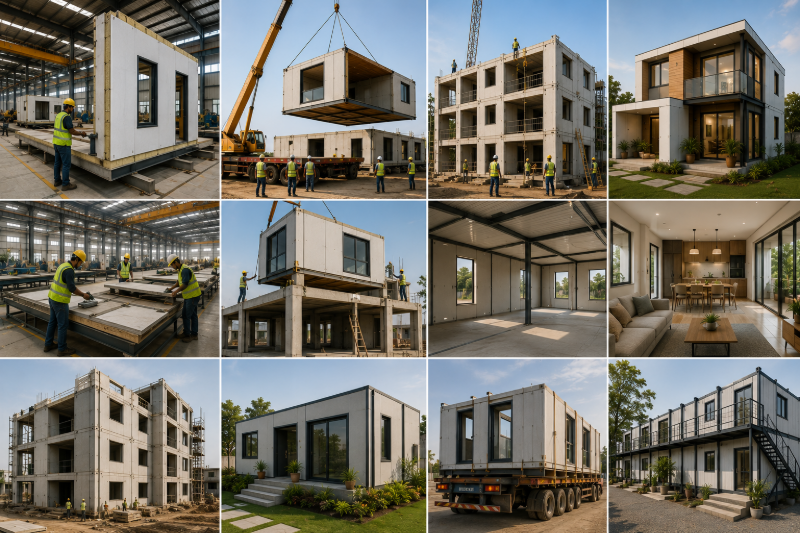
Individual components (beams, columns, panels) are manufactured separately and assembled on-site. This method is most common in India currently, particularly for:
Concrete frame structures
Steel structures
Precast wall panels
Roof systems
Volumetric Prefabrication
Complete 3D modules (rooms or units) are manufactured as finished spaces, including finishes, fixtures, and MEP systems. This approach offers:
Faster on-site assembly (days instead of weeks)
Higher quality interior finishes
Reduced on-site coordination
Better cost predictability
Volumetric prefab is gaining traction in hospitality, student housing, and affordable housing projects.
Panelized Prefabrication
Wall and floor panels are manufactured with integrated MEP systems, then assembled on-site. This hybrid approach balances:
Manufacturing efficiency with transportation ease
Quality control with on-site flexibility
Cost savings with local customization
Cost Analysis: Prefab vs. Traditional Construction in India
A typical comparison for a ₹100 crore residential project in Bangalore:
Cost Component | Traditional Construction | Prefab Construction |
Direct Material Costs | ₹40 crore | ₹38 crore (-5%) |
Labor Costs | ₹25 crore | ₹15 crore (-40%) |
Equipment and Machinery | ₹8 crore | ₹5 crore (-37%) |
Overhead and Contingency | ₹15 crore | ₹12 crore (-20%) |
Finance Costs (30 months vs. 18 months) | ₹12 crore | ₹7 crore (-42%) |
Total Project Cost | ₹100 crore | ₹77 crore (-23%) |
These savings assume proper planning, adequate manufacturing capacity, and favorable logistics conditions.
Finding Prefab Solutions on AECORD
If you're considering prefabricated construction for your project, AECORD connects you with specialized prefab manufacturers, engineers, and consultants across India. Whether you need component suppliers, volumetric module manufacturers, or prefab project management expertise, AECORD's platform makes it easy to find vetted professionals.
You can search by:
Prefab component type (structural, MEP, volumetric)
Geographic location and service radius
Project type and scale
Certifications and quality standards
Best Practices for Implementing Prefab Construction
1. Early Planning and Design Coordination
Prefab success requires design finalization before manufacturing begins. Implement:
BIM (Building Information Modeling) for coordination
Standardized component sizing to reduce variants
Clear specifications and tolerances
Regular design reviews with manufacturers
2. Select the Right Manufacturer
Partner with manufacturers who have:
Relevant experience and completed projects
Quality certifications (ISO 9001, etc.)
Adequate production capacity
Strong logistics network
Technical support capability
3. Logistics Planning
Optimize transportation by:
Selecting manufacturers within 300 km when possible
Planning delivery schedules aligned with site readiness
Arranging temporary storage if needed
Ensuring site access for large components
4. Site Preparation and Assembly
Ensure on-site readiness:
Precise foundation work (tolerances critical for prefab)
Trained assembly crews
Proper equipment for component handling
Quality inspection protocols
5. Contract and Risk Management
Clear contracts should define:
Specifications and quality standards
Delivery schedules and penalties
Warranty and liability terms
Change order procedures
Insurance and risk allocation
Future Outlook for Prefab Construction in India
The prefab construction sector in India is poised for significant growth. Key drivers include:
Government support: Policies promoting affordable housing and sustainable construction
Technology adoption: Increased use of BIM, robotics, and automation
Skill development: Training programs and industry standards emerging
Market maturation: Growing client acceptance and successful project examples
Regulatory evolution: Updated building codes accommodating prefab methods
By 2030, prefab construction could account for 15-20% of India's construction activity, up from current 2-3%.
Conclusion
Prefabricated construction offers compelling advantages for Indian developers, contractors, and project owners: faster timelines, cost savings, superior quality, and sustainability benefits. While challenges remain—regulatory, logistical, and perception-based—the trajectory is clearly toward increased adoption.
Success with prefab requires careful planning, selecting the right partners, and adapting processes to India's specific context. Whether you're a developer exploring prefab for your next project or a manufacturer offering these solutions, finding the right collaborators is crucial.
Explore AECORD's network of prefab specialists, manufacturers, and consultants to find the expertise you need. Connect with experienced professionals who understand India's unique construction landscape and can help you leverage prefabrication's benefits for your project. Browse AECORD today to discover how prefab construction can transform your next development.