

Understanding NOC for Construction in India: A Comprehensive Guide
The No Objection Certificate (NOC) is one of the most critical documents required for any construction project in India. Whether you're planning to build a residential complex, commercial space, or industrial facility, obtaining an NOC is a mandatory step that cannot be bypassed. This guide will walk you through the entire process of securing an NOC for construction in India, helping you navigate the regulatory landscape with confidence.
Build cost · Bengaluru, May 2026
What is an NOC for Construction?
An NOC (No Objection Certificate) is an official document issued by relevant government authorities that certifies they have no objection to a proposed construction project. It serves as proof that your project complies with local regulations, building codes, and zoning laws. The NOC essentially gives you the legal permission to proceed with construction activities on your property.
In India's construction sector, multiple NOCs may be required from different authorities depending on your project's nature and location. These certificates are essential for obtaining building permits and ensuring that your construction adheres to all statutory requirements.
Why is NOC Essential for Construction Projects?
Obtaining an NOC is not just a bureaucratic formality—it has significant legal and practical implications:
Legal Compliance: NOC ensures your project meets all local, state, and national building regulations
Property Security: It protects your property rights and prevents future legal disputes
Financing: Banks and financial institutions require NOC before approving construction loans
Occupancy Certificate: You cannot obtain an occupancy certificate without having proper NOCs
Sale and Transfer: Future buyers will demand proof of NOC before purchasing the property
Insurance: Insurance companies may refuse coverage for properties without proper NOCs

Types of NOCs Required for Construction in India
Depending on your project's location and nature, you may need to obtain NOCs from various authorities:
Frequently asked
1. Municipal Corporation/Local Body NOC
This is the primary NOC required for most construction projects. The municipal corporation or local body ensures that your construction complies with local building bylaws, zoning regulations, and land use policies. In cities like Mumbai, Delhi, Bangalore, and Hyderabad, this is typically issued by the respective municipal corporations.
2. Fire Department NOC
For buildings exceeding certain heights or with specific occupancy types, the Fire Department issues an NOC certifying that the building design includes adequate fire safety measures, emergency exits, and firefighting equipment. This is mandatory for commercial buildings, hospitals, and multi-story residential complexes.
3. Environmental Clearance
For projects in environmentally sensitive areas or projects exceeding certain size thresholds, you may need clearance from the Ministry of Environment, Forest and Climate Change (MoEFCC) or state environmental authorities. This is particularly important for projects in Bangalore, Delhi, and other metro cities.
4. Pollution Control Board NOC
The State Pollution Control Board issues NOC for industrial and commercial construction projects to ensure compliance with air, water, and noise pollution standards.
5. Airport Authority NOC
If your construction site is within a certain distance from an airport, you need NOC from the Airport Authority to ensure the building height doesn't interfere with flight paths.
6. Railway/Highway Authority NOC
For properties near railway lines or major highways, relevant authorities must certify that the construction won't obstruct transportation corridors or violate safety regulations.
7. Water Supply and Sewerage NOC
Local water supply and sewerage authorities issue NOC confirming that adequate water and sewerage infrastructure is available for your project.
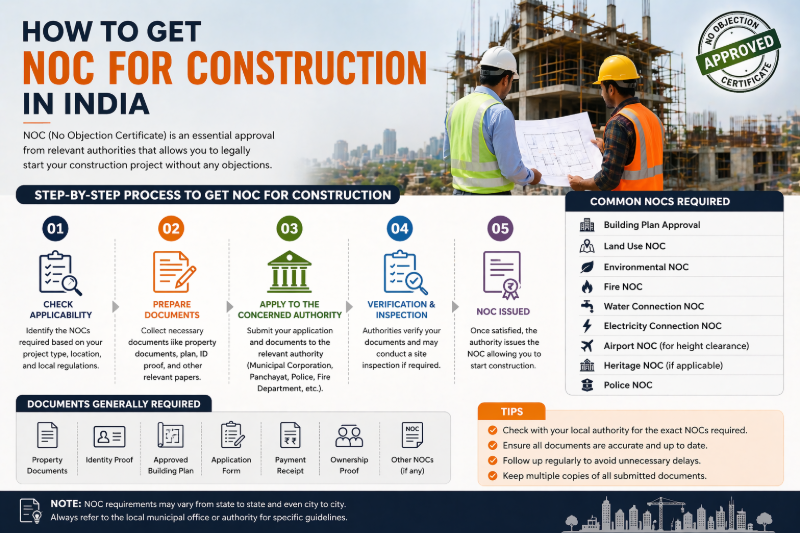
Step-by-Step Process to Obtain NOC for Construction
Step 1: Verify Land Ownership and Title
Before applying for any NOC, ensure that your property title is clear and you have legitimate ownership. Obtain a copy of the property deed, encumbrance certificate, and any relevant land records from the local revenue office. This documentation will be required by all authorities issuing NOCs.
Step 2: Prepare Detailed Project Documentation
Compile all necessary project documents including:
Architectural and structural drawings approved by a licensed architect
Site plan showing property boundaries and neighboring properties
Detailed project report with construction methodology
Environmental impact assessment (if applicable)
Proof of property ownership
Passport and address proof of the applicant
Proof of payment of relevant fees
Step 3: Apply for Building Permission/Sanction
Submit your detailed project documentation to the municipal corporation or local authority. In most Indian cities, this is the first step before any other NOC can be obtained. The municipal corporation will review your plans for compliance with local building bylaws and zoning regulations. Processing typically takes 15-30 days, though this varies by city.
Step 4: Obtain Fire Department NOC
Once you have municipal approval, apply to the Fire Department with your architectural plans. They will verify fire safety provisions including adequate exit routes, fire extinguishers, sprinkler systems, and emergency lighting. For residential buildings, this is often a straightforward process, while commercial and industrial projects require more detailed scrutiny.
Step 5: Secure Environmental and Pollution Control Clearances
If your project requires environmental clearance, submit the Environmental Impact Assessment (EIA) report to the relevant authority. The State Pollution Control Board will review your project's environmental footprint and issue NOC if standards are met. This process can take 30-60 days depending on project complexity.
Step 6: Obtain Other Specialized NOCs
Based on your project's location and nature, apply for NOCs from airport authorities, railway authorities, or highway authorities. These applications are typically straightforward and processed within 15-20 days.
Step 7: Collect All NOCs and Obtain Building Permit
Once you've collected all necessary NOCs, submit them to the municipal corporation along with your building plan for final approval. The municipal corporation will issue your building permit, which is your official authorization to commence construction.
Timeline and Cost Considerations
Processing Timeline
The total time to obtain all necessary NOCs typically ranges from 2-6 months, depending on:
Project complexity and size
Location and number of authorities involved
Completeness of documentation submitted
Specific city regulations
In major metros like Delhi and Mumbai, the process may take longer due to higher application volumes. In Tier-2 cities like Pune and Hyderabad, the timeline is often shorter.
Cost Structure
NOC-related costs typically include:
Municipal Building Plan Approval: ₹5,000 to ₹50,000+ (varies by built-up area and city)
Fire Department NOC: ₹2,000 to ₹20,000
Environmental Clearance: ₹10,000 to ₹1,00,000+ (for large projects)
Pollution Control Board NOC: ₹5,000 to ₹25,000
Other Authority NOCs: ₹2,000 to ₹10,000 each
Professional Fees: ₹20,000 to ₹2,00,000+ (if hiring consultants)
The total cost for obtaining all NOCs typically ranges from ₹50,000 to ₹3,00,000 depending on project scale and location.
Common Mistakes to Avoid When Obtaining NOC
Incomplete Documentation
One of the most common reasons for NOC rejection is submitting incomplete or incorrect documentation. Ensure all drawings are prepared by licensed professionals and all required certificates are included in your application.
Non-Compliance with Building Bylaws
Many projects face delays because the proposed design violates local building bylaws regarding setbacks, floor area ratio (FAR), or height restrictions. Have your architect review all local regulations before finalizing designs.
Ignoring Environmental Requirements
Failing to assess whether your project requires environmental clearance can cause significant delays. Consult with environmental consultants early in the planning stage, especially if your project is in or near environmentally sensitive areas.
Lack of Professional Guidance
Attempting to navigate the NOC process without professional help often leads to mistakes and delays. Consider hiring experienced architects or construction consultants who understand local regulations.
Delayed Submission of Supporting Documents
Authorities often request additional information or clarifications. Respond promptly to such requests to avoid unnecessary delays in the approval process.
Role of Technology and Online Portals
Many Indian municipalities have digitalized their NOC processes. Cities like Bangalore, Pune, and Hyderabad now offer online portals where you can submit applications and track status. Familiarize yourself with your local authority's online systems to streamline the process.
When searching for professional assistance with NOC applications and construction documentation, platforms like AECORD can connect you with experienced architects, structural engineers, and construction consultants who specialize in navigating these regulatory requirements. AECORD's network of verified professionals can help you prepare comprehensive documentation and guide you through the entire NOC approval process.

Specific Considerations for Major Indian Cities
Delhi
In Delhi, the Municipal Corporation of Delhi (MCD) handles building approvals. The process is relatively streamlined, but the volume of applications often causes delays. Fire Department NOC is mandatory for all residential buildings above a certain height.
Mumbai
The Brihanmumbai Municipal Corporation (BMC) has well-defined procedures but is known for stringent compliance checks. Environmental clearance is frequently required due to the city's coastal location and environmental sensitivity.
Bangalore
The Bruhat Bengaluru Mahanagara Palike (BBMP) has implemented an online NOC portal that significantly speeds up the process. Most approvals are granted within 30 days if documentation is complete.
Hyderabad
The Greater Hyderabad Municipal Corporation (GHMC) has modernized its approval system. The city also requires special clearances for projects in IT corridors and specific development zones.
Post-NOC Responsibilities
Obtaining NOC is not the end of your regulatory obligations. Throughout construction, you must:
Maintain compliance with all conditions mentioned in the NOC
Allow inspections by municipal and other authorities
Submit progress reports as required
Maintain proper waste management and pollution control measures
Ensure worker safety and site management
Obtain occupancy certificate upon project completion
Conclusion
Obtaining NOC for construction in India is a multi-stage process that requires careful planning, complete documentation, and adherence to local regulations. While the process may seem complex, understanding the requirements and timeline helps you navigate it efficiently. Whether you're building in Delhi, Mumbai, Bangalore, or any other Indian city, the fundamental principles remain the same: prepare thoroughly, submit complete documentation, and engage with authorities promptly.
For construction professionals and property developers, platforms like AECORD provide access to experienced architects, engineers, and construction consultants who can guide you through the entire NOC approval process. These professionals understand the nuances of different municipal regulations and can help ensure your project meets all compliance requirements from the outset.
Don't let NOC delays derail your construction timeline. Start the process early, gather all necessary documentation, and consider professional guidance to ensure smooth approval. Visit AECORD today to connect with verified construction professionals who can assist with your NOC application and help bring your construction project to reality.
Frequently Asked Questions
What is an NOC for construction and why is it required in India?
An NOC (No Objection Certificate) is an official document issued by government authorities certifying that a proposed construction project complies with local regulations, building codes, and zoning laws. It's mandatory in India as it provides legal permission to proceed with construction and is required by banks for loans, obtaining occupancy certificates, and future property sales.
How many types of NOCs are needed for a construction project in India?
Multiple NOCs may be required depending on your project's nature and location, including Municipal Corporation NOC, Fire Department NOC, Environmental Clearance, Pollution Control Board NOC, Airport Authority NOC, and Railway/Highway Authority NOC. The specific NOCs needed vary based on the project type and its proximity to sensitive areas.
Can I get a building permit without an NOC in India?
No, obtaining an NOC is a mandatory prerequisite for getting a building permit in India. Without proper NOCs from relevant authorities, you cannot legally proceed with construction or obtain the necessary permits from local bodies.
Do I need environmental clearance NOC for all construction projects?
Environmental clearance is required only for projects in environmentally sensitive areas or those exceeding certain size thresholds. Most small residential projects don't require this, but larger commercial and industrial projects, especially in metro cities, typically need clearance from environmental authorities.
What happens if I construct without obtaining an NOC?
Constructing without an NOC can result in legal disputes, inability to obtain an occupancy certificate, rejection of bank loans, insurance coverage denial, and complications during property sale or transfer. It also exposes you to penalties and potential demolition orders from authorities.