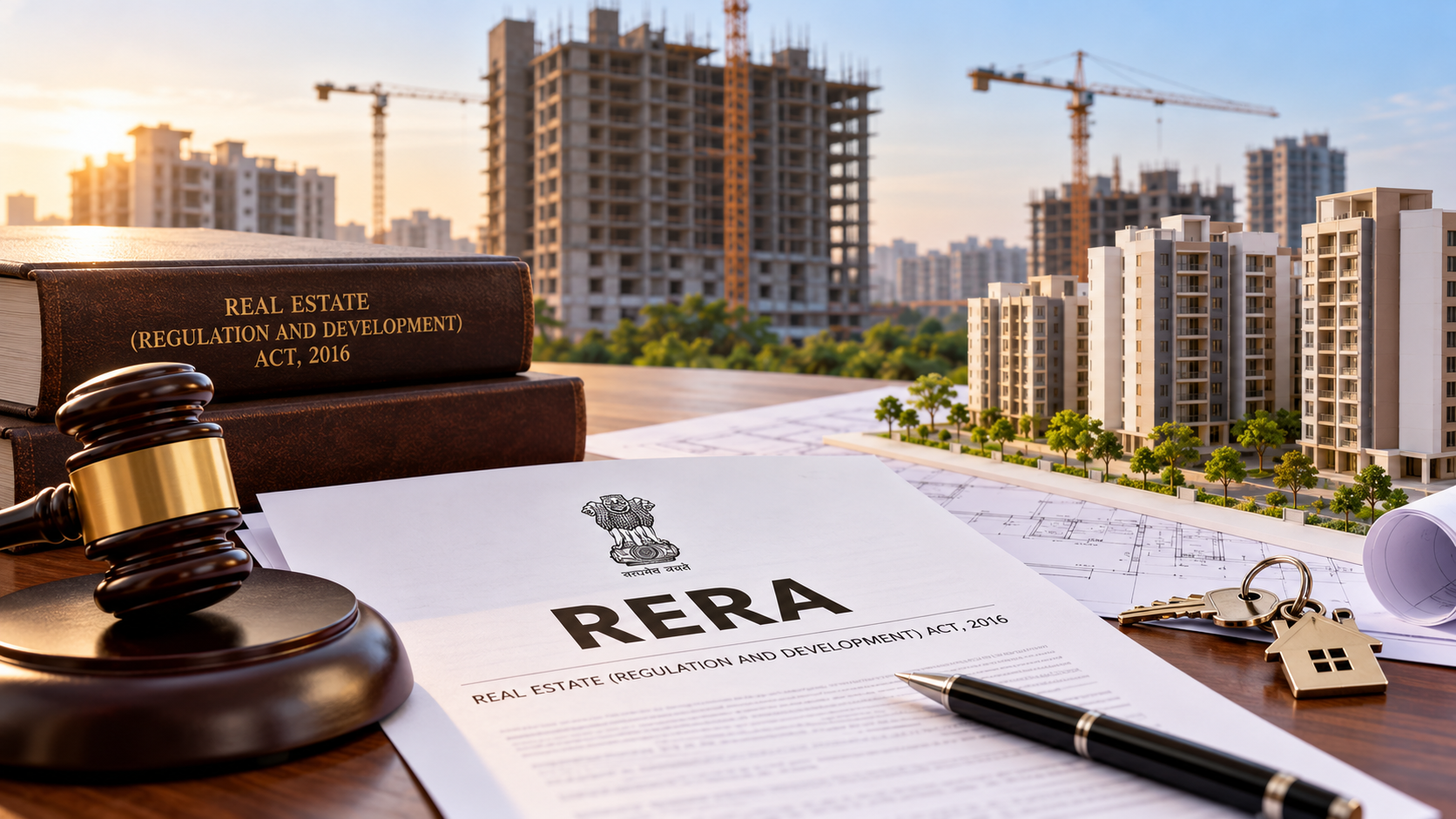
The Real Estate (Regulation and Development) Act, 2016, commonly known as RERA, has fundamentally transformed the Indian real estate landscape by providing buyers with a robust legal framework to protect their interests. However, many homebuyers and investors remain unclear about how to file a complaint when their rights are violated. Understanding the RERA complaint process is essential for anyone purchasing property in India, whether in Delhi, Mumbai, Bangalore, or any other city.
This comprehensive guide walks you through the step-by-step RERA complaint process, helping you navigate the system effectively and protect your investment.

Understanding RERA and When to File a Complaint
RERA applies to all real estate projects across India, covering both residential and commercial properties. The Act empowers buyers to lodge complaints against developers for various violations, including delayed project delivery, construction defects, misleading advertisements, and non-compliance with approved plans.
Before filing a complaint, it's important to understand that RERA complaints can be filed for:
Delays in project completion beyond the stipulated timeline
Deviation from approved plans and specifications
Structural defects in the property
Failure to hand over possession on the agreed date
False or misleading advertisements
Non-refund of booking amounts or down payments
Violation of the terms and conditions of the agreement
Inadequate maintenance of common areas
Build cost · Bengaluru, May 2026
Step 1: Gather All Relevant Documentation
Before initiating a RERA complaint, compile all necessary documents related to your property purchase. This documentation will form the foundation of your case and strengthen your complaint.
Essential documents to collect include:
Agreement for Sale or Purchase Agreement
Receipt of all payments made to the developer
Booking confirmation and offer letter
Approved building plans and layouts
Brochures and promotional materials
Correspondence with the developer (emails, letters, SMS)
Photographs or videos showing defects or deviations
Inspection reports from independent engineers
Bank statements showing payment transfers
Property registration documents (if applicable)
Organizing these documents chronologically will help you present a clear timeline of events and establish your claim effectively. If you're unsure about which documents are most critical for your specific complaint, consulting with a legal professional specializing in real estate matters can be beneficial.
Step 2: Identify the Appropriate RERA Authority
Each state in India has established its own RERA Authority to handle complaints. The jurisdiction depends on where the property is located, not where the buyer resides. For example, if you've purchased a property in Bangalore, you would file your complaint with the Karnataka RERA Authority, regardless of where you live.
Major RERA Authorities in India include:
Maharashtra RERA Authority (handles projects in Mumbai, Pune, Nagpur)
Delhi RERA Authority (covers National Capital Region)
Karnataka RERA Authority (manages Bangalore, Mysore, and other cities)
Tamil Nadu RERA Authority (oversees Chennai, Coimbatore, Salem)
Rajasthan RERA Authority (covers Jaipur, Jodhpur, Udaipur)
Gujarat RERA Authority (manages Ahmedabad, Surat, Vadodara)
Telangana RERA Authority (covers Hyderabad and surrounding areas)
You can find the contact information and official website of your respective state's RERA Authority through a simple online search or by visiting the official RERA portal for your state. Most authorities now provide online filing mechanisms, making the process more accessible.
Step 3: Attempt Amicable Resolution
While not always mandatory, attempting to resolve the issue amicably with the developer before filing a formal complaint is advisable and often recommended by RERA authorities. This approach can save time, money, and stress for both parties.
Steps for amicable resolution:
Send a formal notice to the developer through registered mail or email with acknowledgment
Clearly state the issue, expected timeline for resolution, and consequences of non-compliance
Allow the developer a reasonable period (typically 7-30 days) to respond
Document all communication attempts
Consider mediation if the developer is willing to participate
If the developer responds positively and provides a reasonable resolution plan, you can avoid the formal complaint process. However, if they fail to respond or refuse to address your concerns, you can proceed with filing a formal RERA complaint.
Frequently asked
Step 4: Prepare Your Formal RERA Complaint
Once you've decided to file a formal complaint, you need to prepare a detailed written complaint that clearly outlines your grievance. The complaint should be factual, well-organized, and supported by evidence.
Key elements to include in your complaint:
Complainant Details: Your full name, address, contact number, and email address
Property Details: Project name, location, unit number, carpet area, and registration details
Developer Information: Developer's name, registered office address, and RERA registration number
Detailed Description of the Issue: A chronological narrative of events, violations, and how they affect you
Specific Violations: Reference the specific sections of RERA or the agreement that have been violated
Supporting Evidence: Attach copies of relevant documents, photographs, inspection reports, and correspondence
Relief Sought: Clearly state what you're seeking—compensation, completion of work, refund, or other remedies
Affidavit: A sworn statement confirming the truthfulness of the information provided
The complaint should be written in clear, concise language without emotional language or unsubstantiated claims. Focus on facts and evidence. Many RERA authorities provide specific formats or templates for complaints—check your state's RERA website for these guidelines.
Step 5: File Your Complaint with the RERA Authority
Most RERA Authorities now accept complaints through online portals, making the filing process more convenient. However, the specific procedure may vary by state, so it's important to check your state's RERA website for exact instructions.
Filing methods typically include:
Online Portal: Most states have developed dedicated online complaint filing systems. You'll need to register, create an account, and upload your complaint along with supporting documents.
Physical Submission: Some authorities still accept physical complaints at their offices. You'll need to submit the original complaint with all supporting documents in person.
Email: A few authorities accept complaints via email, though this is becoming less common.
When filing online, ensure that all documents are scanned clearly and in acceptable formats (usually PDF). The file size limits are typically 5-10 MB per document. Keep a copy of your complaint reference number or registration ID for future correspondence.
Step 6: Pay the Required Complaint Fee
RERA authorities charge a nominal fee for filing complaints. This fee varies by state and the amount of compensation being sought. For example, in Maharashtra, the complaint fee ranges from ₹500 to ₹5,000 depending on the relief amount claimed. In Delhi, similar fee structures apply.
The fee is typically paid online through the RERA portal using various payment methods including credit cards, debit cards, and net banking. Keep the payment receipt as proof of your complaint filing. This fee is non-refundable, but it's significantly lower than what you would spend on litigation through conventional courts.
Step 7: Receive Acknowledgment and Case Number
Once your complaint is successfully filed, the RERA Authority will issue an acknowledgment with a unique case number. This number is crucial for all future correspondence and tracking of your complaint. You'll typically receive this acknowledgment via email or SMS, depending on how you filed the complaint.
Keep this acknowledgment safe and use the case number whenever you contact the RERA Authority or refer to your complaint. The RERA Authority will also send a copy of your complaint to the developer, who then has a specified period (usually 30-45 days) to file their response.
Step 8: Attend the Hearing and Present Your Case
After both parties have submitted their documents, the RERA Authority will schedule a hearing. You'll receive a notice with the date, time, and venue of the hearing. It's crucial to attend this hearing personally or through a representative authorized by you.
During the hearing:
Present your case clearly and concisely, focusing on facts and evidence
Answer questions posed by the RERA Authority members
Cross-examine the developer's representative if necessary
Submit any additional evidence or documents if required
Avoid making emotional appeals; stick to the legal and factual aspects of your case
If you're not comfortable presenting your case yourself, you can engage a lawyer to represent you. Many real estate lawyers in major cities like Mumbai, Delhi, Bangalore, and Pune specialize in RERA matters and can effectively present your case before the Authority.
Step 9: Await the RERA Authority's Order
After the hearing, the RERA Authority will review all evidence, arguments, and documentation from both parties before issuing an order. This process typically takes 2-6 months, though it can extend longer in complex cases.
The RERA Authority's order will outline:
The findings of fact in your case
The applicable laws and regulations
The Authority's decision on whether the developer violated RERA
The relief granted to you (if any)
Directions for compliance by the developer
Timeline for implementation
You can download the order from the RERA portal using your case number and login credentials.
Step 10: Enforcement and Appeal
If the RERA Authority's order is in your favor, the developer is legally bound to comply. If they fail to do so, you can file an execution petition to enforce the order. The RERA Authority has the power to impose penalties on developers who fail to comply with its orders.
If you're dissatisfied with the RERA Authority's decision, you have the right to appeal to the RERA Appellate Tribunal within 60 days of the order. This appeal must be filed in the appropriate state's Real Estate Appellate Tribunal, which reviews the Authority's decision.
Important Tips for a Successful RERA Complaint
Document Everything: From the moment you book a property, maintain detailed records of all communications, payments, and agreements. This documentation becomes invaluable if you need to file a complaint later.
Be Specific and Factual: Vague complaints weaken your case. Provide specific dates, amounts, and details of violations. Support your claims with concrete evidence.
Meet Deadlines: RERA proceedings have strict timelines. Ensure you submit your response and appear for hearings within the specified deadlines to avoid dismissal of your complaint.
Consider Professional Help: While you can file a complaint independently, consulting with a real estate lawyer or finding experienced professionals through platforms like AECORD can strengthen your case significantly. AECORD connects buyers with qualified legal experts and real estate consultants who specialize in RERA matters.
Maintain Copies: Keep multiple copies of all documents and maintain both digital and physical backups. This ensures you have evidence even if originals are lost or damaged.
Common RERA Complaint Scenarios in India
Delayed Project Completion: A developer in Pune promises to deliver a residential project by December 2022 but fails to do so even by 2024. The buyer can file a RERA complaint seeking compensation for the delay and demanding completion within a specified timeframe.
Construction Defects: A buyer in Bangalore discovers structural defects in their newly purchased apartment, including cracks in walls and leakage issues. They can file a RERA complaint with photographic evidence and an engineer's inspection report.
Deviation from Plans: A developer in Delhi constructs a property that deviates from the approved plans regarding carpet area or layout. The buyer can lodge a complaint and seek compensation for the difference.
Conclusion
The RERA complaint process provides homebuyers and investors with a powerful mechanism to protect their rights in the Indian real estate market. While the process involves multiple steps and requires careful documentation, it's significantly more accessible and affordable than traditional litigation.
By following this step-by-step guide, you can effectively navigate the RERA complaint system and seek appropriate remedies for violations by developers. Remember that success in RERA complaints depends largely on the quality of your documentation and the clarity of your presentation.
If you're facing issues with your real estate purchase or need guidance on filing a RERA complaint, connect with experienced legal professionals and real estate consultants on AECORD. Our platform brings together qualified experts who can guide you through the entire process, ensuring your rights are protected. Whether you need a lawyer to represent you or a consultant to help document your case, AECORD makes it easy to find the right professional for your needs. Start your search on AECORD today and take the first step toward resolving your real estate dispute.
```
Frequently Asked Questions
What are the main reasons I can file a RERA complaint as a homebuyer?
You can file a RERA complaint for various violations including delayed project completion, deviation from approved plans, structural defects, failure to hand over possession on time, false advertisements, non-refund of booking amounts, and inadequate maintenance of common areas. RERA covers both residential and commercial properties across India.
Which documents do I need to gather before filing a RERA complaint?
Essential documents include your Agreement for Sale, payment receipts, booking confirmation, approved building plans, promotional materials, developer correspondence, photographs of defects, inspection reports, bank statements, and property registration documents. Organizing these chronologically strengthens your complaint significantly.
Which RERA Authority should I file my complaint with?
You must file your complaint with the RERA Authority of the state where the property is located, not where you reside. For example, a property in Bangalore requires filing with the Karnataka RERA Authority, while properties in Mumbai go to the Maharashtra RERA Authority.
Can I file a RERA complaint if I live in a different state than my property?
Yes, your location doesn't matter for filing a RERA complaint. The jurisdiction is determined solely by the property's location. You can file with the appropriate state RERA Authority regardless of where you currently reside.
Should I hire a legal professional to help with my RERA complaint?
While not mandatory, consulting with a real estate legal professional can be beneficial, especially if you're unsure which documents are most critical for your specific complaint or need guidance navigating the RERA process effectively.