

Understanding Rainwater Harvesting: Cost, Benefits, and Return on Investment in India
Rainwater harvesting has emerged as a critical water management solution for India, where water scarcity affects millions of people across urban and rural areas. With increasing regulatory pressure and rising water costs, property owners and developers are increasingly turning to rainwater harvesting systems to reduce their dependence on municipal water supplies and groundwater extraction. This comprehensive guide explores the costs involved, potential returns on investment, and practical considerations for implementing rainwater harvesting in India. As municipal water supplies face severe stress and groundwater tables drop across Indian urban centers, implementing a Rainwater Harvesting (RWH) system has shifted from an eco-friendly option to a legal and financial necessity.
As of 2026, setting up a residential rainwater harvesting system in India typically costs between ₹20,000 to ₹80,000 for standalone independent homes, while large-scale apartment societies and commercial complexes range from ₹2 Lakh to over ₹5 Lakh.This guide explores complete component expenses, per-square-foot metrics, ROI timelines, and state subsidies.
Build cost · Bengaluru, May 2026
What Is Rainwater Harvesting and Why It Matters in India
Rainwater harvesting is the process of collecting, filtering, and storing rainwater from roofs, terraces, and other surfaces for later use in irrigation, toilet flushing, cleaning, and other non-potable applications. In India, where annual rainfall varies significantly by region—from less than 500mm in desert areas to over 10,000mm in coastal regions—rainwater harvesting represents both an environmental imperative and a practical economic solution.
The importance of rainwater harvesting in India cannot be overstated. According to the Central Water Commission, India's per capita water availability has decreased from 1,816 cubic meters in 2001 to approximately 1,486 cubic meters in 2021. In major metropolitan areas like Delhi, Mumbai, Bangalore, and Hyderabad, water demand often exceeds available supply during peak seasons. This scarcity drives up water costs and makes alternative water sources increasingly valuable. 1. Quick Cost Matrix: Residential & Commercial Systems
Property Type / Scope | Average Setup Cost (INR) | Primary Objective | Typical Configuration |
Small Independent House | ₹20,000 – ₹40,000 | Basic groundwater recharge | Rooftop pipes, first-flush diverter, shallow recharge pit. |
Mid-Sized Villa / Bungalow | ₹40,000 – ₹1,20,000 | Storage + non-potable reuse | 5,000L–10,000L storage tank, sand-charcoal filter. |
Apartment Complex (10–20 Flats) | ₹2,00,000 – ₹5,00,000+ | Mandatory compliance & large volume storage | Underground sumps, advanced dual-intensity filters, multiple recharge wells. |
Commercial / Industrial Warehouses | ₹5,00,000 to ₹15,00,000+ | Large-scale recycling & zero discharge | Heavy-duty automatic self-cleaning filters (e.g., Rainy FL-500), large settling tanks. |
Components of a Rainwater Harvesting System
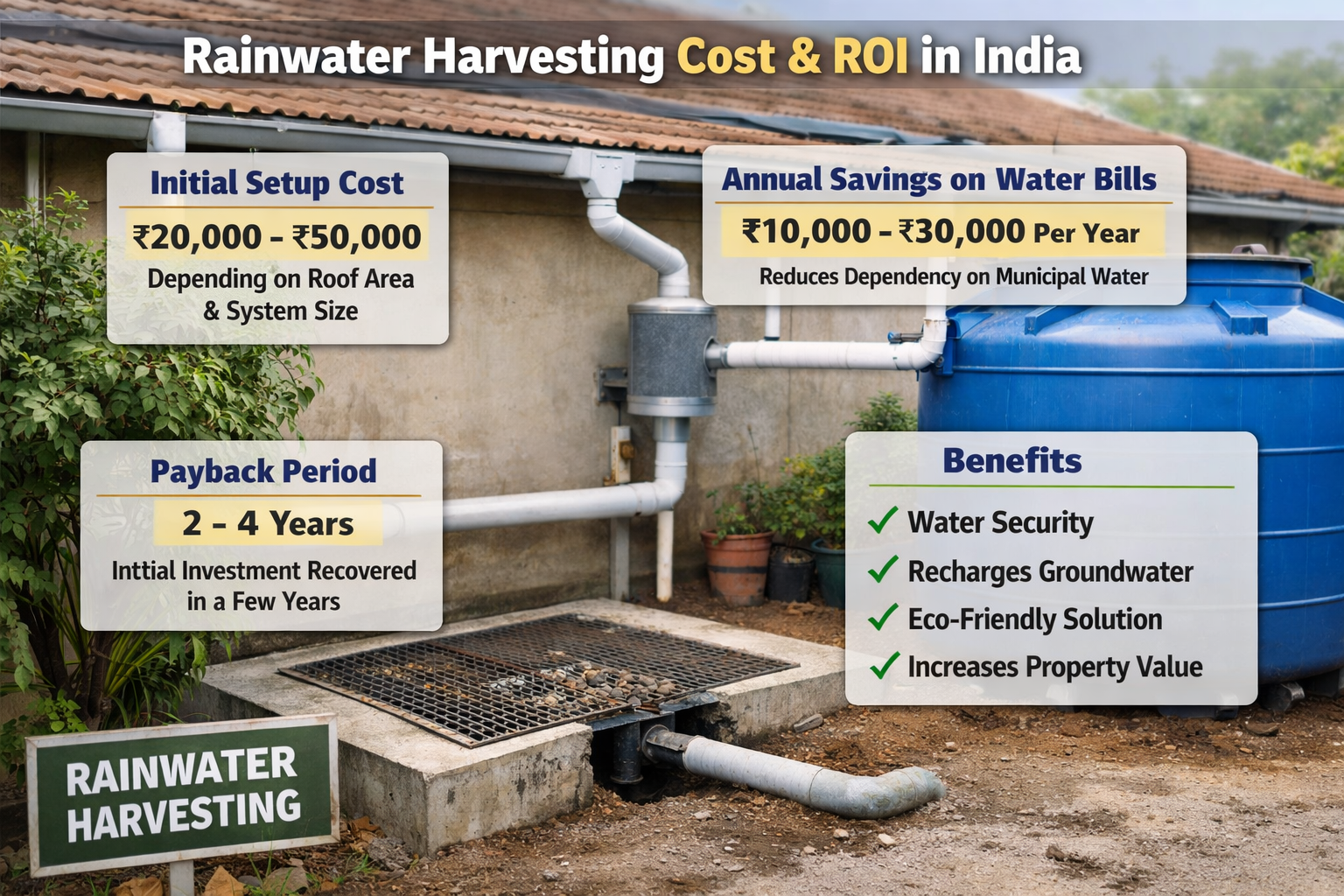
Before diving into costs, it's essential to understand what comprises a typical rainwater harvesting system. Each component contributes to the overall cost and efficiency of the system:
Catchment Area
The catchment area is typically your building's roof surface. For residential buildings, this is usually the terrace or roof area. For commercial properties, warehouses, and industrial facilities, larger roof areas mean greater collection potential. The size of your catchment area directly influences how much rainwater you can harvest.
Frequently asked
Conveyance System
This includes gutters, downpipes, and channels that direct rainwater from the catchment area to storage or filtration units. Quality conveyance systems prevent water loss and contamination. In India, conveyance systems typically cost between ₹150-₹300 per meter, depending on material quality and diameter.
Filtration and First-Flush Diverter
The first-flush diverter automatically diverts the initial rainwater (which contains dust, debris, and bird droppings) away from storage tanks. Filtration systems remove suspended particles and contaminants. These components are crucial for water quality and typically cost ₹15,000-₹50,000 depending on sophistication.
Storage Tanks
Storage tanks are the most expensive component of most rainwater harvesting systems. Tanks can be underground, above-ground, or integrated into building design. Tank costs vary significantly based on capacity, material, and location.
Distribution and Treatment
Depending on your intended use, you may need additional treatment, pumping systems, and distribution networks. These add to the overall system cost. 2. Component-Level Cost Breakdown
Understanding granular equipment pricing helps builders evaluate contractor quotations accurately:
Storage Tanks (Plastic vs. RCC): Typically the largest expense.Modular plastic or HDPE tanks (Sintex-style) cost roughly ₹7 to ₹12 per liter (totaling ₹8,000 to ₹60,000 for 1,000 to 5,000 liters).Underground RCC or ferro-cement sumps range from ₹5 to ₹8 per liter.
Filtration Systems: Prevents debris, silt, and contaminants from entering storage. Basic mesh filters cost ₹2,000 to ₹5,000, sand-charcoal gravity filters range from ₹7,000 to ₹15,000, and automated self-cleaning filters (like popular Rainy Filter models) run from ₹8,500 to ₹26,500 depending on roof square-footage capacity.
First-Flush Diverters & Piping: Essential for discarding initial contaminated roof wash. High-grade UV-resistant PVC pipes and diverter valves add ₹2,000 to ₹10,000.
Recharge Pits / Borewell Integration: Digging and gravel-packing a standard 4–5 ft groundwater recharge pit costs ₹8,000 to ₹15,000, while direct borewell recharge configurations range from ₹20,000 to ₹40,000.
3. Statutory Mandates & Government Subsidies Across India
Rainwater harvesting is legally mandatory for residential and commercial structures exceeding specific plot sizes (typically buildings above 100 sq meters or 1,000 sq ft) under municipal boards like BWSSB (Bangalore), CMWSSB (Chennai), and Delhi Jal Board.Non-compliance attracts heavy monthly water bill penalties or water disconnection notices.
State Subsidies & Incentives:
Maharashtra: Up to 10% property tax rebates or installation subsidies in select municipal corporations.
Karnataka & Tamil Nadu: Mandatory compliance certifications required for occupancy certificates (OC); property tax concessions offered for verified green-rated units.
Rajasthan: Financial subsidies covering up to 40%–50% of setup costs in arid districts.
4. Calculating Return on Investment (ROI)
While direct water bill savings in cities with low municipal tariffs yield a long simple payback period (12–18 years), factoring in groundwater security, borewell revival, avoidance of municipal penalties, and a 5% to 8% green premium on property resale value brings effective ROI realization down to 6 to 8 years.
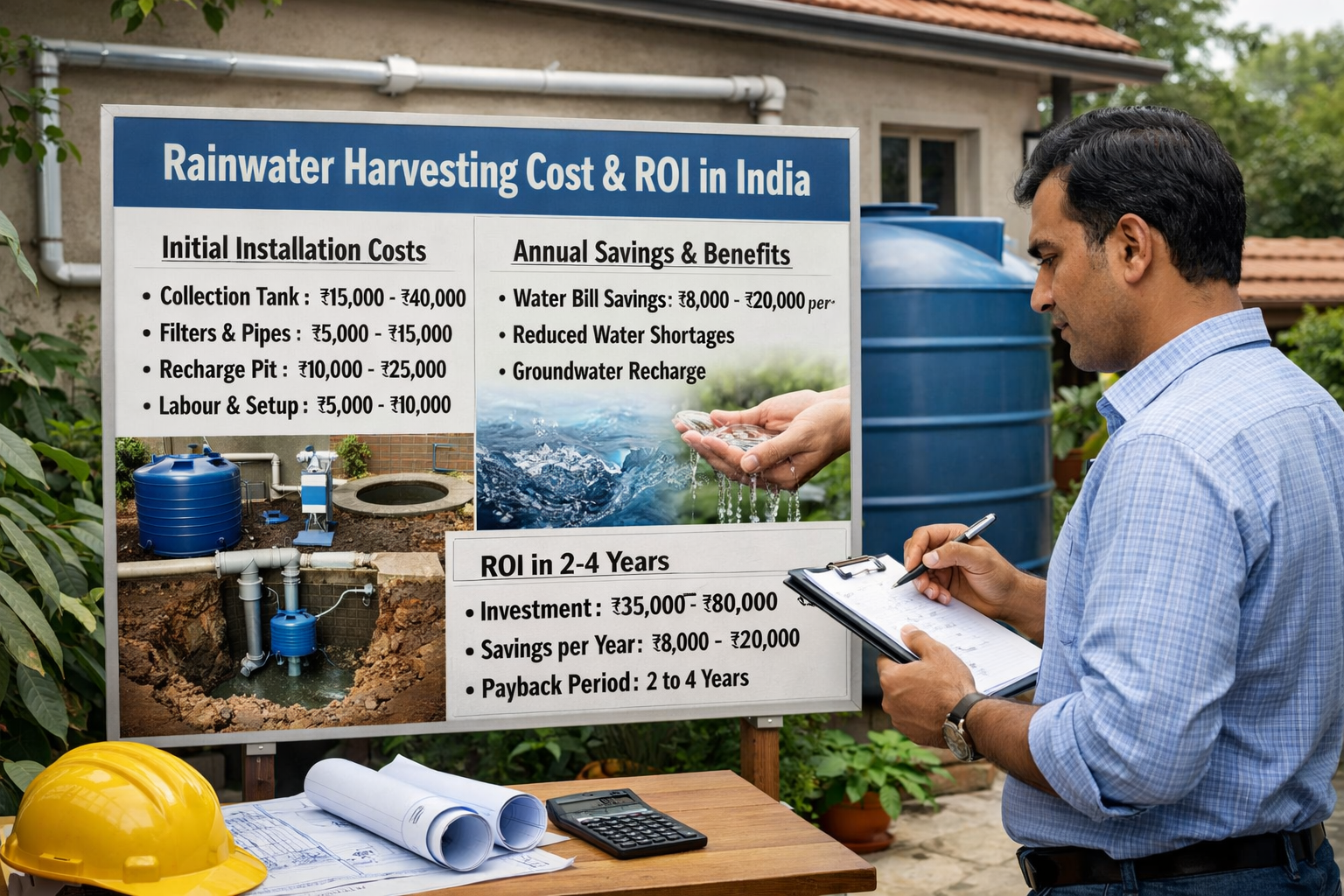
Detailed Cost Breakdown for Rainwater Harvesting Systems in India
Residential Properties (2,000-3,000 sq ft)
For a typical residential property in Indian cities like Pune, Chennai, or Bangalore with a roof area of 2,000-3,000 square feet:
Gutters and Downpipes: ₹25,000-₹45,000
First-Flush Diverter: ₹8,000-₹15,000
Filtration System: ₹12,000-₹25,000
Storage Tank (10,000-15,000 liters): ₹60,000-₹120,000
Pumping and Distribution: ₹20,000-₹40,000
Installation and Labor: ₹30,000-₹50,000
Total Estimated Cost: ₹155,000-₹295,000
A mid-range residential system typically costs around ₹200,000-₹250,000 for complete installation.
Commercial and Institutional Buildings
For larger commercial properties with 10,000-20,000 square feet of roof area:
Gutters and Downpipes: ₹80,000-₹150,000
Advanced First-Flush Diverter: ₹25,000-₹50,000
Multi-Stage Filtration: ₹50,000-₹100,000
Storage Tanks (50,000-100,000 liters): ₹300,000-₹600,000
Pumping, Treatment, and Distribution: ₹100,000-₹200,000
Installation and Civil Work: ₹150,000-₹300,000
Total Estimated Cost: ₹705,000-₹1,400,000
Factors Affecting Rainwater Harvesting Costs
Tank Material: Fiberglass tanks are more durable but cost 20-30% more than concrete or plastic alternatives. Underground tanks cost 30-40% more due to excavation and civil work.
Roof Area and Collection Potential: Larger roof areas allow for bigger systems but also increase gutter and conveyance costs proportionally.
Water Quality Requirements: If you plan to use harvested water for drinking or cooking, advanced treatment systems can add ₹100,000-₹300,000 to your project cost.
Geographic Location: In water-scarce regions like Delhi and Rajasthan, government incentives may reduce costs. Coastal cities with high rainfall may not need large storage tanks.
Integration with Existing Systems: Retrofitting an existing building costs 20-30% more than incorporating rainwater harvesting during new construction.
Calculating Return on Investment (ROI)
Water Savings: The Primary ROI Driver
The primary financial benefit of rainwater harvesting comes from reduced water bills. In India, water costs vary dramatically by city:
Delhi: ₹7-₹12 per kiloliter for residential consumers
Mumbai: ₹6-₹10 per kiloliter
Bangalore: ₹8-₹15 per kiloliter
Hyderabad: ₹5-₹8 per kiloliter
Chennai: ₹12-₹18 per kiloliter
These rates are rising at 8-12% annually in most metropolitan areas. Additionally, many municipalities levy sewerage charges based on water consumption, effectively doubling the cost benefit of water savings.
Sample ROI Calculation: Residential Property in Bangalore
Consider a typical 2,500 sq ft residential property in Bangalore:
Annual rainfall: 900mm
Collectible area: 2,500 sq ft = 232 sq meters
Annual collection potential: 232 × 0.9 = 209 cubic meters (209,000 liters)
Usable collection (accounting for 20% loss): 167,000 liters annually
Current water cost: ₹10 per kiloliter = ₹1,670 per year in water charges
Sewerage charges (typically equal to water charges): ₹1,670 per year
Total annual savings: ₹3,340 per year
System cost: ₹225,000
Simple payback period: 67 years
This calculation reveals an important reality: the payback period for residential rainwater harvesting systems in India is typically 15-25 years, not the 3-5 years sometimes claimed in marketing materials.
Improving ROI Through Additional Benefits
However, the financial equation improves significantly when you account for additional benefits:
Reduced Groundwater Extraction Charges
In many Indian cities, properties with borewells face additional charges or restrictions. Reducing groundwater dependence can save ₹500-₹2,000 annually in borewell operation and maintenance costs.
Increased Property Value
Properties with functional rainwater harvesting systems command 5-8% price premiums in water-conscious markets like Bangalore, Pune, and Hyderabad. For a ₹1 crore property, this represents ₹5-₹8 lakhs in added value.
Regulatory Compliance and Tax Benefits
Many Indian states and municipalities now mandate rainwater harvesting for new construction. Several states offer tax deductions or subsidies:
Maharashtra: Up to 10% subsidy on rainwater harvesting systems
Tamil Nadu: Subsidies for residential and commercial systems
Karnataka: Tax incentives under water conservation programs
Rajasthan: Up to 50% subsidy in water-scarce regions
These incentives can reduce effective system costs by 15-40%, significantly improving ROI.
Revised ROI Calculation with Benefits
Incorporating additional benefits in our Bangalore example:
Water and sewerage savings: ₹3,340/year
Groundwater extraction savings: ₹1,000/year
Property value increase (amortized over 20 years): ₹25,000/year
Subsidy (amortized over system life): ₹5,625/year
Total annual benefit: ₹34,965/year
Revised payback period: 6-7 years
This revised calculation demonstrates that rainwater harvesting can achieve reasonable ROI when all benefits are considered.
Long-Term Financial Projections
20-Year Analysis
Over a 20-year period, assuming water costs rise at 10% annually (typical for Indian cities):
Year 1-5 savings: ₹3,340-₹5,400/year = ₹21,000 total
Year 6-10 savings: ₹5,400-₹8,800/year = ₹36,000 total
Year 11-15 savings: ₹8,800-₹14,300/year = ₹58,000 total
Year 16-20 savings: ₹14,300-₹23,300/year = ₹94,000 total
Total 20-year savings: ₹209,000
Minus maintenance costs (₹5,000/year): -₹100,000
Net benefit over 20 years: ₹109,000 (including property value increase)
Maintenance Costs and Operational Expenses
Successful rainwater harvesting requires ongoing maintenance:
Annual filter replacement: ₹3,000-₹8,000
Tank cleaning and inspection: ₹2,000-₹5,000
Gutter and downpipe cleaning: ₹1,000-₹3,000
Pump servicing and repairs: ₹2,000-₹5,000
Annual maintenance cost: ₹8,000-₹21,000
Budget approximately ₹10,000-₹15,000 annually for routine maintenance to ensure system longevity and efficiency.
Government Incentives and Subsidies in India
Several Indian states and municipalities offer financial incentives to encourage rainwater harvesting adoption:
National Programs
The Pradhan Mantri Krishi Sinchayee Yojana (PMKSY) provides subsidies for water conservation, including rainwater harvesting, with up to 50% cost coverage in eligible areas.
State-Level Incentives
Delhi: The Delhi Jal Board offers subsidies up to ₹50,000 for residential rainwater harvesting systems.
Pune: Municipal Corporation mandates rainwater harvesting for properties above 500 sq meters and offers technical support.
Hyderabad: The Greater Hyderabad Municipal Corporation (GHMC) provides subsidies and mandates rainwater harvesting for new construction.
Check with your local municipal corporation or state water authority for current incentive programs in your area.
When Rainwater Harvesting Makes the Most Sense
Ideal Scenarios for Implementation
High annual rainfall areas: Cities receiving 800mm+ annual rainfall
High water costs: Areas where municipal water costs exceed ₹10 per kiloliter
Water scarcity regions: Areas with restricted groundwater extraction
Large properties: Residential or commercial properties with substantial roof area
New construction: Projects where rainwater harvesting can be integrated during design phase
Regulatory requirements: Areas with mandatory rainwater harvesting policies
Less Favorable Scenarios
Low rainfall areas (less than 600mm annually)
Regions with very low water costs
Properties with minimal roof area
Situations requiring significant excavation or structural modifications
Finding the Right Rainwater Harvesting Professionals
Implementing a rainwater harvesting system requires expertise in civil engineering, water quality management, and system design. When planning your rainwater harvesting project, it's crucial to work with qualified professionals who understand local regulations, climate patterns, and building codes.
AECORD, India's leading B2B2C marketplace for architecture, engineering, construction, and operations professionals, connects property owners with experienced rainwater harvesting specialists, civil engineers, and water management experts. Whether you're planning a residential system or a large commercial installation, AECORD helps you find vetted professionals who can assess your specific needs, calculate potential savings, and design cost-effective solutions tailored to your location and property type.
Conclusion & Procure via AECORD
Implementing a rainwater harvesting plant ensures regulatory compliance, shields your property from future water inflation, and promotes sustainable urban design. To source verified green-building contractors, calculate exact project estimates, and connect with trusted engineering consultants across India, explore verified listings on AECORD.
Frequently Asked Questions
How much does a rainwater harvesting system cost in India?
Costs vary by property type and system size. Residential systems (2,000-3,000 sq ft) typically range from ₹1,50,000-₹3,50,000, while commercial properties can cost ₹5,00,000-₹15,00,000+. The primary cost driver is the storage tank capacity, which can account for 40-50% of total installation expenses.
What is the ROI timeline for rainwater harvesting systems?
Most residential systems achieve ROI within 3-5 years through reduced water bills and potential government subsidies. Commercial properties often see faster returns (2-3 years) due to higher water consumption and larger savings, making rainwater harvesting a financially sound long-term investment.
What are the main components of a rainwater harvesting system?
A typical system includes a catchment area (roof), conveyance system (gutters and pipes), filtration and first-flush diverter, storage tanks, and distribution/treatment systems. Each component is essential for efficient water collection and quality, with storage tanks being the most expensive element.
Why is rainwater harvesting important in India?
India faces severe water scarcity, with per capita water availability declining from 1,816 cubic meters in 2001 to 1,486 cubic meters in 2021. Rainwater harvesting reduces dependence on municipal supplies and groundwater extraction while lowering water costs, especially in water-stressed cities like Delhi, Mumbai, and Bangalore.
What can harvested rainwater be used for?
Harvested rainwater is suitable for non-potable applications including toilet flushing, irrigation, cleaning, and gardening. With proper treatment, it can also be used for washing vehicles and maintaining landscapes, significantly reducing demand on municipal water supplies.