

The rise of artificial intelligence has sparked conversations across every industry, and architecture is no exception. From generative design tools to AI-powered visualization software, technology is reshaping how architects work. Yet despite these advances, the fundamental question persists: do architects still matter in the age of AI?
The answer is an unequivocal yes—but with important caveats. AI is not replacing architects; rather, it's transforming their role, elevating the work they do, and making human expertise more valuable than ever. This article explores why architects remain indispensable in our increasingly digital world, and how they're adapting to lead in an AI-augmented future.
The Misconception: AI as a Replacement
When generative design tools first emerged, headlines suggested that AI could design buildings from scratch. This narrative, while compelling, misses the point entirely. AI excels at processing vast datasets and optimizing within defined parameters, but it cannot make the nuanced decisions that define great architecture.
Consider what AI currently does well:
Analyzing thousands of design iterations in seconds
Optimizing structural efficiency and material usage
Generating realistic visualizations from 2D sketches
Identifying code compliance issues automatically
Predicting energy performance of building designs
Now consider what AI cannot do:
Understand the cultural context of a community
Make ethical decisions about public space design
Respond to the emotional needs of future users
Negotiate between conflicting stakeholder interests
Create designs that inspire and endure across generations
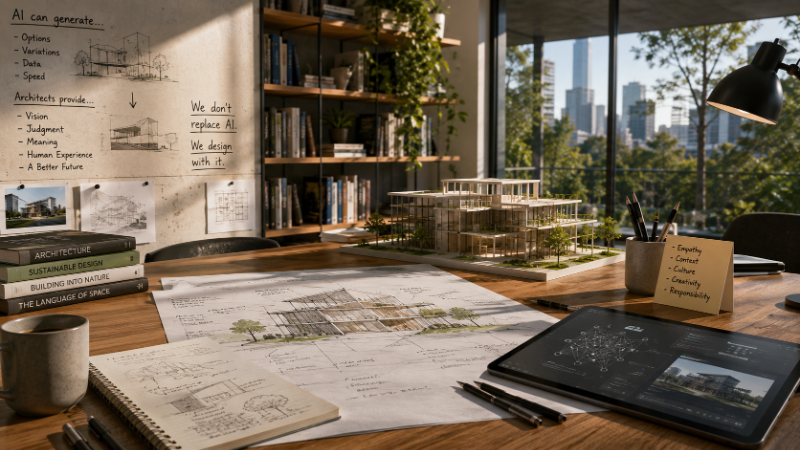
The gap between these two lists reveals why architects remain essential. Architecture is fundamentally about people—their needs, aspirations, and the societies they inhabit. AI is a tool; architects are the professionals who wield it with purpose.

Build cost · Bengaluru, May 2026
The Evolution of the Architect's Role
Rather than replacing architects, AI is fundamentally changing what architects do. The profession is shifting from production-focused work toward strategy, creativity, and human-centered problem-solving.
From Drafting to Strategy
Historically, architects spent significant time on technical drawings—a task increasingly automated by AI and CAD software. This shift frees architects to focus on higher-value work: understanding client needs, envisioning spatial solutions, and orchestrating complex projects. /blog/ai-in-architecture-threat-or-opportunity
In India's booming construction sector, where projects range from affordable housing in Bangalore to commercial complexes in Mumbai, architects who embrace this shift are becoming invaluable strategic partners rather than mere service providers.
From Isolated Design to Integrated Collaboration
AI tools enable architects to work more collaboratively with engineers, contractors, and stakeholders in real-time. Platforms that integrate AI-powered design, structural analysis, and cost estimation mean architects can make informed decisions faster and communicate more effectively with all parties involved.
This is particularly relevant in India, where construction projects often involve coordinating across multiple disciplines, regulatory bodies, and stakeholder groups. Architects who master these collaborative tools become the connective tissue holding projects together.
Frequently asked
From Assumption-Based Design to Data-Driven Decisions
AI doesn't replace intuition; it complements it. Architects can now validate their design decisions with data—understanding how a building will perform thermally, structurally, and functionally before construction begins./blog/smarter-project-execution-with-ai-tools-that-help-architects-and-designers-work-efficiently
For instance, an architect designing a residential complex in Delhi can use AI tools to optimize natural ventilation, predict energy costs in INR, and ensure the design complies with local building bylaws—all before presenting to clients.
Why Human Judgment Remains Irreplaceable
Context and Culture
Architecture exists within cultural contexts. A shopping mall in Kolkata requires different spatial logic than one in Gurgaon. A temple renovation in Varanasi demands sensitivity to centuries of tradition. An office building in Bangalore must reflect India's tech culture while accommodating local climate and lifestyle.
AI can analyze patterns in successful designs, but it cannot truly understand the cultural nuances that make a space resonate with its community. This requires human experience, empathy, and cultural awareness—qualities that define great architects.
Ethical and Social Responsibility
Architecture shapes how people live, work, and interact. Decisions about public space, accessibility, sustainability, and social equity are fundamentally ethical questions that demand human judgment.
Consider affordable housing in Indian cities. While AI can optimize cost-per-unit and structural efficiency, only architects can ensure that affordable housing maintains dignity, provides adequate light and ventilation, and creates communities rather than mere shelters. These decisions cannot be delegated to algorithms.
Adaptability and Unexpected Problems
Real-world projects are messy. Site conditions change, budgets shift, regulations evolve, and stakeholder priorities emerge unexpectedly. Architects must navigate these complexities with creativity and pragmatism—skills that AI, with its rule-based logic, cannot replicate.
An architect in Mumbai might discover unexpected soil conditions during excavation, requiring redesign. Or a client in Hyderabad might request mid-project changes that affect structural systems. Human architects solve these problems through experience, judgment, and creative problem-solving.
AI as an Architect's Superpower
The architects thriving in today's landscape aren't those resisting AI—they're those leveraging it to amplify their capabilities and impact.
Accelerated Design Exploration
Generative design tools allow architects to explore hundreds of design options in the time it once took to develop one. An architect designing a commercial office in Bangalore can generate 500 floor plan variations, each optimized for different criteria—natural light, circulation efficiency, cost—then select the most promising direction for refinement.
This accelerates the creative process and helps architects discover solutions they might not have imagined manually.
Predictive Performance Analysis
AI-powered simulation tools predict how buildings will perform before they're built. Energy modeling, daylight analysis, thermal comfort simulation—all can be run instantly, allowing architects to make design decisions based on performance data rather than assumptions.
For a residential project in Chennai, an architect can test how different window sizes, orientations, and materials affect cooling loads and estimate annual energy costs in rupees. This data-driven approach improves outcomes and demonstrates value to clients.
Enhanced Visualization and Communication
AI tools generate photorealistic renderings, immersive virtual reality experiences, and even animated walkthroughs from simple sketches. This transforms how architects communicate with clients, contractors, and the public.
Instead of asking a client in Delhi to imagine a space from 2D drawings, architects can now show them a fully rendered, interactive 3D experience. This clarity reduces misunderstandings and improves project outcomes.
Compliance and Risk Management
AI can automatically check designs against building codes, zoning regulations, and safety standards. In India, where navigating local building bylaws—which vary significantly between cities—is a major challenge, AI tools that flag compliance issues early save time and prevent costly redesigns.
The Skills Architects Need Today
As AI reshapes the profession, certain skills become increasingly valuable:
Technical Literacy
Architects must understand AI tools—not to become data scientists, but to use these tools effectively. This means learning how generative design works, understanding AI limitations, and knowing when to trust or question algorithmic outputs.
Strategic Thinking
With routine tasks automated, architects who excel at strategy—understanding client objectives, market trends, and long-term value creation—become indispensable. These are skills that require experience and judgment.
Communication and Storytelling
As technical work becomes automated, the ability to communicate vision, inspire stakeholders, and build consensus becomes more valuable. Architects must articulate not just what they're designing, but why—and what it means for the people who will use the spaces.
Interdisciplinary Collaboration
Modern projects require architects to work seamlessly with engineers, sustainability consultants, contractors, and community representatives. Architects who facilitate collaboration and integrate diverse perspectives create better outcomes.
Opportunities for Architects in India's Growing Market
India's construction sector is booming, with opportunities expanding across residential, commercial, infrastructure, and renovation segments. This growth creates unprecedented demand for skilled architects—especially those who've embraced technology.
Affordable Housing and Urban Development
Government initiatives like PM Awas Yojana are driving massive affordable housing projects across India. Architects who combine cost optimization (where AI excels) with human-centered design create housing that's both economically viable and dignified.
Sustainable Design
As India prioritizes sustainability, architects who leverage AI for energy optimization and environmental analysis become essential partners in creating green buildings. The Indian Green Building Council and similar organizations are driving demand for architects with these capabilities.
Smart Cities and Infrastructure
Smart city projects across India—from Pune to Jaipur—require architects who can integrate technology, urban planning, and community needs. These complex projects demand the strategic thinking and collaborative skills that define modern architects.
Finding the Right Architect for Your Project
If you're planning a construction or renovation project in India, look for architects who demonstrate:
Experience with projects similar to yours in your region
Proficiency with modern design and visualization tools
Understanding of local regulations and building bylaws
Commitment to sustainable and cost-effective design
Strong communication and collaboration skills
Portfolio demonstrating both technical excellence and creative vision
Platforms like AECORD make it easier to find qualified architects across India. AECORD's network includes architects experienced in everything from residential projects in tier-2 cities to complex commercial developments in major metros. When searching for an architect, look for those with proven track records and client testimonials.
The Future: Architects and AI in Partnership
The future of architecture isn't AI replacing architects—it's architects and AI working in partnership, each amplifying the other's strengths.
AI will handle increasingly complex optimization, analysis, and visualisation tasks. Architects will focus on strategy, creativity, ethics, and human-centred design. The combination will produce better buildings, faster timelines, and greater value for clients.
In India's rapidly evolving construction landscape, this partnership is already emerging. Forward-thinking architects are using AI to deliver projects faster, more sustainably, and more cost-effectively. They're becoming strategic advisors, not just service providers.
For clients, contractors, and developers, this evolution is good news. It means better access to architectural expertise, faster project delivery, and buildings that perform better and cost less to operate.
Conclusion: Architects Are More Valuable Than Ever
AI won't replace architects—it will make great architects more valuable. The profession is evolving from production-focused work toward strategy, creativity, and human-centred problem-solving. These are distinctly human capabilities that will only grow in importance as technology advances.
For architects willing to embrace AI, the opportunity is enormous. For clients seeking architectural services, the key is finding architects who've mastered this new landscape—who use technology as a tool to amplify their expertise, not as a substitute for it.
Whether you're planning a residential project in Pune, a commercial development in Bangalore, or a renovation in Mumbai, the right architect will combine technical expertise, creative vision, and strategic thinking to deliver results that matter. Explore AECORD to connect with architects who are leading this transformation, bringing both innovation and human insight to your project.
The age of AI hasn't diminished the importance of architects. It's elevated it, creating unprecedented opportunities for those ready to lead the profession into the future.
Frequently Asked Questions
Will AI replace architects?
No, AI is not replacing architects but transforming their role. While AI excels at processing data and optimizing designs, it cannot understand cultural context, make ethical decisions, or create designs that inspire—tasks that remain fundamentally human and essential to great architecture.
What can AI do in architecture?
AI can analyze thousands of design iterations quickly, optimize structural efficiency, generate realistic visualizations, identify code compliance issues, and predict energy performance. However, these are tools that architects use to enhance their work, not replace their expertise.
How is the architect's role changing with AI?
Architects are shifting from production-focused work like technical drafting toward higher-value activities including strategy, creativity, and human-centered problem-solving. This evolution makes architects more valuable as strategic partners rather than service providers.
What skills do architects need in the age of AI?
Modern architects need to master collaborative AI tools, make data-driven design decisions, understand client and community needs deeply, and focus on strategic problem-solving. These skills complement AI capabilities and make architects indispensable in integrated project teams.
Why do architects still matter if AI can generate designs?
Architecture is fundamentally about people—their needs, aspirations, and societies. While AI can generate design options, only architects can understand cultural context, negotiate stakeholder interests, and create designs that inspire and endure across generations.