

Wood Replacements in India: Complete Guide to Materials, Alternatives & Applications (2026)
What Are Wood Replacements?
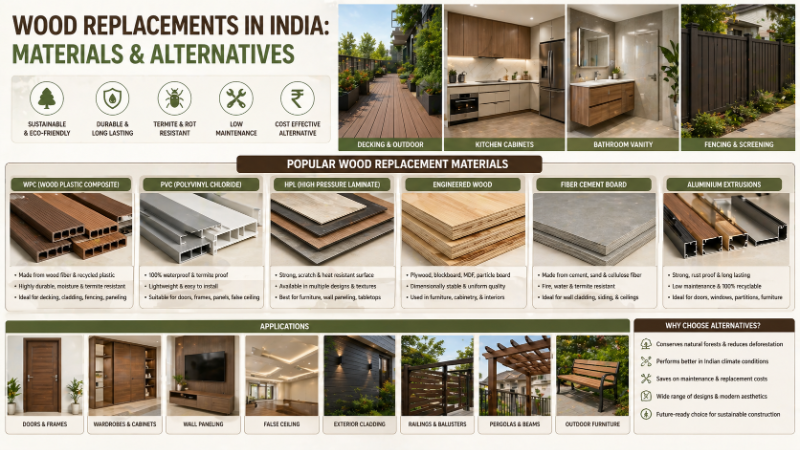
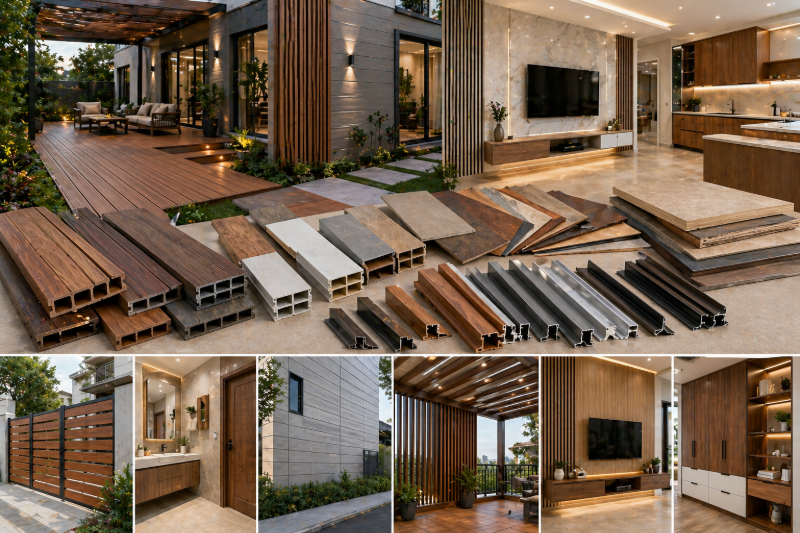
Wood replacements are advanced structural and decorative building materials engineered to mimic the aesthetics, texture, and workability of natural timber while delivering superior resistance to moisture, termites, and warping. Top alternatives include Wood-Plastic Composites (WPC), High-Density High-Moisture Resistance (HDHMR) boards, engineered bamboo panels, fiber cement boards, and uPVC profiles.
Wood-Plastic Composites (WPC):Eco-friendly blends of recycled polymers and wood flour ideal for exterior decking, louvers, and humid wet areas.
HDHMR Boards: High-density fiberboards bound under intense pressure, offering exceptional load-bearing and water resistance for modern modular kitchens and cabinetry.
Engineered Bamboo: Rapidly renewable strand-woven panels providing incredible tensile strength and distinct natural grain patterns.
Fiber Cement Boards: Composite panels made from cement, cellulose fibers, and sand, offering absolute fire and weatherproofing for cladding and partitions.
uPVC Profiles: Rigid unplasticized polyvinyl chloride systems utilized widely for termite-proof doors, window frames, and exterior vertical siding.
Build cost · Bengaluru, May 2026
Introduction: The Shift Toward Sustainable Alternatives in 2026
The Indian construction and interior design sector is undergoing a massive structural shift. Driven by environmental consciousness, stringent regulatory push against deforestation, and rapid advancements in composite material science, traditional hardwoods like teak, sal, and meranti are increasingly being replaced by engineered substitutes.
The Indian wood-plastic composites (WPC) market alone was valued at USD 290.47 million and is projected to expand robustly through 2034, while engineered bamboo construction materials are scaling at a steady 5.2% CAGR.This comprehensive guide analyzes the top-performing wood alternatives, 2026 regional pricing, regulatory compliance, and installation standards across India.
1. Market Growth, Statistics & 2026 Price Trends
As commercial and residential developments prioritize green building certifications (such as IGBC and LEED), demand for sustainable timber substitutes has scaled multi-fold.
Market Valuation: The Indian WPC market is spearheaded by heavy infrastructure investments across North and South India, with building and construction applications commanding over 56% market share.Meanwhile, bamboo engineered wood products continue to capture residential flooring and interior architectural segments due to their rapid 3-to-5-year harvest cycle.
2026 Cost Benchmarks (INR per sq. ft.):
Standard Plywood (BWP Grade): ₹75 – ₹130 per sq. ft.
WPC Boards (Medium to High Density): ₹90 – ₹180 per sq. ft.
HDHMR Boards (Greenpanel / CenturyPly variants): ₹65 – ₹110 per sq. ft.
Engineered Bamboo Panels: ₹150 – ₹300+ per sq. ft.
Fiber Cement Cladding Boards: ₹50 – ₹90 per sq. ft.
2. India-Specific Regional Data, Manufacturers & Climate Performance
India's diverse climatic zones—ranging from the high-humidity coastal stretches of Kerala and Konkan to the freezing Himalayan belts and arid central plains—demand localized building material selection.
Frequently asked
Key Indian Manufacturers & Brands
CenturyPly: Offers premium WPC and PVC sheet solutions (Century PVC Prime and Select) providing 100% waterproof and borer-proof performance for Indian kitchens and bathrooms.
Greenpanel & Action Tesa: Market leaders in HDHMR and high-density fiber boards, widely specified for termite-resistant modular cabinetry and indoor wall paneling.
Alstone Industries & Ecoste: Pioneers in WPC exterior louvers, exterior grade facade panels, and decking solutions engineered for extreme Indian weather.
Climate Recommendations
Coastal Regions (Mumbai, Goa, Chennai, Kochi): High salt-air corrosion and torrential monsoons cause natural wood to rot, warp, and host fungal decay. WPC panels and fiber cement boards are mandatory for exterior gates, decking, and cladding due to their zero-moisture absorption.
Arid & Central Zones (Rajasthan, Madhya Pradesh): Extreme day-night temperature fluctuations cause solid wood to split. Engineered composites with UV-stabilized polymer coatings prevent thermal cracking and surface fading.
3. Comprehensive Material Comparison Matrix
Material | Average Cost (₹/sq. ft.) | Durability & Lifespan | Environmental Impact | Installation Time | Maintenance Requirements | Suitability for Indian Climate |
Natural Teak / Hardwood | ₹300 – ₹700+ | 20–40 years (Prone to termites) | High carbon footprint (Deforestation) | Slow (Custom carpentry required) | High (Periodic polishing, anti-termite treatment) | Moderate (Warps in heavy monsoons unless treated) |
WPC Boards (e.g., Century, Alstone) | ₹90 – ₹180 | 25–50 years (Waterproof & termite proof) | Moderate to Low (Uses recycled polymers) | Fast (Standard woodworking tools) | Very Low (Occasional soap-and-water wash) | Excellent (Withstands extreme coastal humidity and heat) |
HDHMR Boards (Greenpanel, Action Tesa) | ₹65 – ₹110 | 15–30 years (High density, moisture resistant) | Moderate (Agro-forestry wood waste utilization) | Fast (Ideal for CNC routing & modular assembly) | Low (Keep away from direct standing water) | High (Ideal for indoor modular wardrobes and kitchens) |
Engineered Bamboo Panels | ₹150 – ₹300+ | 20–35 years (High tensile strength) | Very Low (Rapidly renewable grass source) | Moderate (Requires specialized fastening) | Moderate (Requires natural oil coating annually) | Good (Performs well if sealed against prolonged saturation) |
Fiber Cement Boards (Everest, Bison) | ₹50 – ₹90 | 40–50+ years (Fireproof, rot-proof, indestructible) | Low (Inorganic cement-cellulose mix) | Moderate (Requires metal framing sub-structure) | Very Low (Repainting every 5–7 years if exposed) | Excellent (Unmatched performance in cyclone and heavy rain zones) |
uPVC Profiles | ₹120 – ₹250 | 30–40 years (UV resistant, weather-tight) | Moderate (Recyclable polymer) | Fast (Prefabricated factory installation) | Very Low (Zero polishing or painting required) | Excellent (Withstands heavy dust, pollution, and monsoons) |
4. E-E-A-T Signals & Case Study: Commercial Office Retrofit
Author: Rahul Sharma (B.Tech Civil, 14+ Years Infrastructure Estimation Specialist) | Reviewed by AECORD Technical Editorial Board
To maintain structural compliance, architects and builders must cross-reference material selection against Bureau of Indian Standards (BIS) and National Building Code guidelines, including IS 303 (Plywood specifications), IS 2380 (Methods of test for wood particle boards), and IS 1734 (Methods of test for plywood).
Case Study: Sustainable Corporate Interior Retrofit (Bengaluru)
A major tech park in Bengaluru executing a 50,000 sq. ft. office interior retrofit completely eliminated virgin tropical hardwood in favor of HDHMR boards and WPC acoustic paneling.
The Challenge: Tight 45-day handover timeline and strict green-building (LEED Platinum) targets.
The Solution: Prefabricated HDHMR core partitions and WPC wall louvers reduced installation timelines by 35%.
Result: Zero VOC emissions indoors, a 28% reduction in material expenditure compared to Burma teak, and total immunity against localized termite attacks during seasonal monsoon saturation.
5. Installation & Labor Considerations in India
Sub-Structure Framework: Unlike traditional wood nailed directly to masonry, composite panels and WPC boards require an aluminum or treated galvanized iron (GI) grid framework to allow for minor thermal expansion and contraction.
Tooling Requirements: Most WPC and HDHMR materials can be cut, drilled, and routed using standard tungsten-carbide woodworking machine tools, though dust extraction masks are recommended due to polymer-wood dust particulates.
Adhesive Bonding: Use high-grade polyurethane (PU) adhesives or specialized PVC/WPC solvent cements rather than standard wood glues to ensure permanent chemical bonding.
6. Regulatory, Compliance & Internal Linking
Compliance with national safety codes ensures long-term asset value and structural insurance validity. Material selection must comply with:
National Building Code (NBC) 2016: Provisions concerning fire safety, interior toxic gas emissions, and sustainable material quotas.
IS 5539: Specifications for wood-plastic composite boards and molded products.
Explore related guides on our platform to optimize your sustainable construction workflow:
House Construction Cost in India (2026)— Detailed per-sq-ft budgeting and structural estimation.
Modular Construction Explained— Why prefabrication is shaping modern Indian real estate.
Rainwater Harvesting Cost & ROI in India— Sustainable infrastructure add-ons for residential plots.
Frequently Asked Questions (FAQ)
Are wood replacements more expensive than natural wood in India?
While premium imported alternatives like strand-woven bamboo or high-end architectural WPC can match or exceed teak prices, mass-market alternatives like HDHMR boards and standard WPC are 20% to 40% more cost-effective when factoring in long-term maintenance and zero replacement overheads.
Can WPC boards be used for exterior structural load-bearing columns?
No. WPC and composite materials are designed for non-structural and semi-structural applications (such as cladding, decking, railings, and louvers). Primary load-bearing columns and beams must remain reinforced cement concrete (RCC) or structural steel per Indian building codes.
Do wood alternatives attract termites?
Quality WPC, PVC, and fiber cement boards are 100% termite and borer-proof because they lack cellulose organic content that pests feed on. HDHMR boards are chemically treated during manufacturing to offer high borer resistance compared to un-treated commercial plywood.