

How to Estimate Plumbing Materials for Your House in India
Planning a construction or renovation project in India requires careful estimation of materials, and plumbing is one of the most critical aspects. Whether you're building a new home in Mumbai, Bangalore, Delhi, or any other Indian city, accurate plumbing material estimation can save you significant time and money. This comprehensive guide will walk you through the process of calculating plumbing materials needed for a residential house in India.
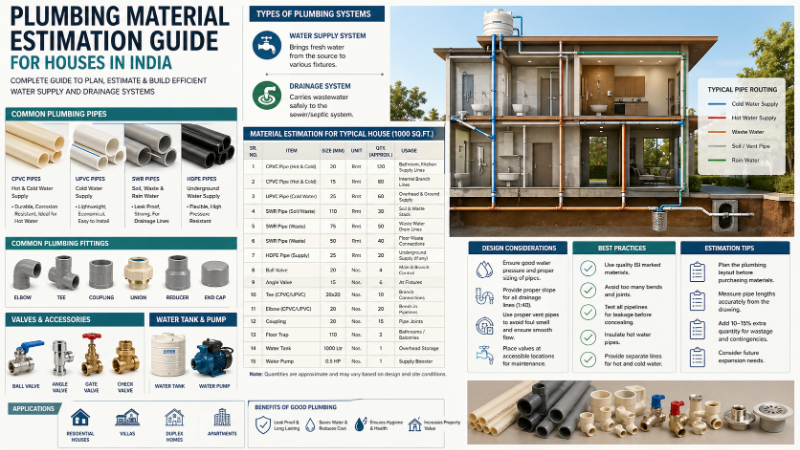
Build cost · Bengaluru, May 2026
Understanding the Importance of Accurate Plumbing Estimation
Plumbing is the backbone of any modern household. Underestimating materials can lead to project delays and unexpected costs, while overestimating wastes money and creates storage issues. In India, where construction costs vary significantly by region and material quality, precise estimation becomes even more critical. For instance, plumbing costs in Bangalore may differ substantially from those in smaller cities like Jaipur or Lucknow.
Before diving into calculations, it's essential to understand that plumbing material estimation depends on several factors: the size of your house, the number of bathrooms and kitchens, water pressure requirements, local building codes, and your chosen quality standards. Many homeowners find it helpful to consult with professionals available on platforms like AECORD, India's leading B2B2C marketplace for AECO professionals, who can provide expert guidance tailored to your specific project.
Key Steps to Estimate Plumbing Materials
Step 1: Gather Essential Project Information
Start by collecting detailed information about your property:
Total built-up area: Measured in square feet or square meters
Number of floors: Affects pipe routing and material requirements
Number of bathrooms: Each requires fixtures and supply lines
Number of kitchens: Including wet kitchens and pantries
Water source: Municipal supply, borewell, or both
Drainage system: Municipal sewerage or septic tank
Local building codes: Different states in India have varying standards
For example, a typical 2-bedroom, 2-bathroom apartment in Delhi might have approximately 1,000-1,200 square feet of built-up area, while a similar property in Bangalore could vary based on local construction standards.
Frequently asked
Step 2: Calculate Water Supply Pipe Requirements
Water supply pipes form the foundation of your plumbing system. To estimate these accurately:
Determine the main water line diameter: For residential properties in India, the main water line typically ranges from 20mm to 25mm (¾ inch to 1 inch) diameter. The choice depends on water pressure available from your municipal supply or borewell.
Calculate branch pipe lengths: Measure the distance from your main water meter (usually at the entry point) to each fixture. Branch pipes typically use 15mm (½ inch) or 20mm (¾ inch) diameter pipes. For a 1,500 square foot house with water entry on one side, you might need approximately:
Main line to tank/distribution point: 20-30 meters of 20mm pipe
Distribution to bathrooms: 40-60 meters of 15mm pipe
Kitchen supply: 15-20 meters of 15mm pipe
Outdoor/garden taps: 10-15 meters of 15mm pipe
In Indian rupees, PVC pipes cost approximately ₹80-150 per meter for 15mm diameter and ₹120-200 per meter for 20mm diameter, depending on quality and local market rates. Copper pipes, though more durable, cost ₹400-600 per meter and are often reserved for visible areas or premium installations.
Step 3: Estimate Plumbing Fixtures
Plumbing fixtures include all the visible components where water is used. A standard estimation for a typical Indian residential house:
Bathrooms (assuming 2 bathrooms):
Wash basins: 2 units @ ₹3,000-8,000 each
WC pans (Indian/Western): 2 units @ ₹4,000-15,000 each
Shower heads: 2 units @ ₹800-3,000 each
Taps/faucets: 4-6 units @ ₹1,500-5,000 each
Towel rods, soap dispensers, mirrors: ₹5,000-10,000 combined
Kitchen:
Kitchen sink (single or double): 1 unit @ ₹5,000-12,000
Kitchen taps/faucets: 1-2 units @ ₹2,000-6,000 each
Water filter tap: 1 unit @ ₹1,500-4,000
Outdoor fixtures:
Garden taps: 2-3 units @ ₹800-2,000 each
Washing machine tap: 1 unit @ ₹500-1,500
When sourcing these materials, platforms like AECORD can connect you with reliable suppliers and contractors who offer competitive pricing across Indian cities.
Step 4: Calculate Drainage Pipe Requirements
Drainage systems are equally important as water supply. These pipes carry wastewater away from your home.
Main drainage line: Typically 100mm (4 inches) diameter PVC pipes. For a standard house, you'll need approximately 15-25 meters of main drainage pipe from the house to the municipal sewer or septic tank. Cost: ₹200-350 per meter.
Branch drainage pipes: These are 50mm (2 inches) diameter pipes connecting individual fixtures to the main line. Estimate:
From bathrooms: 20-30 meters of 50mm pipe
From kitchen: 10-15 meters of 50mm pipe
From other sources: 5-10 meters of 50mm pipe
PVC drainage pipes cost approximately ₹150-250 per meter for 50mm and ₹200-350 per meter for 100mm diameter.
Fittings and accessories: You'll need various T-junctions, bends, traps, and connectors. Budget approximately ₹8,000-15,000 for a standard 2-bathroom house.
Step 5: Account for Water Storage and Pumping
Most Indian homes require water storage tanks due to intermittent municipal supply. This significantly impacts your material estimation:
Overhead tank: For a 2-3 bedroom house, typically 500-1,000 liters capacity. Cost: ₹8,000-20,000 depending on material (plastic, concrete, or steel).
Underground sump: Usually 1,500-2,500 liters for water harvesting and backup supply. Cost: ₹15,000-35,000.
Water pump: A 0.5-1 HP pump for typical residential use costs ₹6,000-15,000. You'll also need:
Pump suction and delivery pipes: ₹3,000-8,000
Pressure gauge and relief valve: ₹2,000-5,000
Check valves and foot valves: ₹1,500-4,000
Electrical connections and wiring: ₹3,000-8,000
Step 6: Include Sanitary Fittings and Accessories
Beyond major pipes and fixtures, numerous smaller items are essential:
Valves: Gate valves, ball valves, stop valves (₹300-2,000 each)
Bends and elbows: 45-degree and 90-degree bends in various sizes (₹50-500 each)
Couplings and unions: For pipe connections (₹50-300 each)
Reducers: To connect pipes of different diameters (₹100-400 each)
End caps and plugs: To seal pipe ends (₹50-200 each)
PTFE tape: For sealing threaded connections, approximately ₹50-150 per roll
Plumbing cement and adhesive: For PVC pipe joints, ₹200-400 per bottle
Inspection chambers: For access to drainage lines, ₹2,000-5,000 each
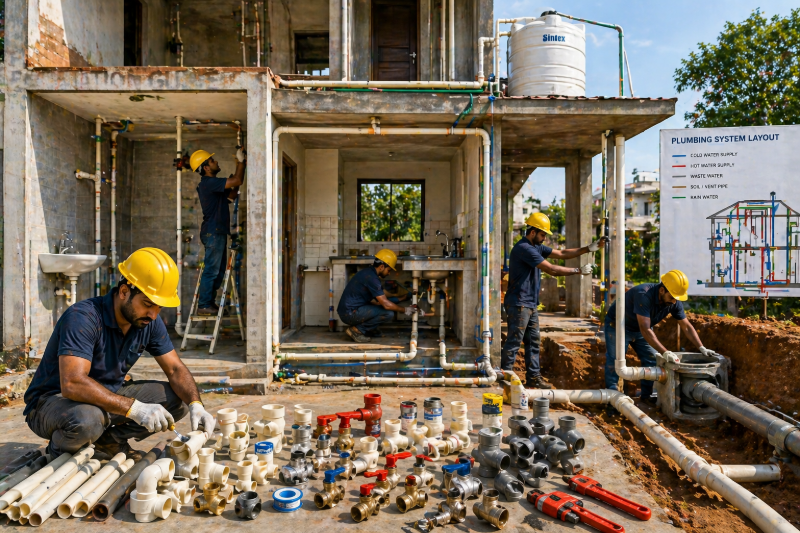
Creating Your Plumbing Material Estimate
Sample Estimate for a Typical 2-Bedroom House in India
Let's create a realistic estimate for a 1,200 square foot, 2-bedroom, 2-bathroom house in a major Indian city:
Water Supply System:
PVC pipes (15mm & 20mm): ₹12,000-18,000
Fittings and accessories: ₹5,000-8,000
Fixtures (taps, showerheads): ₹15,000-25,000
Drainage System:
PVC drainage pipes (50mm & 100mm): ₹8,000-12,000
Fittings and traps: ₹8,000-12,000
Water Storage:
Overhead tank: ₹12,000-18,000
Underground sump: ₹20,000-30,000
Water pump and accessories: ₹15,000-25,000
Sanitary fixtures:
WC pans: ₹8,000-20,000
Wash basins: ₹6,000-12,000
Other bathroom fittings: ₹8,000-15,000
Miscellaneous:
Valves, connectors, cement, tape: ₹8,000-12,000
Contingency (10%): ₹12,000-18,000
Total Estimated Cost: ₹1,35,000 - ₹2,25,000
This estimate can vary significantly based on your location within India. Plumbing material costs in metropolitan areas like Mumbai, Delhi, and Bangalore tend to be 10-20% higher than in tier-2 cities like Pune or Ahmedabad.
Regional Variations in Indian Plumbing Materials
When estimating plumbing materials, consider regional differences:
Metropolitan areas (Delhi, Mumbai, Bangalore): Higher costs for materials and labor, but better availability of premium brands. Expect to budget 15-20% more than national averages.
Tier-2 cities (Pune, Hyderabad, Jaipur): Moderate costs with good availability of standard materials. Most estimates align with our sample calculation.
Tier-3 and smaller cities: Lower material costs but potentially limited availability of premium options. You might save 10-15% on materials but could face longer delivery times.
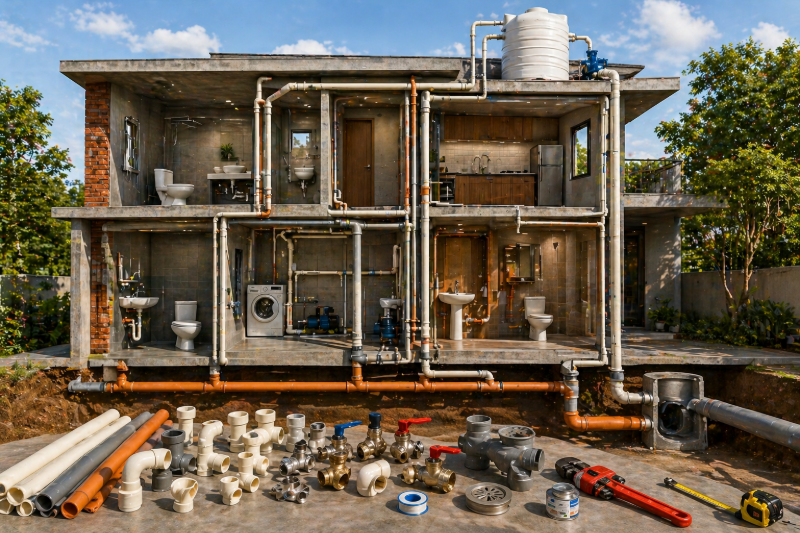
Tips for Accurate Estimation
Conduct a Site Survey
Before finalizing your estimate, physically measure all distances where pipes will run. Account for:
Vertical distances between floors
Horizontal distances from water source to fixtures
Obstacles like structural elements that pipes must navigate around
Accessibility for future maintenance
Consult Local Building Codes
Each state in India has specific plumbing standards. For example, Maharashtra, Karnataka, and Delhi have distinct regulations regarding pipe sizes, material specifications, and safety requirements. Verify these before finalizing your material list.
Plan for Future Expansion
If you anticipate adding bathrooms or extending your house later, consider installing larger diameter main supply and drainage lines now. The incremental cost is minimal compared to retrofitting later.
Choose Quality Wisely
While budget-friendly options exist, investing in quality plumbing materials pays dividends:
ISI-certified pipes: Ensure durability and compliance with Indian standards
Reputable brands: Better warranty and after-sales support
Corrosion-resistant materials: Essential in areas with hard water or coastal regions
Get Multiple Quotations
Contact multiple suppliers and contractors to compare prices. Platforms like AECORD make it easy to connect with verified professionals across India who can provide detailed quotations based on your specific requirements.
Common Mistakes to Avoid
Underestimating pipe length: Always add 10-15% extra for bends, connections, and unforeseen routing challenges
Ignoring water pressure requirements: Insufficient pressure necessitates larger diameter pipes or additional pumping
Neglecting drainage slope: Improper slopes require additional fittings and can increase material costs
Forgetting about isolation valves: These are essential for maintenance but often overlooked in estimates
Not accounting for local water quality: Hard water areas may require additional filtration equipment
Working with Professionals
While DIY estimation is possible, collaborating with experienced plumbing professionals ensures accuracy and compliance with local standards. They can identify potential issues early and suggest cost-effective solutions. Many contractors available through AECORD offer free consultations and detailed material estimates, helping you make informed decisions for your plumbing project.
Professional estimators consider factors that homeowners often miss, such as:
Future maintenance accessibility
Earthquake and seismic considerations (relevant in states like Gujarat and Himachal Pradesh)
Thermal expansion in hot climates
Integration with other building systems
Conclusion
Estimating plumbing materials for your house in India requires careful planning, accurate measurements, and understanding of local conditions. By following this comprehensive guide, you can create a detailed material list that helps you budget effectively and avoid costly delays. Remember that prices vary by location, material quality, and market conditions, so always get current quotations from local suppliers.
Whether you're building a new home in Chennai, renovating a property in Kolkata, or expanding your house in Ahmedabad, accurate plumbing estimation is crucial for project success. Don't hesitate to seek professional guidance—the investment in expert advice often pays for itself through better material selection and efficient project execution.
Ready to find experienced plumbing professionals and suppliers for your project? Visit AECORD today to connect with verified AECO professionals across India who can help you estimate materials, source quality products, and execute your plumbing project flawlessly.
Frequently Asked Questions
What factors affect plumbing material estimation for houses in India?
Plumbing material estimation depends on several key factors: the size of your house, number of bathrooms and kitchens, water pressure requirements, local building codes, and your chosen quality standards. Regional variations in construction costs across Indian cities like Mumbai, Bangalore, and Delhi also significantly impact material requirements and pricing.
What diameter pipes are typically used for residential plumbing in India?
For residential properties in India, main water lines typically range from 20mm to 25mm (¾ inch to 1 inch) diameter, while branch pipes usually use 15mm (½ inch) or 20mm (¾ inch) diameter pipes. The choice depends on water pressure available from your municipal supply or borewell.
How much water supply pipe do I need for a typical Indian house?
For a 1,500 square foot house, you typically need approximately 20-30 meters of 20mm pipe for the main line, 40-60 meters of 15mm pipe for bathroom distribution, 15-20 meters for kitchen supply, and 10-15 meters for outdoor taps. Exact requirements vary based on your property layout and fixture locations.
What is the cost of PVC and copper pipes in India?
PVC pipes in India cost approximately ₹80-150 per meter for 15mm diameter and ₹120-200 per meter for 20mm diameter, depending on quality and local market rates. Copper pipes are more durable but significantly more expensive at ₹400-600 per meter and are typically used for visible areas or premium installations.
Should I consult a professional for plumbing material estimation in India?
Yes, consulting with AECO professionals through platforms like AECORD, India's leading B2B2C marketplace, is highly recommended as they can provide expert guidance tailored to your specific project, local building codes, and regional variations in construction standards and costs.