

Hempcrete is emerging as a sustainable alternative in India’s construction industry. Made from hemp fibers, lime, and water, it offers low carbon emissions, thermal insulation, breathability, and reduced environmental impact compared to conventional concrete.
As India’s construction sector contributes heavily to carbon emissions through extensive cement use, hempcrete presents a promising eco-friendly solution for architects, engineers, and developers seeking greener building practices without compromising performance. Its growing adoption reflects the industry’s shift toward climate-responsive and sustainable construction materials. Hempcrete Projects and Case Studies in India

Several pioneering projects across India demonstrate hempcrete's viability:
Bangalore Eco-Residences: A residential complex in Bangalore incorporated hempcrete walls in 15 bungalows, reducing cooling costs by 35% compared to conventional construction. The project demonstrated hempcrete's effectiveness in India's warm climate.
Delhi Heritage Restoration: A heritage building restoration project in Delhi used hempcrete for infill walls, successfully preserving the building's aesthetic while improving thermal performance and breathability.
Agricultural Storage Facilities in Punjab: Hempcrete has been used to construct grain storage facilities in Punjab, combining sustainability with functional agricultural architecture.
These projects, while limited in number, provide valuable data supporting hempcrete's adoption across India.
Understanding Hempcrete: Composition and Properties
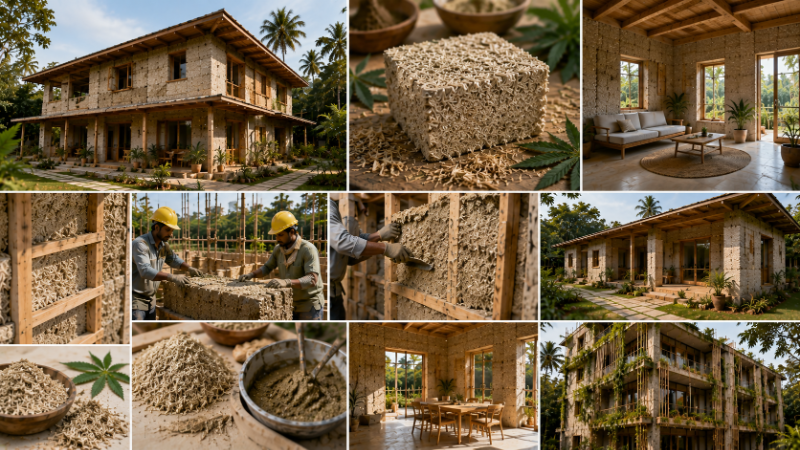
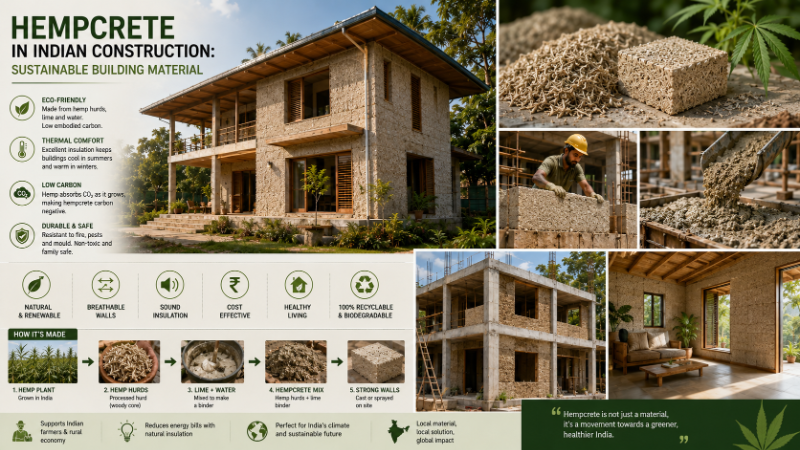
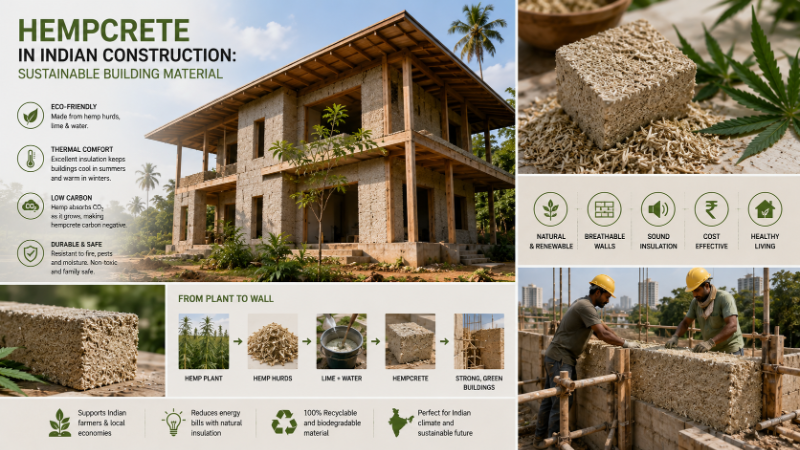
Hempcrete is a lightweight, breathable composite material created by mixing hemp plant fibers (hurd) with lime binder and water. The hemp component comprises approximately 85-90% of the material by volume, while lime and other binders make up the remaining portion. This unique composition creates a material that is fundamentally different from traditional concrete.
The key properties of hempcrete include:
Low Density: Hempcrete weighs only 300-600 kg/m³, compared to conventional concrete at 2,400 kg/m³, making it significantly lighter and easier to handle on construction sites.
Thermal Insulation: With thermal conductivity values between 0.06-0.12 W/mK, hempcrete provides excellent insulation properties, reducing heating and cooling requirements in buildings.
Breathability: Unlike synthetic insulators, hempcrete allows moisture vapor to pass through, regulating indoor humidity naturally and preventing moisture accumulation.
Carbon Sequestration: Hemp plants absorb CO2 during growth, and this carbon remains locked in the material throughout its lifespan, making hempcrete carbon-negative in many cases.
Fire Resistance: The lime binder provides inherent fire resistance, with hempcrete achieving good fire performance ratings.
Acoustic Properties: The porous structure of hempcrete provides excellent sound absorption, beneficial for residential and commercial spaces.
Build cost · Bengaluru, May 2026
Hempcrete Applications in Indian Construction
Residential Construction
In India's booming residential sector, hempcrete is finding applications in both new constructions and retrofitting projects. The material is particularly suitable for:
Wall Construction: Hempcrete can be used for non-load-bearing infill walls in timber or steel-framed structures, significantly reducing the overall weight of buildings.
Thermal Insulation: In cities like Bangalore, Pune, and Mumbai where air conditioning costs are substantial, hempcrete walls help maintain indoor temperatures, reducing energy consumption by 30-40%.
Heritage Restoration: Hempcrete's breathability makes it ideal for restoring heritage buildings, particularly in cities like Delhi, Jaipur, and Hyderabad, where maintaining the integrity of old structures is crucial.
Commercial and Institutional Buildings
Offices, schools, and hospitals in India are increasingly adopting hempcrete for its sustainability credentials and health benefits. The material's ability to regulate humidity and temperature naturally creates healthier indoor environments, which is particularly valuable in India's hot and humid climate.
Frequently asked
Agricultural and Industrial Structures
Hempcrete is gaining popularity in constructing agricultural storage facilities, warehouses, and industrial buildings across rural India. Its lightweight nature reduces foundation requirements and overall construction costs, making it economically attractive for large-scale applications.
Environmental Benefits of Hempcrete
The environmental advantages of hempcrete are substantial, particularly for India's sustainability goals:
Carbon Footprint Reduction
Producing one cubic meter of hempcrete generates approximately 0.5-1.5 tonnes of CO2 equivalent, compared to 0.4 tonnes for conventional concrete. However, when accounting for carbon sequestration during hemp cultivation, hempcrete becomes carbon-negative. A typical hempcrete wall can sequester 110 kg of CO2 per cubic meter, offsetting its production emissions multiple times over.
Renewable Raw Material
Hemp is a fast-growing crop that can be cultivated in India's diverse climatic zones, from the plains to hilly regions. Unlike cement production, which relies on limestone quarrying and high-temperature kilns, hemp cultivation is relatively benign environmentally. India's agricultural sector could benefit from diversifying into industrial hemp cultivation, creating additional income streams for farmers.
Waste Reduction
Hempcrete production generates minimal waste. The entire hemp plant can be utilized—fibers for hempcrete, seeds for oil and nutrition, and remaining biomass for energy. This circular economy approach aligns with India's vision of sustainable development.
Indoor Environmental Quality
Hempcrete's hygroscopic properties naturally regulate indoor humidity between 40-60%, creating healthier living and working spaces. In India's humid climate, this reduces the need for mechanical dehumidification systems, further lowering energy consumption.
Cost Considerations for Hempcrete in India

Understanding the economic aspects of hempcrete adoption is crucial for Indian builders and developers:
Material Costs
As of 2024, hempcrete costs in India range from ₹4,000-₹7,000 per cubic meter, depending on source, quality, and transportation distance. While this is higher than conventional concrete at ₹3,500-₹4,500 per cubic meter, the additional cost is offset by reduced insulation requirements and lower operational expenses.
Labor and Installation
Hempcrete installation requires skilled labor trained in the material's specific properties. Labor costs in metropolitan areas like Delhi, Mumbai, and Bangalore range from ₹500-₹800 per square meter, with slightly lower rates in tier-2 cities. As hempcrete adoption increases, labor availability and costs are expected to improve.
Long-term Operational Savings
The primary economic advantage of hempcrete emerges over the building's lifetime. Energy savings from superior insulation and thermal mass can reduce cooling costs by 30-40% annually in Indian climates. For a typical residential building in Pune or Hyderabad, this translates to annual savings of ₹15,000-₹30,000 on air conditioning expenses.
Maintenance and Durability
Hempcrete's durability is well-established in European markets where it has been used for over two decades. The material resists cracking better than conventional concrete and requires minimal maintenance. Lime renders on hempcrete surfaces need recoating every 15-20 years, a cost far less than conventional building repairs.
Challenges and Limitations in Indian Context
Regulatory and Standards Issues
India's building codes, particularly the National Building Code (NBC), do not yet have comprehensive standards for hempcrete construction. This creates uncertainty for developers and architects, as hempcrete buildings must often be designed and approved case-by-case, requiring additional engineering and approval time.
Limited Local Supply Chain
Unlike Europe where hempcrete is widely available, India's supply chain is nascent. Hemp cultivation for industrial use remains limited, and hempcrete production facilities are sparse. Most hempcrete used in India is currently imported, increasing costs and reducing accessibility for smaller projects.
Lack of Skilled Workforce
The construction industry in India has limited expertise in hempcrete application. Training programs are minimal, and contractors experienced with hempcrete are concentrated in metropolitan areas. This knowledge gap slows adoption and increases project costs.
Structural Limitations
Hempcrete is not suitable for load-bearing structural elements in multi-story buildings. It must be used as infill material within timber or steel frames. This limits its application in India's booming high-rise residential and commercial sectors, where concrete remains the dominant material.
Moisture Sensitivity During Construction
Hempcrete requires careful moisture management during and after construction. In India's monsoon-prone regions, proper drying and protection protocols are essential. Buildings in areas like Kerala, Goa, and coastal Maharashtra require additional precautions and longer construction schedules.
Future Prospects and Market Growth
Government Initiatives and Support
India's commitment to sustainable construction is evident through initiatives like the Green Building Council of India (GBCI) and various state-level green building policies. As hempcrete aligns with these objectives, government support through incentives, tax benefits, and regulatory clarity is likely to increase.
Domestic Hemp Cultivation
The Ministry of Agriculture is exploring industrial hemp cultivation opportunities across India. Successful cultivation in states like Himachal Pradesh, Uttarakhand, and Madhya Pradesh could establish a local supply chain, significantly reducing hempcrete costs and improving accessibility.
Technological Advancements
Research institutions across India are developing hempcrete formulations optimized for Indian climatic conditions. Innovations in lime binders, hemp processing, and composite design are expected to enhance performance and reduce costs.
Market Potential
With India's construction sector projected to reach $1.4 trillion by 2030, even a 2-3% adoption rate of hempcrete would represent a substantial market opportunity. Early movers and professionals adopting hempcrete now will be well-positioned to capitalize on this growth.
How to Adopt Hempcrete in Your Projects
Finding Qualified Professionals
Engaging architects and engineers experienced with hempcrete is crucial. Platforms like AECORD connect you with specialists who understand hempcrete's properties, applications, and India-specific considerations. You can find professionals in your city who have worked on sustainable building projects and can guide your hempcrete adoption.
Design Considerations
Hempcrete works best in timber or steel-framed structures where it serves as infill material. Designers should plan for hempcrete's lower strength compared to concrete and incorporate appropriate structural systems. The material's thermal and humidity-regulating properties should inform HVAC system design.
Sourcing and Procurement
Identify reliable suppliers and establish long-term relationships to ensure consistent material quality and availability. For projects in regions without local hempcrete producers, plan procurement timelines accordingly, as importing or transporting from distant suppliers can extend project schedules.
Quality Control and Testing
Implement rigorous testing protocols to ensure hempcrete meets design specifications. Density, compressive strength, thermal conductivity, and moisture resistance testing should be conducted on samples from each batch.
Conclusion
Hempcrete represents a significant opportunity for India's construction industry to advance sustainability while maintaining structural performance and occupant comfort. While challenges exist—particularly regarding regulatory frameworks, supply chain development, and workforce training—the material's environmental benefits and long-term cost savings make it increasingly attractive.
As India progresses toward its environmental goals and the construction sector evolves, hempcrete adoption will likely accelerate. Early adopters, particularly in metropolitan areas and for appropriate building types, can demonstrate hempcrete's viability and pave the way for broader market acceptance.
Whether you're an architect designing sustainable residential complexes, an engineer planning agricultural facilities, or a developer committed to green construction, hempcrete merits serious consideration for your next project. AECORD connects you with specialized professionals who understand hempcrete's nuances and can help integrate this innovative material into your designs effectively.
The future of Indian construction increasingly depends on materials that balance performance, cost, and environmental responsibility. Hempcrete, with its unique combination of these qualities, is poised to become a cornerstone of sustainable building in India.
Ready to explore hempcrete for your next project? Visit AECORD today to connect with architects, engineers, and construction specialists experienced in sustainable materials and green building practices across India.
Frequently Asked Questions
What is hempcrete made of and how does it differ from regular concrete?
Hempcrete is a composite material made from hemp plant fibers (85-90% by volume), lime binder, and water. Unlike conventional concrete which weighs 2,400 kg/m³, hempcrete is significantly lighter at only 300-600 kg/m³, making it easier to handle and install on construction sites.
How much can hempcrete reduce cooling costs in Indian buildings?
According to the Bangalore Eco-Residences case study, hempcrete walls reduced cooling costs by 35% compared to conventional construction. Its thermal conductivity of 0.06-0.12 W/mK provides excellent insulation, reducing heating and cooling requirements in buildings.
Is hempcrete environmentally friendly and carbon-negative?
Yes, hempcrete is carbon-negative because hemp plants absorb CO2 during growth, and this carbon remains locked in the material throughout its lifespan. It also has low carbon emissions compared to conventional concrete, making it an eco-friendly alternative for sustainable construction.
Can hempcrete be used for load-bearing walls in construction?
Hempcrete is primarily used for non-load-bearing infill walls rather than structural load-bearing applications. It works well for wall construction, thermal insulation, and retrofitting projects, but requires a structural frame for support.
What are the moisture and acoustic benefits of hempcrete?
Hempcrete is breathable and allows moisture vapor to pass through, naturally regulating indoor humidity and preventing moisture accumulation. Its porous structure also provides excellent sound absorption, making it beneficial for residential and commercial spaces requiring acoustic performance.