

When planning interior design for residential or commercial spaces in India, one of the most important decisions you'll make is choosing the right false ceiling material. Two of the most popular options are gypsum and POP (Plaster of Paris), each with distinct advantages and drawbacks. Understanding the differences between these materials—particularly regarding cost, durability, maintenance, and aesthetic appeal—will help you make an informed decision for your project.
Understanding Gypsum and POP: What's the Difference?
Build cost · Bengaluru, May 2026
What is Gypsum False Ceiling?
Gypsum false ceilings are made from gypsum board (also called drywall or plasterboard), which consists of a gypsum core sandwiched between two layers of paper. This material is manufactured in standardized sheets and has become increasingly popular in India over the past decade. Gypsum boards are typically 9mm to 12.5mm thick and come in various sizes, making them easier to install in modern construction projects.
For more on this, read our detailed guide to 17 Famous Historic Buildings in India.
For deeper context, see AAC Blocks vs Red Bricks: Cost.
The gypsum board is attached to a metal or wooden framework using screws and adhesive, creating a smooth, finished surface that requires minimal additional work. This method is widely used in commercial spaces, offices, and modern residential properties across major Indian cities like Mumbai, Delhi, Bangalore, and Hyderabad.
What is POP False Ceiling?
POP (Plaster of Paris) is a white powder made from gypsum that has been heated and dehydrated. When mixed with water, it forms a paste that can be molded and applied to create decorative ceiling designs. POP false ceilings are constructed by applying this paste over a framework of wooden battens or metal channels, allowing artisans to create intricate patterns, cornices, and decorative elements.
POP has been used in Indian construction for centuries and remains a traditional choice, particularly for residential properties and heritage buildings. It's especially popular in tier-2 and tier-3 cities where skilled craftspeople are readily available.
Cost Comparison: Gypsum vs POP in India
Frequently asked
Gypsum False Ceiling Costs
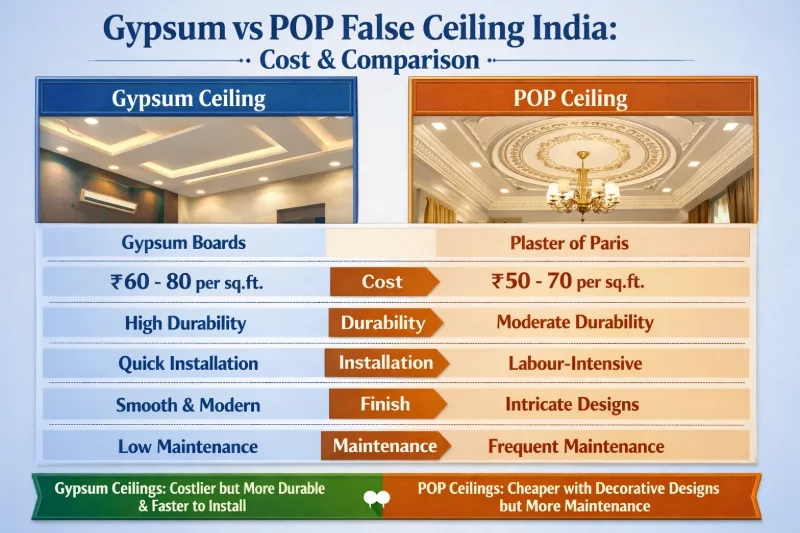
Material Costs: Gypsum board prices in India typically range from ₹250 to ₹450 per square foot, depending on the thickness and brand. Premium imported brands may cost more, while locally manufactured boards are more affordable. For a 1,000 sq ft space, you can expect material costs between ₹2.5 to ₹4.5 lakhs.
Installation Costs: Labor charges for gypsum installation in India range from ₹80 to ₹150 per square foot. This includes the cost of metal frameworks, screws, adhesives, joint compounds, and finishing materials. For the same 1,000 sq ft space, installation could cost ₹0.8 to ₹1.5 lakhs.
Total Cost: The combined cost for a gypsum false ceiling typically ranges from ₹3.3 to ₹6 lakhs for 1,000 sq ft. In metropolitan areas like Mumbai and Delhi, costs tend to be on the higher end, while in cities like Pune or Ahmedabad, they may be more reasonable.
POP False Ceiling Costs
Material Costs: POP powder costs approximately ₹150 to ₹250 per square foot, making it significantly cheaper than gypsum board. For 1,000 sq ft, material costs typically range from ₹1.5 to ₹2.5 lakhs.
Installation Costs: POP installation is labor-intensive and requires skilled artisans. Labor costs range from ₹100 to ₹200 per square foot, depending on design complexity. Simple, flat POP ceilings cost less, while ornate designs with cornices and patterns command premium rates. For 1,000 sq ft, labor could cost ₹1 to ₹2 lakhs.
Total Cost: POP false ceilings typically cost ₹2.5 to ₹4.5 lakhs for 1,000 sq ft. However, highly decorative designs can exceed this range.
Cost Advantage: POP is generally 20-30% cheaper than gypsum, particularly for simpler designs. However, if you opt for elaborate decorative work, the cost difference narrows considerably.
Durability and Maintenance: Which Lasts Longer?
Gypsum False Ceiling Durability
Gypsum boards are engineered products designed to last 10-15 years or more with proper maintenance. They resist sagging and maintain their structural integrity well in stable indoor environments. The main factors affecting gypsum durability include:
Moisture Resistance: Standard gypsum boards are vulnerable to moisture. However, moisture-resistant (MR) boards are available in India and are essential for kitchens, bathrooms, and areas prone to humidity.
Fire Resistance: Fire-rated gypsum boards provide better safety and are recommended for commercial spaces and multi-story buildings.
Minimal Maintenance: Gypsum ceilings require only occasional dusting and can be repainted every 3-5 years if needed.
No Cracking: Unlike POP, gypsum boards don't develop cracks due to structural movement or seasonal changes.
POP False Ceiling Durability
POP ceilings typically last 8-12 years, though with excellent maintenance, they can last longer. POP is more vulnerable to environmental factors:
Moisture Sensitivity: POP absorbs moisture readily, making it unsuitable for humid environments. In cities like Mumbai or coastal areas, POP ceilings deteriorate faster.
Cracking Issues: POP is prone to cracking due to structural movement, temperature fluctuations, and humidity changes. This is particularly common in older buildings or those experiencing settlement.
Regular Maintenance Required: POP ceilings need frequent repairs, re-plastering, and repainting—often every 2-3 years in humid climates.
Dust and Debris: POP ceilings shed dust particles over time, requiring more frequent cleaning.
Aesthetic Appeal and Design Flexibility
Gypsum Design Capabilities
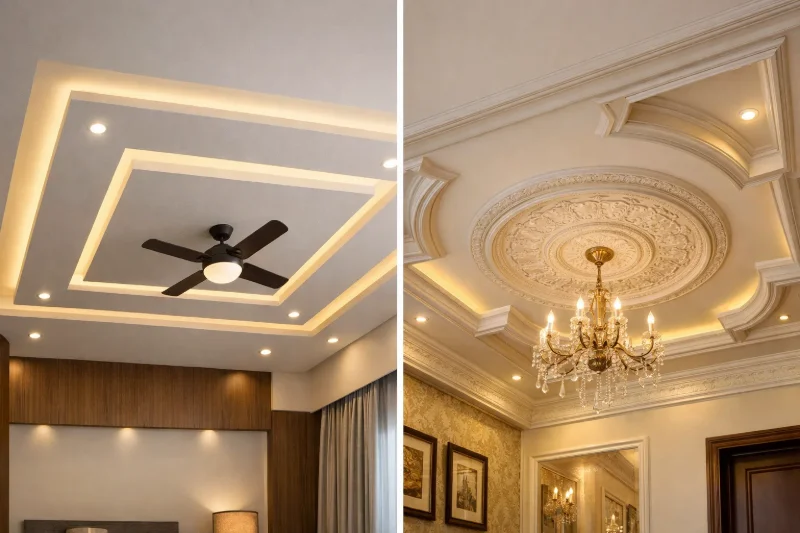
While gypsum boards are primarily flat surfaces, modern design techniques allow for:
Curved and Layered Designs: Gypsum can be bent to create curved ceilings and multi-level designs.
Integrated Lighting: Gypsum ceilings accommodate recessed lighting, LED strips, and modern lighting fixtures seamlessly.
Acoustic Solutions: Perforated gypsum boards provide sound insulation, ideal for offices and commercial spaces.
Clean, Modern Aesthetics: Gypsum offers a minimalist, contemporary look that suits modern interior design trends.
POP Design Capabilities
POP excels in decorative applications:
Ornate Patterns: Skilled artisans can create intricate designs, cornices, medallions, and artistic patterns.
Traditional Aesthetics: POP is ideal for heritage properties, classical interiors, and traditional Indian designs.
Customization: Every design can be customized to match specific aesthetic preferences.
Artistic Expression: POP allows for hand-crafted, unique designs that mass-produced gypsum cannot match.
Installation Timeline and Complexity
Gypsum Installation Process
Gypsum installation is relatively quick and straightforward:
Metal framework installation: 1-2 days
Board fixing and taping: 2-4 days
Joint compound application and finishing: 3-5 days
Painting: 1-2 days
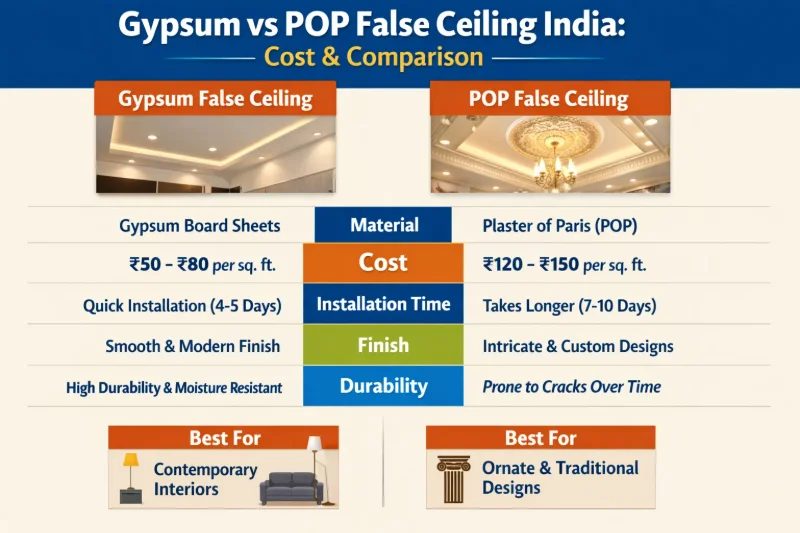
Total Timeline: 7-14 days for 1,000 sq ft
The standardized nature of gypsum boards makes installation faster and less dependent on individual craftsperson skill levels.
POP Installation Process
POP installation is more time-consuming and skill-dependent:
Framework preparation: 1-2 days
Base coat application: 2-3 days
Design creation and finishing coats: 5-10 days (depending on complexity)
Curing time: 7-14 days before painting
Painting: 1-2 days
Total Timeline: 16-31 days for 1,000 sq ft
Complex POP designs can extend the timeline significantly, making project planning crucial.
Environmental Factors and Climate Considerations
Performance in Different Indian Climates
Humid Coastal Areas (Mumbai, Goa, Kolkata): Gypsum performs better than POP in these regions. Use moisture-resistant gypsum boards to prevent warping and mold growth. POP deteriorates quickly in high humidity.
Dry Interior Regions (Delhi, Jaipur, Indore): Both materials perform reasonably well, though POP may crack due to temperature fluctuations. Gypsum is more stable in dry climates.
Moderate Climate Areas (Bangalore, Pune, Hyderabad): Both materials work well, but gypsum offers better long-term durability with minimal maintenance.
Practical Considerations for Choosing Between Gypsum and POP
Choose Gypsum If:
You prioritize durability and low maintenance
Your space is in a humid or coastal region
You prefer modern, minimalist aesthetics
You need quick installation and project completion
You have integrated electrical or HVAC requirements
You're designing commercial or office spaces
Choose POP If:
Budget is your primary constraint
You desire ornate, decorative designs
Your property has a traditional or heritage aesthetic
You're in a dry climate with stable structural conditions
You appreciate hand-crafted, artistic elements
You're designing residential spaces in tier-2 or tier-3 cities
Finding Quality Professionals for Your Project
Whether you choose gypsum or POP, the quality of installation is crucial for achieving the desired results and longevity. Experienced contractors and skilled artisans make a significant difference in the final outcome. Platforms like AECORD connect you with verified architects, contractors, and ceiling specialists across India who can guide you through the selection process and execute your project professionally.
On AECORD, you can find professionals experienced in both gypsum and POP installations, read reviews from previous clients, and compare quotes to ensure you get the best value for your investment. Whether you're in Mumbai, Delhi, Bangalore, or any other Indian city, AECORD makes it easy to connect with trusted experts.
Hybrid Approach: Combining Both Materials
Many modern projects use a hybrid approach, combining the advantages of both materials:
Use gypsum for the main ceiling structure for durability and quick installation
Add POP cornices or decorative elements for aesthetic appeal
This approach balances cost, aesthetics, and longevity
Conclusion
The choice between gypsum and POP false ceilings depends on your budget, aesthetic preferences, climate, and maintenance expectations. Gypsum offers superior durability, modern aesthetics, and low maintenance, making it ideal for contemporary spaces and humid climates. POP provides cost savings and unmatched decorative possibilities, making it perfect for traditional designs and budget-conscious projects in dry regions.
For a detailed breakdown, see our guide on Floor Plan vs Elevation vs Section.
For most modern Indian homes and commercial spaces, gypsum is becoming the preferred choice due to its durability and minimal maintenance requirements. However, POP remains a viable option for those seeking traditional aesthetics or working with limited budgets.
To make the best decision for your specific project, consult with experienced professionals who understand local building conditions and can provide tailored recommendations. Visit AECORD today to connect with qualified architects, contractors, and ceiling specialists in your area. Our platform makes it simple to find the right professionals, compare options, and execute your false ceiling project with confidence and quality assurance.
Frequently Asked Questions
What is the main difference between gypsum and POP false ceilings?
Gypsum false ceilings are made from manufactured gypsum boards attached to metal frameworks with screws and adhesive, while POP (Plaster of Paris) is a white powder mixed with water and applied over wooden or metal frameworks to create decorative designs. Gypsum offers a more standardized, modern finish, whereas POP allows for intricate decorative patterns and is rooted in traditional Indian construction methods.
How much does a gypsum false ceiling cost in India?
Gypsum false ceiling costs typically range from ₹3.3 to ₹6 lakhs for 1,000 sq ft, including material costs of ₹2.5 to ₹4.5 lakhs and installation costs of ₹0.8 to ₹1.5 lakhs. Prices vary based on location, with metropolitan areas like Mumbai and Delhi being more expensive than tier-2 cities.
Is POP false ceiling cheaper than gypsum?
Yes, POP false ceilings are generally 20-30% cheaper than gypsum, costing ₹2.5 to ₹4.5 lakhs for 1,000 sq ft compared to gypsum's ₹3.3 to ₹6 lakhs. However, highly decorative POP designs with intricate patterns can increase costs and potentially exceed gypsum pricing.
Which false ceiling material is better for modern homes in India?
Gypsum is typically preferred for modern residential and commercial spaces due to its standardized manufacturing, ease of installation, and clean finish. POP remains popular for traditional homes and heritage properties, particularly in tier-2 and tier-3 cities where skilled artisans are available for decorative work.
What are the installation costs for POP false ceilings?
POP installation labor costs range from ₹100 to ₹200 per square foot, depending on design complexity, with simple flat ceilings costing less and ornate designs with cornices commanding premium rates. For 1,000 sq ft, expect labor costs between ₹1 to ₹2 lakhs.