

Cement Fibre Board and Particle Board: A Comprehensive Guide for Indian Construction Professionals
In the Indian construction industry, choosing the right building materials is crucial for ensuring durability, cost-effectiveness, and structural integrity. Two materials that frequently appear in specification documents and material lists are cement fibre board and particle board. While both serve important functions in modern construction, they have distinctly different properties, applications, and performance characteristics. This comprehensive guide will help architects, engineers, contractors, and builders understand when and how to use each material effectively.
Build cost · Bengaluru, May 2026
Understanding Cement Fibre Board
What is Cement Fibre Board?
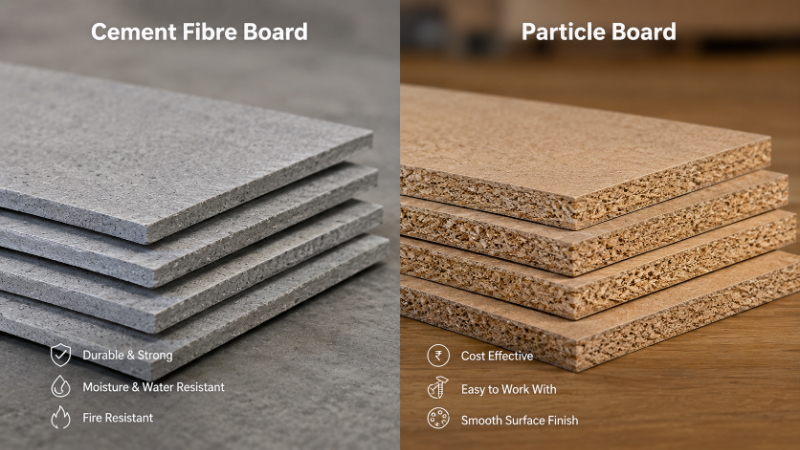
Cement fibre board, also known as fibre cement board or asbestos-free fibre cement board, is a composite material made from Portland cement, cellulose fibres, and other additives. In India, manufacturers produce cement fibre boards that comply with Indian Standards (IS 12467:2008), which ensure quality and safety standards. Unlike older asbestos-containing boards that were phased out, modern cement fibre boards use synthetic or natural cellulose fibres for reinforcement.
The manufacturing process involves mixing Portland cement with processed cellulose fibres, then compressing and curing the mixture under controlled conditions. This creates a dense, rigid board that combines the strength of cement with the flexibility of fibres, resulting in a material that resists cracking and breaking.
Key Properties of Cement Fibre Board
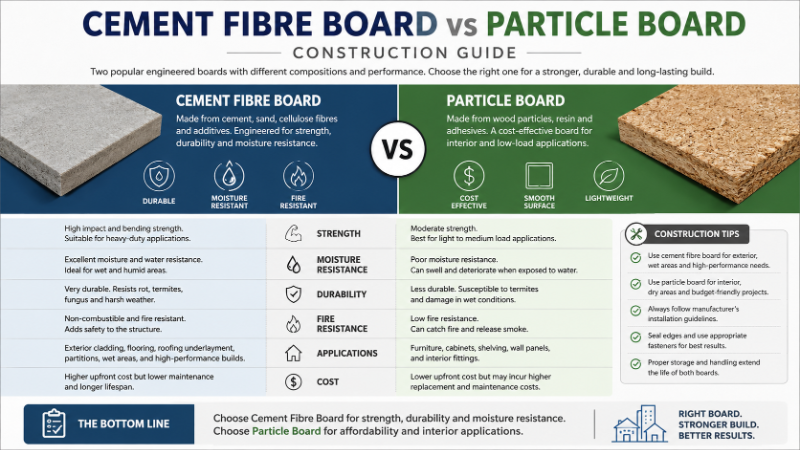
Durability: Cement fibre boards are exceptionally durable and can withstand harsh environmental conditions. They resist moisture, rot, termites, and fungal growth, making them ideal for Indian climates that experience heavy monsoons and humidity.
Fire Resistance: These boards are non-combustible and have excellent fire-rating properties. They meet Class A fire ratings, which is crucial for safety-conscious projects in cities like Mumbai, Delhi, and Bangalore.
Strength: Cement fibre boards offer high tensile and flexural strength, making them suitable for load-bearing applications and structural uses. They can withstand physical impacts better than particle boards.
Water Resistance: Unlike particle boards, cement fibre boards don't absorb water readily. This makes them excellent for wet areas such as bathrooms, kitchens, and external facades.
Dimensional Stability: These boards maintain their shape and size even when exposed to temperature and humidity fluctuations, which is essential in Indian climates where seasonal variations are significant.
Frequently asked
Common Applications of Cement Fibre Board in India
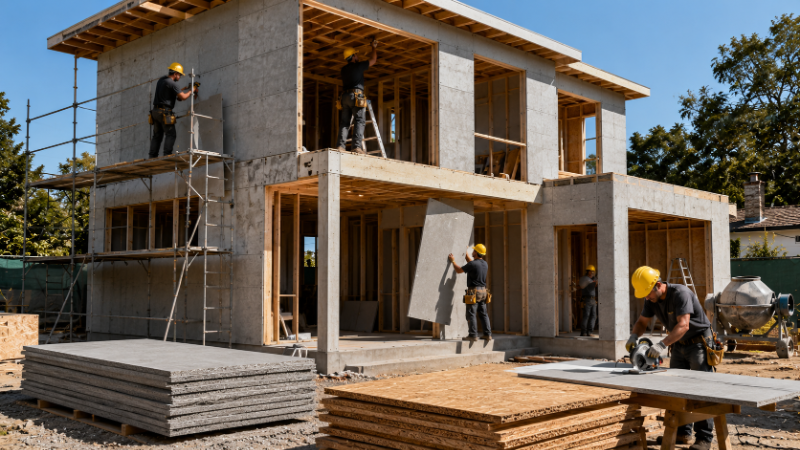
External Cladding: Used as exterior wall panels in residential and commercial buildings across Indian metros
Roofing Sheets: Commonly used as corrugated or flat roofing materials in industrial and residential structures
Internal Partitions: Ideal for creating fire-resistant internal walls in offices and commercial spaces
Wet Area Linings: Perfect for bathrooms, kitchens, and other moisture-prone areas
Soffit and Fascia: Used in architectural detailing for building exteriors
Acoustic Panels: Specialized versions used in offices and commercial establishments
Cost Considerations for Cement Fibre Board
In the Indian market, cement fibre board prices typically range from ₹400 to ₹900 per square foot, depending on thickness, brand, and specifications. Premium brands and thicker variants (10-12mm) cost more than standard options. When budgeting for projects in cities like Pune, Hyderabad, or Kolkata, factor in transportation costs and installation labour, which can add 30-40% to material costs.
Understanding Particle Board
What is Particle Board?
Particle board, also called chipboard or low-density fibreboard (LDF), is an engineered wood product made from wood particles, sawdust, and wood chips bonded together with synthetic resin (usually urea-formaldehyde or melamine-formaldehyde). In India, particle boards are manufactured according to IS 12823:2003 standards.
The manufacturing process involves shredding wood waste into small particles, drying them, mixing with adhesive resin, and then hot-pressing the mixture into boards. This process allows manufacturers to utilize wood waste efficiently, making particle board an economical choice for various applications.
Key Properties of Particle Board
Affordability: Particle board is significantly cheaper than cement fibre board, typically costing ₹200 to ₹500 per square foot in India, making it attractive for budget-conscious projects.
Workability: These boards are easier to cut, drill, and shape compared to cement fibre boards. Carpenters and contractors in Indian cities find them convenient to work with on-site.
Lightweight: Particle boards are lighter than cement fibre boards, reducing structural load and making transportation easier—an important factor in congested Indian cities.
Aesthetic Options: Particle boards come with various veneers and laminates, offering diverse design possibilities for furniture and interior applications.
Sound Insulation: The porous structure provides reasonable sound absorption, useful in office spaces and residential buildings.
Limitations of Particle Board
Moisture Sensitivity: Particle boards absorb moisture readily, which is a significant drawback in India's humid climate. Prolonged exposure to moisture causes swelling, warping, and degradation.
Lower Strength: These boards have lower tensile and flexural strength compared to cement fibre boards, limiting their structural applications.
Durability Concerns: Particle boards are susceptible to termite attacks, fungal growth, and rot—critical issues in Indian climates, particularly in coastal areas and regions with high rainfall.
Fire Risk: While some particle boards have fire-retardant treatments, they are generally more flammable than cement fibre boards.
Common Applications of Particle Board in India
Furniture Manufacturing: Widely used in affordable furniture production across Indian markets
Interior Partitions: Used for non-load-bearing internal walls in dry areas
Cabinetry: Common in kitchen and bathroom cabinets, though moisture-resistant variants are preferred
Shelving: Used in retail displays and storage solutions in offices
Underlay: Serves as base material for flooring applications
Acoustic Panels: Used in offices and commercial spaces for sound control
Comparing Cement Fibre Board and Particle Board
Performance Comparison Table
Durability: Cement fibre board wins decisively in durability, lasting 25-30 years or more, while particle board typically lasts 10-15 years in Indian conditions.
Moisture Resistance: Cement fibre board is superior for wet applications, while particle board requires protective treatments and is unsuitable for external or wet areas.
Strength: Cement fibre board offers higher structural strength, making it suitable for load-bearing applications where particle board would fail.
Cost: Particle board is 40-60% cheaper initially, but cement fibre board's longevity makes it more cost-effective over the building's lifetime.
Installation Ease: Particle board is easier to cut and install, while cement fibre board requires specialized tools and trained labour.
Environmental Impact: Particle board uses recycled wood waste, making it environmentally friendly. Modern cement fibre boards are also increasingly eco-conscious, though they require more energy to produce.
Selecting the Right Material for Your Project
Choose Cement Fibre Board When:
Your project is in a high-humidity region like Goa, Kerala, or coastal Tamil Nadu
The application involves external exposure or wet areas
Fire resistance is a critical requirement (hospitals, schools, offices)
Long-term durability is prioritized over initial cost savings
The project is in areas prone to termite infestation
Structural integrity and load-bearing capacity are essential
Choose Particle Board When:
Budget constraints are significant and the application is in dry indoor spaces
The project involves furniture manufacturing or cabinetry
Easy workability and quick installation are priorities
The application is temporary or short-term
Aesthetic customization through veneers and laminates is desired
The project is in low-humidity regions like Rajasthan or parts of Gujarat
Quality Standards and Certifications in India
When sourcing cement fibre boards, ensure they comply with IS 12467:2008, which specifies requirements for non-asbestos fibre cement flat sheets. For particle boards, IS 12823:2003 provides quality parameters. Leading Indian manufacturers like Visaka Industries, Magnum Boards, and Surya Boards produce certified products that meet these standards.
Always request third-party test certificates and ensure materials come with proper warranty documentation. This is particularly important when working with architects and contractors through professional platforms like AECORD, where you can verify supplier credentials and access verified professional networks.
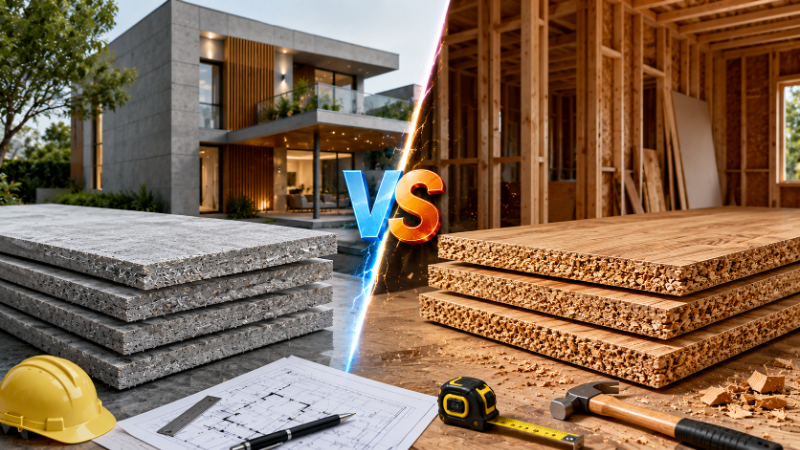
Installation and Maintenance Tips
For Cement Fibre Board:
Use carbide-tipped saw blades for cutting to prevent chipping
Ensure proper ventilation during installation to avoid dust inhalation
Use stainless steel fasteners to prevent rust and corrosion
Apply appropriate sealants at joints for external applications
Minimal maintenance required; occasional cleaning with mild detergent suffices
For Particle Board:
Seal all edges with paint or varnish to prevent moisture absorption
Avoid direct contact with water; use moisture-resistant variants in damp areas
Ensure proper ventilation to prevent fungal growth
Regular inspection for signs of swelling or warping
Apply protective treatments against termite infestation in susceptible areas
Regional Considerations for Indian Projects
Coastal Regions (Mumbai, Chennai, Goa): Cement fibre board is strongly recommended due to salt spray corrosion and high humidity. Particle board will deteriorate rapidly in these conditions.
Metropolitan Areas (Delhi, Bangalore, Hyderabad): Both materials can be used depending on application. Cement fibre board for external and wet areas, particle board for interior dry spaces.
Arid Regions (Rajasthan, Parts of Gujarat): Particle board can be cost-effective in dry climates, but cement fibre board remains superior for long-term durability.
High-Rainfall Areas (Northeast India, Western Ghats): Cement fibre board is essential for any external or semi-external applications.
Working with Professional Networks
Whether you're an architect specifying materials, a contractor sourcing supplies, or a builder planning a project, connecting with verified professionals is crucial. AECORD provides a comprehensive B2B2C platform where you can find material suppliers, contractors, and specialists who understand these materials deeply. AECORD's network includes manufacturers, distributors, and installation experts across India who can provide site-specific recommendations based on local climate conditions and project requirements.
Using professional networks like AECORD ensures you access vetted suppliers with proper certifications, competitive pricing, and reliable delivery schedules—critical factors for project success in the Indian construction industry.
Cost-Benefit Analysis for Long-Term Projects
While particle board offers lower upfront costs, a 25-year lifecycle analysis typically favors cement fibre board in Indian climates. Factor in replacement costs, maintenance expenses, and potential project delays from material failure. For a 10,000 sq ft commercial project in Pune, choosing cement fibre board over particle board might cost ₹2-3 lakhs more initially, but saves ₹5-7 lakhs in replacement and maintenance over the building's lifetime.
Conclusion
Cement fibre board and particle board serve different purposes in Indian construction. Cement fibre board excels in durability, moisture resistance, and structural applications, making it ideal for challenging Indian climates. Particle board remains valuable for cost-sensitive interior applications and furniture manufacturing in appropriate conditions.
The key to successful material selection is understanding your project's specific requirements, climate conditions, and long-term maintenance implications. By making informed choices based on application, climate, and budget considerations, you ensure your projects achieve optimal performance and longevity.
Ready to source quality materials and connect with verified professionals for your next project? Explore AECORD's network of certified suppliers, contractors, and specialists who can provide expert guidance on material selection and installation. Whether you need cement fibre board for external cladding in Mumbai or particle board for interior furniture in Bangalore, AECORD connects you with the right professionals to bring your vision to life.
Frequently Asked Questions
What is the difference between cement fibre board and particle board?
Cement fibre board is a composite made from Portland cement and cellulose fibres, offering superior durability, fire resistance, and water resistance, making it ideal for wet areas and external applications. Particle board is made from wood particles and resin, is less durable, absorbs moisture easily, and is better suited for interior, dry applications only.
Is cement fibre board water resistant?
Yes, cement fibre board is highly water resistant and doesn't absorb water readily, making it excellent for bathrooms, kitchens, and external facades. This is one of its key advantages over particle board, which readily absorbs moisture and can deteriorate in wet conditions.
What is the fire rating of cement fibre board?
Cement fibre board is non-combustible and meets Class A fire ratings, making it a safe choice for safety-conscious construction projects. This superior fire resistance is a significant advantage over particle board in commercial and residential applications.
How much does cement fibre board cost in India?
In the Indian market, cement fibre board typically costs between ₹400 to ₹900 per square foot, depending on thickness, brand, and specifications. Premium brands and thicker variants (10-12mm) command higher prices than standard options.
What are the main applications of cement fibre board in construction?
Cement fibre board is commonly used for external cladding, roofing sheets, internal fire-resistant partitions, wet area linings in bathrooms and kitchens, soffit and fascia, and acoustic panels in commercial spaces. Its durability and moisture resistance make it suitable for both structural and architectural applications.