Understanding Green Roofs and Living Walls: The Sustainable Building Revolution
India's urban landscape is rapidly transforming, with cities like Mumbai, Bangalore, Delhi, and Pune experiencing unprecedented growth. As concrete jungles expand, architects and engineers are increasingly turning to innovative solutions that merge sustainability with functionality. Green roofs and living walls represent a paradigm shift in how we design buildings—transforming the building envelope from a mere barrier into a thriving ecosystem that benefits both occupants and the environment. /blog/modern-facade-design-guide-for-indian-architects
The building envelope—comprising roofs, walls, windows, and foundations—is traditionally designed to separate interior spaces from external conditions. However, the integration of green infrastructure fundamentally reimagines this concept, creating a living, breathing interface that actively contributes to environmental health, energy efficiency, and urban biodiversity.
Build cost · Bengaluru, May 2026
What Are Green Roofs and Living Walls?
Green Roofs: Types and Components
Green roofs, also known as vegetated roofs or eco-roofs, are roof surfaces partially or completely covered with vegetation. In India, where space constraints are a significant challenge in metropolitan areas, green roofs offer an elegant solution to reclaim ecological value from underutilized surfaces.
There are two primary types of green roofs:
Extensive Green Roofs: These shallow systems (typically 2-6 inches deep) feature low-maintenance vegetation like sedums and grasses. They're lightweight, cost-effective (ranging from ₹800 to ₹1,500 per square meter in India), and ideal for retrofitting existing structures in cities like Bangalore and Hyderabad.
Intensive Green Roofs: These deeper systems (6+ inches) support a wider variety of plants, including shrubs and small trees. While more expensive (₹2,000 to ₹5,000 per square meter), they create accessible green spaces and can function as rooftop gardens in urban centers like Mumbai and Delhi.
A typical green roof structure includes a waterproof membrane, root barrier, drainage layer, filter fabric, growing medium, and vegetation layer. Each component plays a critical role in system longevity and performance.
Living Walls: Vertical Greening Solutions
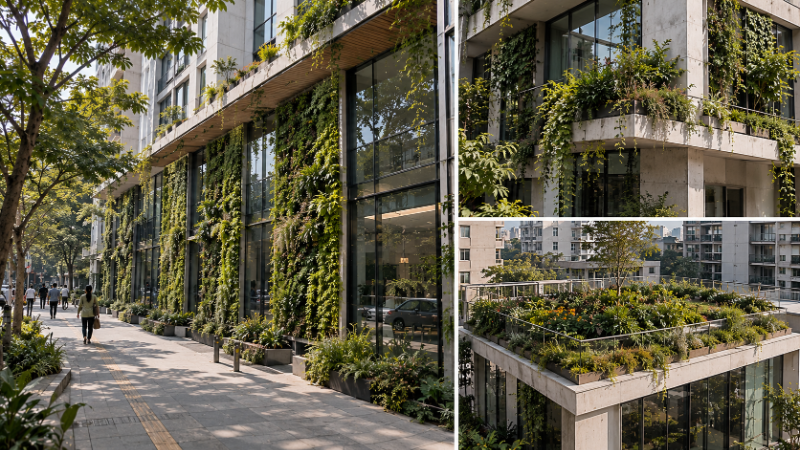
Living walls, or vertical gardens, are wall-mounted systems that support plant growth on vertical surfaces. These systems are particularly valuable in India's densely populated urban areas where horizontal space is scarce but vertical surfaces are abundant.
Living walls employ various technologies:
Modular Panel Systems: Pre-grown plant modules that attach to walls, offering flexibility and ease of maintenance.
Climbing Systems: Trellises and frameworks that support ivy and creeping plants, creating natural green facades.
Hydroponic Systems: Soil-less growing methods that deliver nutrients through water, ideal for controlled indoor environments.
Felt-Based Systems: Permeable fabric layers that hold growing medium and plants, pioneered by companies like Woolly Pocket.
Installation costs for living walls in India typically range from ₹1,200 to ₹3,000 per square meter, depending on complexity and plant selection.
Frequently asked
The Building Envelope as an Ecosystem
Reimagining Architectural Boundaries
Traditionally, the building envelope serves as a thermal and moisture barrier—a passive interface. Green roofs and living walls transform this concept into an active ecosystem that performs multiple functions simultaneously. This integrated approach aligns with India's growing focus on sustainable development and compliance with regulations like the Energy Conservation Building Code (ECBC) and green building standards such as LEED and IGBC certification.
When you integrate green infrastructure into the building envelope, you create a multi-layered system that:
Regulates temperature through evapotranspiration
Manages stormwater through absorption and filtration
Improves air quality by filtering pollutants
Provides habitat for urban biodiversity
Enhances aesthetic and psychological well-being
Thermal Performance and Energy Efficiency
One of the most significant advantages of green roofs is their impact on building thermal performance. In India's hot climate, particularly in cities like Delhi, Mumbai, and Pune, summer cooling costs can represent 30-40% of total energy consumption in commercial buildings./blog/how-to-make-sustainability-a-selling-point-not-a-compromise
Green roofs reduce surface temperatures by up to 30-40°C compared to conventional dark roofs through:
Evapotranspiration: Plants release water vapor, creating a cooling effect similar to natural perspiration.
Shading: Vegetation blocks direct solar radiation from reaching the roof membrane.
Thermal Mass: Growing medium stores heat during the day and releases it gradually at night.
Studies conducted in Indian cities have demonstrated that buildings with extensive green roofs can reduce annual cooling energy consumption by 15-25%. When combined with other envelope improvements, these savings become even more substantial, making green roofs a financially viable investment with payback periods of 8-12 years in many cases.
Living walls similarly provide insulation benefits, creating an air gap that reduces heat transfer through exterior walls. In Bangalore's IT corridors and Mumbai's commercial districts, strategic placement of living walls can reduce wall surface temperatures by 5-8°C.
Stormwater Management and Urban Flooding
India's rapidly urbanizing areas face increasing challenges with stormwater management. Cities like Pune, Hyderabad, and Kolkata experience severe flooding during monsoon seasons, partly due to reduced permeable surfaces and inadequate drainage infrastructure.
Green roofs and living walls address this challenge through:
Water Retention: Extensive green roofs retain 40-60% of annual rainfall, while intensive systems can retain up to 80%. This reduces peak stormwater runoff during heavy precipitation events.
Delayed Release: Water is gradually released through evapotranspiration and drainage, reducing strain on municipal stormwater systems.
Improved Water Quality: Growing medium filters pollutants, improving runoff quality before it reaches water bodies.
For a typical 1,000 square meter green roof in Mumbai receiving an average monsoon rainfall of 2,200mm annually, water retention can prevent approximately 880-1,100 cubic meters of runoff from entering the municipal system. This translates to reduced flooding risk and lower stormwater management costs for municipalities.

Biodiversity and Urban Ecology
Creating Habitat in the Urban Landscape
Rapid urbanization in India has resulted in significant habitat loss for native species. Green roofs and living walls serve as artificial ecosystems, providing food, shelter, and breeding grounds for birds, insects, and pollinators in otherwise sterile urban environments.
Research from Indian cities has shown that:
Green roofs support 20-30 different insect species per 100 square meters
Living walls attract native bird species, contributing to urban pollination networks
Diverse plantings create microclimates that support beneficial organisms
In Delhi and Bangalore, where air pollution levels frequently exceed WHO standards, green infrastructure supports native bee populations crucial for food production. A single green roof can support 2-3 bee colonies, each providing pollination services worth ₹50,000-100,000 annually in agricultural productivity.
Plant Selection for Indian Climates
Successful green roofs and living walls in India require careful plant selection based on local climate conditions. For hot, dry regions like Rajasthan and Gujarat, drought-tolerant species such as:
Sedum species (Sedum acre, Sedum spurium)
Sempervivum varieties
Native grasses (Chrysopogon zizanioides)
Lantana camara
For humid tropical regions like Kerala and coastal areas, moisture-loving plants work better:
Ferns and shade-tolerant species
Creeping fig (Ficus pumila)
Philodendron varieties
Native climbing plants
The choice of vegetation directly impacts maintenance requirements and long-term system performance. Professional consultation with landscape architects familiar with AECORD's network of specialists ensures optimal plant selection for your specific location and building type.
Air Quality and Health Benefits
Pollution Mitigation in Indian Cities
India's major metropolitan areas consistently rank among the world's most polluted. Delhi's winter air quality index frequently exceeds 400, while Mumbai and Bangalore also face significant air quality challenges. Green infrastructure offers a tangible solution to improve air quality at the building and neighborhood scale.
Plants in green roofs and living walls remove air pollutants through:
Particulate Matter Capture: Leaves trap dust, PM2.5, and PM10 particles. A single living wall can remove up to 130 grams of particulate matter annually per square meter.
Gaseous Pollutant Absorption: Plants absorb nitrogen dioxide (NO₂), sulfur dioxide (SO₂), and ozone (O₃) through stomata.
Oxygen Production: Through photosynthesis, plants increase oxygen levels in immediate surroundings.
For a typical office building in Delhi with 500 square meters of living walls, annual air quality improvements could benefit 200-300 occupants, reducing respiratory complaints by 10-15% according to studies from Indian research institutions.
Psychological and Well-being Benefits
Beyond environmental metrics, green infrastructure provides significant psychological benefits. Employees in buildings with green roofs and living walls report:
15-20% improvement in mood and stress levels
10-15% increase in productivity and focus
Reduced sick leave by 5-10%
Enhanced sense of connection to nature
In India's competitive IT and corporate sectors, these wellness benefits translate to measurable business value, making green infrastructure an investment in human capital as much as environmental sustainability.
Implementation Challenges and Solutions
Structural Considerations
A critical challenge in implementing green roofs and living walls is structural capacity. Growing medium, vegetation, and retained water add significant weight—typically 100-200 kg/m² for extensive systems and 300-500+ kg/m² for intensive systems.
Solutions include:
Structural Assessment: Engage structural engineers to evaluate load-bearing capacity. Many older buildings in Indian cities may require reinforcement.
Lightweight Growing Media: Use engineered substrates combining expanded clay, pumice, and compost to reduce weight while maintaining plant support.
Modular Installation: Distribute loads across the roof using modular systems rather than monolithic coverage.
Maintenance and Long-term Management
Green infrastructure requires ongoing maintenance, though less than commonly assumed. Annual maintenance costs typically range from ₹200-400 per square meter for extensive systems and ₹500-800 for intensive systems.
Key maintenance tasks include:
Seasonal watering during dry periods (May-June and December-January in most Indian cities)
Weed management and invasive species removal
Fertilization and soil amendment
Drainage system inspection and cleaning
Plant replacement and renewal
Establishing clear maintenance protocols and engaging professional landscape management companies ensures optimal system performance over 20-30 year lifespan.
Regulatory and Code Compliance
Indian building codes are increasingly incorporating green infrastructure requirements. The ECBC mandates renewable energy and efficiency measures, while municipal authorities in cities like Mumbai and Bangalore offer incentives for green roof installation through floor area ratio (FAR) bonuses and tax benefits.
Before implementation, verify compliance with:
Local municipal building bye-laws
National Building Code of India (NBC)
Fire safety regulations
Waterproofing standards
Drainage and stormwater management guidelines
Case Studies: Green Infrastructure in Indian Buildings
Commercial Office Building, Bangalore
A 50,000 square meter IT office complex implemented 8,000 square meters of extensive green roofs and 2,000 square meters of living walls. Results included:
22% reduction in annual cooling energy consumption
Retention of 2.2 million liters of stormwater annually
Support for 40+ native bird species
ROI achieved in 9 years through energy savings
Residential Complex, Mumbai
A 200-unit residential tower in Mumbai's Bandra area integrated living walls on 15% of exterior wall surfaces, creating a distinctive green facade. Benefits included:
5°C reduction in average wall surface temperature
Improved aesthetic appeal increasing property values by 3-5%
Enhanced resident satisfaction and wellness perception
Maintenance costs of ₹600 per square meter annually
Cost-Benefit Analysis for Indian Developers
Financial Considerations
While initial capital costs for green infrastructure are higher than conventional construction, lifecycle analysis demonstrates strong financial viability:
Extensive Green Roof: ₹1,000/m² initial cost, ₹250/m² annual maintenance, 8-10 year payback through energy savings
Intensive Green Roof: ₹3,500/m² initial cost, ₹600/m² annual maintenance, 12-15 year payback with property value enhancement
Living Wall: ₹2,000/m² initial cost, ₹400/m² annual maintenance, 10-12 year payback through energy and wellness benefits
Additional financial benefits include:
LEED/IGBC certification credits reducing compliance costs
Municipal incentives and tax benefits in major Indian cities
Increased property values and rental premiums (3-8%)
Reduced stormwater management fees
Improved insurance rates in flood-prone areas

Future of Green Building Envelopes in India
Emerging Technologies and Trends
The Indian green building sector is evolving rapidly, with innovations including:
Smart Green Roofs: IoT-enabled systems monitoring moisture, temperature, and plant health in real-time
Algae-Based Facades: Bio-reactive walls that harness algae photosynthesis for energy generation
Integrated Food Production: Rooftop gardens producing vegetables and herbs for building occupants
Mycelium-Based Growing Media: Sustainable alternatives to conventional substrates
Policy and Market Growth
India's National Action Plan on Climate Change and various state-level sustainability initiatives are creating favorable conditions for green infrastructure adoption. By 2030, experts project that 15-20% of new commercial buildings in major Indian cities will incorporate significant green roof or living wall components.
Professional networks like AECORD are facilitating this transition by connecting architects, engineers, landscape specialists, and contractors who understand the technical and practical requirements of implementing green infrastructure in Indian contexts.
Conclusion: The Building Envelope as Living System
Green roofs and living walls represent far more than aesthetic improvements or environmental gestures. They fundamentally reimagine the building envelope as an active, living ecosystem that delivers measurable environmental, economic, and social benefits. In India's context—where rapid urbanization, climate change, air pollution, and space constraints present unprecedented challenges—this approach offers practical solutions grounded in ecological science and proven performance data.
For architects, engineers, developers, and facility managers in India, the question is no longer whether to incorporate green infrastructure, but how to do so effectively for your specific project, location, and objectives. Whether you're planning a new commercial development in Bangalore, retrofitting an existing building in Delhi, or designing a residential complex in Mumbai, green infrastructure represents a strategic investment in long-term sustainability and value creation.
Ready to explore green infrastructure options for your project? Connect with experienced architects, engineers, and landscape specialists on AECORD—India's dedicated marketplace for AECO professionals. Our network includes experts who have successfully implemented green roofs and living walls across India's diverse climates and urban contexts. Browse detailed profiles, review past projects, and find the right team to transform your building envelope into a thriving ecosystem
Frequently Asked Questions
What is the difference between extensive and intensive green roofs?
Extensive green roofs are shallow systems (2-6 inches) with low-maintenance vegetation like sedums, costing ₹800-₹1,500 per square meter and ideal for retrofitting. Intensive green roofs are deeper systems (6+ inches) supporting shrubs and trees, costing ₹2,000-₹5,000 per square meter, and can function as accessible rooftop gardens.
How much do green roofs and living walls cost in India?
Green roof costs range from ₹800-₹1,500 per square meter for extensive systems to ₹2,000-₹5,000 for intensive systems. Living walls typically cost ₹1,200-₹3,000 per square meter depending on complexity and plant selection.
What are the main types of living wall systems?
Living walls include modular panel systems with pre-grown plants, climbing systems with trellises for ivy, hydroponic soil-less growing methods, and felt-based systems that hold growing medium. Each type offers different maintenance levels and aesthetic benefits.
How do green roofs and living walls improve building performance?
These systems transform the building envelope from a passive barrier into an active ecosystem that improves energy efficiency, enhances urban biodiversity, manages stormwater, and contributes to environmental health while meeting sustainability standards like LEED and IGBC.
Are green roofs suitable for retrofitting existing buildings in India?
Yes, extensive green roofs are particularly suitable for retrofitting existing structures because they are lightweight and cost-effective (₹800-₹1,500 per square meter), making them ideal for cities like Bangalore and Hyderabad with space constraints.