

Bijoy Jain: India's Master of Sustainable Luxury Architecture
In the landscape of contemporary Indian architecture, few names carry as much weight and reverence as Bijoy Jain. As the founder and principal architect of Studio Mumbai, Jain has carved a distinctive niche in global architecture by seamlessly blending traditional Indian craftsmanship with modernist principles and environmental consciousness. His work represents a paradigm shift in how luxury architecture is conceived and executed in India, proving that opulence and sustainability need not be mutually exclusive. /blog/igbc-certification-benefits
Studio Mumbai, established in 1983, has become synonymous with a philosophy that challenges the conventional understanding of luxury in the Indian context. Rather than equating luxury with ostentation, Jain's designs emphasize material honesty, spatial generosity, and a deep respect for the environment. This approach has garnered international recognition, with his projects featured in prestigious publications and exhibitions worldwide, yet his work remains profoundly rooted in Indian sensibilities and construction traditions.
Build cost · Bengaluru, May 2026
The Philosophy Behind Studio Mumbai's Design Approach
Material Authenticity and Craftsmanship
At the heart of Bijoy Jain's design philosophy lies an unwavering commitment to material authenticity. Unlike contemporary architectural trends that often prioritize aesthetic novelty over substance, Studio Mumbai celebrates the inherent beauty of raw materials—stone, timber, concrete, and earth. This approach is deeply influenced by traditional Indian building practices that have sustained communities for centuries. /blog/vastu-shastra-vs-modern-architecture-can-they-coexist-mpnl3tk7
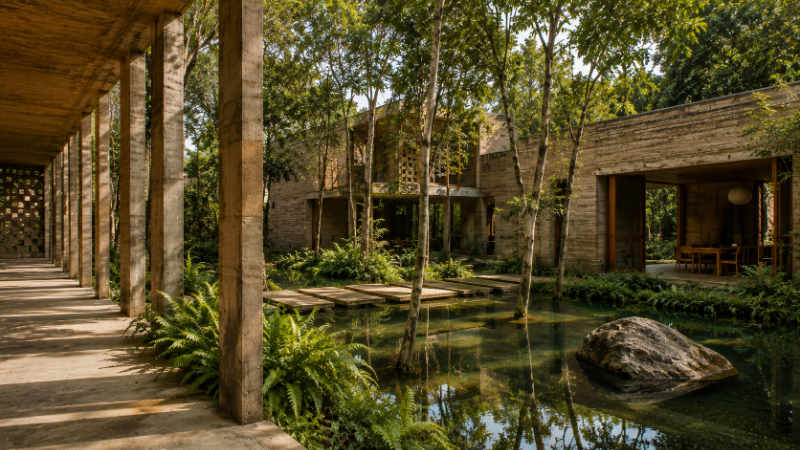
Jain's projects showcase an almost reverential treatment of materials. Walls are left unplastered to reveal the texture of stone or brick, floors feature natural finishes that age gracefully, and timber is used in ways that honor its organic qualities. This material honesty extends beyond aesthetics; it reflects a sustainable practice that reduces the need for resource-intensive finishing treatments and artificial embellishments. The cost implications are significant—by minimizing unnecessary finishes and treatments, projects can achieve luxury through quality and craftsmanship rather than expensive surface applications.
Integration with Landscape and Environment
Studio Mumbai's designs are never imposed upon a landscape; instead, they emerge from a profound understanding of the site's topography, climate, and existing ecosystem. This environmental integration is a cornerstone of sustainable luxury design that Indian architects and developers are increasingly recognizing as essential.
Jain's approach involves extensive site analysis and often requires significant time spent understanding the local context before design begins. Buildings are positioned to work with natural light and ventilation patterns, reducing dependence on artificial climate control. Water management is integral to the design process, with projects incorporating natural drainage patterns and rainwater harvesting systems that blend seamlessly into the architectural composition.
This philosophy is particularly relevant for Indian architects designing residential and commercial projects across diverse climates—from the humid coastal regions of Mumbai and Kerala to the arid landscapes of Rajasthan and Gujarat. The principles established by Studio Mumbai demonstrate that environmentally responsive design is not a luxury add-on but a fundamental aspect of creating spaces that endure both physically and culturally.
Frequently asked
Signature Projects That Define an Era
The Dravida House and Residential Masterpieces
Among Studio Mumbai's most celebrated works is the Dravida House, a residential project that exemplifies Jain's design philosophy. The residence showcases how luxury can be achieved through spatial planning, proportion, and the careful orchestration of light and shadow rather than through expensive materials or technological systems.
The house features soaring interior spaces with minimal ornamentation, where the architecture itself becomes the primary design element. Thick stone walls provide thermal mass, naturally regulating interior temperatures. Large openings are strategically positioned to capture prevailing breezes, and the overall design minimizes the need for mechanical cooling—a significant consideration for sustainable luxury in the Indian climate.
Other residential projects by Studio Mumbai follow similar principles, creating homes that feel both intimate and expansive, luxurious yet unpretentious. These projects have influenced how affluent Indian homeowners and developers conceptualize residential design, shifting focus from square footage and amenities to quality of space and environmental harmony.
Commercial and Institutional Works
Studio Mumbai's portfolio extends beyond residential design to encompass cultural institutions, commercial spaces, and hospitality projects. Each project demonstrates how sustainable principles can be applied across different building typologies without compromising on the experience or functionality expected in luxury developments.
The studio's institutional works, including cultural centers and galleries, showcase how public spaces can be designed with the same material rigor and environmental sensitivity as private residences. These projects have set benchmarks for institutional architecture in India, demonstrating that cultural facilities need not be resource-intensive or environmentally damaging to achieve architectural distinction.
Sustainable Luxury: Redefining the Concept for India
Economic Efficiency Without Compromise
One of the most significant contributions of Bijoy Jain and Studio Mumbai to Indian architecture is the demonstration that sustainable design can be economically efficient. In a market where luxury is often equated with cost, Studio Mumbai's projects prove that thoughtful design, quality craftsmanship, and environmental responsibility can actually reduce overall project costs while enhancing long-term value.
By minimizing mechanical systems, reducing finish complexity, and designing for natural climate control, Studio Mumbai projects often operate at lower lifecycle costs than conventionally designed luxury buildings. For Indian developers and architects, this represents a compelling business case for sustainable design—environmental responsibility becomes aligned with financial prudence.
The cost of construction in major Indian cities like Mumbai, Delhi, and Bangalore varies significantly based on design approach. While premium finishes and complex mechanical systems can drive costs to ₹3,000-5,000 per square foot or higher, Studio Mumbai's approach demonstrates that exceptional quality and lasting value can be achieved at more moderate cost per square foot through intelligent design and authentic material use.
Cultural Continuity and Modern Living
Bijoy Jain's work addresses a fundamental challenge in contemporary Indian architecture: how to create spaces that honor cultural traditions while accommodating modern living requirements. His designs reference vernacular Indian architecture—the courtyards of traditional homes, the spatial hierarchies of historical settlements, the material practices of regional building traditions—while incorporating contemporary functionality.
This approach has profound implications for how residential and commercial architecture develops across India. Rather than wholesale adoption of international architectural styles or nostalgic recreation of historical forms, Studio Mumbai demonstrates a path of critical regionalism—creating architecture that is authentically contemporary while remaining rooted in Indian cultural and environmental contexts.
Technical Innovation and Traditional Craft
Integration of Modern and Traditional Construction Methods
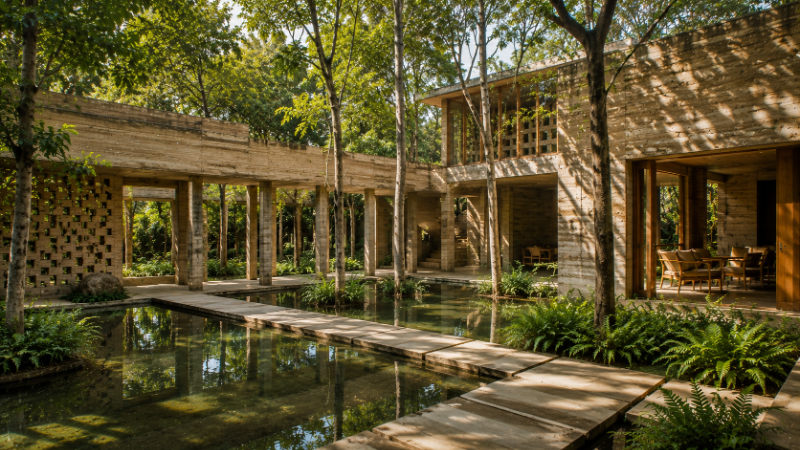
Studio Mumbai's projects showcase a sophisticated integration of modern construction technology with traditional Indian building crafts. This approach recognizes that India possesses centuries of accumulated knowledge about building sustainably in diverse climates, and this knowledge remains relevant and valuable in contemporary practice.
Jain works closely with skilled craftspeople, ensuring that traditional techniques are preserved and valued in the construction process. Stone masonry, timber carpentry, and earth construction techniques are employed not as nostalgic gestures but as practical solutions that often outperform modern alternatives in terms of durability, environmental impact, and aesthetic quality.
For Indian architects and construction professionals, this demonstrates the importance of maintaining relationships with skilled craftspeople and understanding traditional construction methods. As the AECO sector in India becomes increasingly professionalized, there is a risk that valuable traditional knowledge could be lost. Studio Mumbai's example shows how this knowledge can be integrated into contemporary practice to create buildings of exceptional quality.
Structural Honesty and Design Integrity
A defining characteristic of Studio Mumbai's work is structural honesty—the design expresses how buildings actually work, rather than concealing or disguising structural systems. Concrete is left exposed, stone walls are left unplastered, and timber framing is celebrated rather than hidden.
This approach has significant implications for construction quality and building longevity. When structural systems are exposed, there is less tolerance for poor workmanship, and building performance becomes immediately apparent. This creates incentives for quality construction and makes it easier to identify and address maintenance issues early.
Influence on Contemporary Indian Architecture
Shifting Paradigms in Luxury Development
The influence of Bijoy Jain and Studio Mumbai extends far beyond their direct projects. Their work has fundamentally shifted how luxury architecture is conceived in India. A new generation of architects, developers, and affluent clients increasingly recognize that authentic luxury derives from quality, durability, and environmental harmony rather than from expensive finishes or technological complexity.
This shift is evident in how major Indian real estate developers now approach residential and commercial projects. Sustainability certifications, natural materials, and biophilic design principles have become increasingly common in luxury developments across Indian cities. While not all projects achieve the sophistication of Studio Mumbai's work, the direction of the market has clearly been influenced by the philosophical framework that Jain has established.
Educational Impact and Professional Practice
Through lectures, exhibitions, and publications, Bijoy Jain has significantly influenced architectural education in India. His emphasis on site understanding, material authenticity, and environmental integration has become increasingly central to how architecture is taught in Indian institutions.
For professional architects and designers seeking to develop expertise in sustainable luxury design, Studio Mumbai's example provides a comprehensive case study in how these principles can be applied across different project types and scales. Whether designing residential projects in Bangalore, commercial spaces in Mumbai, or hospitality facilities in Goa, Indian architects can reference Studio Mumbai's approach as evidence that environmental responsibility and design excellence are not competing objectives.
Practical Lessons for Indian AECO Professionals
Site Analysis and Contextual Design
One of the most transferable lessons from Studio Mumbai's practice is the importance of thorough site analysis. Before design begins, the studio invests significant time understanding climate patterns, existing vegetation, topography, and local construction traditions. This approach should be standard practice for all architectural projects in India, regardless of scale or budget.
For professionals working through platforms like AECORD, which connect architects, engineers, and construction specialists across India, emphasizing site-specific design approaches can differentiate practices and lead to better project outcomes. Clients increasingly value architects who understand their local context and can design accordingly.
Material Selection and Sourcing
Studio Mumbai's approach to materials offers practical guidance for Indian architects and builders. Rather than specifying expensive imported materials, the studio sources locally available materials and works with regional suppliers and craftspeople. This approach reduces costs, supports local economies, and ensures that materials are appropriate for local climate conditions.
For construction professionals and material suppliers in India, this emphasizes the value of understanding regional material sources and traditional building practices. The AECO sector in India benefits when architects, engineers, and builders collaborate to identify and promote locally appropriate materials and construction methods.
Collaboration and Craftsmanship
Studio Mumbai's success depends on deep collaboration with skilled craftspeople, engineers, and construction specialists. This model contrasts with project delivery approaches where design is completely separated from construction expertise. For Indian AECO professionals, this suggests the value of integrated project teams where architects, engineers, and skilled builders collaborate from the earliest design stages.
Platforms like AECORD facilitate these kinds of collaborative relationships by connecting professionals across the AECO sector. Architects seeking to implement sustainable design principles can find structural engineers, MEP specialists, and construction managers who understand and support these approaches.
Challenges and Opportunities in Scaling Sustainable Luxury
Market Perception and Client Education
While Studio Mumbai's work has gained international recognition, scaling sustainable luxury design across the Indian market remains challenging. Many clients still equate luxury with visible expense and technological sophistication rather than with quality, durability, and environmental harmony.
Architects and developers working on projects across Indian cities must invest in client education, demonstrating through case studies and lifecycle cost analysis how sustainable design approaches deliver superior long-term value. AECORD professionals can support this by sharing project experiences and best practices across the network.
Regulatory Framework and Incentives
The Indian regulatory environment increasingly supports sustainable building practices through codes like ECBC (Energy Conservation Building Code) and green building certifications like LEED and IGBC. However, regulations often focus on measurable metrics rather than the holistic design philosophy that characterizes Studio Mumbai's work.
As India's built environment sector matures, there is opportunity to develop regulatory frameworks that incentivize the kind of integrated, context-responsive design that Bijoy Jain exemplifies. This might include density bonuses for projects demonstrating exceptional environmental integration, or accelerated approval processes for designs meeting sustainability criteria.
The Global Recognition of Indian Architectural Excellence
Bijoy Jain's international recognition—including the prestigious Pritzker Prize nomination and exhibitions at major institutions worldwide—demonstrates that Indian architecture can achieve global significance while remaining deeply rooted in local context. This is an important message for the Indian AECO sector as it develops on the world stage.
The success of Studio Mumbai shows that India need not import architectural solutions wholesale from Western contexts. Instead, Indian architects can develop distinctive approaches that respond to Indian conditions, draw on Indian traditions, and address Indian needs—while achieving excellence that is recognized globally.
Conclusion: The Future of Sustainable Luxury in India
Bijoy Jain and Studio Mumbai have fundamentally reshaped how luxury architecture is understood and practiced in India. By demonstrating that sustainable design, environmental responsibility, and architectural excellence are not competing objectives but rather mutually reinforcing principles, the studio has established a template for how the Indian built environment can develop.
As India's cities continue to grow and evolve, the principles established by Studio Mumbai become increasingly relevant. The pressure on environmental resources, the need for affordable housing, and the desire to maintain cultural identity all point toward the necessity of the kind of thoughtful, context-responsive, sustainable design that characterizes Jain's work.
For architects, engineers, builders, and developers across India, Studio Mumbai's example provides both inspiration and practical guidance. Whether you're designing a residential project in Mumbai, a commercial development in Bangalore, or an institutional facility in Delhi, the principles of material authenticity, environmental integration, and design integrity can elevate your work.
If you're seeking to develop expertise in sustainable luxury design or looking to collaborate with professionals who share these values, AECORD connects you with architects, engineers, and construction specialists across India who are advancing sustainable design practices. Explore the platform to find professionals committed to creating exceptional, environmentally responsible architecture that honors Indian traditions while serving contemporary needs. AECORD is where India's AECO professionals collaborate to build a better-designed, more sustainable built environment.
Frequently Asked Questions
What is Bijoy Jain's approach to sustainable luxury architecture?
Bijoy Jain, founder of Studio Mumbai, redefines luxury by emphasizing material honesty, spatial generosity, and environmental consciousness rather than ostentation. His philosophy proves that opulence and sustainability can coexist through thoughtful design that respects traditional Indian craftsmanship and environmental integration.
How does Studio Mumbai use materials in sustainable architecture?
Studio Mumbai celebrates the inherent beauty of raw materials like stone, timber, concrete, and earth by leaving them unplastered and unfinished. This material authenticity approach reduces resource-intensive treatments, lowers costs, and achieves luxury through quality craftsmanship rather than expensive surface applications.
What role does environmental integration play in Studio Mumbai's designs?
Environmental integration is fundamental to Studio Mumbai's work, involving extensive site analysis to position buildings with natural light and ventilation patterns. Projects incorporate natural drainage, rainwater harvesting, and climate-responsive design that reduces dependence on artificial systems across India's diverse climates.
When was Studio Mumbai established and what makes it unique?
Studio Mumbai was established in 1983 and has become synonymous with blending traditional Indian construction practices with modernist principles. The studio's distinctive approach challenges conventional luxury definitions while remaining deeply rooted in Indian sensibilities and building traditions.
How can Indian architects apply Studio Mumbai's sustainable principles to projects?
Indian architects can adopt Studio Mumbai's principles by prioritizing material honesty, conducting thorough site analysis before design, and integrating natural ventilation and water management systems. These practices are applicable across diverse Indian climates and demonstrate that environmental responsiveness is essential, not optional.