

TMT Steel Bars in India: A Comprehensive Brand Comparison Guide
The construction industry in India heavily relies on TMT (Thermo-Mechanically Treated) steel bars, which form the backbone of modern infrastructure projects. Whether you're building a residential apartment in Bangalore, a commercial complex in Mumbai, or a small house in tier-2 cities, choosing the right TMT steel brand can significantly impact the structural integrity and longevity of your project. This comprehensive guide will help you understand the nuances of TMT steel bars and compare India's best brands to make an informed purchasing decision.
Build cost · Bengaluru, May 2026
Understanding TMT Steel Bars: The Basics
What Are TMT Steel Bars?
TMT steel bars are reinforcement steel bars manufactured using a specialized thermo-mechanical treatment process. This process involves heating the steel to a specific temperature and then cooling it rapidly, creating a unique crystalline structure. The result is a steel bar with exceptional strength, ductility, and earthquake resistance—properties that make them ideal for seismic zones across India.
The TMT process creates three distinct layers in the steel:
Outer layer (Martensite): Hard and wear-resistant
Middle layer (Bainite): Provides strength and ductility balance
Core (Ferrite-Pearlite): Provides toughness and flexibility
Why TMT Steel Bars Are Essential in India
India's diverse geological and climatic conditions demand construction materials that can withstand various stresses. TMT steel bars offer superior earthquake resistance, corrosion resistance, and bendability compared to conventional reinforcement steel. They're particularly crucial in seismic zones like the Himalayan region, parts of Gujarat, and the Deccan plateau.
Frequently asked
Top TMT Steel Brands in India: Detailed Comparison
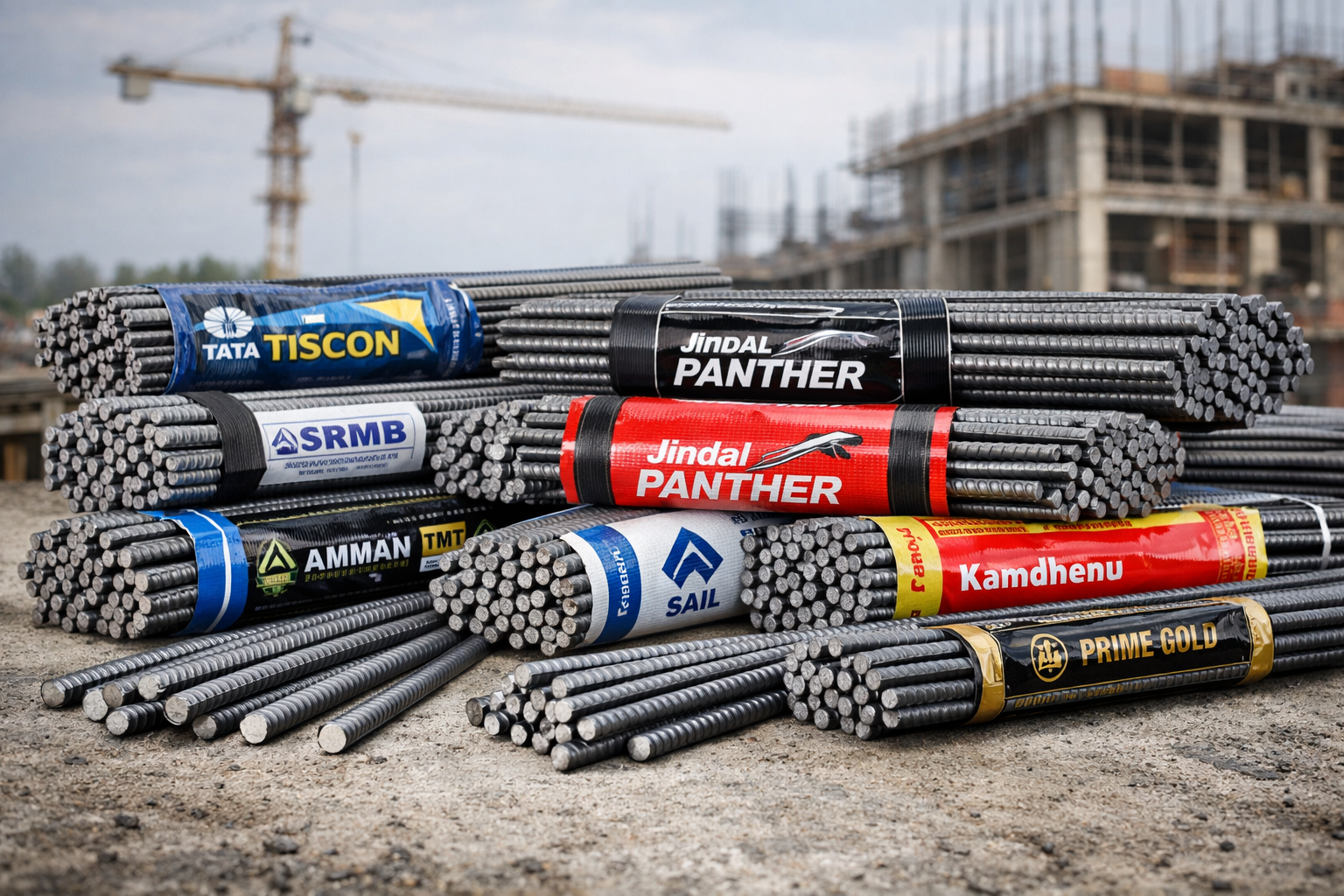
1. Tata Steel TMT Bars
Tata Steel is India's largest integrated steel producer and a pioneer in TMT bar manufacturing. Their TMT bars are manufactured under the brand name "Tata Tiscon" and are widely available across India.
Key Features:
Superior tensile strength (500-550 MPa)
Excellent earthquake resistance (IS 1786:2008 certified)
Lower carbon content for better weldability
Consistent quality across all production facilities
Price Range (as of 2024): ₹55,000 to ₹62,000 per metric ton (subject to market fluctuations)
Availability: Pan-India distribution network with presence in all major cities including Delhi, Mumbai, Bangalore, Chennai, Kolkata, and Hyderabad.
2. JSW Steel TMT Bars
JSW Steel is India's second-largest steel producer and offers TMT bars under the "JSW Jindal TMT" brand. Known for consistent quality and competitive pricing, JSW has become a preferred choice for many construction companies.
Key Features:
High yield strength (500 MPa)
Enhanced corrosion resistance
Good weldability and bendability
Competitive pricing without compromising quality
Price Range (as of 2024): ₹52,000 to ₹59,000 per metric ton
Availability: Strong presence in Western and Southern India, with expanding distribution in Northern and Eastern regions.
3. Jindal Steel & Power Limited (JSPL)
JSPL offers TMT bars under multiple brand names including "Jindal Panther" and "Jindal Smiles." The company is known for its advanced manufacturing technology and quality control measures.
Key Features:
Advanced thermal treatment technology
Superior surface finish
Excellent ductility (elongation > 12%)
Cost-effective options for budget-conscious builders
Price Range (as of 2024): ₹50,000 to ₹57,000 per metric ton
Availability: Primarily available in North and Central India, with growing presence in other regions.
4. Sail (Steel Authority of India Limited)
As a government-owned enterprise, Sail produces TMT bars under the "Sail Shaktiman" brand. These bars are known for their reliability and are often preferred for government and public sector projects.
Key Features:
Government-backed quality assurance
Competitive pricing
Good availability in government projects
Reliable supply chain
Price Range (as of 2024): ₹48,000 to ₹55,000 per metric ton
Availability: Available across India with stronger presence in Eastern and Central regions.
5. Essar Steel TMT Bars
Essar Steel offers high-quality TMT bars manufactured using state-of-the-art technology. Their products are known for consistency and reliability in the construction sector.
Key Features:
Superior bend test performance
Enhanced corrosion resistance
Excellent weldability
Competitive market pricing
Price Range (as of 2024): ₹51,000 to ₹58,000 per metric ton
Availability: Available across major Indian markets with strong presence in Western India.
6. Dalmia TMT Bars
Dalmia Steel is a regional player that has gained significant traction in Central and Eastern India. They offer quality TMT bars at competitive prices.
Key Features:
Cost-effective pricing
Good quality standards
Regional availability
Suitable for budget projects
Price Range (as of 2024): ₹48,000 to ₹54,000 per metric ton
Availability: Primarily available in Central and Eastern India.
Comparative Analysis: Which Brand Should You Choose?
Quality vs. Price Comparison
The TMT steel market in India can be segmented into three categories:
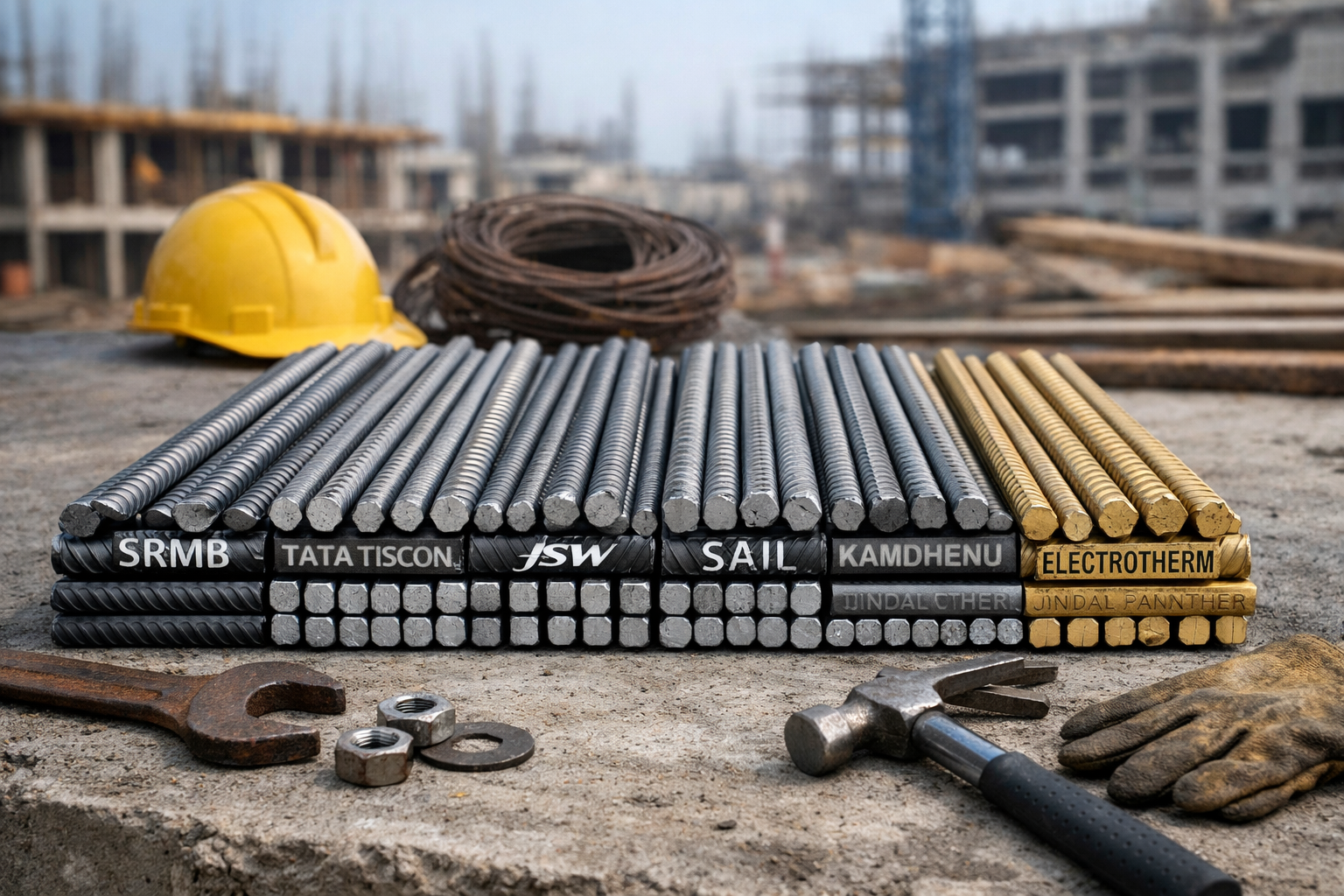
Premium Brands: Tata Tiscon, JSPL Panther — Higher price (₹55,000-₹62,000/MT), superior quality, best for critical projects
Mid-Range Brands: JSW, Essar — Balanced pricing (₹51,000-₹59,000/MT), good quality, suitable for most residential projects
Budget Brands: Sail, Dalmia — Competitive pricing (₹48,000-₹55,000/MT), acceptable quality, ideal for cost-conscious builders
Strength Specifications Comparison
Most leading TMT brands in India meet or exceed IS 1786:2008 standards. Here's what you should look for:
Tensile Strength: 500-550 MPa (all premium brands meet this)
Yield Strength: 400-500 MPa
Elongation: Minimum 12% (indicates ductility)
Bend Test: Should pass 180-degree bend test without cracking
Earthquake Resistance Performance
For projects in seismic zones (which includes most of India's major cities), choose brands with proven earthquake resistance:
Tata Tiscon — Excellent performance in seismic testing
JSW Steel — Good seismic performance ratings
JSPL — Strong earthquake resistance credentials
Sail Shaktiman — Reliable seismic performance
How to Verify TMT Steel Bar Quality
Check for Proper Certification
Before purchasing TMT steel bars, verify that they carry the following certifications:
IS 1786:2008: Indian Standard for TMT bars
BIS (Bureau of Indian Standards) Mark: Mandatory for all TMT bars sold in India
Third-party testing certificates: Independent lab reports confirming strength properties
Physical Inspection Guidelines
When receiving TMT bars at your construction site, check for:
Surface finish: Should be smooth without deep cracks or pitting
Straightness: Bars should not be bent or twisted
Markings: Brand name and size should be clearly embossed
Weight verification: Confirm weight matches specifications (typically 8-12 kg per meter for 8mm to 16mm bars)
Testing at Construction Site
For large projects, conduct the following tests:
Tensile strength test: Verify yield and ultimate tensile strength
Bend test: Ensure bars can bend without cracking
Weight check: Verify bars meet weight specifications
Price Trends and Market Factors in India
Current Market Scenario (2024)
TMT steel prices in India have been relatively stable compared to previous years, hovering between ₹48,000 to ₹62,000 per metric ton depending on brand and quality. Several factors influence these prices:
Iron ore prices: International iron ore costs directly impact TMT pricing
Fuel costs: Energy expenses affect manufacturing costs
Import duties: Government policies on steel imports
Seasonal demand: Construction season (October-May) typically sees higher prices
Regional variations: Prices vary by 5-10% across different states due to transportation costs
Regional Price Variations
TMT steel prices vary across India's major markets:
Delhi/NCR: ₹52,000-₹60,000/MT (high transportation costs from mills)
Mumbai: ₹51,000-₹59,000/MT (proximity to Western mills)
Bangalore: ₹52,000-₹60,000/MT (Southern market rates)
Kolkata: ₹49,000-₹57,000/MT (Eastern market rates)
Hyderabad: ₹50,000-₹58,000/MT (Central market rates)
Selecting TMT Bars for Your Project: A Practical Guide
For Residential Projects
For typical residential construction (apartments, villas, individual houses), mid-range brands like JSW Steel or Essar offer the best value. These brands provide excellent quality at competitive prices without unnecessary premium charges.
Recommended diameter: 8mm, 10mm, 12mm, and 16mm for typical residential structures.
For Commercial and High-Rise Projects
Commercial projects, especially those in seismic zones, demand premium brands. Tata Tiscon and JSPL Panther are preferred choices for:
High-rise buildings
Seismic zone projects
Projects with critical load requirements
Infrastructure projects
For Government and Public Sector Projects
Government projects often mandate specific brands or require compliance with stringent quality standards. Sail Shaktiman and Tata Tiscon are commonly specified in government tenders due to their reliability and quality assurance.
Using AECORD for TMT Steel Bar Procurement
AECORD, India's leading B2B2C AECO marketplace, simplifies the process of sourcing TMT steel bars from verified suppliers. The platform allows you to:
Compare prices: View real-time pricing from multiple suppliers across different regions
Verify suppliers: Access detailed information about supplier credentials and certifications
Check product specifications: Review detailed product information and certification documents
Place bulk orders: Negotiate competitive pricing for large quantity purchases
Track deliveries: Monitor order status and ensure timely delivery to your site
By using AECORD, builders and contractors can ensure they're getting quality TMT steel bars at competitive prices while maintaining complete transparency in the procurement process.
Common Mistakes to Avoid When Buying TMT Steel
1. Buying Based on Price Alone
The cheapest TMT bars may not offer the best value. A ₹2,000-3,000 per ton difference might indicate lower quality or inferior manufacturing standards. Always prioritize quality certifications over marginal price savings.
2. Ignoring Certification Requirements
Never compromise on BIS certification or IS 1786:2008 compliance. These standards exist to ensure structural safety.
3. Not Verifying Supplier Credentials
Purchase TMT bars only from authorized dealers and distributors of recognized brands. Counterfeit or substandard products are a significant problem in the Indian market.
4. Overlooking Seismic Compliance
Even if your project is not in a designated seismic zone, choosing TMT bars with superior earthquake resistance provides added safety margins.
5. Skipping Quality Testing
For large projects, always conduct third-party testing of TMT bars to verify compliance with specifications.
Future Trends in TMT Steel Market
Technological Advancements
Indian steel manufacturers are increasingly adopting advanced manufacturing technologies that improve:
Consistency in product quality
Environmental sustainability
Corrosion resistance
Weldability characteristics
Sustainability Focus
Leading brands are investing in eco-friendly manufacturing processes. Expect to see more TMT bars produced using renewable energy and recycled steel in the coming years.
Price Stability
As domestic steel production increases and supply chains stabilize, TMT steel prices are expected to remain relatively stable, with fluctuations primarily driven by international commodity prices.
Conclusion
Choosing the right TMT steel bar brand is crucial for ensuring the structural integrity and longevity of your construction project. While premium brands like Tata Tiscon offer superior quality and reliability, mid-range options from JSW Steel and Essar provide excellent value for most residential projects. Budget-conscious builders can opt for Sail or Dalmia without significantly compromising quality, provided they verify certifications and conduct proper quality checks.
The key is to balance your project requirements, budget constraints, and quality standards. For critical projects in seismic zones or high-rise structures, invest in premium brands. For standard residential projects, mid-range brands offer the best value proposition. Always verify BIS certification, conduct site inspections, and consider using platforms like AECORD for transparent and competitive procurement.
Frequently Asked Questions
Q1: What is the difference between TMT and mild steel bars?
TMT (Thermo-Mechanically Treated) bars have superior strength, ductility, and earthquake resistance compared to mild steel bars. TMT bars undergo a specialized heat treatment process that creates a unique crystalline structure, resulting in a tensile strength of 500-550 MPa. Mild steel bars, on the other hand, have a tensile strength of only 250 MPa and are more prone to cracking during earthquakes. TMT bars are mandatory for all modern construction projects in India as per IS 1786:2008 standards.
Q2: How much TMT steel is required for a typical residential building?
The quantity of TMT steel required depends on several factors including building height, design specifications, and local building codes. As a general rule of thumb, a typical 5-story residential building requires approximately 80-100 kg of TMT steel per square meter of built-up area. For a 1,500 sq ft (approximately 140 sq m) apartment, you would need roughly 11,000-14,000 kg of TMT steel. It's best to consult with your structural engineer for accurate quantity calculations based on your specific design.
Q3: Are all TMT brands available in smaller towns and cities?
Premium brands like Tata Tiscon and JSW Steel have pan-India distribution networks and are available even in smaller towns. However, availability may be limited in very remote areas. Regional brands like Dalmia and JSPL may have stronger presence in specific regions. If you're building in a smaller city, it's advisable to check availability with local dealers or use AECORD's platform to connect with suppliers in your region. Most suppliers can arrange delivery even to remote locations, though transportation costs may be higher.
Q4: How can I verify if TMT bars are genuine and not counterfeit?
To verify authenticity, check for: (1) Clear BIS mark and certification number embossed on the bars, (2) Brand name and manufacturer details clearly visible, (3) Valid BIS certificate from the supplier, (4) Weight verification matching specifications, and (5) Surface finish quality. You can also contact the brand directly with the batch number to verify authenticity. For large projects, conduct third-party testing through NABL (National Accreditation Board for Testing and Calibration Laboratories) accredited labs. Counterfeit TMT bars are a serious issue in India, so always purchase from authorized dealers.
Q5: What is the shelf life of TMT steel bars?
TMT steel bars do not have an expiry date and can be stored indefinitely without losing their structural properties, provided they are stored properly. However, proper storage is crucial: keep bars in a dry location protected from moisture and rain, ensure good air circulation to prevent rust formation, and store them on wooden supports rather than directly on the ground. If bars develop surface rust due to improper storage, they can be cleaned before use without affecting their structural properties. For projects spanning several months, ensure proper site storage management to maintain bar quality.