

Updated 2026-05-28 — 2026 ₹/sq.ft and NBC 2016 compliance.
Staircase Design and Cost in India 2026: A Comprehensive Guide
Staircases are one of the most critical architectural elements in multi-level buildings, yet they're often overlooked during the planning phase. Whether you're designing a residential villa in Bangalore, a commercial office in Mumbai, or a retail space in Delhi, understanding staircase design principles and current costs is essential for budgeting and aesthetic appeal. As we move into 2026, material prices, design trends, and building regulations continue to evolve, making it crucial for architects, contractors, and homeowners to stay informed.
This comprehensive guide covers everything you need to know about staircase design and costs in India, from basic design principles to material selection and regulatory compliance.
Build cost · Bengaluru, May 2026
Understanding Staircase Design Fundamentals
Key Design Parameters
Before diving into costs, it's important to understand the fundamental design parameters that govern staircase construction in India. These parameters ensure safety, comfort, and compliance with building codes.
Riser Height: The vertical distance between consecutive steps, typically 150-190mm in India. The standard recommended height is 175mm for residential buildings.
Tread Depth: The horizontal distance of each step, usually 250-300mm. A comfortable tread depth is 280mm, following the formula: 2 × Riser + Tread = 550-600mm.
Staircase Width: Minimum 900mm for residential buildings, 1200mm for commercial spaces, and up to 1800mm for high-traffic areas.
Handrail Height: 850-900mm from the stair surface, mandatory for all staircases above 600mm height.
Flight Length: Maximum 12 steps per flight before requiring a landing.
These parameters are governed by the National Building Code of India (NBC) 2016, which all architects and builders must follow. Deviations require special approvals from municipal authorities.
Types of Staircases
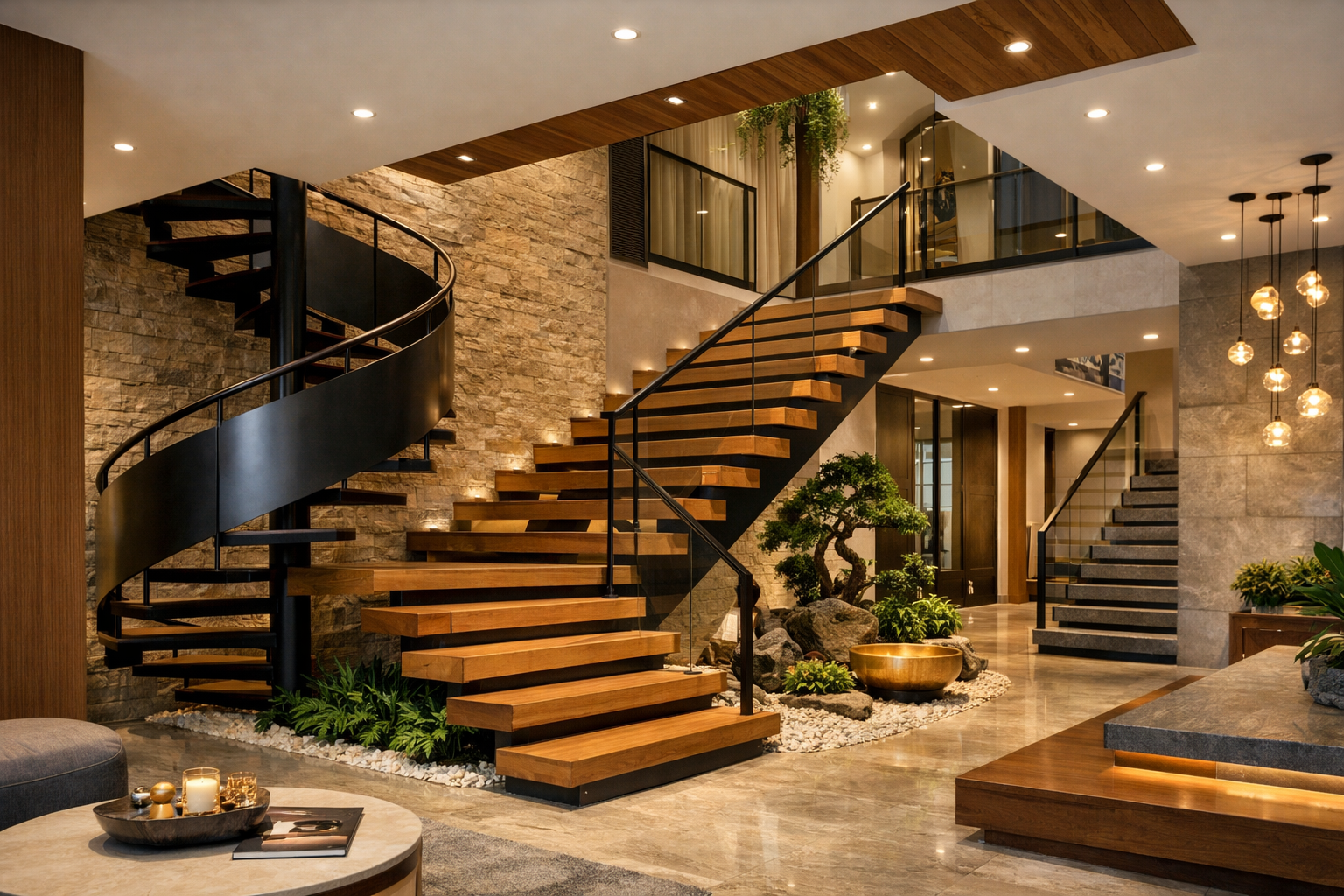
Different staircase types serve different purposes and have varying cost implications:
Straight Staircase: The simplest and most economical design, ideal for narrow spaces. Cost-effective but requires more horizontal space.
L-Shaped Staircase: Features a 90-degree turn with a landing. More space-efficient than straight staircases and increasingly popular in modern Indian homes.
U-Shaped Staircase: Has a 180-degree turn, creating a compact footprint. Requires careful planning but maximizes usable space.
Spiral Staircase: Circular design with minimal footprint, ideal for tight spaces or as a design statement. More expensive due to complex engineering.
Floating Staircase: Modern design with minimal support structure, creating a visually light appearance. Requires advanced structural engineering and premium materials.
Curved Staircase: Elegant, flowing design often used in luxury homes. Most expensive option due to custom fabrication requirements.
Frequently asked
Material Options and Pricing in 2026
Concrete Staircases
Concrete remains the most common staircase material in India due to its durability and cost-effectiveness. In 2026, concrete staircase costs range from ₹800 to ₹2,500 per square foot, depending on the design complexity and finish quality.
Cost Breakdown:
Basic RCC staircase: ₹800-₹1,200/sq.ft
Finished concrete with tiles: ₹1,200-₹1,800/sq.ft
Polished concrete finish: ₹1,500-₹2,200/sq.ft
Decorative concrete with patterns: ₹2,000-₹2,500/sq.ft
For a standard 10-step staircase (approximately 30 sq.ft), expect to spend ₹24,000 to ₹75,000 for concrete construction alone, excluding finishes.
Marble and Granite Staircases
Premium natural stone staircases are popular in luxury residential projects across metros like Delhi, Mumbai, and Bangalore. Marble and granite add elegance but significantly increase costs.
Current Pricing (2026):
Indian marble (standard grades): ₹2,500-₹4,500/sq.ft
Imported marble: ₹5,000-₹12,000/sq.ft
Granite (Indian): ₹2,000-₹4,000/sq.ft
Premium granite: ₹4,500-₹8,000/sq.ft
A marble staircase for a 30 sq.ft space could cost ₹75,000 to ₹3,60,000, depending on marble quality and origin. Labor costs for marble installation add another ₹15,000-₹35,000.
Wooden Staircases
Wood staircases offer warmth and aesthetic appeal, particularly in residential settings. Costs vary dramatically based on wood type and finish quality.
Wood Type Pricing:
Plywood with laminate finish: ₹1,500-₹3,000/sq.ft
Engineered wood: ₹2,500-₹5,000/sq.ft
Solid wood (local): ₹4,000-₹7,000/sq.ft
Premium hardwood (teak, rosewood): ₹8,000-₹18,000/sq.ft
A 30 sq.ft wooden staircase with premium hardwood and custom railings could cost ₹2,40,000 to ₹5,40,000, including installation and finishing.
Steel and Glass Staircases
Modern commercial and contemporary residential projects increasingly feature steel and glass combinations. These create striking visual impacts but require specialized fabrication.
Cost Range:
Basic steel staircase with glass: ₹3,000-₹6,000/sq.ft
Custom-designed steel staircase: ₹6,000-₹12,000/sq.ft
High-end designer steel staircases: ₹12,000-₹25,000/sq.ft
Steel staircases require structural engineering approval and are typically 40-60% more expensive than concrete alternatives due to fabrication complexity.
Composite and Engineered Materials
Newer materials like engineered quartz, porcelain tiles, and composite materials are gaining traction in 2026:
Porcelain tile staircases: ₹2,000-₹4,500/sq.ft
Engineered quartz: ₹3,500-₹7,000/sq.ft
Laminate finishes: ₹1,200-₹2,500/sq.ft
Cost-at-a-glance: staircase type × material (2026, ₹/sq.ft installed)
| Type | RCC+tile | Indian marble | Solid wood | Steel+glass |
|---|---|---|---|---|
| Straight / RCC dogleg | ₹1,200–1,800 | ₹2,500–4,500 | ₹4,000–7,000 | ₹3,000–6,000 |
| L-shape / U-shape | ₹1,400–2,000 | ₹2,800–4,800 | ₹4,500–7,500 | ₹3,500–6,500 |
| Spiral steel | — | — | ₹5,500–9,000 | ₹6,000–12,000 |
| Floating / cantilever | — | ₹6,000–10,000 | ₹8,000–15,000 | ₹10,000–25,000 |
| Curved / helical | ₹2,200–3,200 | ₹5,500–9,000 | ₹9,000–18,000 | ₹12,000–25,000 |
Metro installed rates; tier-2 ~10–15% lower. Excludes balustrade + lighting.
Detailed Cost Breakdown for Common Scenarios
Residential Villa Staircase (Delhi/NCR Region)
Project Specifications:
Type: L-shaped, 15 steps
Material: Marble treads with granite risers
Staircase area: 40 sq.ft
Handrails: Wrought iron with brass finish
Cost Estimation:
Structural work (RCC): ₹35,000-₹45,000
Marble and granite: ₹1,60,000-₹2,40,000
Handrails and balusters: ₹40,000-₹70,000
Installation and finishing: ₹35,000-₹50,000
Total: ₹2,70,000-₹4,05,000
Commercial Office Building (Mumbai)
Project Specifications:
Type: Straight staircase with landing
Material: Polished concrete with ceramic tiles
Width: 1500mm (high-traffic area)
Staircase area: 60 sq.ft
Safety features: Handrails on both sides, anti-slip treads
Cost Estimation:
RCC structural work: ₹50,000-₹70,000
Ceramic tiling and finishing: ₹60,000-₹90,000
Safety railings (steel/glass): ₹50,000-₹80,000
Lighting integration: ₹20,000-₹35,000
Installation: ₹30,000-₹45,000
Total: ₹2,10,000-₹3,20,000
Apartment Building Staircase (Bangalore)
Project Specifications:
Type: U-shaped, 24 steps across 4 floors
Material: Concrete with vitrified tiles
Width: 1200mm (standard residential)
Total staircase area: 100 sq.ft
Cost Estimation:
RCC structural work: ₹80,000-₹1,10,000
Vitrified tile finishing: ₹80,000-₹1,20,000
Handrails and balusters: ₹50,000-₹75,000
Installation: ₹40,000-₹60,000
Total: ₹2,50,000-₹3,65,000
Design Trends in 2026
Minimalist and Floating Designs
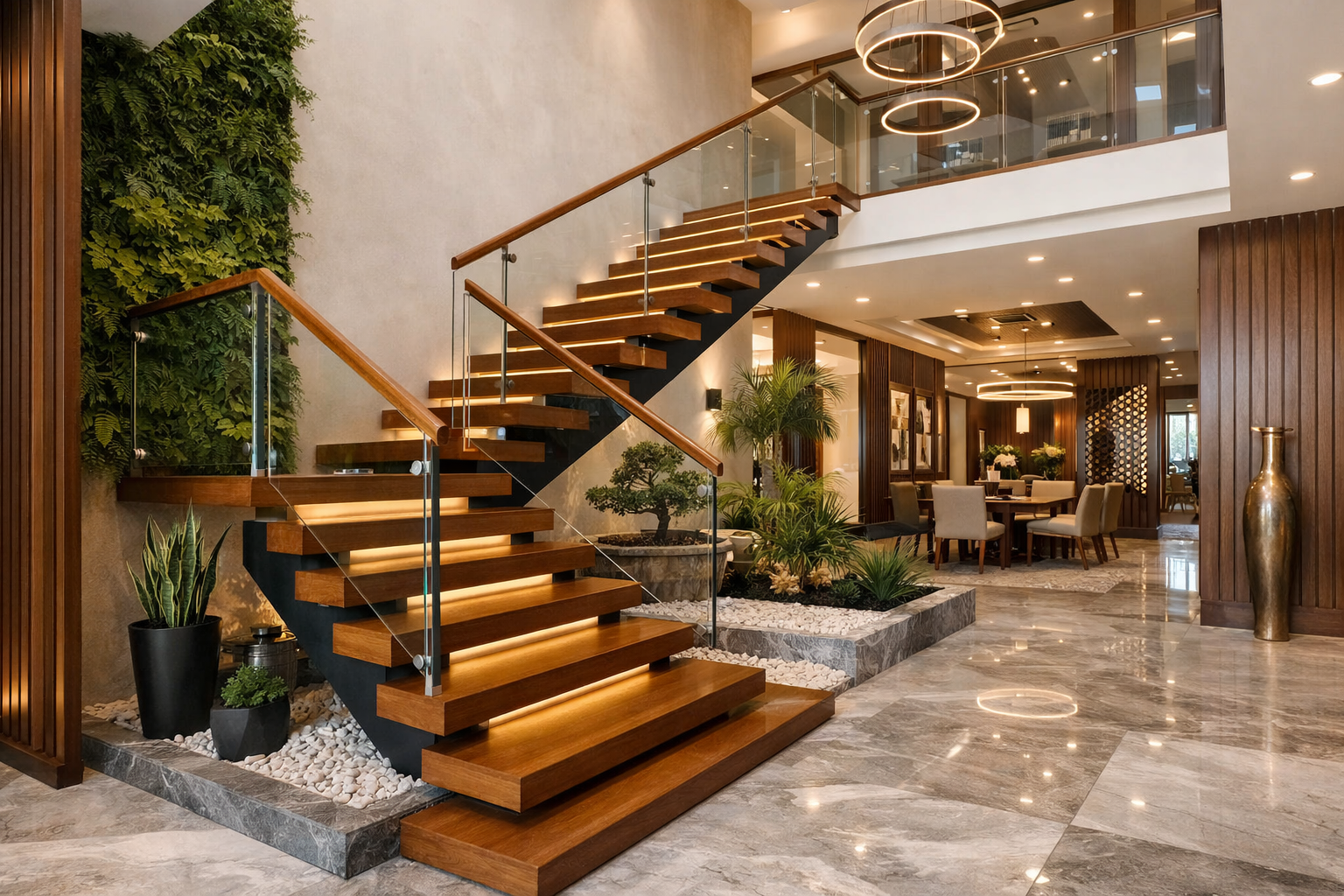
Contemporary Indian architecture increasingly favors floating staircases with minimal visual obstruction. These designs create an illusion of lightness and are particularly popular in modern villas and penthouses. However, they command a premium of 50-80% over conventional designs due to advanced structural engineering requirements.
Sustainability and Eco-Friendly Materials
Green building practices are influencing staircase design. Recycled materials, locally-sourced stone, and sustainable wood options are becoming mainstream. These materials often cost 10-20% more but align with LEED and IGBC certification requirements.
Smart Staircase Integration
LED lighting integrated into treads, motion sensors, and even smart handrails with health monitoring are emerging in premium projects. These additions cost ₹50,000-₹2,00,000 depending on complexity.
Curved and Sculptural Forms
Architects are moving beyond geometric shapes toward organic, flowing designs. Custom-curved staircases cost 60-100% more than standard designs but serve as architectural focal points.
Regulatory and Safety Considerations
National Building Code Compliance
All staircases in India must comply with NBC 2016 standards. Key requirements include:
Maximum riser height of 190mm
Minimum tread depth of 250mm
Handrails on at least one side (both sides for width exceeding 1500mm)
Anti-slip surface treatment (minimum COF of 0.5)
Adequate lighting (minimum 50 lux)
Proper landing dimensions and safety zones
Non-compliance can result in penalties and rejection of building approvals. Budget an additional ₹20,000-₹50,000 for structural certification and safety audits.
Fire Safety Regulations
Commercial buildings must ensure staircases meet fire safety codes. This includes non-combustible materials, proper emergency lighting, and clear signage. These requirements add ₹30,000-₹80,000 to project costs.
Accessibility Standards
The Rights of Persons with Disabilities Act mandates accessible design. Staircases should be complemented by ramps or elevators. Budget an additional ₹1,00,000-₹3,00,000 for accessibility features.
Cost-Saving Strategies
Material Selection
Choosing locally-available materials can reduce costs by 20-30%. For instance, using Indian marble instead of imported varieties or local granite instead of premium imported stone significantly impacts the budget.
Design Simplification
Straight and L-shaped staircases are inherently cheaper than spiral or curved designs. Simplifying the design without compromising aesthetics can save ₹50,000-₹1,50,000.
Phased Construction
For large projects, constructing staircases in phases allows for better budget management and material procurement at optimal prices.
Bulk Material Procurement
For multi-building projects, bulk ordering of materials like tiles, stone, and steel can yield discounts of 10-25%.
Local Labor Utilization
Hiring skilled local craftspeople instead of specialized firms can reduce labor costs by 15-25%, though this requires careful quality oversight.
Hiring the Right Professionals
Architects and Structural Engineers
Professional fees typically range from 5-12% of the staircase project cost. For a ₹3,00,000 staircase, expect to pay ₹15,000-₹36,000 for design and engineering services.
Contractors and Fabricators
Experienced contractors can help optimize designs for cost-efficiency. It's advisable to get 3-4 quotes and compare not just pricing but also experience with similar projects.
Using AECORD for Professional Connections
Platforms like AECORD connect homeowners and developers with verified architects, engineers, and contractors across India. You can compare portfolios, read reviews, and get transparent quotes for staircase projects. This reduces the risk of cost overruns and ensures quality workmanship.
Timeline and Project Management
A typical staircase project timeline includes:
Design Phase: 2-4 weeks
Approvals: 2-6 weeks (varies by municipality)
Material Procurement: 2-4 weeks
Construction: 4-8 weeks (depending on complexity)
Finishing and Installation: 2-4 weeks
Total Timeline: 3-6 months
Delays in approvals or material sourcing can extend timelines significantly. Building in a 20-30% time buffer is prudent.
Common Mistakes to Avoid
Ignoring NBC Standards: Non-compliance leads to rejections and costly rework.
Poor Space Planning: Inadequate staircase dimensions create safety hazards and user discomfort.
Underestimating Costs: Hidden expenses like structural reinforcement or accessibility features often surprise project managers.
Choosing Inappropriate Materials: Using non-slip materials in high-moisture areas or poor-quality finishes that deteriorate quickly.
Skipping Professional Consultation: DIY designs often violate codes and create safety risks.
Inadequate Ventilation and Lighting: Poorly lit staircases are safety hazards and appear dingy.
Future Outlook for 2026 and Beyond
Several trends are expected to shape staircase design and costs in 2026:
Material Cost Inflation: Expect 5-10% annual increases in premium materials like imported marble and specialty wood.
Labor Cost Growth: Skilled labor costs are rising at 8-12% annually in metros, affecting installation expenses.
Technology Integration: Smart features will become standard in premium projects, adding 10-20% to costs.
Sustainability Focus: Green building certifications will drive demand for eco-friendly materials and designs.
Modular Solutions: Pre-fabricated staircase components will gain popularity, potentially reducing on-site construction time by 30-40%.
Conclusion
Staircase design and construction in India involves a complex interplay of design principles, material selection, regulatory compliance, and budget management. As of 2026, costs range from ₹800 to ₹25,000 per square foot depending on materials and complexity, with total project costs typically ranging from ₹2,00,000 to ₹5,00,000 for residential applications.
For a closer look at what this involves, see our guide to Floor Plan vs Elevation vs Section.
The key to successful staircase projects is early planning, professional consultation, and adherence to building codes. By understanding the factors that influence costs and staying informed about current market prices, you can make informed decisions that balance aesthetics, functionality, and budget.
Whether you're building a modest home or a premium commercial space, investing time in proper design and material selection ensures your staircase is both safe and beautiful for years to come.
Frequently Asked Questions
What is the most cost-effective staircase material in India in 2026?
Concrete with ceramic tile finish remains the most cost-effective option, ranging from ₹1,200-₹1,800 per square foot. It offers durability, low maintenance, and compliance with building codes at a fraction of the cost of marble or wood. For even greater savings, basic RCC without premium finishes can cost as low as ₹800-₹1,200 per square foot.
How much should I budget for a standard residential staircase in a 3-story villa?
For a typical 3-story villa with L-shaped or U-shaped staircases (approximately 40-60 sq.ft total), budget ₹2,50,000-₹4,00,000 for concrete with marble/granite finish, including design, structural work, materials, and installation. Premium designs with hardwood or custom steel can range from ₹4,00,000-₹8,00,000. Always add 15-20% contingency for unforeseen costs.
Are floating staircases worth the extra cost?
Floating staircases cost 50-80% more than conventional designs (₹4,000-₹15,000 per sq.ft vs. ₹1,200-₹3,000) due to advanced structural engineering and custom fabrication. They're worth the investment if you prioritize modern aesthetics and have adequate structural capacity. They're particularly suitable for contemporary homes, penthouses, and commercial spaces where visual impact matters. However, for budget-conscious projects, traditional designs offer better value.
What are the key NBC compliance requirements I must follow?
Critical NBC 2016 requirements include: maximum riser height of 190mm, minimum tread depth of 250mm, staircase width of at least 900mm for residential (1200mm for commercial), handrails at 850-900mm height, maximum 12 steps per flight, and anti-slip surface treatment. Non-compliance can result in building rejection and penalties. Always consult a structural engineer to ensure your design meets these standards.
How can I reduce staircase project costs without compromising quality?
Several strategies can reduce costs by 15-30%: (1) Choose locally-available materials like Indian marble or granite instead of imported varieties, (2) Opt for simpler designs like straight or L-shaped staircases, (3) Use ceramic tiles instead of premium stone, (4) Hire local skilled contractors instead of premium firms, (5) Bulk-order materials for multiple buildings, and (6) Use AECORD or similar platforms to get competitive quotes from multiple vendors. Plan ahead to avoid rush charges and material wastage.