

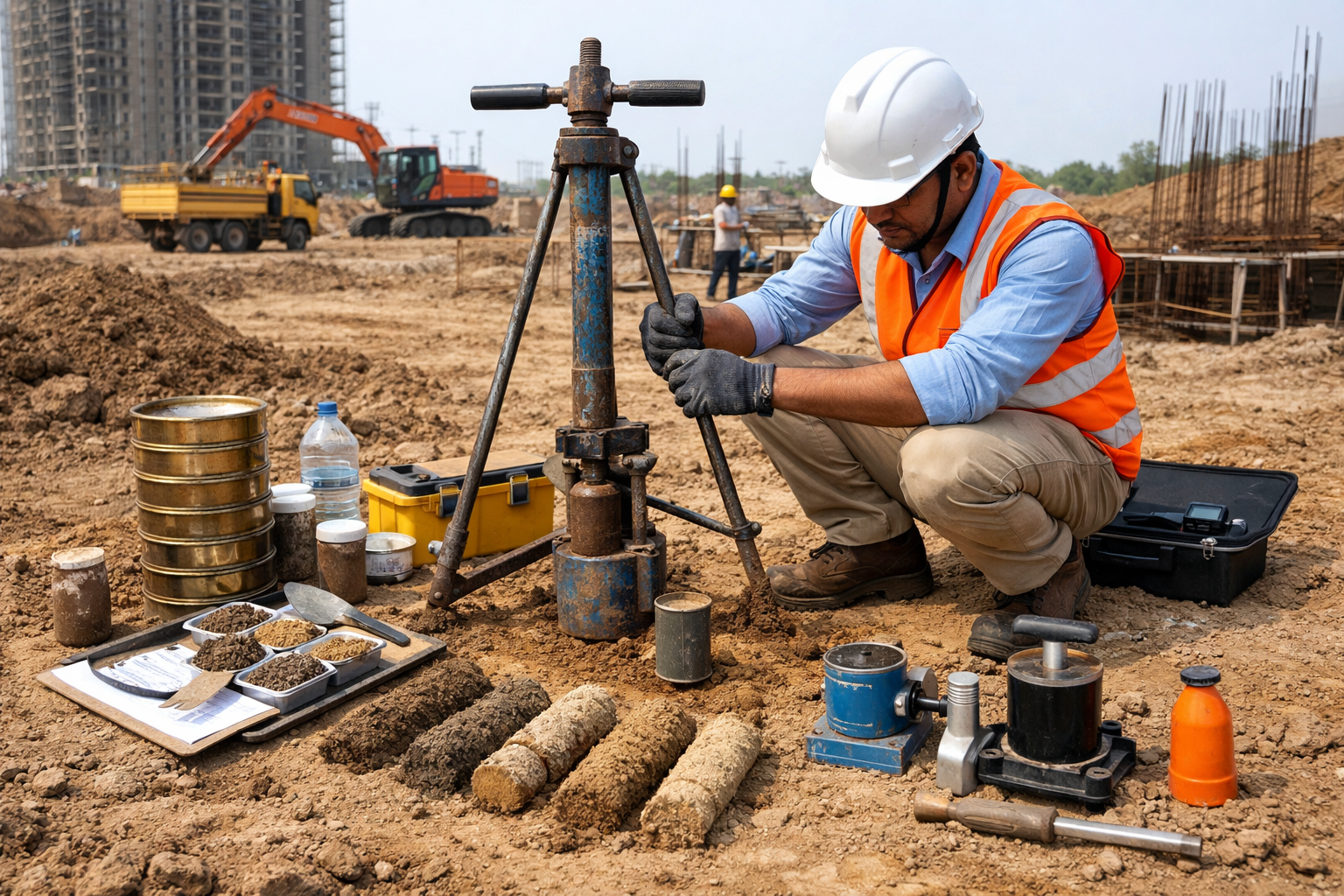
Soil Testing for Construction in India: Complete Guide to Cost, Process & Importance
Soil testing is one of the most critical yet often overlooked phases in construction projects across India. Whether you're planning a residential building in Bangalore, a commercial complex in Mumbai, or an industrial facility in Delhi, understanding soil composition and bearing capacity is essential for structural safety and longevity. This comprehensive guide covers everything you need to know about soil testing costs, procedures, and regulations in India.
Build cost · Bengaluru, May 2026
Why Soil Testing is Critical for Construction Projects
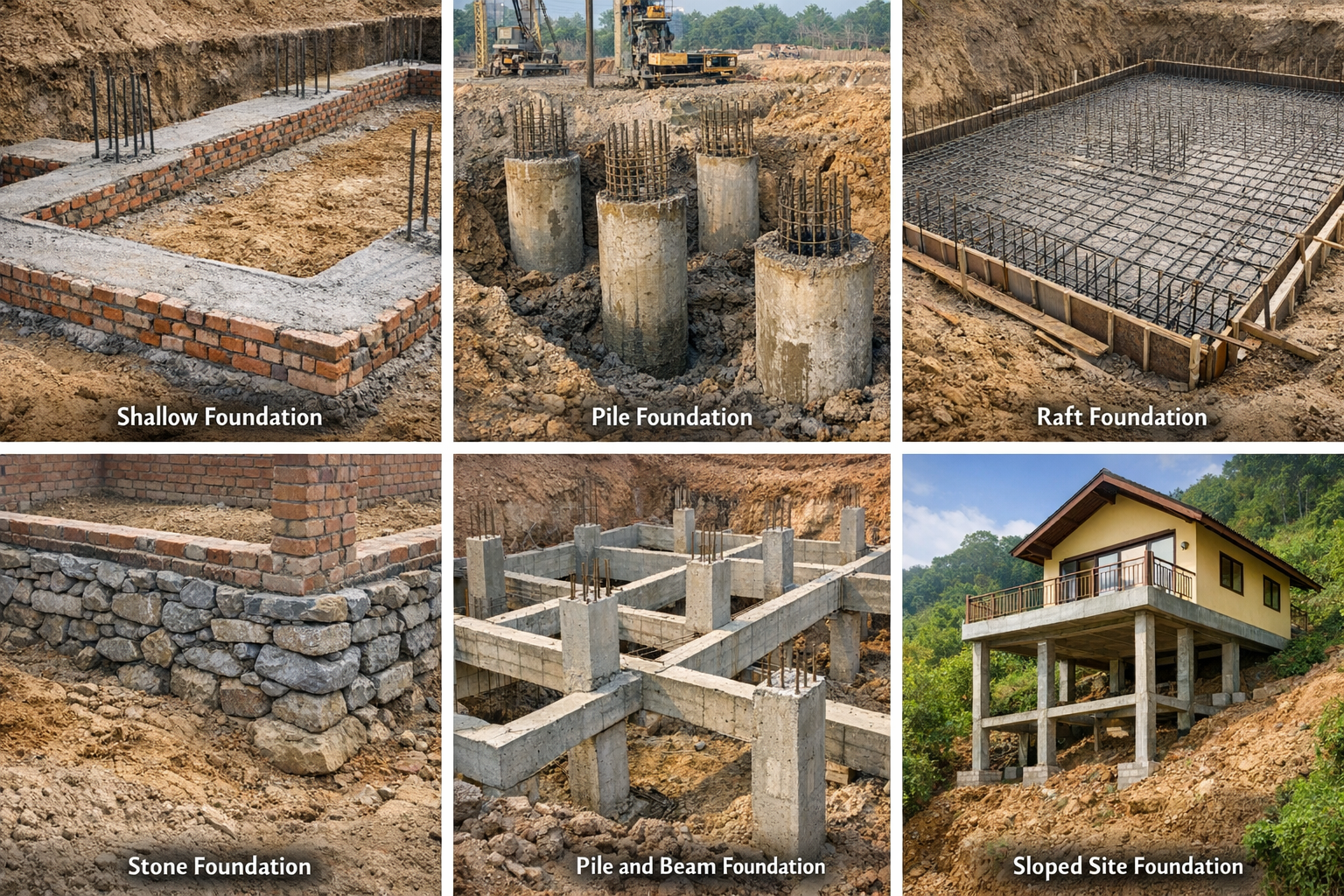
The foundation of any structure depends entirely on the soil beneath it. Soil testing determines whether your construction site can safely support the planned structure's weight and what type of foundation design is required. In India, where geological conditions vary dramatically from coastal alluvial soils in Kerala to rocky terrain in Himachal Pradesh, soil investigation is non-negotiable.
Poor soil assessment has led to numerous structural failures across Indian cities. The 2001 Bhuj earthquake exposed weaknesses in structures built without proper soil investigations. Similarly, many buildings in Mumbai and Pune have experienced foundation issues due to inadequate soil testing before construction commenced.
Understanding the Soil Testing Process in India
Phase 1: Preliminary Site Investigation
The soil testing process begins with a visual assessment of the site. Geotechnical engineers examine:
Surface topography and drainage patterns
Existing geological maps and records
Proximity to water bodies, slopes, or unstable zones
Local construction history and neighboring structures
Climate and seasonal water table variations
This preliminary phase typically costs ₹5,000 to ₹15,000 depending on site accessibility and location.
Frequently asked
Phase 2: Borehole Drilling and Sample Collection
The actual soil investigation involves drilling boreholes at strategic locations across your site. The number of boreholes depends on:
Total plot area
Project type (residential, commercial, industrial)
Planned structure height and load
Local soil variability
Standard guidelines for borehole spacing:
Residential buildings: 1 borehole per 500-1000 sq.m
Commercial buildings: 1 borehole per 400-600 sq.m
Industrial structures: 1 borehole per 300-500 sq.m
For a typical 2000 sq.m residential plot, you would typically need 2-4 boreholes. Each borehole is drilled to a depth of 1.5 to 2 times the width of the proposed foundation, or until stable soil is reached (typically 15-30 meters).
Cost breakdown for borehole drilling:
Manual boring: ₹200-400 per meter
Mechanical boring (rotary): ₹300-600 per meter
Percussion boring: ₹400-800 per meter
Sample collection and preservation: ₹1,000-2,000 per borehole
For a 20-meter deep borehole with mechanical drilling, expect costs around ₹6,000-12,000 per borehole.
Phase 3: Laboratory Testing
Soil samples collected from various depths undergo multiple laboratory tests. The major tests include:
Physical Properties Tests:
Moisture content test: ₹300-500 per sample
Grain size analysis (sieve analysis): ₹800-1,200 per sample
Specific gravity test: ₹400-700 per sample
Atterberg limits test: ₹1,000-1,500 per sample
Strength and Bearing Capacity Tests:
Standard Penetration Test (SPT): ₹500-800 per test (usually conducted during boring)
Unconfined Compression Strength (UCS): ₹1,500-2,500 per sample
Direct Shear Test: ₹2,000-3,500 per sample
Triaxial Compression Test: ₹3,000-5,000 per sample
Other Important Tests:
Permeability test: ₹1,200-2,000 per sample
Consolidation test: ₹2,500-4,000 per sample
California Bearing Ratio (CBR) test: ₹1,500-2,500 per sample
Chemical analysis (pH, sulfates, chlorides): ₹2,000-3,500 per sample
Chemical testing is particularly important in coastal areas like Chennai, Kochi, and Goa where sulfate and chloride content can affect concrete durability.
Total Cost of Soil Testing in India
Let's break down realistic costs for different project types:
Small Residential Project (500-1000 sq.m)
Preliminary investigation: ₹10,000
1 borehole (20m depth): ₹8,000
SPT tests during boring: ₹3,000
Laboratory tests (10 samples, basic suite): ₹15,000-20,000
Report preparation: ₹5,000
Total: ₹41,000-46,000
Medium Residential/Commercial Project (2000-5000 sq.m)
Preliminary investigation: ₹15,000
3 boreholes (20m depth each): ₹24,000
SPT tests: ₹8,000
Laboratory tests (25 samples, comprehensive suite): ₹45,000-60,000
Report preparation and recommendations: ₹10,000
Total: ₹102,000-127,000
Large Commercial/Industrial Project (10,000+ sq.m)
Preliminary investigation: ₹20,000
8-10 boreholes (25-30m depth): ₹80,000-120,000
SPT tests and other in-situ tests: ₹25,000-35,000
Laboratory tests (50+ samples, advanced testing): ₹120,000-180,000
Geotechnical report with foundation design recommendations: ₹20,000-30,000
Total: ₹265,000-385,000
These costs can vary significantly based on:
Geographic location (remote areas cost more)
Soil accessibility and drilling difficulty
Groundwater table depth
Laboratory accreditation and reputation
Complexity of soil strata
Indian Standards and Regulations for Soil Testing
All soil testing in India must comply with Indian Standards (IS) codes:
IS 1892:1979 - Code of practice for subsurface investigation for foundations
IS 1904:1986 - Code of practice for boring and sampling of soils
IS 2131:1981 - Method of standard penetration test
IS 2720 (Parts 1-41) - Methods of test for soils (comprehensive series)
IS 1498:1970 - Classification and identification of soils for general engineering purposes
Many laboratories in India are accredited by NABL (National Accreditation Board for Testing and Calibration Laboratories), which ensures quality and reliability of test results. Always choose NABL-accredited laboratories for critical projects.
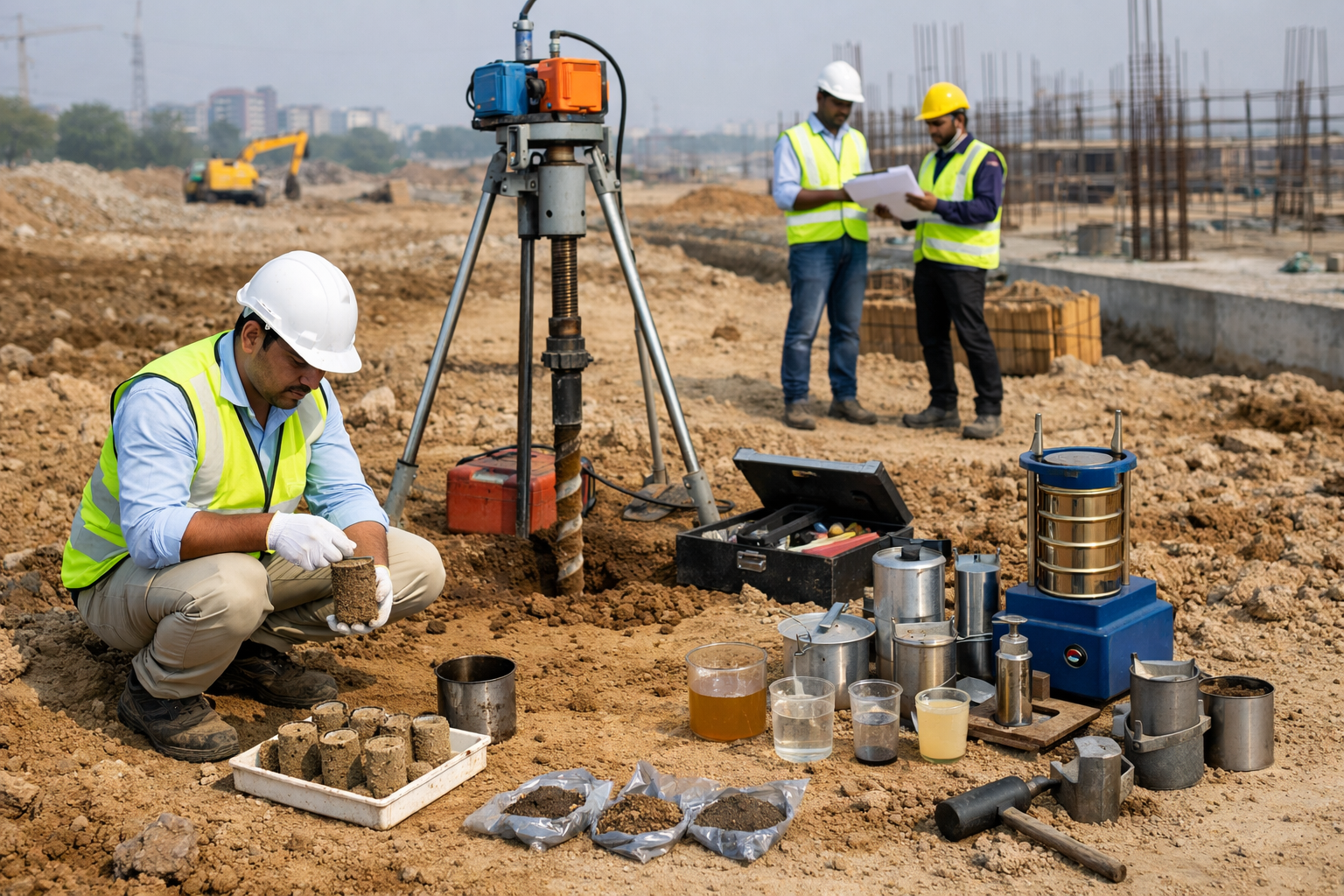
Soil Testing Across Major Indian Cities
Mumbai and Coastal Areas
Coastal projects require additional testing for marine influence. Soil here is predominantly alluvial with high moisture content. Chemical testing for sulfates and chlorides is mandatory. Expected costs are 15-20% higher than inland projects.
Delhi and Northern Plains
NCR region has variable soil conditions—from soft clays to dense sands. Deeper investigations (25-30m) are often necessary. Costs are moderate, averaging ₹2,000-2,500 per meter for boring.
Bangalore and Southern Plateau
Rocky terrain with thin soil cover is common. Boreholes often require percussion boring, increasing costs to ₹400-800 per meter. However, depths are usually less (10-15m).
Kolkata and Eastern Region
High water table and soft clay deposits characterize this region. Piezometers are often installed to monitor groundwater. Testing costs are moderate but require careful interpretation.
What the Soil Testing Report Should Include
A comprehensive geotechnical report from your testing laboratory should contain:
Soil classification and stratigraphy
Groundwater level and seasonal variations
Bearing capacity of soil at various depths
Foundation recommendations (type, depth, design load)
Settlement calculations and predictions
Slope stability analysis (if applicable)
Chemical analysis results for concrete durability
Recommendations for excavation and dewatering
Special construction considerations
Liquefaction potential (for seismic zones)
How AECORD Simplifies Soil Testing Procurement
Finding reliable geotechnical laboratories and testing agencies in India can be challenging. AECORD's B2B2C marketplace connects construction professionals with verified soil testing laboratories across India. Through AECORD, you can:
Compare quotes from multiple accredited laboratories
Verify NABL accreditation and certifications
Access detailed service descriptions and past project reviews
Manage testing projects and timelines efficiently
Maintain organized documentation of all test results
This transparency helps ensure you get quality testing at competitive rates without compromising on standards.
Timeline for Soil Testing
Plan for adequate time before construction begins:
Preliminary investigation: 1-2 days
Borehole drilling: 3-7 days (depending on number and depth)
Sample transportation and preparation: 2-3 days
Laboratory testing: 2-4 weeks (depending on test complexity)
Report preparation and review: 1 week
Total timeline: 4-6 weeks
Start soil testing at least 2-3 months before planned construction commencement to allow for report analysis and foundation design modifications if needed.
Common Mistakes to Avoid
Insufficient boreholes: Skimping on boreholes leads to incomplete soil profile understanding
Shallow boring: Not drilling deep enough misses important bearing strata
Inadequate testing: Doing only basic tests without specialized testing for project requirements
Using non-accredited labs: Unreliable results can lead to structural failures
Ignoring groundwater: Not assessing seasonal water table variations
Delaying investigation: Rushing into construction without proper soil assessment
Red Flags in Soil Testing Reports
Be cautious if your report shows:
Bearing capacity less than 15 tonnes/sq.m (may require deep foundations)
High settlement predictions (above 50mm)
Presence of organic matter or peat layers
High sulfate or chloride content (concrete durability issues)
Liquefaction potential in seismic zones
High water table with poor drainage
These conditions require specialized foundation designs and expert consultation.
Frequently Asked Questions
Q: Is soil testing mandatory for all construction projects in India?
While not legally mandatory for all projects, soil testing is essential for any structure above 4-5 stories or with significant loads. The National Building Code of India (NBC) and most state building bylaws recommend soil investigation for all major construction. For safety and insurance purposes, it's advisable even for smaller projects. Most structural engineers and architects will not proceed without soil test reports.
Q: How deep should boreholes be drilled?
Borehole depth depends on the structure's size and load. General rule: drill to 1.5-2 times the width of the proposed foundation, or until you reach stable bearing strata. For a 30-meter tall building, boreholes typically go 25-35 meters deep. For small residential buildings, 15-20 meters is usually sufficient. Your geotechnical engineer will determine the appropriate depth based on site conditions.
Q: Can I reuse soil testing reports from neighboring properties?
Not recommended. While neighboring soil data provides context, each plot has unique geological conditions. Soil composition can change significantly within short distances, especially in areas with varied topography or past geological activity. Always conduct fresh testing for your specific site. Using outdated or neighboring reports has been a cause of foundation failures in Indian cities.
Q: What's the difference between bearing capacity and safe bearing capacity?
Bearing capacity is the maximum load soil can support before failure. Safe bearing capacity (or allowable bearing capacity) is the bearing capacity divided by a safety factor (typically 2.5-3), accounting for uncertainties and variations. Structural foundations are designed using safe bearing capacity, not ultimate bearing capacity. A soil with 30 tonnes/sq.m bearing capacity might have a safe bearing capacity of 10-12 tonnes/sq.m.
Q: How often should soil testing be repeated for large projects?
For most projects, initial soil testing is sufficient. However, for very large projects (10+ hectares) or those spanning multiple phases, additional testing may be needed for different areas. If significant time passes between testing and construction (over 2-3 years), consider repeating tests to account for seasonal groundwater variations. For ongoing projects with unforeseen soil conditions during excavation, supplementary testing is advisable.
Conclusion
Soil testing is an investment that protects your construction project from costly failures and ensures structural safety for decades. While costs range from ₹40,000 to ₹400,000+ depending on project scale, this is typically 0.1-0.5% of total construction cost—a small price for comprehensive risk mitigation. By following Indian Standards, using NABL-accredited laboratories, and allowing adequate time for investigation and analysis, you establish a solid foundation for successful construction. Whether you're building in Bangalore, Delhi, Mumbai, or any other Indian city, proper soil testing should be your first step after acquiring land.