

Buildings That Breathe: How Hygromorphic Materials Are Quietly Transforming Spaces.
Imagine a wooden facade that opens itself up on a dry summer afternoon and closes when the monsoon rolls in. No motors. No sensors. No code. Just the material doing what it has always done responding to the air around it. /blog/the-10-sustainable-materials-reshaping-commercial-architecture-right-now
That's hygromorphic behaviour. From the Greek hygro (moisture) and morphic (form), it describes materials that change shape, density, or porosity in response to atmospheric humidity entirely passively. For a country with monsoons in Mumbai, dry heat in Jaipur, and coastal humidity in Kochi, this isn't a curiosity. It's a design lever most Indian projects aren't pulling.
Build cost · Bengaluru, May 2026
How It Works
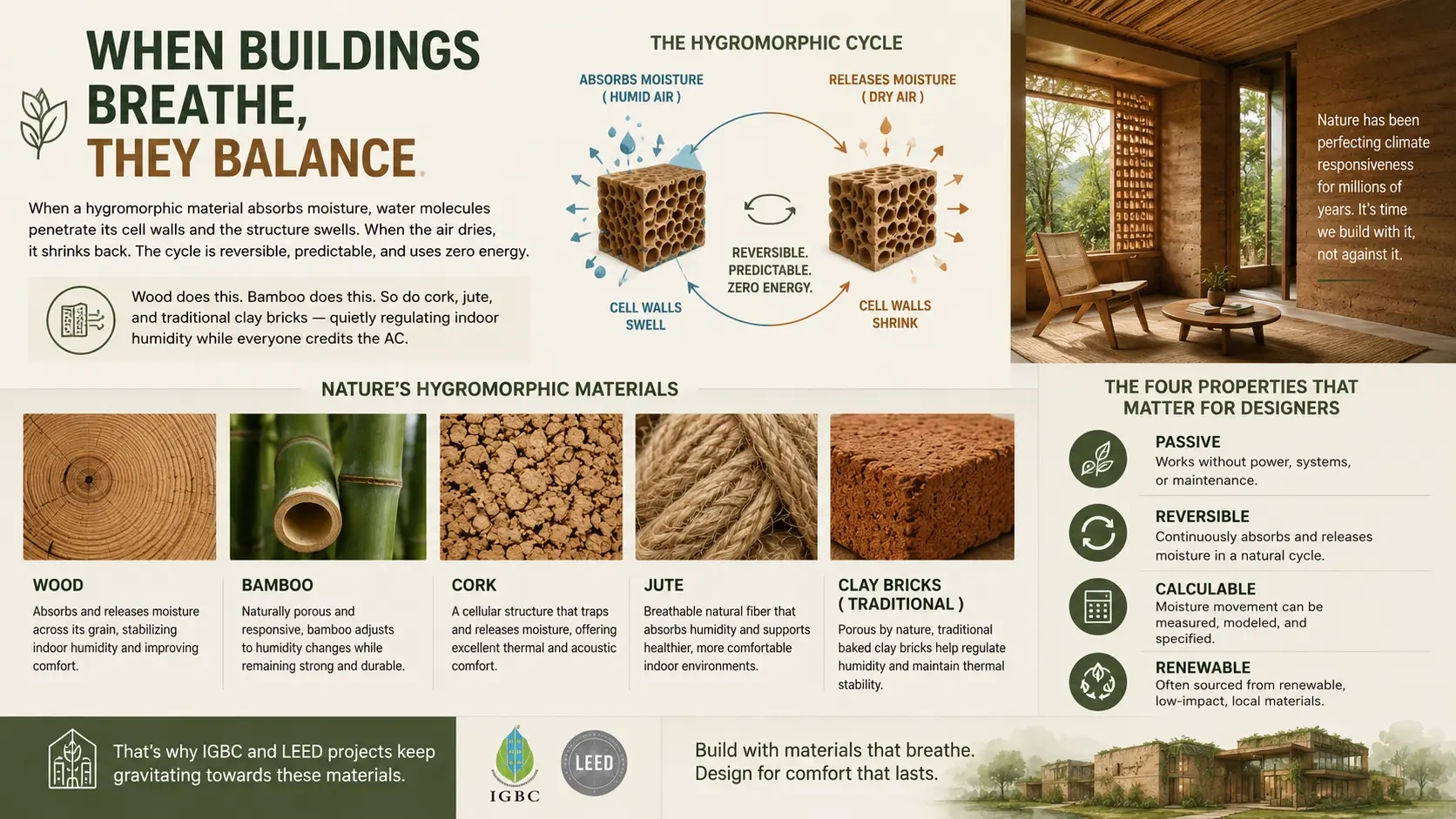
When a hygromorphic material absorbs moisture, water molecules penetrate its cell walls and the structure swells. When the air dries, it shrinks back. The cycle is reversible, predictable, and uses zero energy. Wood does this. Bamboo does this. So do cork, jute, and traditional clay bricks quietly regulating indoor humidity while everyone credits the AC.
The four properties that matter for designers: it's passive, it's reversible, it's calculable, and it's often sourced from renewables. That last point is why IGBC and LEED projects keep gravitating towards these materials.
The Materials Worth Knowing
Bamboo is the standout for Indian construction. It matures in 3–5 years, costs ₹3,000–₹8,000 per cubic metre, and its hygroscopic behaviour shines during monsoon. Bangalore and Pune are already using it for partitions, ceilings, and structural elements.
Wood — teak, sal, deodar remains the workhorse at ₹8,000–₹25,000 per cubic metre. Properly seasoned timber regulates indoor humidity beautifully; badly seasoned timber warps and embarrasses you six months in. The difference is entirely in the sourcing.
Cork (₹2,500–₹5,000 per sqm) is the premium play. Ninety percent air by volume, so it's hygroscopic, acoustic, and thermally insulating in one layer. Used sparingly in high-end residential and commercial work. /blog/how-to-make-sustainability-a-selling-point-not-a-compromise-mp15qu9a
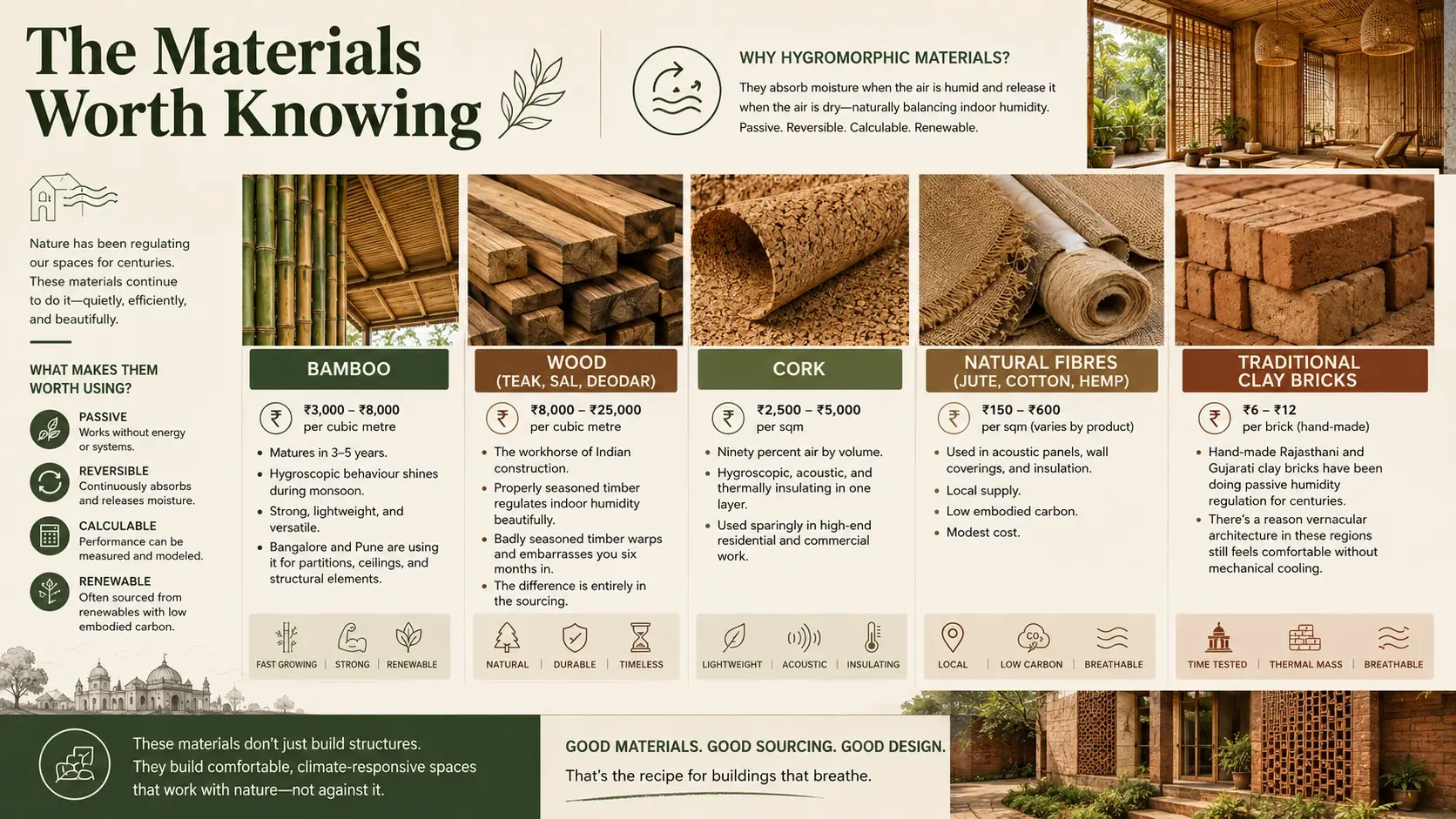
Natural fibres jute, cotton, hemp show up in acoustic panels, wall coverings, and insulation. Local supply, low embodied carbon, modest cost.
Traditional clay bricks are the underrated entry. Hand-made Rajasthani and Gujarati clay bricks have been doing passive humidity regulation for centuries. There's a reason vernacular architecture in these regions still feels comfortable without mechanical cooling.
Where They Earn Their Keep
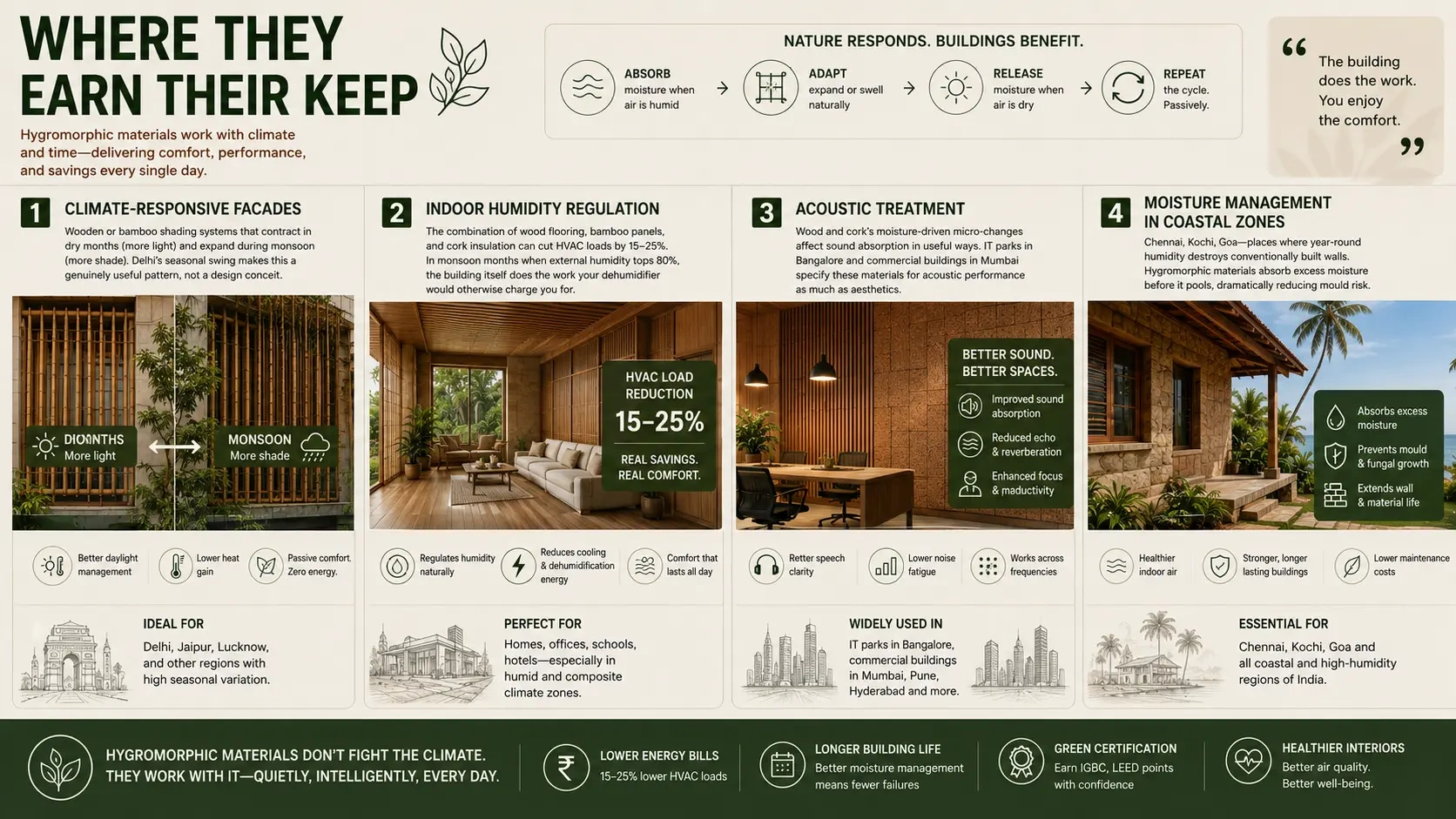
Climate-responsive facades. Wooden or bamboo shading systems that contract in dry months (more light) and expand during monsoon (more shade). Delhi's seasonal swing makes this a genuinely useful pattern, not a design conceit.
Indoor humidity regulation. The combination of wood flooring, bamboo panels, and cork insulation can cut HVAC loads by 15–25%. In monsoon months when external humidity tops 80%, the building itself does the work your dehumidifier would otherwise charge you for.
Acoustic treatment. Wood and cork's moisture-driven micro-changes affect sound absorption in useful ways. IT parks in Bangalore and commercial buildings in Mumbai specify these materials for acoustic performance as much as aesthetics.
Moisture management in coastal zones. Chennai, Kochi, Goa places where year-round humidity destroys conventionally built walls. Hygromorphic materials absorb excess moisture before it pools, dramatically reducing mould risk.
Frequently asked
What Trips Projects Up
The mistake most teams make is treating hygromorphic materials like dimensionally stable ones. They move. The whole point is that they move. Three rules:
Use breathable finishes sealing the surface kills the property you paid for. Design connections that allow movement; expansion gaps in flooring, flexible fasteners, joints that flex without stress. And match the material to the climate: Kerala wants moisture management; Rajasthan wants humidity addition; Delhi wants both at different times of year.
Quality sourcing is the other hidden cost. Bamboo is abundant but inconsistent. Wood seasoning practices vary wildly between suppliers. The premium for working with vetted, certified suppliers pays back in not having to replace warped panels three years in.
The Numbers That Matter
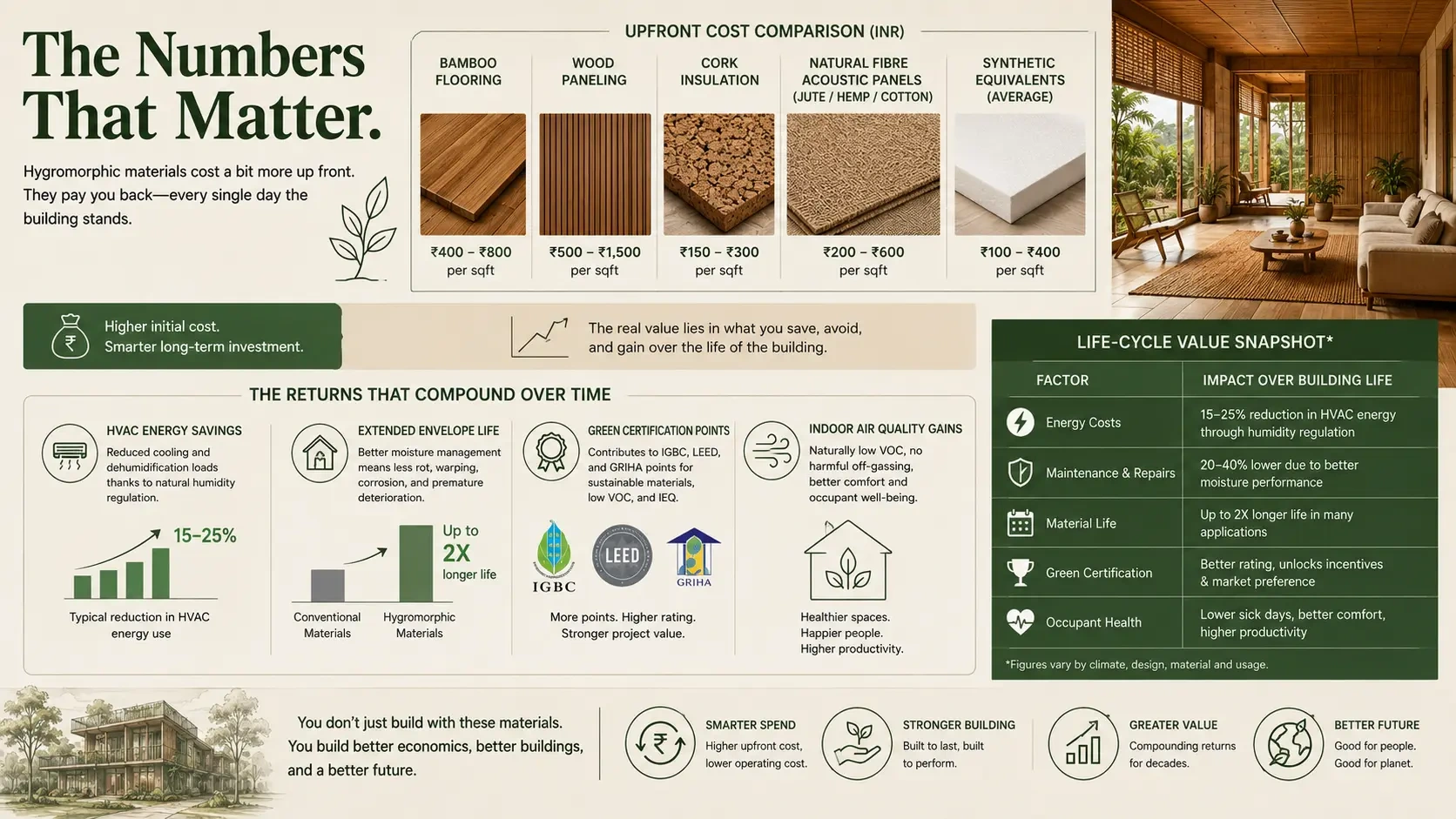
Bamboo flooring runs ₹400–₹800 per sqft. Wood paneling, ₹500–₹1,500. Cork insulation, ₹150–₹300. Natural fibre acoustic panels, ₹200–₹600. Higher than synthetic equivalents up front. But the HVAC savings, the extended envelope life from better moisture management, the green certification points, and the indoor air quality gains compound over the building's life.
Why This Matters Now
India's construction industry is hitting a sustainability inflection point. Energy costs are rising, IGBC and LEED targets are tightening, and passive design strategies that used to be optional are becoming specification defaults. Hygromorphic materials sit exactly at this intersection locally available, climate-appropriate, and quietly powerful.
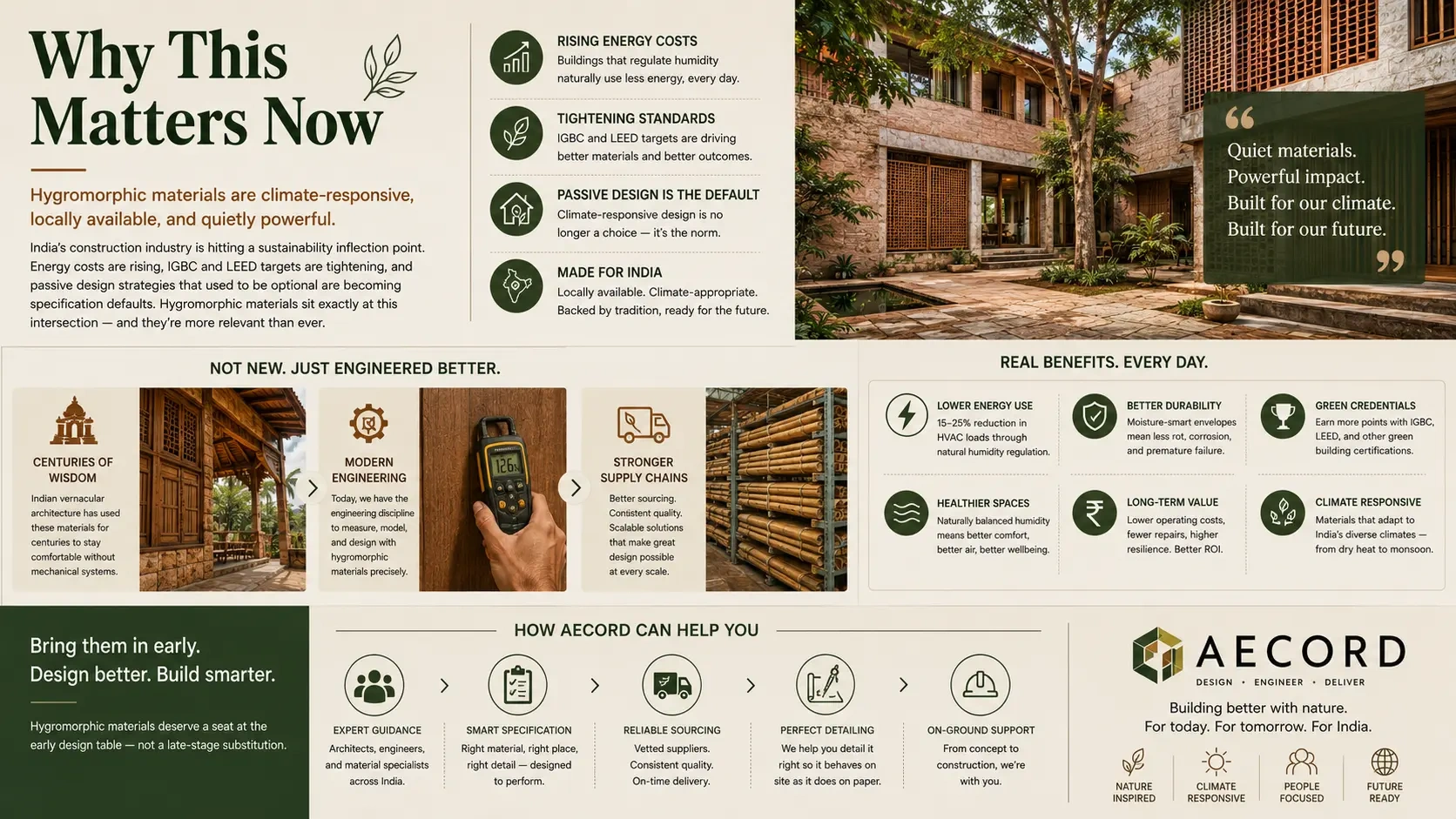
The technology isn't new. Indian vernacular architecture has been using it for centuries. What's new is the engineering discipline to design with it precisely and the supply chains to deliver consistent quality at scale. /blog/hempcrete-suppliers-in-india
If you're planning a project where climate response, indoor comfort, or sustainability credentials matter, hygromorphic materials deserve a seat at the early design conversations not a late-stage substitution. AECORD's network of architects, engineers, and material specialists across India can help you spec them properly, source them reliably, and detail them so they behave on site the way they do on paper.
Frequently Asked Questions
What are hygromorphic materials and how do they work in buildings?
Hygromorphic materials are substances that passively change shape, density, or porosity in response to atmospheric humidity without requiring any energy input. When moisture is absorbed, the material swells, and when air dries, it shrinks back—a reversible cycle that helps regulate indoor humidity naturally, making them ideal for climate-responsive construction in India.
Which hygromorphic materials are best for Indian construction?
Bamboo is the standout choice for Indian projects, maturing in 3-5 years at ₹3,000-₹8,000 per cubic metre, while traditional wood (₹8,000-₹25,000/m³), cork (₹2,500-₹5,000/sqm), natural fibres, and traditional clay bricks also perform excellently depending on the application and budget.
How much can hygromorphic materials reduce HVAC costs?
The combination of hygromorphic materials like wood flooring, bamboo panels, and cork insulation can reduce HVAC loads by 15-25%, particularly during monsoon months when external humidity exceeds 80% and the building naturally regulates moisture without mechanical cooling.
What are the main applications of hygromorphic materials in construction?
Hygromorphic materials are used for climate-responsive facades that adapt seasonally, indoor humidity regulation, acoustic treatment in commercial spaces, and moisture management in coastal zones where conventional construction fails due to year-round high humidity.
Why are hygromorphic materials important for Indian monsoon climates?
India's diverse climates—from monsoons in Mumbai to dry heat in Jaipur—make hygromorphic materials valuable for passive humidity control without energy consumption. They naturally absorb excess moisture during wet seasons and release it during dry periods, improving comfort and building durability.