Introduction
Choosing the right foundation is the most critical structural decision in home construction. In India’s diverse geographical and climatic landscape—ranging from the active black cotton soils of Maharashtra and Karnataka to the alluvial plains of the Indo-Gangetic basin, the rocky terrains of the Deccan Plateau, and high-seismic zones mandated by updated building codes—soil conditions vary dramatically.
Selecting an inappropriate foundation can lead to differential settlement, severe wall cracking, structural tilting, and, in worst-case scenarios, catastrophic failure. Aligned with current Bureau of Indian Standards (BIS) regulations, geotechnical parameters, and modern engineering updates, this comprehensive guide outlines the primary foundation types utilized in Indian residential construction, compliance codes, regional variations, cost estimates, and emerging techniques.
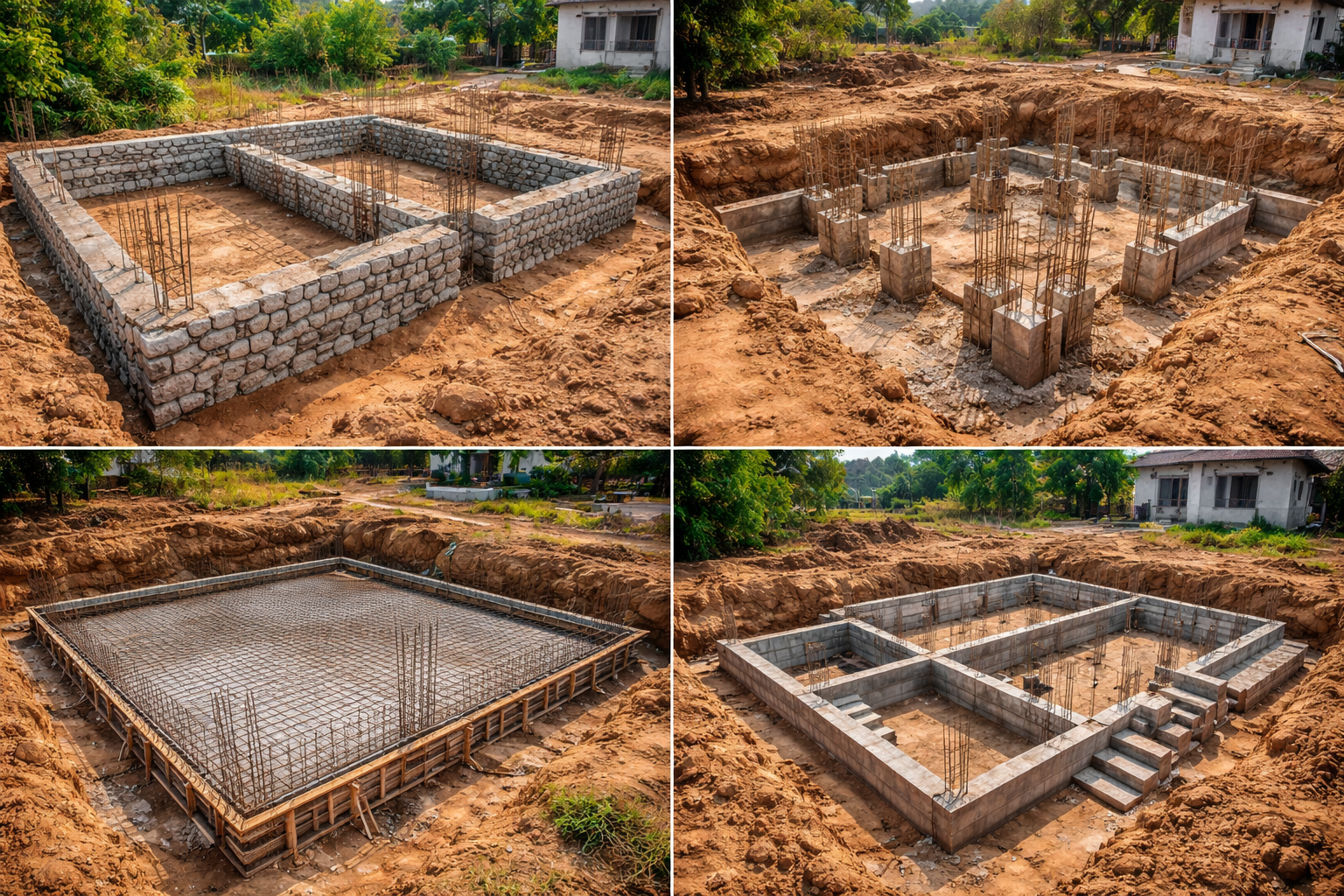
Build cost · Bengaluru, May 2026
1. Understanding Indian Soil Mechanics and Site Preparation
Before finalizing a foundation design, geotechnical investigations and soil testing (such as Standard Penetration Tests, or SPT) are mandatory under modern structural requirements. Indian soils behave uniquely under structural loads:
Black Cotton Soil (Expansive Clays): Predominant in Central and Western India (Maharashtra, parts of Madhya Pradesh, Gujarat, and northern Karnataka). These soils swell significantly when wet and shrink/crack severely during dry seasons. They require specialized undercut or pile foundations to bypass active zone movements.
Alluvial Soil: Found extensively across Northern and Eastern India (Punjab, Haryana, Uttar Pradesh, Bihar, West Bengal). While deep and fertile, they have varying load-bearing capacities requiring careful depth planning.
Laterite Soil: Common in coastal regions (Goa, Kerala, coastal Karnataka, and Odisha). They are generally stable when dry but prone to erosion and require adequate surface drainage protection.
Red and Yellow Soils: Found in parts of Southern and Eastern India. These are sandy-to-loamy and require moderate foundation depths depending on the water table.
2. Major Foundation Types in Indian Residential Construction
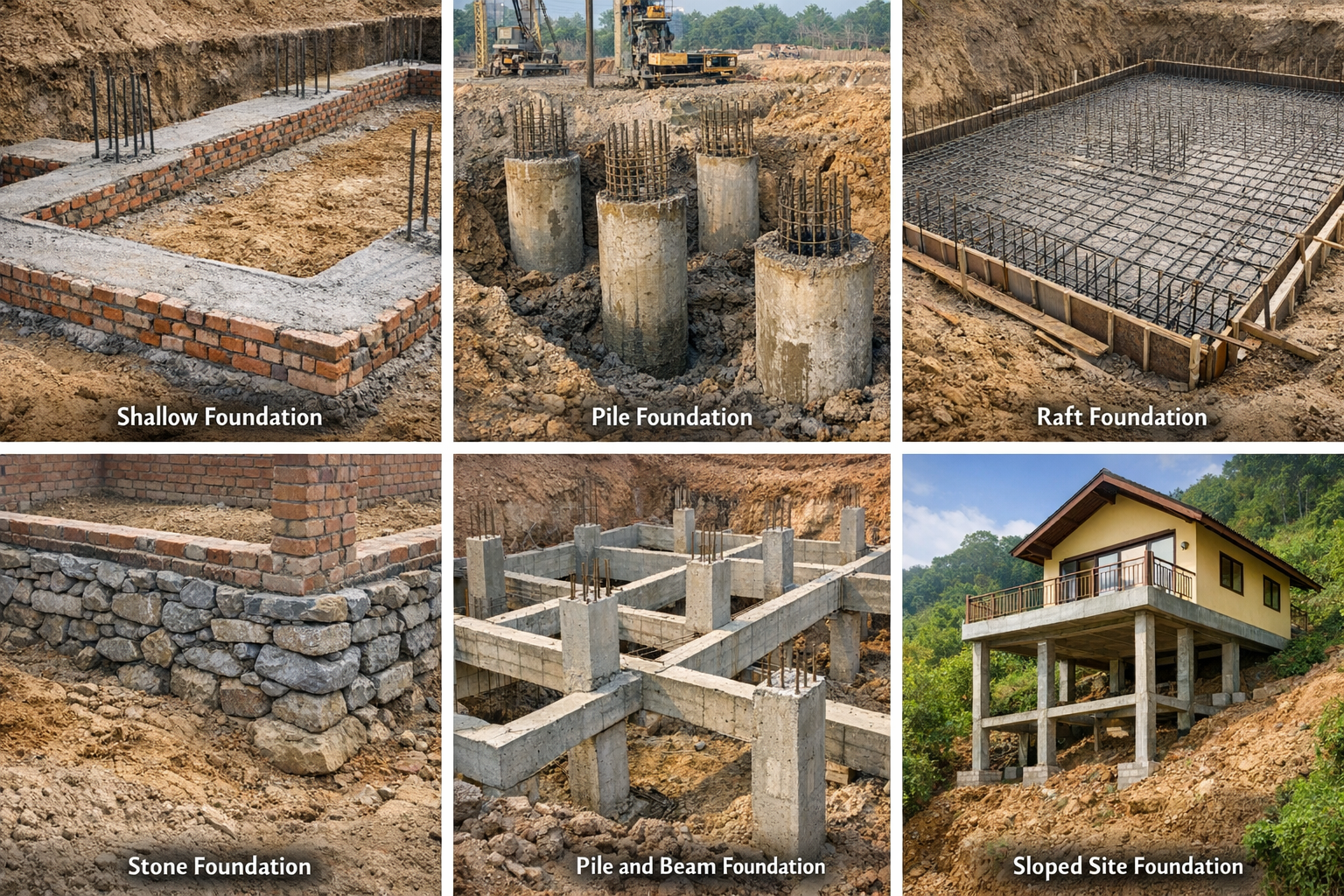
Foundations are broadly categorized into Shallow Foundations (depth is less than or equal to width) and Deep Foundations (depth significantly exceeds width).
+-----------------------------------------------------------------+ | FOUNDATION CLASSIFICATION | +---------------------------------+-------------------------------+ | SHALLOW FOUNDATIONS | DEEP FOUNDATIONS | +---------------------------------+-------------------------------+ | • Isolated / Pad Footing | • Bored Cast-in-Situ Piles | | • Combined Footing | • Driven Precast Piles | | • Strip / Continuous Footing | • Micropiles (Mini Piles) | | • Raft / Mat Foundation | • Well Foundations | +---------------------------------+-------------------------------+ A. Isolated Footing (Pad Footing)
Best Used For: Low-rise residential buildings (G+1 or G+2) on soils with good bearing capacity (typically above $150 \text{ kN/m}^2$).
Description: Independent square, rectangular, or stepped concrete pads beneath individual columns.
Advantages: Economical, simple to construct, requires minimal excavation.
Disadvantages: Unsuitable for soft soils or sites with highly variable soil strata across the footprint.
B. Strip Footing / Continuous Footing
Best Used For: Load-bearing masonry structures (brick or stone walls) without RCC columns.
Description: A continuous strip of concrete supporting load-bearing walls along their entire length.
Advantages: Distributes wall weight evenly over a larger surface area, preventing localized sinking.
Disadvantages: Limited load capacity; labor-intensive for multi-story structures.
C. Raft or Mat Foundation
Best Used For: Poor soil bearing capacity, erratic soil profiles, or structures subjected to heavy uniform loads.
Description: A single thick reinforced concrete slab covering the entire footprint of the building, acting like a floating raft on water.
Advantages: Bridges weak spots in the soil, minimizes differential settlement, and provides a moisture barrier for the basement.
Disadvantages: High consumption of steel and cement; requires precise waterproofing.
D. Pile Foundations (Bored Cast-in-Situ)
Best Used For: Multi-story apartments, high-rises, or sites with expansive black cotton soils where firm strata lie deep underground ($10\text{m}$ to $30\text{m}$ down).
Description: Slender columns of concrete or steel driven or bored deep into the earth to transfer building loads to competent rock layers or dense soil beds.
Advantages: Excellent load transfer in weak soils; prevents structural movement caused by seasonal soil shrinking and swelling.
Disadvantages: Specialized machinery (piling rigs) required; higher execution costs.
3. Emerging Foundation Technologies in Indian Construction
With modern land constraints, urban redevelopment, and tight spaces, structural engineering has evolved beyond conventional methods:
Micropile (Mini Pile) Foundations: Utilizing small-diameter ($100\text{mm}$ to $300\text{mm}$) high-capacity drilled elements, micropiles are pressure-grouted with steel reinforcement.They are ideal for urban retrofitting, tight restricted-access sites, low headroom basements, and underpinning historical or failing structures without causing heavy vibrational damage.
Green Building Foundation Practices: Incorporating fly ash blended cements (PPC) to reduce carbon footprint, utilizing recycled aggregate concrete for non-structural blinding layers, and implementing advanced moisture-retention membranes to safeguard sub-grade soils against chemical corrosion. 4. Foundation Types by Region in India
Region | Predominant Soil Type | Recommended Foundation Types |
Northern Plains (Punjab, UP, Delhi) | Deep Alluvial Silt and Clay | Isolated Footings with tie beams, Raft for heavy loads |
Western & Central (Maharashtra, MP, Gujarat) | Expansive Black Cotton Soil | Under-reamed Piles, Deep Isolated Footings |
Southern Plateau (Karnataka, TN, AP) | Hard Rock / Red Loam / Laterite | Shallow Isolated Footings directly on weathered rock strata |
Coastal Belts (Kerala, Goa, Odisha, WB) | Soft Alluvial, Sandy, Lateritic | Bored Cast-in-Situ Piles, Raft Foundations to handle high water tables |
Frequently asked
5. Compliance with Indian Standards (IS Codes)
Structural safety in India is governed strictly by the Bureau of Indian Standards. Engineers and builders must adhere to the following key updated codes:
IS 456: Code of Practice for Plain and Reinforced Concrete.
IS 1893 (Part 1): Criteria for Earthquake Resistant Design of Structures.
IS 2911 (Parts 1 to 4): Code of Practice for Design and Construction of Pile Foundations.
IS 14893: Guidelines for Micro Piling design and execution.
IS 1904: Code of Practice for Design and Construction of Foundations in Soils: General Requirements.
IS 1498: Classification and Identification of Soils for General Engineering Purposes.
6. Cost Breakdown and Estimation for Foundations in India
Foundation expenses generally account for 10% to 15% of the total structural construction budget, depending on soil conditions and depth requirements.
Foundation Type | Typical Depth | Estimated Cost Range (INR per sq. ft. of built-up area) |
Isolated Footing | 1.2m - 1.8m | ₹200 – ₹280 |
Strip Footing | 1.0m - 1.5m | ₹160 – ₹240 |
Raft Foundation | 1.5m - 2.5m | ₹340 – ₹480 |
Bored Pile Foundation | 10m - 25m | ₹500 – ₹750+ |
Micropile Foundation | Variable(6m-20m) | ₹600 – ₹900+ |
7. Step-by-Step Foundation Selection Checklist
Geotechnical Investigation: Execute soil boring and core sampling to determine safe bearing capacity (SBC) and water table depth.
Structural Load Calculation: Assess total dead loads, live loads, and seismic zone lateral loads with a certified structural engineer.
Site Access & Environmental Audit: Review space availability for heavy piling rigs or if compact equipment (like micropiling rigs) is required.
Excavation & Shoring: Excavate per design specifications with appropriate slope protection or shoring frameworks.
Anti-Termite Treatment & PCC: Lay chemical barriers and a clean leveling course of Plain Cement Concrete.
Reinforcement & Concreting: Place steel cages with proper cover blocks and pour structured concrete under strict vibration control.
8. Frequently Asked Questions (FAQs)
What is the best foundation type for Indian black cotton soil?
For black cotton soils, under-reamed pile foundations or deep isolated footings resting on stable strata below the active zone are recommended to counteract volumetric expansion and shrinkage.
What is the average cost of house foundations in India?
Foundation costs typically range between ₹200 to ₹480 per square foot for standard shallow systems (isolated or raft), while deep pile and micropile foundations range from ₹500 to ₹900+ per square foot depending on depth and accessibility.
What are the foundation depth requirements in India?
For standard residential buildings on normal soil, the minimum foundation depth should not be less than $1.2\text{m}$ (approx. 4 feet) below natural ground level to bypass surface temperature variations and seasonal moisture shifts.
Conclusion
A durable home begins from the ground up. Investing in rigorous soil testing, adhering strictly to BIS building codes, and selecting the correct structural foundation protects your investment and ensures decades of safety against geological and environmental shifts. Always consult a licensed structural engineer or certified architect before commencing excavation work.