

Choosing the right roofing material is one of the most critical structural decisions for homeowners and developers across India. With shifting regional climate patterns, fluctuating material costs, and updated building regulations, the traditional debate between clay tiles and concrete tiles has taken on new significance in 2026.
This comprehensive guide breaks down the true cost implications, structural longevity, monsoon resilience, regional suitability, and recent 2026 market trends to help you make an informed investment.
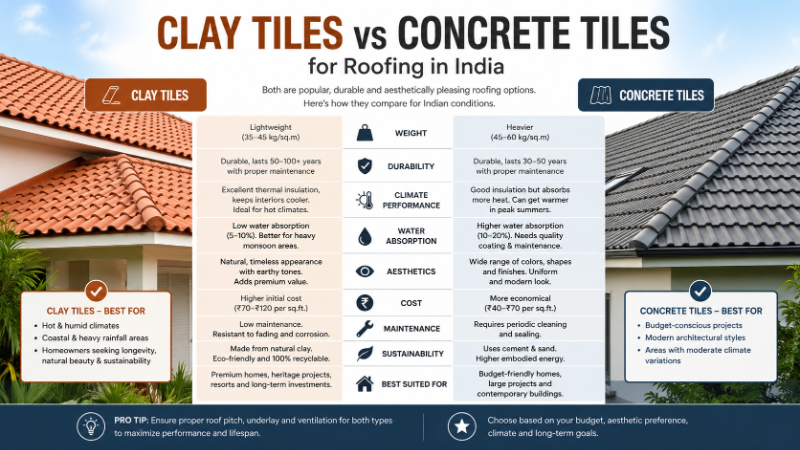
Quick Comparison at a Glance
Parameter | Clay Roof Tiles | Concrete Roof Tiles |
Average Cost (INR per sq. ft.) | ₹65 – ₹110+ (Premium/Imported variants higher) | ₹45 – ₹75 |
Weight Load | Moderate (approx. 35–50 kg/m²) | Heavy (approx. 45–60 kg/m²) |
Lifespan | 50–100+ years (Excellent color fastness) | 30–50 years (Requires periodic coating/painting) |
Thermal Insulation | Superior (Natural cooling properties) | Moderate (Absorbs and retains heat longer) |
Monsoon & Water Absorption | Low absorption (<6% when vitrified/glazed) | Higher absorption unless treated with waterproof sealants |
Maintenance Needs | Low (Resistant to fading and algae) | Moderate (Requires anti-fungal washing & repainting) |
Build cost · Bengaluru, May 2026
1. Cost Analysis & Market Trends (2026 Update)
Material pricing across India has experienced shifts due to updated supply chain dynamics, raw material tariffs, and implementation of current GST structures (standardized at 18% for manufactured building materials).
Clay Tile Pricing & Economics
Standard Country Tiles / Mangalore Tiles: ₹45 to ₹65 per sq. ft. installed.
Interlocking / Glazed Ceramic Tiles: ₹70 to ₹120 per sq. ft. installed.
Market Outlook: While initial procurement costs for clay tiles remain 20–30% higher than concrete alternatives, their lifecycle cost is exceptionally low due to minimal maintenance and zero color-fade liabilities.
Concrete Tile Pricing & Economics
Standard Flat/Interlocking Concrete Tiles: ₹45 to ₹60 per sq. ft. installed.
Designer / Colored Through-Body Concrete Tiles: ₹60 to ₹80 per sq. ft. installed.
Market Outlook: Concrete tiles remain the preferred choice for large-scale budget-conscious residential developments due to lower upfront capital expenditure, though ongoing maintenance budgets must account for repainting every 5 to 7 years.
Frequently asked
Disadvantages of Clay Tiles
Higher Initial Cost: Clay tiles are significantly more expensive than concrete alternatives. In India, premium clay tiles can cost ₹200-400 per square foot, compared to ₹80-150 for concrete tiles. For a 1000 sq ft roof, this represents a difference of ₹1.2-3.2 lakhs.
Weight Considerations: Clay tiles are heavier than concrete tiles, weighing approximately 40-60 kg per square meter. This requires stronger roof structures and may necessitate additional reinforcement, increasing construction costs.
Installation Complexity: Laying clay tiles requires skilled labor with specialized knowledge. In metropolitan areas like Mumbai and Bangalore, finding experienced clay tile installers can be challenging and expensive.
Fragility During Installation: Clay tiles are more prone to breakage during handling and installation. Typically, 5-10% extra tiles must be ordered to account for breakage and future repairs.
Concrete Tiles: Modern Durability and Affordability
What Are Concrete Tiles?
Concrete tiles are a modern roofing solution manufactured by mixing Portland cement, aggregates, water, and sometimes additives. The mixture is molded and either air-cured or steam-cured to achieve the desired strength. This manufacturing process allows for greater consistency and standardisation compared to clay tiles.
Advantages of Concrete Tiles
Cost-Effectiveness: Concrete tiles are significantly cheaper than clay tiles, making them ideal for budget-conscious projects. With prices ranging from ₹80-150 per square foot, they offer excellent value for money, particularly for large-scale residential projects in developing areas of Indian cities.
Lighter Weight: Weighing approximately 30-40 kg per square meter, concrete tiles place less stress on roof structures. This can result in savings on structural reinforcement and makes them suitable for retrofit projects where structural modifications are limited.
Ease of Installation: Concrete tiles are easier to handle and install compared to clay tiles. Standard labor can manage installation with minimal specialized training, reducing labor costs significantly. This is a major advantage in regions where skilled clay tile installers are scarce.
Durability and Consistency: Modern concrete tiles can last 30-50 years with proper maintenance. The manufacturing process ensures consistent quality and uniform appearance across all tiles.
Design Versatility: Concrete tiles can be manufactured in various colors, textures, and profiles. Whether you want to mimic traditional clay tile appearance or create contemporary designs, concrete offers flexibility that appeals to modern architectural preferences.
Weather Resistance: Quality concrete tiles resist moisture, UV radiation, and temperature extremes effectively. They perform well across India's varied climate zones, from coastal areas prone to salt spray to inland regions with extreme temperature variations. 2. Monsoon Durability & Climate Performance in India
With changing weather extremes—ranging from intense tropical cloudbursts in coastal belts to dry, scorching summers in central India—roofing performance under stress is paramount.
High-Rainfall & Coastal Zones (Kerala, Goa, Coastal Karnataka, Mumbai): Clay tiles, particularly double-interlocking glazed variants, excel in high-moisture environments. Their low porosity prevents water seepage and salt-air corrosion. Concrete tiles used in coastal zones require high-grade waterproof acrylic coatings to prevent efflorescence and algae growth during prolonged monsoons.
Thermal Performance & Heat Mitigation: Clay possesses natural thermal mass properties that reflect a significant portion of solar radiation. Homes roofed with quality clay tiles maintain indoor temperatures up to 3°C to 5°C cooler compared to concrete-roofed structures, directly lowering cooling loads and HVAC energy consumption.
3. Regional Selection: Best Tiles for Your Climate
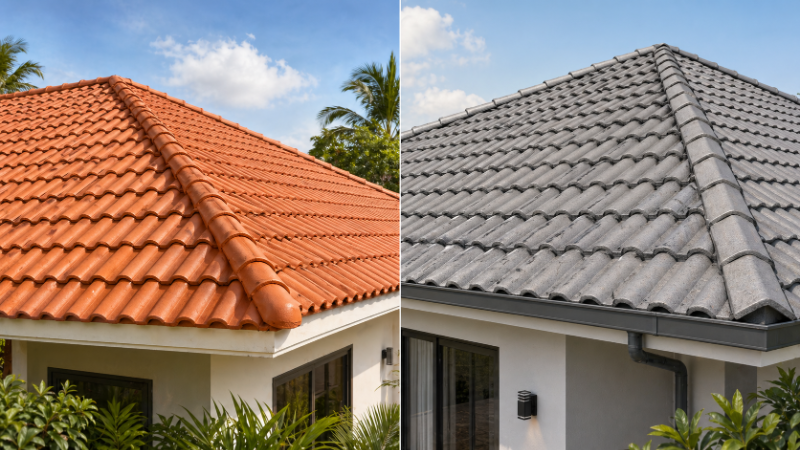
Best for Coastal and High-Rainfall Areas: Glazed Terracotta or Engineered Clay Interlocking Tiles. They shed heavy runoff rapidly and resist moisture retention.
Best for Arid and Extreme Heat Regions (Rajasthan, Central India): Natural Terracotta Clay Tiles. Their breathability prevents thermal cracking under rapid day-night temperature swings.
Best for Urban Multi-Story Residential Projects (Delhi NCR, Bangalore): Heavy-Duty Concrete Tiles. When engineered with reinforced roof trusses, they offer robust wind-uplift resistance during severe seasonal thunderstorms. 4. Structural Engineering & Code Compliance
When installing roof tiles in India, structural planning must adhere to Bureau of Indian Standards (BIS) guidelines:
IS 654: Specifications for clay roofing tiles (Mangalore pattern).
IS 2858 / Relevant Load Standards: Ensuring roof framing (timber trusses or light-gauge steel purlins) can safely support the dead load of concrete tiles, which can exceed 50 kg/m² when saturated with rainwater.
Wind Load Considerations: Per National Building Code (NBC) guidelines, tiles in cyclone-prone coastal corridors must be mechanically clipped or screwed to purlins rather than simply laid loose.
Comparative Analysis: Clay vs Concrete Tiles
Cost Comparison Over Time
While concrete tiles have lower upfront costs, a lifecycle cost analysis reveals interesting insights. Consider a 1000 sq ft roof in Pune:
Clay Tiles: Initial cost ₹3-4 lakhs, lifespan 80+ years, minimal maintenance (₹5,000-10,000 every 20 years)
Concrete Tiles: Initial cost ₹1-1.5 lakhs, lifespan 40 years, maintenance every 5 years (₹15,000-20,000), replacement after 40 years (₹1-1.5 lakhs)
Over an 80-year period, clay tiles prove more economical despite higher initial investment.
Climate Suitability
Coastal Regions (Goa, Kerala, Mumbai): Clay tiles are superior due to their resistance to salt spray and moisture. Concrete tiles in coastal areas require more frequent maintenance and may experience accelerated deterioration.
Hot, Dry Regions (Rajasthan, Gujarat): Both materials perform well, but clay tiles' superior thermal properties make them preferable for temperature regulation and energy efficiency.
Monsoon-Heavy Regions (Western Ghats, Northeast): Clay tiles' lower water absorption makes them ideal. Concrete tiles require excellent drainage design and regular maintenance to prevent moss and algae growth.
Urban Heat Island Areas (Delhi, Bangalore): Clay tiles' reflective properties help mitigate urban heat. Their thermal insulation reduces cooling loads, translating to lower electricity bills over time.
Structural Requirements
Clay tiles' weight necessitates stronger roof trusses and reinforced concrete slabs. In a typical residential building in Hyderabad, upgrading from concrete to clay tiles might cost an additional ₹50,000-100,000 in structural reinforcement. Conversely, concrete tiles work well with standard roof structures designed for modern building codes.
Installation and Labor Considerations in India
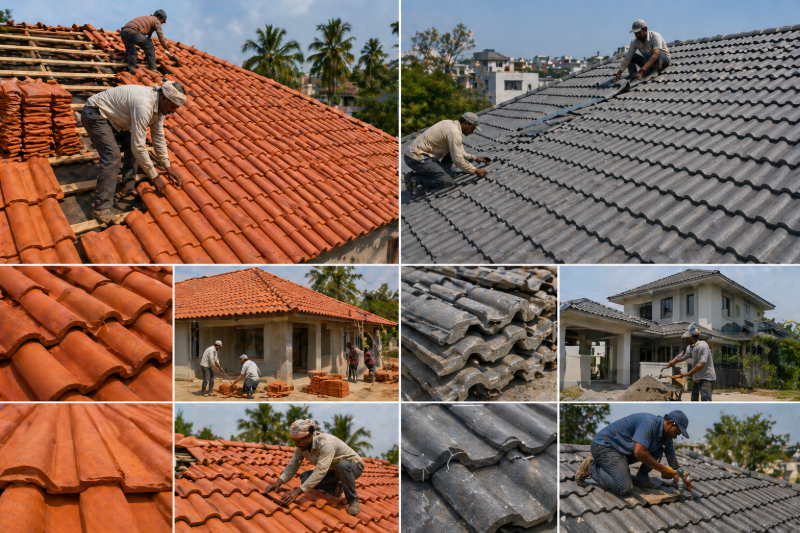
Finding skilled labor for clay tile installation is increasingly challenging in metropolitan areas. In cities like Bangalore and Pune, experienced clay tile installers command premium wages (₹500-800 per day) compared to general construction labor (₹300-500 per day). Concrete tile installation requires less specialized skill, making it more accessible and cost-effective in terms of labor.
When sourcing materials through platforms like AECORD, you can connect with specialized roofing contractors who have expertise in both materials, enabling you to get accurate quotes and professional recommendations tailored to your specific project location and requirements.
Aesthetic and Heritage Considerations
For heritage conservation projects, especially in cities like Jaipur, Udaipur, and Goa, clay tiles are often mandatory to maintain architectural authenticity. Local regulations and heritage guidelines frequently specify traditional materials. Concrete tiles, while available in clay-mimicking designs, lack the authentic character that clay provides.
For modern residential and commercial projects, concrete tiles offer contemporary aesthetics that appeal to younger homeowners and contemporary architectural styles. However, clay tiles remain the preferred choice for premium developments where timeless elegance and long-term value appreciation are priorities.
Maintenance and Care
Clay Tile Maintenance
Clay tiles require minimal maintenance. Occasional inspection for broken tiles (every 10-15 years) and clearing debris from gutters suffice. The mortar between tiles may need repointing every 20-30 years in regions with heavy rainfall.
Concrete Tile Maintenance
Concrete tiles demand more active maintenance: cleaning every 2-3 years to prevent algae growth, sealing every 5-7 years, and regular inspection for cracks or deterioration. In humid regions, anti-fungal treatments may be necessary.
Making Your Decision: A Framework
Choose Clay Tiles If:
You're building a heritage property or in a heritage zone
Your budget allows for higher initial investment with long-term savings
You prioritize aesthetic appeal and timeless elegance
Your roof structure can support the additional weight
You value environmental sustainability
You plan to stay in the property for 50+ years
Choose Concrete Tiles If:
Budget constraints are significant
You need quick installation with readily available labor
Your roof structure has weight limitations
You prefer modern, contemporary aesthetics
You plan to sell within 30-40 years
You're comfortable with regular maintenance schedules
Regional Recommendations for Indian Cities
Mumbai and Coastal Cities: Clay tiles are recommended despite higher costs due to superior salt spray resistance and lower maintenance in humid conditions.
Delhi and Northern Plains: Either option works well; choose based on budget and aesthetic preferences. Clay tiles offer better thermal properties for temperature regulation.
Bangalore and South Indian Tech Hubs: Concrete tiles are popular due to cost-effectiveness and availability of installation services. However, clay tiles are gaining traction in premium residential projects.
Jaipur and Heritage Towns: Clay tiles are often mandatory due to heritage conservation guidelines and local regulations.
Conclusion: Making the Right Choice for Your Project
The choice between clay tiles and concrete tiles ultimately depends on your specific circumstances: budget, location, climate, aesthetic preferences, and long-term plans. Clay tiles offer unmatched longevity, aesthetic appeal, and environmental benefits, making them ideal for long-term investments and heritage projects. Concrete tiles provide immediate cost savings and ease of installation, making them suitable for budget-conscious projects and modern developments.
For Indian builders and homeowners, understanding these trade-offs is crucial. When planning your roofing project, consider engaging with experienced professionals who can assess your specific requirements. Platforms like AECORD connect you with verified architects, engineers, and roofing contractors across India who can provide expert guidance tailored to your project's unique needs and local conditions.
Whether you ultimately choose clay or concrete tiles, investing time in this decision will pay dividends through years of reliable, weather-resistant roofing that protects your property and enhances its value. Start exploring your options today and find the perfect roofing solution for your Indian construction project on AECORD.
Frequently Asked Questions (FAQ)
Are clay tiles heavier than concrete tiles?
No. Concrete tiles are generally denser and heavier than clay tiles, requiring sturdier roof framing structures to support the dead load.
Do clay tiles fade over time?
Natural kiln-fired clay tiles never lose their color because the hue is baked into the terracotta itself. Glazed clay tiles maintain their glossy finish for decades. Concrete tiles, conversely, rely on surface coatings that can fade or chalk under intense UV exposure over 5 to 7 years.
Which tile is better for heavy monsoon regions like Kerala or Mumbai?
Glazed clay interlocking tiles are generally preferred in high-rainfall coastal regions due to their superior water-shedding design, lower porosity, and resistance to saline atmosphere degradation.