

Understanding Cement: A Comprehensive Guide for Indian Construction Professionals
Cement is the backbone of modern construction in India. Whether you're building a residential complex in Bangalore, a commercial tower in Mumbai, or a bridge in Delhi, cement plays a critical role in determining the quality, durability, and cost-effectiveness of your project. As an AECO professional, understanding cement specifications, types, and quality standards is essential for making informed decisions that impact project outcomes.
This comprehensive guide covers everything you need to know about cement in the Indian construction industry, from basic composition to practical selection criteria for different applications.
Build cost · Bengaluru, May 2026
What is Cement and How Does It Work?
Cement is a fine powder made from limestone, clay, and other raw materials that, when mixed with water, acts as a binding agent. Unlike concrete, which is a composite material containing cement, sand, and aggregates, cement itself is the adhesive component that holds everything together.
The Chemistry Behind Cement
When cement is mixed with water, a chemical reaction called hydration occurs. This process transforms the dry powder into a hardened mass that binds aggregates together. The main compounds in cement include:
Tricalcium Silicate (C3S): Responsible for early strength development (first 7-28 days)
Dicalcium Silicate (C2S): Contributes to long-term strength development (after 28 days)
Tricalcium Aluminate (C3A): Affects setting time and early strength
Tetracalcium Aluminoferrite (C4AF): Influences color and heat of hydration
Understanding these compounds helps engineers specify the right cement type for specific project requirements, whether it's rapid strength gain for fast-track projects or sustained strength for long-term durability.
Types of Cement Available in India
The Indian Standards Institution (ISI) has established specifications for various cement types under IS 269:2015. Each type serves different construction needs and environmental conditions.
Frequently asked
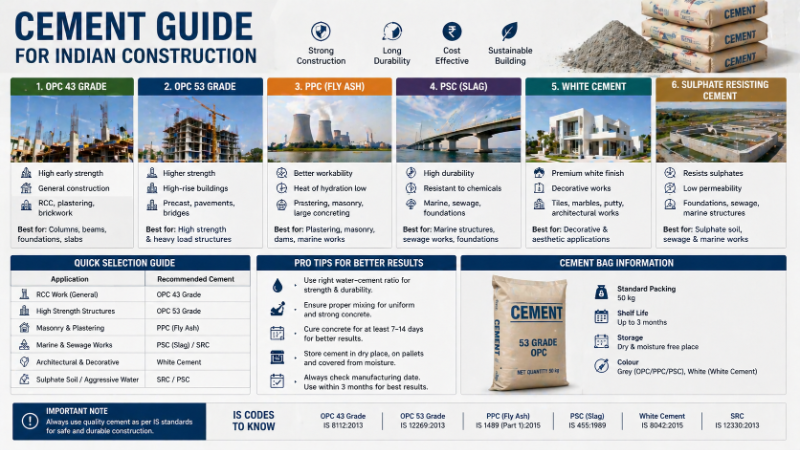
Ordinary Portland Cement (OPC)
OPC is the most commonly used cement in India, accounting for approximately 60-70% of total cement consumption. It's suitable for most general construction purposes and offers good strength development.
Setting Time: Initial set 30 minutes, final set 10 hours
Strength: 28-day compressive strength of 33 MPa (33 Grade) or 43 MPa (43 Grade)
Best For: Residential buildings, commercial structures, pavements
Cost: Approximately ₹350-450 per bag (50 kg) depending on region and market conditions
OPC 53 Grade, with higher early strength, is preferred for structures requiring rapid strength gain, such as precast elements or projects on tight schedules.
Portland Pozzolana Cement (PPC)
PPC contains pozzolanic materials (fly ash) that improve durability and reduce heat of hydration. It's increasingly popular for sustainable construction in India.
Composition: 85-95% OPC clinker + 5-15% fly ash
Advantages: Better durability, lower heat generation, improved workability
Cost: Approximately ₹320-400 per bag, making it more economical than OPC
Best For: Large structures, mass concrete works, coastal projects, hydraulic structures
PPC is particularly valuable for projects in harsh environments like coastal areas near Chennai, Kolkata, or Mumbai where durability against chloride attack is critical.
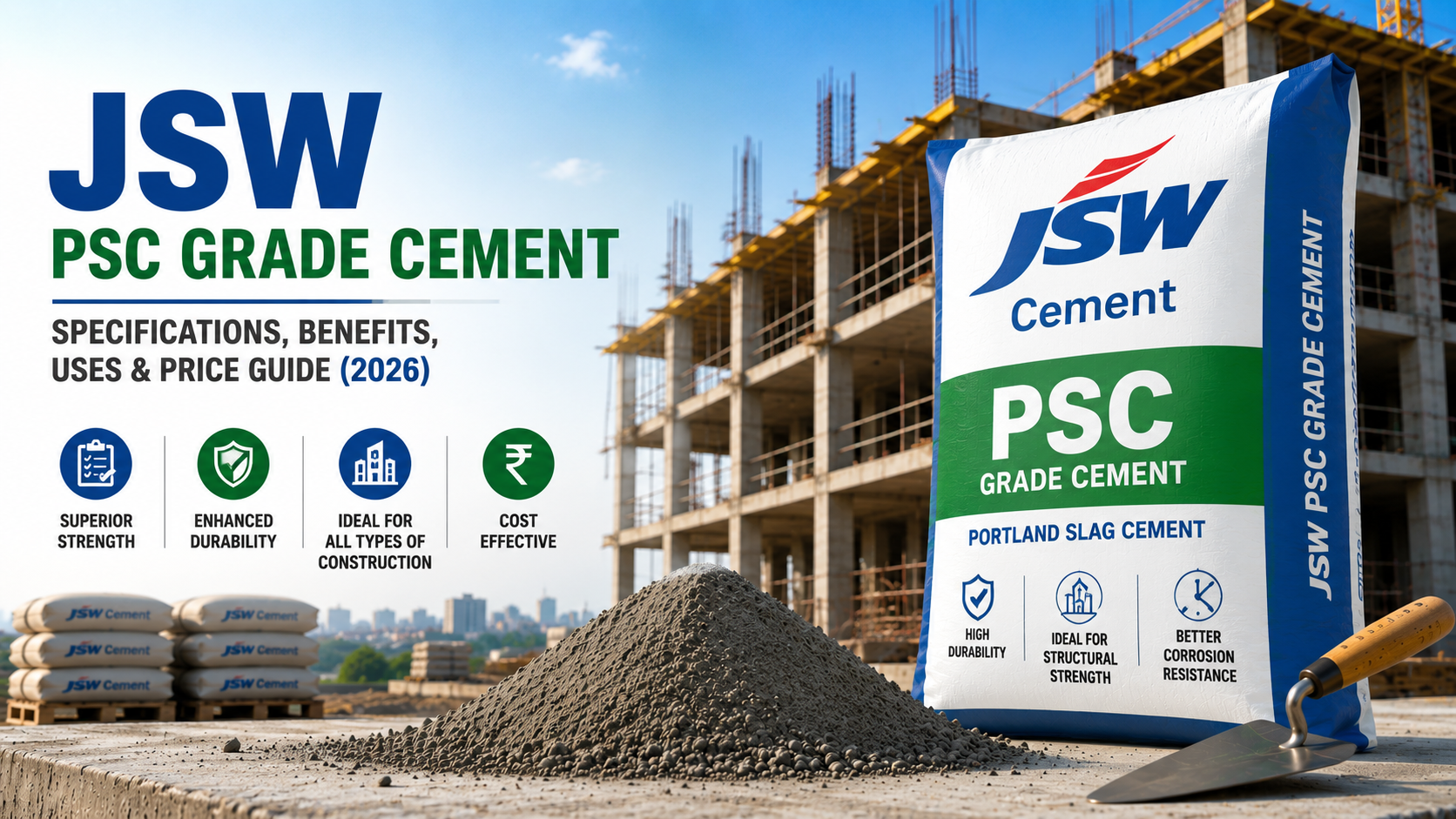
Portland Slag Cement (PSC)
PSC incorporates granulated blast furnace slag (GBFS), making it an excellent choice for sustainable construction and projects requiring long-term durability.
Composition: 50-70% OPC clinker + 30-50% GBFS
Benefits: Excellent for underwater construction, reduced permeability, lower heat of hydration
Cost: ₹300-380 per bag
Best For: Dams, bridges, underground structures, waterfront projects
White Cement
White cement is a specialty product made from raw materials with low iron oxide content. It's used primarily for aesthetic and architectural applications.
Applications: Architectural finishes, decorative concrete, terrazzo, swimming pools
Cost: ₹800-1200 per bag (significantly higher than gray cement)
Strength: Similar to OPC but with superior color consistency
Rapid Hardening Cement
This cement is specifically designed for projects requiring quick strength development, typically achieving 24-hour strength equivalent to 3-day OPC strength.
Best For: Emergency repairs, precast factories, fast-track construction projects
Cost: Premium pricing, approximately 10-15% higher than OPC
Key Cement Specifications and Quality Standards
When selecting cement for your project, understanding quality parameters is crucial. All cement sold in India must comply with IS 269:2015, which specifies minimum requirements for various grades.
Compressive Strength Grades
Cement is classified by its compressive strength at 28 days of curing:
33 Grade: Minimum 33 MPa at 28 days (rarely used now)
43 Grade: Minimum 43 MPa at 28 days (suitable for most general construction)
53 Grade: Minimum 53 MPa at 28 days (preferred for high-strength requirements)
For most residential and commercial projects in Indian cities like Pune, Hyderabad, and Ahmedabad, 43 Grade OPC or PPC is sufficient and cost-effective. However, for structural elements, bridges, or projects in aggressive environments, 53 Grade is recommended.
Important Quality Parameters
Fineness: Measured in m²/kg, fineness affects strength development and heat generation. Finer cement develops strength faster but generates more heat, which can be problematic in mass concrete works.
Setting Time: Initial set should occur between 30 minutes to 2 hours, and final set between 4-10 hours. This parameter is critical for construction scheduling and workability.
Soundness: Measured using Le Chatelier's expansion test, soundness ensures the cement doesn't expand excessively after setting, which could cause cracking.
Heat of Hydration: Important for large concrete pours. Lower heat cement (like PPC or PSC) is preferred for dams and mass concrete to prevent thermal cracking.
Selecting the Right Cement for Your Project
Choosing appropriate cement requires analsings Environmental Conditions
Environmental exposure significantly impacts cement selection. For projects in coastal areas like Goa, Kerala, or the Malabar Coast, use PPC or PSC to resist chloride ingress. For inland construction withy normal exposure, OPC is adequate. Underground or submerged structures benefit from PSC's superior impermeability.
Consider Project Timeline
Fast-track projects in metropolitan areas like Bangalore or Pune may justify the premium cost of 53 Grade or rapid hardening cement. For conventional projects with longer schedules, 43 Grade PPC offers better economics without compromising quality.
Evaluate Structural Requirements
High-strength applications (columns, prestressed elements, bridges) require 53 Grade cement. General-purpose construction (walls, slabs, footings) performs adequately with 43 Grade. Use AECORD to connect with structural engineers who can provide specific recommendations based on your design requirements.
Account for Aggregate and Water Quality
Aggressive water or poor-quality aggregates necessitate more durable cement types. PPC or PSC are superior choices for such scenarios, providing better long-term performance despite initial cost considerations.
Cement Storage and Handling Best Practices
Cement quality deteriorates with improper storage. Implement these practices to maintain cement integrity on-site:
Storage Conditions
Temperature: Store in cool, dry locations. Excessive heat accelerates hydration and strength loss
Humidity: Keep moisture below 5%. Humid environments cause premature hydration and lumping
Ventilation: Ensure proper air circulation to prevent moisture accumulation
Duration: Limit storage to 3 months maximum. Older cement has reduced strength development
Handling Procedures
Stack bags maximum 10 bags high to prevent bottom bags from compacting and hydrating. Rotate stock using FIFO (First In, First Out) principle. Inspect bags for tears or leaks before use. For bulk cement storage in silos, ensure silos are weatherproof and equipped with moisture control systems.
Understanding Cement Costs and Market Dynamics in India
Cement pricing in India varies significantly based on region, transportation costs, and market demand. Current price ranges (2024) are approximately:
43 Grade OPC: ₹350-450 per 50 kg bag
53 Grade OPC: ₹380-480 per 50 kg bag
PPC: ₹320-400 per 50 kg bag
PSC: ₹300-380 per 50 kg bag
Prices in tier-1 cities like Delhi, Mumbai, and Bangalore tend to be higher due to transportation costs. Cement from major manufacturers like Ambuja, ACC, Lafarge, and Dalmia typically commands premium pricing due to quality assurance and brand reputation.
Cost Optimization Strategies
Consider bulk purchases for large projects to negotiate better rates. Using PPC instead of OPC can reduce material costs by 8-10% while improving durability. For projects in cement-producing regions like Madhya Pradesh or Rajasthan, local sourcing reduces transportation expenses significantly.
Quality Assurance and Testing
Ensure cement quality through third-party testing. Standard tests include:
Compressive Strength Test: Conducted at 3, 7, and 28 days on mortar cubes
Setting Time Test: Vicat apparatus determines initial and final setting times
Soundness Test: Le Chatelier's expansion method checks for delayed hydration
Fineness Test: Blaine's air permeability method measures surface area
Chemical Analysis: X-ray fluorescence determines oxide composition
Reputable cement manufacturers provide third-party test certificates. Always verify cement compliance with IS 269:2015 before accepting deliveries on-site.
Sustainability and Green Cement Initiatives
India's construction industry is increasingly adopting sustainable cement practices. PPC and PSC are environmentally preferable alternatives to OPC, requiring less clinker production and reducing CO2 emissions by 20-30%.
The Indian government promotes green building practices through GRIHA and LEED certifications, which favor sustainable cement choices. Using PPC or PSC doesn't compromise structural performance while contributing to environmental goals.
Common Cement-Related Issues and Solutions
Rapid Strength Loss
If concrete strength falls short of expectations, investigate cement age, storage conditions, and water quality. Ensure cement hasn't exceeded its 3-month shelf life and verify proper hydration conditions during curing.
Excessive Heat Generation
In mass concrete works, high heat from OPC can cause thermal cracking. Switch to PPC or PSC with lower heat of hydration, reduce concrete temperature through cooling measures, or implement post-cooling techniques.
Premature Setting
If concrete sets too quickly, check ambient temperature, water quality, and cement fineness. Use retarders or cooler water in hot climates. Verify cement type matches project requirements.
Finding Quality Cement Suppliers on AECORD
Selecting reliable cement suppliers is as important as choosing the right cement type. AECORD connects construction professionals with verified cement manufacturers and distributors across India. Whether you're sourcing for a small residential project in Jaipur or a large infrastructure development in Gujarat, AECORD's network includes suppliers offering competitive pricing, quality assurance, and reliable delivery.
Use AECORD to compare cement suppliers, verify certifications, and access customer reviews. Many suppliers on the platform offer bulk discounts and can coordinate logistics for large projects, helping you optimize procurement costs while ensuring consistent quality.
Conclusion
Cement selection significantly impacts construction quality, durability, and project economics. By understanding cement types, specifications, and quality standards, you make informed decisions that enhance project outcomes. Consider environmental conditions, timeline requirements, structural needs, and budget constraints when selecting cement.
Partner with qualified professionals and verified suppliers to ensure cement quality and appropriate application. Whether you need technical consultation, supplier connections, or procurement assistance, AECORD provides a comprehensive platform connecting you with industry experts and reliable vendors across India's AECO sector.
For your next project, leverage AECORD's network to find cement suppliers, structural engineers, and construction consultants who can guide cement selection and ensure optimal results for your specific requirements.
Frequently Asked Questions
What is the difference between cement and concrete in construction?
Cement is a fine powder binding agent made from limestone and clay that hardens when mixed with water, while concrete is a composite material containing cement, sand, and aggregates. Cement acts as the adhesive that holds the other components together in concrete.
Which type of cement is most commonly used in Indian construction?
Ordinary Portland Cement (OPC) is the most commonly used cement in India, accounting for 60-70% of total cement consumption. It's suitable for most general construction purposes like residential buildings, commercial structures, and pavements.
What is Portland Pozzolana Cement (PPC) and when should it be used?
PPC contains fly ash (5-15%) which improves durability and reduces heat generation compared to regular OPC. It's ideal for large structures, mass concrete works, coastal projects, and hydraulic structures where durability against environmental stress is critical.
How long does cement take to set and gain strength?
OPC typically has an initial set time of 30 minutes and final set time of 10 hours. The cement continues gaining strength over 28 days, with different compounds contributing to early strength (first 7-28 days) and long-term strength (after 28 days).
What are the main chemical compounds in cement and why do they matter?
The four main compounds are Tricalcium Silicate (early strength), Dicalcium Silicate (long-term strength), Tricalcium Aluminate (setting time), and Tetracalcium Aluminoferrite (color and heat). Understanding these compounds helps engineers select the right cement type for specific project requirements.