By Ajay Gupta Co-Founder, Studio Masons Pvt Ltd LinkedIn: https://www.linkedin.com/in/guptaja/
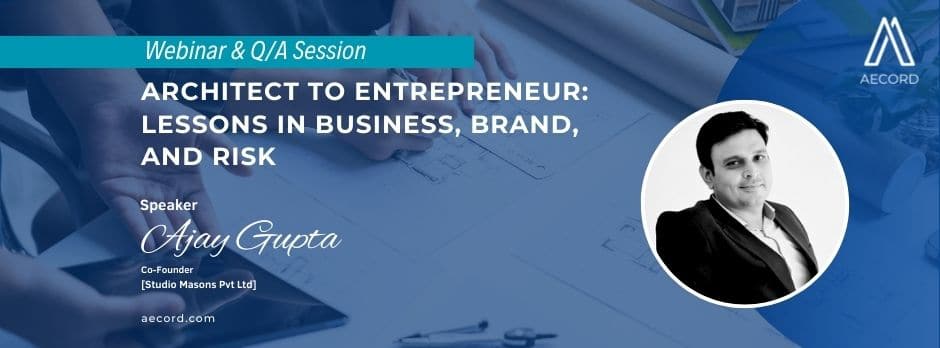
On November 28th, 2025, AECORD hosted an insightful online session titled “Architect to Entrepreneur: Lessons in Business, Brand, and Risk.” The journey from architect to entrepreneur is far more complex than it appears. In this deeply insightful session, Ajay Gupta—Co-Founder of Studio Masons Pvt Ltd—shares honest reflections from his own professional story, revealing what it truly takes to evolve from an architect into an entrepreneur. With decades of experience across India and international markets, Ajay offers clarity on business fundamentals, people management, finances, risk, and the fast-changing role of technology in architecture.
Understanding the Journey: From Designer to Entrepreneur
Ajay begins by describing his early career. After returning from the U.S. in 2008, he joined KGD and later became a partner. His years there taught him how businesses function—operations, running teams, dealing with clients, budgeting, saving, and making difficult decisions. When the firm was sold in 2018, he had gained the clarity and experience required to build something of his own.
He explains that starting a practice requires three things: experience, some savings, and the courage to take risks. With these, he began his entrepreneurial journey and built his foundation through structure, discipline, and continuous learning.
Build cost · Bengaluru, May 2026
Empathy: The Core of Architectural Practice
Ajay emphasizes repeatedly that architecture is ultimately about people. To design good spaces, architects must deeply understand their clients—who they are, how they think, what they expect, and how they emotionally connect with their environment.
Convincing a client, he says, does not happen through drawings alone. It comes from understanding their personality, behaviour, and perspective.
AI Will Transform Architecture But It Won’t Replace Understanding
One of the strongest messages Ajay delivers is about artificial intelligence.
Many architects fear that AI may replace them. Ajay disagrees.
He explains that AI will significantly reduce production time—renderings, drawings, presentations—but it cannot replace client understanding. AI can generate visuals from references, but:
It cannot understand human intent
It cannot interpret emotional needs
It cannot build trust
It cannot handle complex behavioural expectations
For Ajay, AI frees architects to focus more on clients, relationships, and strategic thinking.
The Cash Flow Reality of Architecture Firms
Ajay openly discusses the financial uncertainties all architecture firms face—whether new or established.
Clients may delay payments, but teams and salaries cannot wait.
To manage this, he recommends maintaining two types of projects:
Stable-paying projects for steady cash flow
Passion projects for design expression and portfolio growth
Balancing these helps firms stay stable while continuing to grow.
Frequently asked
Scaling a Practice: From Local to Global
When asked about expanding to international markets, Ajay is clear: You cannot scale globally until your home base is structurally stable.
Every country has different laws, processes, and ways of working. You need capable teams, leadership layers, and clear structures before entering new geographies.
Without systems, global expansion becomes risky and unsustainable.
hr class="wp-block-separator has-alpha-channel-opacity" />
Risk Taking in Architecture: How Do You Know When to Say Yes?
Ajay explains that selecting projects is always a calculated risk. There is no universal formula — it comes from experience.
He advises architects to evaluate:
client attitude
paying capacity
past experiences
how they negotiate
their decision-making style
Contracts help, but judgment matters more. Over time, architects learn to identify red flags early.
The Truth About Architecture Salaries
A student asked Ajay: Why are architecture salaries so low? He acknowledges the perception but offers a different perspective.
Architecture is unlike engineering, IT, or management, where growth paths are pre-defined. In architecture, each person must carve their own journey.
Those who build clarity, structure, and specialization eventually earn well. The profession rewards those who continue learning and take charge of their direction.
hr class="wp-block-separator has-alpha-channel-opacity" />
Q&A: Key Questions Answered by Ajay Gupta
1. What are the top three challenges for scaling up from national to global domain?
Answer (from Ajay Gupta): Scaling internationally is actually the second step. The biggest challenge is that Indian architecture firms lack structuring. If you want to go global, your Indian firm must first be structured properly — multiple leaderships, shared responsibilities, a clear shareholding or profit-sharing system. Every country has its own laws; someone has to run the firm there. You cannot run everything from India. You need the right people, the right capital structure, and a strong internal backbone before global expansion becomes realistic. AECORD Architect to Entrepreneu…
hr class="wp-block-separator has-alpha-channel-opacity" />
2. What inspired you to move from practicing architect to starting your own business?
Answer: Ajay Gupta shares that he is "not a very old entrepreneur." He returned from the US in 2008, became a partner at KGD Architecture, and learned business there. The only thing he wanted as an architect was to work on large-scale projects, and the firm enabled that. KGD was sold in 2018, after which he founded Studio Masons and Knowledge Squirrel, backed by experience, some savings, and a growing appetite for risk. AECORD Architect to Entrepreneu…
hr class="wp-block-separator has-alpha-channel-opacity" />
3. What new trends or technologies will shape the future of architecture, and how is the firm preparing for them?
Answer: Ajay highlights that people are scared of AI, but AI is already reshaping workflows. He notes that:
Designers can now give a reference image + plan → receive rendered outputs automatically.
Design will become a byproduct, while client understanding becomes the core skill.
Human interaction still matters: emotional needs, lifestyle behaviour, adjacency of spaces — things only architects can interpret.
Production of drawings, renderings, and presentations will drastically reduce with AI. AECORD Architect to Entrepreneu…
hr class="wp-block-separator has-alpha-channel-opacity" />
4. What skills outside of design do architects need?
Answer: People skills. You must convince clients why your design is right for them. Empathy with the client is essential. Ego-driven design will fail. You must understand the client’s psychological and functional needs, align with them, and communicate clearly. AECORD Architect to Entrepreneur…
5. What challenges do you face with cash flow or finances when starting a studio?
Answer: Cash flow is the biggest challenge for every firm, whether 1-year-old or 30-year-old. Clients don’t pay on time, but salaries must be paid monthly. Ajay advises:
Keep some projects that pay reliably (even if they aren’t portfolio-worthy).
Keep some “passion projects” separately.
Balance bread-and-butter with brand-building work. This mix helps stabilize cash flow. AECORD Architect to Entrepreneurs…
hr class="wp-block-separator has-alpha-channel-opacity" />
6. How do you decide if a new project is worth the risk?
Answer: There is no checklist. You must gauge:
the client’s paying capacity
their attitude
your past experience with difficult clients
After being “burned” a few times, you learn to identify red flags. Contracts help, but in India, their value is limited. Experience teaches you which clients may delay payments or overwork you. AECORD Architect to Entrepreneu…
hr class="wp-block-separator has-alpha-channel-opacity" />
7. Many students feel architecture doesn’t pay well. How can this change?
Answer: Ajay says: It’s not a perception — it’s the reality. Fresh architecture graduates earn less than B.Com graduates. However, architecture can make you very rich if you choose the right direction. Unlike engineering or MBA careers, architecture has no preset industry-driven growth path. Architects must create their own path — choosing niches, business models, and strategic directions early.
Conclusion
Ajay Gupta’s session offers something rare — an unfiltered, experience-based blueprint for architects who want to build sustainable practices. His insights highlight the need for empathy, structure, financial awareness, and courage.
In a world transforming rapidly with AI and changing client expectations, Ajay’s message is clear: Architects must evolve into entrepreneurs — not by abandoning design, but by strengthening the business behind it.