

Concrete is one of the most widely used construction materials in India, and its performance directly impacts the durability and longevity of structures. While cement and aggregates form the basic components of concrete, admixtures have become essential in modern construction practices. These chemical additives modify concrete properties, enhance workability, improve durability, and reduce costs—making them indispensable for projects ranging from residential buildings in Bangalore to large infrastructure projects in Mumbai.
Understanding cement concrete admixtures is crucial for architects, engineers, and contractors who want to optimize concrete performance and meet stringent building codes across India. This comprehensive guide explores everything you need to know about concrete admixtures, their types, applications, and how to select the right ones for your projects.
What Are Concrete Admixtures?
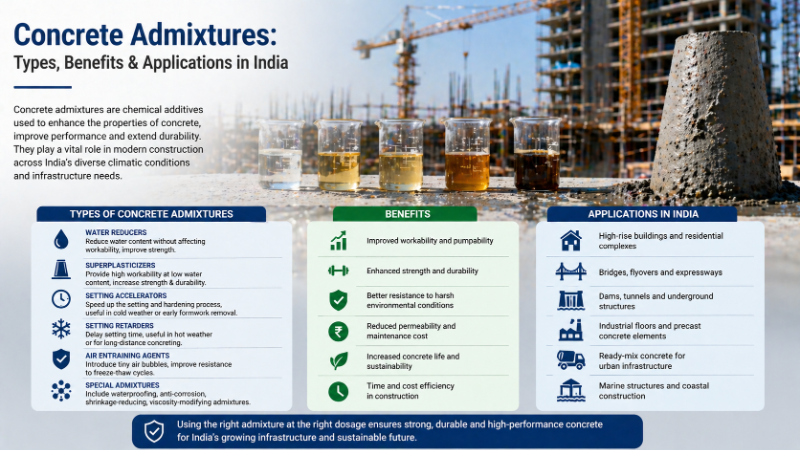
Admixtures are materials added to concrete in small quantities during or after mixing to modify one or more of its properties. According to IS 9103:1999 (Indian Standard for Admixtures for Concrete), admixtures are defined as materials other than water, aggregates, and Portland cement that are added to the concrete mixture to modify its properties.
The primary purpose of using admixtures is to:
Improve workability and pumpability of concrete
Reduce water content and lower cost
Accelerate or retard setting time
Enhance durability and weather resistance
Reduce heat of hydration in mass concrete
Improve strength development
Enhance appearance and aesthetic qualities
In India's diverse climate—from the humid coastal regions of Kerala to the dry deserts of Rajasthan—admixtures play a critical role in ensuring concrete performs optimally under local environmental conditions./blog/cement-vs-concrete-differences-uses-india
Build cost · Bengaluru, May 2026
Types of Concrete Admixtures
1. Plasticizers and Water Reducers
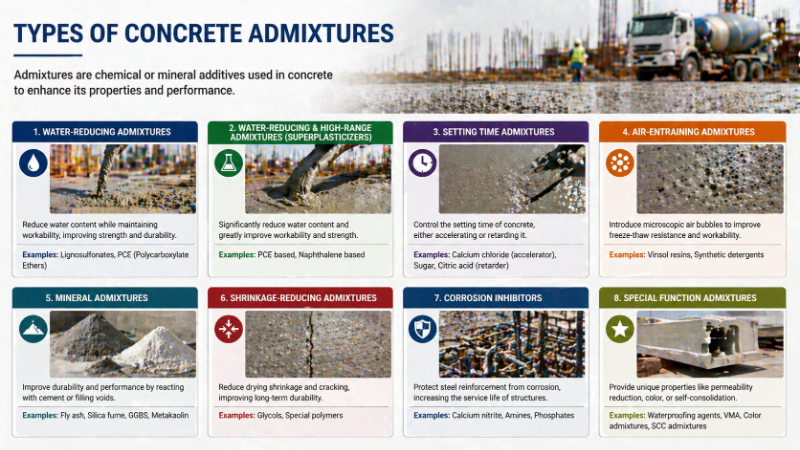
Water-reducing admixtures are among the most commonly used in Indian construction projects. These admixtures reduce the amount of water required to achieve a specific workability level, thereby improving concrete strength and durability.
Benefits:
Reduce water-cement ratio by 10-15%
Increase compressive strength by 5-15%
Improve durability and reduce permeability
Enhance workability without adding extra water
For projects in cities like Delhi and NCR region where water scarcity is a concern, water reducers help achieve sustainable construction practices. A typical water reducer costs between ₹800-1,500 per liter in India.
2. Accelerators
Accelerating admixtures speed up the hydration process of cement, reducing the time required for concrete to gain strength. Calcium chloride was traditionally used, but modern non-chloride accelerators are preferred for reinforced concrete structures to prevent corrosion.
Common accelerators in India include:
Calcium nitrate-based accelerators
Sodium formate accelerators
Triethanolamine-based products
These are particularly useful in:
Cold weather concreting in Himachal Pradesh and Uttarakhand
Rapid construction schedules requiring early formwork removal
Emergency repairs and restoration projects
Accelerators typically cost ₹1,200-2,000 per liter and can reduce setting time by 30-50%.
Frequently asked
3. Retarders
Retarding admixtures delay the hydration process, extending the working time of concrete. This is invaluable in India's hot climate, where concrete can set too quickly during summer months.
Applications in Indian construction:
Summer concreting in cities like Phoenix (Pune), Hyderabad, and Chennai
Large-area concrete pours requiring extended workability
Long-distance transportation of ready-mix concrete
Complex architectural concrete finishes
Retarders cost approximately ₹1,000-1,800 per liter and can extend setting time by 2-10 hours depending on dosage.
4. Air-Entraining Admixtures
These admixtures introduce microscopic air bubbles (typically 4-8% of concrete volume) into concrete, significantly improving freeze-thaw resistance and durability. While freeze-thaw is less common in most of India, air entrainment benefits coastal and high-altitude projects.
Key advantages:
Improved resistance to salt spray in coastal areas (Goa, Maharashtra coast)
Better workability and reduced segregation
Slight reduction in strength (5-10%) offset by durability gains
Enhanced finishing characteristics
Air-entraining agents cost ₹600-1,200 per liter and are essential for marine structures and bridge projects in coastal regions.
5. Superplasticizers (High-Range Water Reducers)
Superplasticizers are advanced admixtures that dramatically improve concrete flowability without adding water. They are based on:
Sulfonated naphthalene formaldehyde (SNF)
Sulfonated melamine formaldehyde (SMF)
Polycarboxylate ethers (PCE)
In India, superplasticizers are extensively used for:
Self-consolidating concrete (SCC) in Mumbai and Bangalore's high-rise projects
Architectural and precast concrete elements
Underwater and tremie concreting
Repair and restoration work
Superplasticizers cost ₹1,500-3,500 per liter and can reduce water requirement by 20-30% while maintaining excellent flow./blog/architect-vs-civil-engineer
6. Durability-Enhancing Admixtures
Corrosion inhibitors: Protect reinforcement steel in concrete, particularly important for structures in industrial areas and coastal regions. These admixtures form a protective layer on steel surfaces, preventing corrosion initiation.
Permeability reducers: Decrease concrete permeability, reducing water and chloride ingress. These are critical for:
Underground structures and basements
Structures in areas with aggressive groundwater
Water-retaining structures like dams and reservoirs
Industrial structures exposed to chemical attack
Durability admixtures typically cost ₹2,000-4,000 per liter but provide long-term cost savings through extended structure life.
Indian Standards and Regulations
All concrete admixtures used in India must comply with relevant Indian Standards:
IS 9103:1999 – Admixtures for Concrete
IS 456:2000 – Plain and Reinforced Concrete Code of Practice
IS 383:2016 – Coarse and Fine Aggregate for Concrete
IS 1199:1959 – Methods of Testing Concrete
When sourcing admixtures from suppliers, ensure they provide third-party test certificates and compliance documentation. Major cities like Delhi, Bangalore, and Pune have authorized testing laboratories that can verify admixture quality./blog/architect-vs-civil-engineer
Practical Applications in Indian Construction
Residential Construction
For apartment buildings and residential complexes across Indian cities, water reducers and plasticizers are standard. They improve concrete quality, reduce construction time, and lower overall project costs. In a typical residential project in Pune or Hyderabad, using water reducers can save 5-8% on cement content while improving strength.
Infrastructure Projects
Major infrastructure projects like highways, bridges, and metro systems require specialized admixture combinations. The Mumbai Metro project extensively uses superplasticizers for self-consolidating concrete, while highway projects utilize retarders for extended paving windows.
Coastal and Marine Structures
Projects in Goa, Kerala, and along the Maharashtra coast require corrosion inhibitors and air-entraining admixtures to combat salt spray and chloride attack. These admixtures add ₹50-150 per cubic meter to concrete cost but prevent expensive repairs.
Industrial and Chemical Plants
Structures in industrial zones around Surat, Vadodara, and Chennai require permeability reducers and chemical-resistant admixtures to withstand aggressive environments.
Selection Criteria for Admixtures
Climate Considerations
India's diverse climate demands different admixture strategies:
Hot and dry regions (Rajasthan, Gujarat): Use retarders to extend working time
Coastal regions (Goa, Kerala): Use corrosion inhibitors and air-entraining agents
Cold regions (Himachal Pradesh, Uttarakhand): Use accelerators for faster strength gain
High-rainfall areas (Western Ghats): Use permeability reducers
Project Requirements
Consider the specific demands of your project:
Strength requirements and timeline
Workability and pumpability needs
Durability expectations and environmental exposure
Aesthetic and finish requirements
Cost constraints and budget limitations
Concrete Mix Design
Admixture selection must align with your concrete mix design. Different cement types, water-cement ratios, and aggregate combinations interact differently with admixtures. Professional mix design services in cities like Bangalore and Mumbai can help optimize admixture selection.
Cost-Benefit Analysis
While admixtures add to concrete costs (typically ₹50-300 per cubic meter), they often provide significant returns:
Reduced cement content: Water reducers can save 5-10% on cement costs
Faster construction: Accelerators reduce curing time, speeding up project completion
Improved durability: Durability admixtures extend structure life by 10-20+ years
Better quality: Reduced defects and rework costs
Environmental benefits: Lower cement content reduces carbon footprint
For a typical residential project in Bangalore using 5,000 cubic meters of concrete, strategic admixture use can save ₹5-15 lakhs while improving quality.
Common Mistakes to Avoid
Overdosing: Using excessive admixtures doesn't improve results and wastes money
Incompatible combinations: Mixing incompatible admixtures can cause adverse reactions
Poor quality products: Using non-certified admixtures compromises concrete integrity
Ignoring mix design: Admixtures must be selected based on specific mix designs
Inadequate testing: Always conduct trial mixes before full-scale implementation
Finding Quality Admixture Suppliers
AECORD connects you with verified suppliers and manufacturers of quality concrete admixtures across India. When selecting suppliers, verify:
IS 9103:1999 compliance certifications
Third-party test reports and quality documentation
Technical support and consultation services
Consistency and reliability of supply
Competitive pricing and delivery options
Major admixture manufacturers operating in India include international brands like BASF, Sika, and Mapei, as well as Indian companies like Pidilite and Fosroc. Using AECORD, you can compare suppliers, read reviews from other professionals, and find the best fit for your project requirements.
Future Trends in Concrete Admixtures
The Indian construction industry is witnessing emerging trends:
Sustainable admixtures: Bio-based and eco-friendly alternatives gaining popularity
Smart admixtures: Products that adapt to environmental conditions
Nano-technology: Nano-particles improving concrete properties at molecular level
Self-healing concrete: Admixtures enabling concrete to repair micro-cracks automatically
These innovations are particularly relevant for India's growing focus on sustainable construction and green building certifications.
Conclusion
Concrete admixtures are no longer optional additions but essential components of modern construction in India. Whether you're building in the bustling metros of Delhi and Mumbai, the tech hubs of Bangalore, or smaller cities across the country, selecting the right admixtures can significantly impact project success, cost efficiency, and long-term durability.
The key to successful admixture use lies in understanding your specific project requirements, climate conditions, and performance goals. Professional consultation with experienced engineers and suppliers ensures optimal selection and application.
Ready to find the right concrete admixture suppliers and professionals for your project? Explore AECORD's comprehensive directory of verified admixture manufacturers, concrete suppliers, and construction professionals across India. Whether you need water reducers for a residential project in Pune, durability admixtures for coastal structures, or superplasticizers for architectural concrete, AECORD connects you with industry experts who can deliver quality solutions tailored to your specific needs. Browse verified suppliers today and take the first step toward optimizing your concrete performance.
Frequently Asked Questions
What are concrete admixtures and why are they used in India?
Concrete admixtures are chemical additives mixed into concrete to modify its properties such as workability, durability, and strength. In India, they're essential for optimizing concrete performance across diverse climates—from humid coastal regions to dry deserts—and help meet stringent building codes while reducing costs and improving construction efficiency.
What is the difference between water reducers and accelerators in concrete?
Water reducers decrease the amount of water needed to achieve desired workability, improving strength and durability by reducing the water-cement ratio by 10-15%. Accelerators, conversely, speed up cement hydration to reduce setting time by 30-50%, making them ideal for cold weather concreting and rapid construction schedules in India.
When should retarders be used in concrete construction?
Retarders are used to delay concrete hydration and extend working time, making them particularly valuable during summer concreting in hot Indian cities like Pune, Hyderabad, and Chennai where concrete sets too quickly. They're essential for large-area pours and projects requiring extended placement windows.
How much do concrete admixtures cost in India?
Concrete admixture costs in India vary by type: water reducers typically cost ₹800-1,500 per liter, while accelerators range from ₹1,200-2,000 per liter. Prices depend on the specific product type, supplier, and market conditions across different regions.
Are chloride-based accelerators safe for reinforced concrete structures?
No, traditional calcium chloride accelerators are not recommended for reinforced concrete as they can cause corrosion of steel reinforcement. Modern non-chloride alternatives like calcium nitrate and sodium formate-based accelerators are preferred in India for reinforced concrete projects to prevent structural damage.