Understanding Cement Selection for Coastal Construction in India
Coastal construction in India presents unique challenges that demand careful material selection. The combination of salt spray, high humidity, and aggressive environmental conditions can rapidly deteriorate standard construction materials. When it comes to cement—the backbone of any construction project—choosing the right type becomes critical for ensuring longevity and structural integrity.
India's coastline spans over 7,500 kilometers, with major coastal cities like Mumbai, Chennai, Kolkata, and Kochi witnessing continuous construction activity. Projects in these areas, whether residential complexes, commercial buildings, or infrastructure developments, face accelerated corrosion risks that standard cement simply cannot withstand effectively.
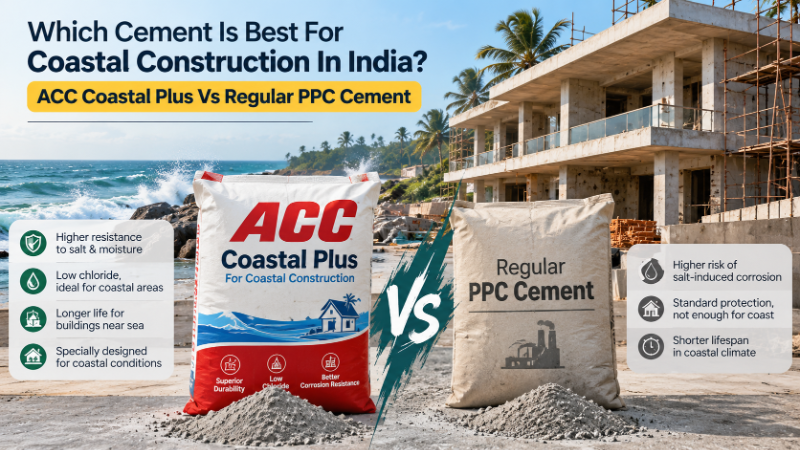
This comprehensive guide explores the differences between specialized coastal cement like ACC Coastal Plus and regular Portland Pozzolana Cement (PPC), helping architects, engineers, and construction professionals make informed decisions for their coastal projects.
Build cost · Bengaluru, May 2026
The Coastal Environment Challenge in India
Why Coastal Areas Demand Special Attention
Coastal regions in India experience environmental stressors that inland areas don't face:
Salt Spray Exposure: Chloride ions from seawater penetrate concrete, initiating corrosion of reinforcement steel
High Humidity: Coastal humidity levels often exceed 80%, accelerating concrete deterioration
Cyclic Wetting and Drying: Tidal zones experience constant moisture fluctuations
Sulfate Attack: Seawater contains sulfates that chemically attack cement paste
Carbonation: Higher CO₂ levels in coastal air speed up concrete carbonation
These factors collectively reduce concrete durability, potentially cutting the service life of a structure from 50+ years to just 15-20 years if inappropriate materials are used. For coastal projects in Mumbai, Goa, or Kerala, this translates to significant financial losses and safety concerns.
Real-World Impact on Indian Coastal Projects
Recent studies on coastal infrastructure in India have documented accelerated deterioration in structures built with standard cement. Reinforcement corrosion has been observed within 5-7 years in some Mumbai waterfront projects, leading to expensive repairs and structural reinforcement work costing lakhs of rupees.
Frequently asked
Regular PPC Cement: Limitations in Coastal Environments
What Is Portland Pozzolana Cement?
Portland Pozzolana Cement (PPC) is a blended cement containing Portland clinker (65-70%), pozzolanic materials (20-30%), and gypsum. It's widely used across India due to its lower cost (typically ₹350-420 per bag compared to specialty cements) and reasonable performance in normal environments.
PPC offers several advantages:
Lower heat of hydration, reducing thermal cracking
Better workability and flow
Cost-effective for general construction
Adequate strength for inland projects
Why PPC Fails in Coastal Conditions
Despite its merits, PPC has significant limitations for coastal construction:
Chloride Permeability: PPC's pozzolanic materials, while beneficial for long-term strength, create a more porous microstructure initially. This allows chloride ions to penetrate the concrete matrix more readily, reaching reinforcement steel faster than specialized coastal cements.
Sulfate Resistance: PPC contains higher C₃A (tricalcium aluminate) content compared to sulfate-resistant variants. When exposed to seawater sulfates, this leads to ettringite formation, causing expansion and deterioration. In Chennai's marine environment, PPC structures have shown visible cracking within 3-5 years.
Early Strength Development: While PPC develops strength adequately, it doesn't provide the dense microstructure needed to resist aggressive coastal environments. The pore structure remains vulnerable to ion penetration.
Cost Implications: Though initially cheaper (₹350-420 per 50 kg bag), using PPC in coastal areas leads to:
Premature repairs and maintenance (₹2,000-5,000 per square meter for concrete restoration)
Structural deterioration requiring expensive reinforcement
Reduced property value due to visible corrosion staining
Potential safety hazards from structural compromise
ACC Coastal Plus: Engineered for Marine Environments
Composition and Special Properties
ACC Coastal Plus is specifically formulated for harsh coastal environments. Its composition includes:
Lower C₃A Content: Reduced tricalcium aluminate (less than 5%) for enhanced sulfate resistance
Optimized Pozzolanic Materials: Selected fly ash and silica fume that create a denser microstructure
Refined Particle Size Distribution: Ensures better packing and reduced porosity
Chloride Binding Capacity: Enhanced ability to bind chloride ions, preventing them from reaching steel reinforcement
These modifications create concrete with significantly lower permeability, making it resistant to both chloride penetration and sulfate attack.
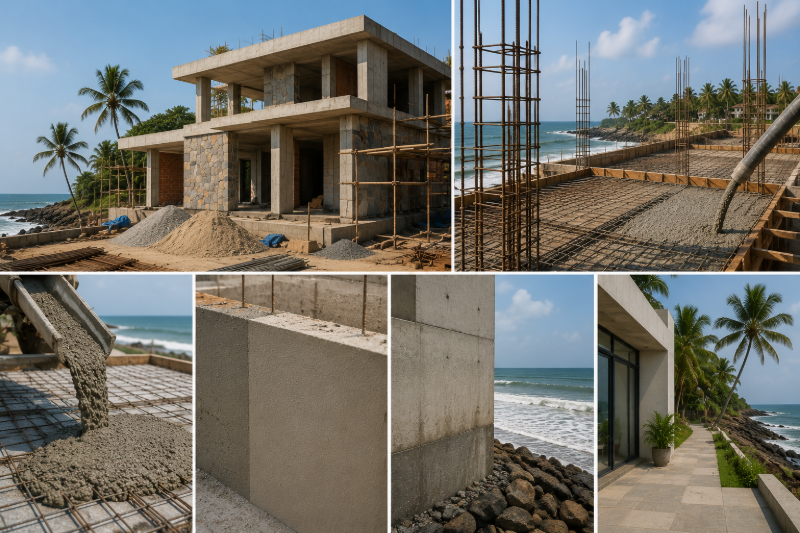
Performance Advantages in Coastal Settings
Durability: ACC Coastal Plus concrete maintains structural integrity for 50+ years in coastal environments, compared to 15-20 years with PPC. Studies on structures in Kochi and Visakhapatnam using coastal-specific cements show minimal corrosion after 20+ years of exposure.
Reduced Permeability: The cement produces concrete with permeability coefficients 3-4 times lower than PPC, significantly slowing chloride and sulfate ingress.
Enhanced Binding: The specialized composition binds chloride ions chemically, preventing them from participating in corrosion reactions even if they penetrate the concrete.
Improved Resistance to Sulfate Attack: With minimal C₃A content, ACC Coastal Plus resists sulfate-induced expansion and deterioration far more effectively than standard PPC.
Cost Considerations
ACC Coastal Plus costs approximately ₹520-600 per 50 kg bag, roughly 40-50% more than standard PPC. However, lifecycle cost analysis reveals significant savings:
Initial Cost Difference: For a typical 2,000 sq. ft. residential building requiring approximately 400-450 bags of cement, the additional cost is ₹60,000-75,000
Maintenance Savings Over 50 Years: Avoiding major repairs (₹8-15 lakhs for concrete restoration in a typical coastal apartment) justifies the premium many times over
Resale Value: Properties built with marine-grade cement command 5-10% higher resale value in coastal markets
Insurance and Warranty: Better cement selection can reduce insurance premiums and extend structural warranties
Comparative Analysis: PPC vs. ACC Coastal Plus
Parameter | Regular PPC | ACC Coastal Plus |
|---|---|---|
Price per 50 kg bag | ₹350-420 | ₹520-600 |
Chloride Permeability | High | Very Low (3-4x better) |
Sulfate Resistance | Moderate | Excellent |
Coastal Durability | 15-20 years | 50+ years |
Early Strength Development | Good | Good |
Workability | Excellent | Good |
Heat of Hydration | Moderate | Moderate to Low |
Lifecycle Cost (50 years) | Higher (due to repairs) | Lower |
Best Practices for Coastal Cement Selection in India
Regulatory Considerations
Indian Standards (IS 1489-1:2015) specify requirements for PPC, while IS 12330:1988 covers sulfate-resistant Portland cement. For coastal construction, many architects and engineers now reference IS 456:2000 guidelines, which recommend:
Use of sulfate-resistant cement for marine environments
Lower water-cement ratio (0.45 or less) for improved durability
Adequate concrete cover (75-100 mm for reinforcement in coastal zones)
High-quality aggregates with low chloride content
When to Use ACC Coastal Plus
ACC Coastal Plus is essential for:
Direct Seawater Exposure: Seawalls, jetties, and marine structures
Splash Zone Structures: Buildings within 500 meters of coastline in cities like Mumbai, Goa, Kochi
High-Rise Coastal Buildings: Structures in Chennai, Visakhapatnam, and other coastal metros where salt spray reaches significant heights
Critical Infrastructure: Hospitals, educational institutions, and heritage structures in coastal areas
Long-Term Investment Properties: Residential projects where durability directly impacts property value
When Regular PPC Might Be Acceptable
Standard PPC can be used in coastal areas only when:
The structure is located more than 2 kilometers inland from the coast
Additional protective measures are implemented (epoxy coating on reinforcement, increased concrete cover, waterproofing membranes)
The project has a limited design life (5-10 years) with planned replacement
Budget constraints are absolute, with understanding of future maintenance costs
Implementation Tips for Coastal Projects
Beyond Cement Selection
Choosing the right cement is crucial, but successful coastal construction requires a holistic approach:
Concrete Design Mix: Work with qualified structural engineers to design concrete mixes specifically for coastal exposure. A typical marine-grade concrete might specify:
Minimum 28-day compressive strength: 40-50 MPa
Water-cement ratio: 0.40-0.45
Air entrainment: 4-6% for freeze-thaw resistance (relevant in cooler coastal areas)
Slump: 75-100 mm for workability without excess water
Quality Control: Coastal projects demand rigorous quality monitoring. Ensure:
Third-party testing of all cement batches for compliance with IS standards
Regular concrete cube testing (at 7, 14, and 28 days)
Chloride content testing of aggregates and mixing water
Permeability testing of concrete samples
Reinforcement Protection: Complement cement selection with:
Epoxy-coated reinforcement bars (adds 15-20% to steel cost but significantly extends durability)
Increased concrete cover: minimum 75 mm for columns, 100 mm for exposed surfaces
Proper spacing and support of reinforcement to ensure uniform cover
Surface Protection: After construction, apply protective coatings:
Hydrophobic sealers to reduce water ingress
Elastomeric coatings for crack bridging
Maintenance painting every 3-5 years in salt spray zones
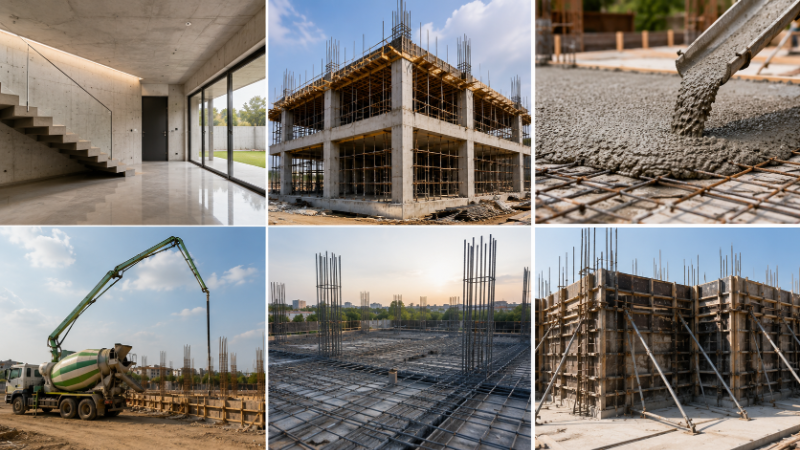
Case Study: Coastal Construction in India
A comparison of two residential projects in Mumbai illustrates the long-term impact of cement selection:
Project A (2000): 20-story residential building in Bandra using regular PPC cement. By 2010, visible rust staining appeared on the facade. By 2015, structural investigation revealed significant reinforcement corrosion requiring ₹2.5 crore concrete restoration work. Current structural integrity remains compromised.
Project B (2000): Similar 20-story building in Worli using sulfate-resistant marine cement. After 24 years, minimal corrosion observed. Routine maintenance cost approximately ₹15 lakhs. Structural condition remains excellent, with no major repairs required.
The initial cement cost difference of approximately ₹80,000 proved insignificant compared to the ₹2.5 crore difference in maintenance and repair costs.
Making the Right Choice for Your Coastal Project
The decision between ACC Coastal Plus and regular PPC cement should be based on:
Location: Proximity to coastline and exposure severity
Project Type: Critical infrastructure requires premium cement; temporary structures may accept lower durability
Design Life: Structures intended for 50+ years need superior materials
Budget Analysis: Lifecycle costing, not just initial material cost
Regulatory Requirements: Check local building codes and client specifications
Professional Consultation: Engage structural engineers experienced in coastal construction
For most permanent coastal construction in India's major cities, ACC Coastal Plus or equivalent marine-grade cements represent the most economical choice when lifecycle costs are considered.
Conclusion
Coastal construction in India demands materials engineered for aggressive marine environments. While regular PPC cement offers cost advantages in inland applications, its limitations in coastal zones make it a false economy. ACC Coastal Plus and similar marine-grade cements provide the durability, resistance to chloride and sulfate attack, and long-term structural integrity that coastal projects require.
The 40-50% premium on cement costs is rapidly offset by avoided repair expenses, extended structure life, and maintained property value. For architects and engineers designing coastal projects in Mumbai, Chennai, Kochi, Visakhapatnam, and other coastal cities, specifying appropriate marine-grade cement is a critical decision that impacts project success and client satisfaction for decades.
If you're planning a coastal construction project in India, finding the right cement supplier and structural consultant is essential. Explore AECORD's network of experienced structural engineers, material suppliers, and coastal construction specialists who can guide your cement selection and overall project execution. AECORD connects you with verified professionals who understand India's coastal construction challenges and can ensure your project is built to last. Visit AECORD today to find the right experts for your coastal construction needs.
Frequently Asked Questions
Why is regular PPC cement not suitable for coastal construction in India?
Regular PPC cement has higher chloride permeability and increased C₃A content, making it vulnerable to salt spray and sulfate attack from seawater. Studies show reinforcement corrosion can occur within 5-7 years in coastal projects using standard PPC, significantly reducing the structure's service life from 50+ years to just 15-20 years.
What are the main environmental challenges for coastal construction in India?
Coastal areas face unique stressors including salt spray exposure, humidity levels exceeding 80%, cyclic wetting and drying in tidal zones, sulfate attack from seawater, and accelerated carbonation. These factors collectively cause rapid concrete deterioration and reinforcement corrosion if inappropriate materials are used.
What is ACC Coastal Plus cement and how does it differ from regular cement?
ACC Coastal Plus is a specialized cement formulated specifically for coastal environments with enhanced resistance to chloride penetration and sulfate attack. Unlike regular PPC cement, it features a denser microstructure and lower C₃A content, providing superior durability in high-humidity, salt-spray conditions typical of India's coastline.
Which Indian coastal cities require specialized cement for construction projects?
Major coastal cities like Mumbai, Chennai, Kolkata, Kochi, and Goa experience continuous construction activity where specialized coastal cement is critical. These regions face aggressive environmental conditions from seawater exposure that standard cement cannot withstand effectively.
How much longer does coastal-grade cement last compared to regular PPC in marine environments?
Coastal-grade cement can maintain structural integrity for 50+ years in marine conditions, while regular PPC may deteriorate within 15-20 years due to chloride penetration and sulfate attack. This extended service life makes specialized coastal cement more cost-effective despite higher initial material costs.