

Can AI Replace Architects? What AI Can and Cannot Do
The rise of artificial intelligence has sparked considerable debate across industries, and architecture is no exception. As AI tools become increasingly sophisticated, many professionals and clients alike wonder: Can AI actually replace architects? The short answer is no—but the nuanced answer reveals why AI is reshaping the profession rather than replacing it.
In India's rapidly growing construction sector, where projects range from residential complexes in Bangalore to commercial towers in Mumbai, the integration of AI is creating new opportunities for architects to work smarter, not harder. Understanding what AI can and cannot do is crucial for architects navigating this technological shift and for clients seeking the right expertise for their projects.
Build cost · Bengaluru, May 2026
What AI Can Do in Architecture
Rapid Design Iteration and Concept Generation
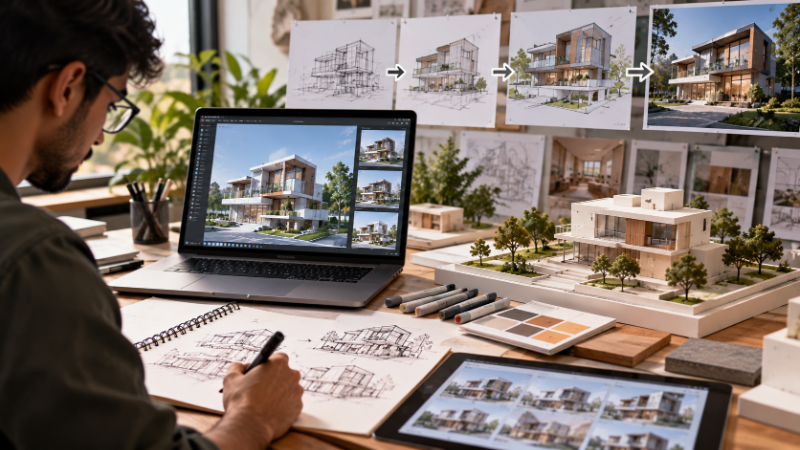
One of AI's most impressive capabilities is generating multiple design variations quickly. Tools powered by machine learning can analyze design parameters—such as site dimensions, budget constraints, and functional requirements—and produce dozens of conceptual designs in hours. What might take a human architect days or weeks can now be accomplished in a fraction of the time.
For architects in India working on tight project timelines, this acceleration is invaluable. A design firm in Delhi working on a mixed-use development can use AI to explore various massing options, orientation strategies, and spatial configurations simultaneously, then refine the most promising concepts with human expertise.
Data Analysis and Pattern Recognition
AI excels at processing vast amounts of data and identifying patterns humans might miss. In architectural practice, this translates to:
Building performance analysis: AI can analyze energy consumption patterns across thousands of buildings to predict how your design will perform in Indian climate conditions
Cost estimation: Machine learning models trained on construction data across Indian cities can provide accurate preliminary cost estimates in INR, helping architects and clients understand project feasibility early
Regulatory compliance: AI can cross-reference designs against building codes, zoning regulations, and safety standards specific to different Indian states and municipalities
Site analysis: AI-powered tools can process satellite imagery, traffic data, and demographic information to provide comprehensive site analysis reports
Frequently asked
Automating Routine Design Tasks
Repetitive, rule-based tasks are where AI truly shines. These include:
Generating floor plans based on functional requirements and spatial relationships
Creating construction documentation and technical drawings
Optimizing parking layouts and circulation patterns
Scheduling and coordinating building systems
Producing material takeoffs and quantity estimations
By automating these tasks, architects can focus their creative energy on higher-level design decisions that require judgment and innovation.
Visualization and Rendering
AI-powered rendering engines can create photorealistic visualizations far faster than traditional methods. For architects in Bangalore, Mumbai, or Pune presenting designs to clients, these tools enable rapid iteration on visual presentations without waiting days for rendering farms to process images.
Sustainability Analysis
As India increasingly emphasizes green building standards like LEED and GRIHA, AI tools can automatically analyze designs for sustainability performance. These systems can evaluate daylighting potential, thermal comfort, water efficiency, and embodied carbon across different design options, helping architects create more sustainable buildings.
What AI Cannot Do in Architecture
Make Value Judgments and Design Decisions
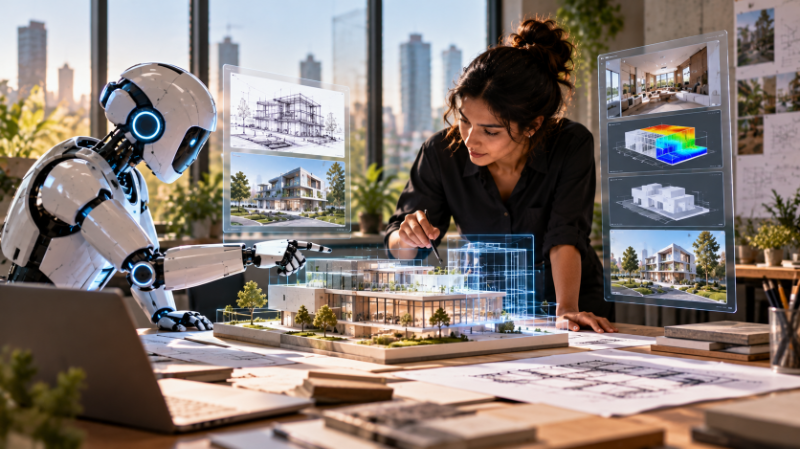
Architecture is fundamentally about making choices based on values, aesthetics, and human experience. AI can present options, but it cannot decide which option is "better" in a meaningful sense. Should a building prioritize visual drama or contextual harmony? Should it maximize floor area or preserve green space? These decisions require understanding the project's purpose, the client's values, and the community's needs—all deeply human considerations.
An architect designing a cultural center in Jaipur must understand not just the functional requirements but the city's heritage, its architectural identity, and how the new building should relate to its surroundings. This requires cultural knowledge, aesthetic judgment, and professional experience that AI simply cannot replicate.
Engage in Creative Problem-Solving
While AI can generate variations on existing patterns, true creativity—the ability to imagine something genuinely new that solves a problem in an unexpected way—remains a distinctly human capacity. When faced with a challenging site in Hyderabad with difficult topography and conflicting constraints, an experienced architect draws on years of experience, intuition, and creative thinking to develop innovative solutions. AI can help explore the solution space, but the breakthrough idea typically comes from human insight.
Understand Context and Culture
Architecture exists within cultural, historical, and social contexts that AI struggles to fully comprehend. A residential complex in Chennai must respect local building traditions, climate adaptation strategies developed over centuries, and community expectations. An architect understands these nuances intuitively; an AI system would need explicit programming for each cultural context.
When designing for diverse Indian communities—whether in Kolkata, Pune, or smaller cities—architects must understand local preferences, traditions, and social dynamics. This contextual awareness is crucial for creating buildings that communities will embrace and value.
Manage Client Relationships and Expectations
Clients don't just need designs; they need guidance, reassurance, and collaborative problem-solving. An architect must listen to clients' concerns, manage expectations, educate them about design trade-offs, and build trust throughout the project. These interpersonal skills are irreplaceable. A client considering a ₹5 crore commercial project in Gurgaon needs to work with a professional who understands their business, can communicate complex design concepts clearly, and can advocate for good design decisions.
Navigate Regulatory Complexity and Negotiate with Authorities
India's construction landscape involves navigating multiple regulatory frameworks—municipal building codes, state-specific regulations, environmental clearances, and increasingly complex zoning requirements that vary between Delhi, Bangalore, Chennai, and other cities. While AI can help track regulatory requirements, an experienced architect must interpret regulations, identify conflicts, and negotiate with municipal authorities when needed. This requires professional judgment and experience that no AI system currently possesses.
Adapt to Unforeseen Challenges During Construction
Construction is messy. Site conditions differ from surveys, material costs fluctuate, contractors encounter unexpected challenges, and clients change their minds. An architect must make real-time decisions, solve problems creatively, and maintain project quality despite obstacles. An AI system trained on historical data cannot adapt to novel situations the way experienced professionals can.
The Real Future: AI-Augmented Architecture
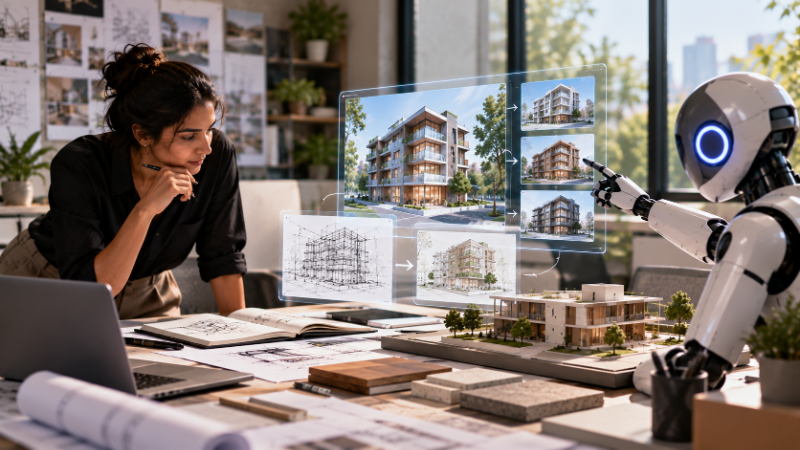
Rather than replacing architects, AI is becoming a powerful tool that enhances architectural practice. The most successful firms—whether in Delhi, Mumbai, or emerging tech hubs—are those that integrate AI strategically while maintaining the human expertise that creates truly exceptional buildings.
How Architects Are Using AI Today
Forward-thinking architectural practices across India are already leveraging AI:
Parametric design: Using AI and algorithmic tools to explore design spaces defined by performance criteria
BIM optimization: AI-enhanced Building Information Modeling for better coordination and clash detection
Predictive maintenance: Using AI to predict maintenance needs and plan building lifecycle costs
Site selection: Analyzing multiple potential sites using AI to identify the best location for a project
Construction sequencing: AI optimization of construction schedules and resource allocation
The Skills Architects Need Now
As AI becomes more prevalent, architects must develop new capabilities:
AI literacy: Understanding what AI tools can do and their limitations
Data interpretation: Ability to work with data-driven insights and translate them into design decisions
Creative leadership: Focusing on uniquely human skills like vision-setting and creative problem-solving
Technology integration: Knowing how to effectively combine AI tools into design workflows
Ethical awareness: Understanding the implications of AI-driven design decisions on communities and environments
Why Human Architects Still Matter
Responsibility and Accountability
When a building fails structurally, aesthetically, or functionally, someone must be accountable. In India's regulatory framework, the architect bears professional responsibility for design decisions. An AI system cannot accept this responsibility. Clients need to know that a qualified professional has reviewed and endorsed their design.
Holistic Design Thinking
Great architecture balances multiple competing concerns: aesthetics, function, cost, sustainability, cultural context, and human experience. This holistic thinking requires wisdom and judgment that emerges from years of practice and reflection. An AI system optimizes for specific parameters; a master architect synthesizes multiple considerations into a coherent vision.
Creating Meaningful Spaces
Architecture's ultimate purpose is creating spaces where human life unfolds. Whether it's a corporate office in Bangalore, a hospital in Mumbai, or a school in a tier-2 city, buildings profoundly affect how people work, heal, learn, and live. This human dimension requires empathy, understanding, and design sensibility that only human architects possess.
Finding the Right Architectural Expertise
As the architecture profession evolves with AI integration, selecting the right architect for your project is more important than ever. You need professionals who understand both traditional design excellence and emerging technologies. Look for architects who:
Demonstrate experience with complex projects similar to yours
Show willingness to leverage technology while maintaining design integrity
Communicate clearly and engage collaboratively with clients
Understand local context, regulations, and market conditions in your city
Combine innovation with proven, reliable design principles
If you're planning a construction project in India—whether residential, commercial, institutional, or industrial—finding qualified architects and design professionals is crucial. AECORD connects you with vetted architectural professionals across India who combine traditional expertise with contemporary tools and methods. Whether you need a boutique design firm or a large practice, AECORD's marketplace helps you find the right team for your specific needs and budget.
Conclusion: The Architect's Evolving Role
AI will not replace architects, but it will transform how architects work. The profession is moving toward a model where architects focus on what they do best—creative vision, strategic thinking, client advocacy, and ensuring design excellence—while AI handles data analysis, routine documentation, and performance optimization.
For clients in India's booming construction sector, this evolution is good news. It means architects can dedicate more time to understanding your project's unique requirements, exploring creative solutions, and ensuring your building achieves its full potential. AI is not architecture's replacement; it's architecture's enhancement.
The buildings that will define India's cities in the coming decades will be designed by architects who skillfully combine human creativity with AI-powered tools. If you're planning a project and need to find such professionals, explore AECORD to connect with architects and design teams who are leading this transformation in India's AECO industry.