




```html
Soil testing is one of the most critical yet often overlooked aspects of construction projects in India. Whether you're planning a residential building in Bangalore, a commercial complex in Mumbai, or an industrial facility in Pune, understanding the soil composition and bearing capacity is essential for ensuring structural safety and longevity. This comprehensive guide explores why soil testing matters, the various types of tests, and how to navigate the process in the Indian construction landscape.
Why Soil Testing is Critical for Indian Construction Projects
India's diverse geography presents unique soil challenges across different regions. From the alluvial plains of North India to the laterite soils of the Western Ghats, and the black soils of the Deccan Plateau, each region demands specific construction approaches. Soil testing provides the scientific foundation for making informed decisions about foundation design, construction methodology, and long-term structural stability.
Poor soil assessment has been the root cause of numerous construction failures, including foundation settlements, structural cracks, and in extreme cases, building collapses. The cost of rectifying these issues—often running into crores of rupees—far exceeds the investment in proper soil investigation at the project's inception. Additionally, regulatory bodies like the Indian Bureau of Mines and local municipal corporations increasingly require soil testing reports before granting construction permits.
When you're sourcing construction professionals and engineers on AECORD, one of the first questions they should ask is about your soil testing plan. This demonstrates their commitment to proper project execution and risk management.
Build cost · Bengaluru, May 2026
Types of Soil Tests for Construction
Geotechnical Investigation and Boring
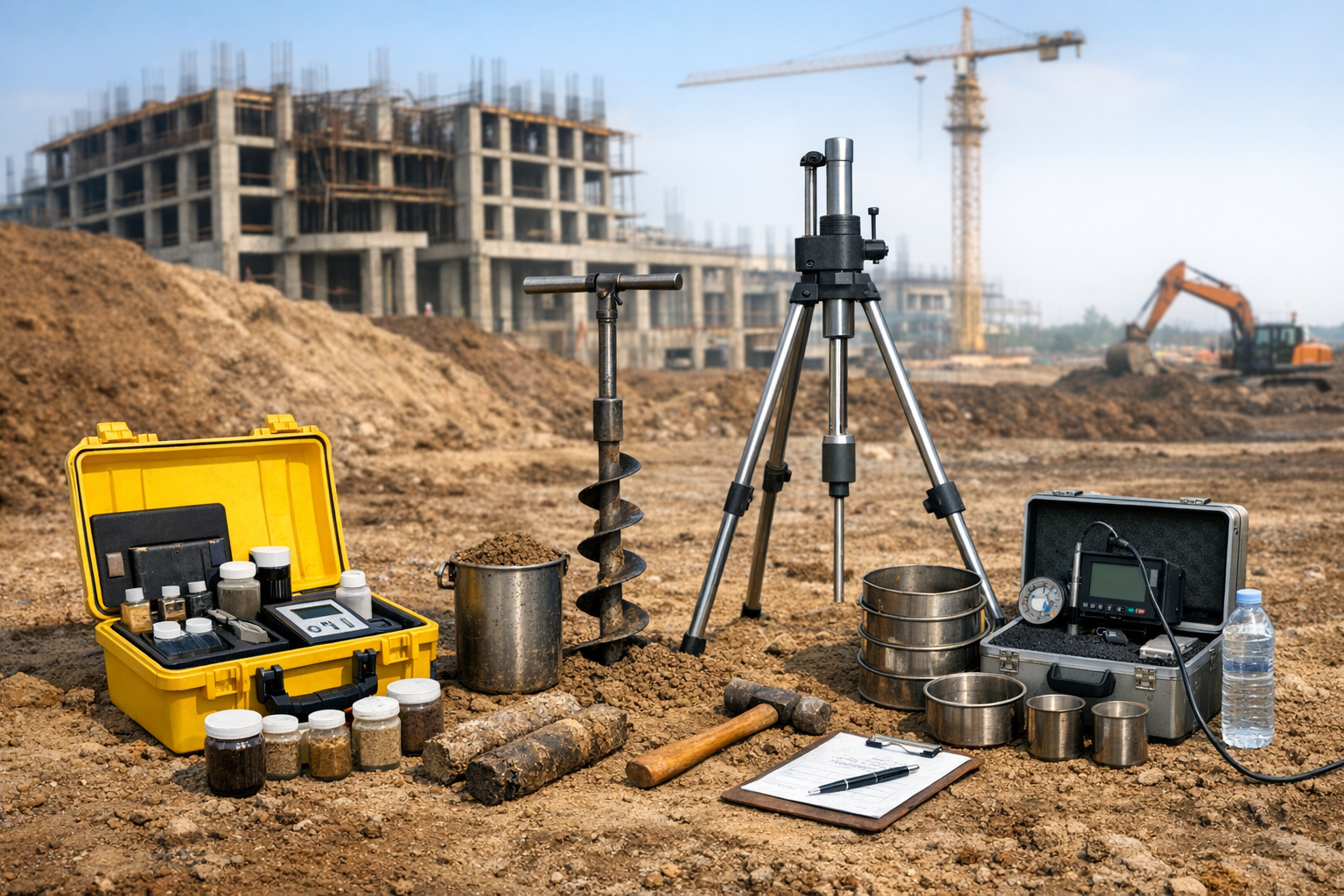
Geotechnical investigation involves drilling boreholes at strategic locations across your construction site to extract soil samples from various depths. The depth of boring typically depends on the proposed structure's size and foundation type, but generally ranges from 10 to 50 meters for multi-story buildings.
In India, the cost of borehole investigation ranges from ₹5,000 to ₹15,000 per meter, depending on the soil type and location. For a typical residential project in Delhi or Hyderabad, you might expect to invest ₹1.5 to ₹3 lakhs for comprehensive boring and sampling.
Laboratory Testing
Once soil samples are collected, they undergo various laboratory tests to determine their properties:
Particle Size Analysis (Sieve Analysis): Determines the distribution of particle sizes in the soil, helping classify whether it's sandy, silty, or clayey. This test costs approximately ₹2,000 to ₹3,000 per sample.
Atterberg Limits Test: Measures the plasticity and consistency characteristics of fine-grained soils. Essential for understanding how soil behaves under different moisture conditions. Cost: ₹1,500 to ₹2,500 per sample.
Standard Proctor Test (Compaction Test): Determines the relationship between moisture content and soil density, crucial for designing embankments and fill materials. Cost: ₹2,500 to ₹4,000 per sample.
Unconfined Compression Strength Test: Measures the soil's ability to withstand compressive stress, particularly important for clayey soils. Cost: ₹2,000 to ₹3,500 per sample.
Permeability Test: Assesses the soil's ability to allow water flow, critical for drainage design and foundation stability. Cost: ₹1,500 to ₹2,500 per sample.
Consolidation Test: Evaluates how soil settles under load over time, essential for predicting future settlements. Cost: ₹3,000 to ₹5,000 per sample.
Shear Strength Test (Triaxial or Direct Shear): Determines the soil's resistance to shearing forces, fundamental for slope stability and foundation design. Cost: ₹3,500 to ₹6,000 per sample.
Frequently asked
In-Situ Tests
These tests are performed directly at the construction site and provide real-time data about soil properties:
Standard Penetration Test (SPT): Uses a standardized hammer and sampler to measure soil resistance at various depths. The SPT value directly correlates with bearing capacity and is widely used in India. Cost: ₹1,000 to ₹2,000 per boring location.
Cone Penetration Test (CPT): A more advanced alternative to SPT, providing continuous soil profile data. Cost: ₹2,000 to ₹4,000 per boring location.
Plate Load Test: Directly measures the bearing capacity of soil by loading a steel plate and observing settlement. Essential for final foundation design verification. Cost: ₹20,000 to ₹40,000 per test.
Vane Shear Test: Measures undrained shear strength of soft clays, particularly useful in coastal regions and areas with high water tables. Cost: ₹1,500 to ₹2,500 per test.
Understanding Soil Bearing Capacity
Bearing capacity—the maximum load soil can safely support—is perhaps the most critical parameter determined through soil testing. In India, different soil types have vastly different bearing capacities:
Loose sand: 10-15 tonnes per square meter (t/m²)
Medium sand: 20-30 t/m²
Dense sand: 40-50 t/m² or more
Soft clay: 5-10 t/m²
Medium clay: 15-25 t/m²
Stiff clay: 30-50 t/m²
For example, a multi-story residential building in Mumbai might rest on medium clay with a bearing capacity of 20 t/m², while a similar building in Bangalore might encounter laterite soils with bearing capacities exceeding 50 t/m². These differences directly impact foundation design costs, ranging from simple spread footings (₹500-₹1,000 per square meter) to more complex pile foundations (₹2,000-₹5,000 per square meter).
Regional Soil Characteristics in India
Northern India (Delhi, Jaipur, Chandigarh)
The alluvial plains of Northern India typically feature sandy and silty soils with variable bearing capacities. Groundwater levels are often deep (15-30 meters), making foundation design relatively straightforward. However, seasonal variations and future groundwater depletion concerns require careful assessment.
Western India (Mumbai, Pune, Ahmedabad)
Laterite and basaltic soils dominate this region, offering good bearing capacity (40-60 t/m²) but requiring careful excavation due to their hard, brittle nature. Proximity to the Arabian Sea in coastal areas introduces salinity concerns, necessitating special concrete mixes and protective measures.
Southern India (Bangalore, Chennai, Hyderabad)
Granite and gneissic soils characterize much of South India, providing excellent bearing capacity but often requiring specialized equipment for excavation. Water table variations and seasonal monsoons demand comprehensive hydrological assessment.
Eastern India (Kolkata, Bhubaneswar)
Alluvial deposits with high water tables characterize this region. Soft clays and silts necessitate deep foundation investigations and careful management of groundwater during construction.
Regulatory Requirements for Soil Testing in India
India doesn't have a single mandatory national standard for soil testing in building construction, but several guidelines and codes provide direction:
Indian Standard IS 1892-1979: Code of practice for subsurface investigation for foundations
Indian Standard IS 4091-1968: Code of practice for determination of bearing capacity of shallow foundations
National Building Code (NBC) 2016: Provides guidelines for foundation design based on soil investigation
Local Municipal Regulations: Many cities like Mumbai, Delhi, and Bangalore have specific requirements in their building bylaws
Before starting your project, consult with local municipal authorities and professional geotechnical engineers to understand specific requirements for your location and project type.
Selecting a Qualified Soil Testing Laboratory
Choosing the right laboratory is as important as conducting the tests. Look for laboratories that are:
Accredited by NABL (National Accreditation Board for Testing and Calibration Laboratories)
Compliant with relevant Indian Standards (IS codes)
Equipped with modern testing equipment and experienced staff
Capable of providing comprehensive reports with clear recommendations
Major cities like Mumbai, Delhi, Bangalore, and Hyderabad have numerous accredited laboratories. Expect to pay 15-25% more for NABL-accredited testing, but the investment ensures credibility and acceptance by regulatory authorities.
Cost Considerations for Soil Testing
A comprehensive soil investigation for a typical 5,000 square meter residential project in India typically costs ₹4 to ₹8 lakhs, breaking down as follows:
Borehole drilling and sampling: ₹2-3 lakhs
Laboratory testing (20-30 samples): ₹1.5-2.5 lakhs
In-situ tests (SPT, CPT): ₹0.5-1 lakh
Plate load tests: ₹0.5-1 lakh
Report preparation and recommendations: ₹0.5 lakh
While this might seem substantial, it typically represents only 0.5-1% of the total project cost, making it an excellent investment in risk mitigation.
Common Soil Problems in Indian Construction
Expansive Soils
Black soils in regions like Maharashtra and Karnataka expand significantly when wet and shrink when dry, causing differential settlement and structural damage. Proper identification through soil testing allows engineers to design appropriate foundations and use stabilizing techniques.
Collapsible Soils
Certain soils, particularly in semi-arid regions, collapse when saturated. This can occur if groundwater levels rise due to irrigation or water supply leakages, causing sudden and severe settlements.
High Water Tables
In coastal areas and regions with high rainfall, elevated water tables complicate foundation construction and require specialized dewatering and waterproofing measures.
Contaminated Soils
Industrial areas often have contaminated soils requiring remediation before construction. Proper soil testing identifies these issues early, preventing environmental and health hazards.
Integrating Soil Testing into Your Project Timeline
Ideally, soil investigation should commence during the land acquisition phase, before finalizing purchase. This allows you to:
Make informed decisions about land suitability
Adjust the project design based on soil characteristics
Negotiate land prices based on foundation requirements
Identify potential risks early
The typical soil investigation and reporting process takes 4-6 weeks, so budget accordingly in your project schedule.
Working with Professionals on AECORD
When you're ready to execute your soil testing program, AECORD connects you with qualified geotechnical engineers, soil testing laboratories, and construction professionals across India. Whether you're in Pune, Kolkata, or Chandigarh, you can find specialists who understand local soil conditions and regulatory requirements.
Look for professionals with:
Experience in your specific region and soil type
Certifications from relevant professional bodies
Track records with similar project scales
Understanding of current Indian Standards and building codes
Conclusion
Soil testing is not an optional expense but a fundamental requirement for safe, durable construction in India. The diverse geological conditions across the country demand region-specific expertise and comprehensive investigation protocols. By investing in proper soil testing, you protect your project from costly failures, ensure regulatory compliance, and optimize foundation design for maximum economy and safety.
Whether you're developing a small residential plot or a large commercial complex, make soil investigation your first priority. The insights gained will guide every subsequent decision in your construction project, from foundation design to material selection and construction methodology.
Ready to begin your soil testing journey? Connect with experienced geotechnical engineers and soil testing laboratories on AECORD today. Our platform brings together India's most qualified AECO professionals, making it easy to find the right expertise for your project, regardless of location. Start your search now and ensure your construction project is built on solid ground—literally.
```
Frequently Asked Questions
Why is soil testing important for construction projects in India?
Soil testing is critical because India's diverse geography presents unique soil challenges across regions, and poor soil assessment has caused numerous construction failures including foundation settlements and structural collapses. Regulatory bodies like the Indian Bureau of Mines now require soil testing reports before granting construction permits, making it essential for structural safety and longevity.
How much does soil testing cost for a construction project in India?
Geotechnical investigation costs range from ₹5,000 to ₹15,000 per meter of borehole drilling, with a typical residential project in Delhi or Hyderabad requiring ₹1.5 to ₹3 lakhs for comprehensive boring and sampling. Individual laboratory tests range from ₹1,500 to ₹5,000 per sample depending on the test type.
What types of soil tests are required for construction?
Key tests include Particle Size Analysis (₹2,000-₹3,000), Atterberg Limits Test (₹1,500-₹2,500), Standard Proctor Test (₹2,500-₹4,000), Unconfined Compression Strength Test (₹2,000-₹3,500), Permeability Test (₹1,500-₹2,500), Consolidation Test (₹3,000-₹5,000), and Shear Strength Test. These tests determine soil properties essential for foundation design and construction methodology.
How deep should boreholes go for soil testing?
Borehole depth typically ranges from 10 to 50 meters for multi-story buildings, depending on the proposed structure's size and foundation type. The depth is determined by geotechnical engineers based on the specific project requirements and soil conditions.
What do different soil types in India require for construction?
India's diverse soil types—from alluvial plains in North India to laterite soils in the Western Ghats and black soils of the Deccan Plateau—each demand specific construction approaches. Soil testing helps determine the appropriate foundation design and construction methodology for each region's unique soil characteristics.