

The year 2026 is no longer a distant future. Smart buildings—structures that anticipate your needs and respond automatically to environmental changes—are transitioning from cutting-edge concepts to practical reality. In India, where rapid urbanization and sustainability concerns are reshaping the construction landscape, smart buildings represent a significant evolution in how we design, operate, and inhabit our spaces.
The promise is compelling: imagine walking into your office and the lighting automatically adjusts to your preference, the HVAC system has already optimized temperature based on occupancy patterns, and energy consumption is monitored in real-time to prevent wastage. This isn't science fiction—it's the direction the Indian construction and real estate sectors are heading.
Understanding Smart Buildings: Beyond Basic Automation
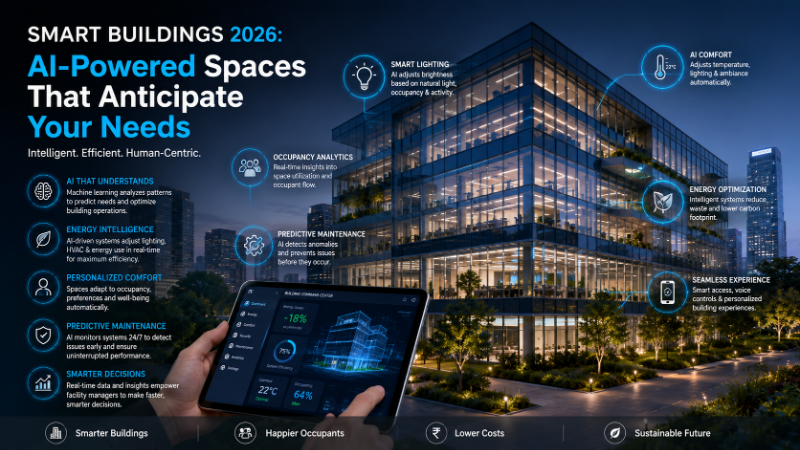
Smart buildings are fundamentally different from simply automated buildings. While automation follows pre-programmed rules, smart buildings use artificial intelligence, machine learning, and interconnected sensors to learn from patterns and respond intelligently to changing conditions.
A traditional office building in Mumbai might have a thermostat set to 22°C year-round. A smart building, by contrast, learns that occupancy peaks between 9 AM and 5 PM, that summer afternoons require different cooling strategies than monsoon mornings, and that certain zones remain empty on weekends. It adjusts proactively, sometimes hours before occupants even arrive.
Build cost · Bengaluru, May 2026
Key Technologies Enabling Smart Buildings
Internet of Things (IoT) Sensors: These devices collect real-time data on temperature, humidity, occupancy, air quality, and energy consumption. In 2026, sensor costs in India have dropped significantly—a quality occupancy sensor now costs between ₹2,000-₹5,000, making widespread deployment economically viable.
Artificial Intelligence and Machine Learning: AI algorithms process sensor data to identify patterns and predict needs. For example, ML models can forecast peak energy demand in a Bangalore IT park based on historical data, weather patterns, and scheduled events.
Cloud Computing: Buildings generate enormous amounts of data. Cloud platforms allow this data to be stored, processed, and analyzed without requiring expensive on-site infrastructure.
Edge Computing: Some processing happens locally on devices rather than sending all data to the cloud. This reduces latency and improves response times—critical for systems like emergency protocols or elevator management.
5G Connectivity: Faster, more reliable connectivity enables real-time communication between building systems. This is particularly important in India, where 5G rollout is expanding rapidly.
How Smart Buildings Anticipate Your Needs
The magic of smart buildings lies in their predictive capabilities. Here's how they work in practice:
Occupancy Prediction and Space Optimization
Smart buildings don't just respond to occupants already present—they anticipate arrivals. By analyzing historical patterns, calendar data, and even weather forecasts, a building can predict occupancy 30 minutes to 2 hours in advance.
In a corporate office in Delhi, this means:
Lighting systems activate in parking areas and lobbies before the morning rush
HVAC systems begin conditioning spaces before occupants arrive
Elevators are positioned optimally to minimize wait times
Meeting rooms are automatically prepared based on scheduled bookings
This predictive approach reduces energy consumption by 20-30% compared to conventional buildings, translating to annual savings of ₹5-15 lakhs for a mid-sized commercial building in India.

Frequently asked
Personalized Comfort Without Asking
Modern smart buildings integrate with mobile apps and wearable devices. A building can recognize when you're approaching and adjust your preferred workspace accordingly. Your desk lighting, chair height, temperature preference, and even your preferred music playlist can all be configured automatically.
This is particularly valuable in India's hot and humid climate. An employee working in a Hyderabad office tower might have their desk cooled to 24°C while the main office operates at 26°C, reducing individual energy consumption while maintaining comfort.
Predictive Maintenance
Rather than waiting for equipment to fail, smart buildings monitor the health of all systems continuously. Sensors detect subtle changes in performance that signal upcoming failures.
For instance, an elevator's motor might show increased vibration or temperature rise weeks before catastrophic failure. The building alerts maintenance teams automatically, preventing costly downtime and safety risks. In a 20-story commercial building in Pune, predictive maintenance can reduce maintenance costs by 25-35% annually.
Energy Management: The Financial Impact
Energy consumption is one of the largest operational costs for Indian buildings. Smart buildings address this through multiple mechanisms:
Real-Time Energy Monitoring
Every electrical circuit, HVAC zone, and equipment is monitored individually. Building managers can identify energy waste immediately. If a conference room's air conditioning runs on an empty floor, alerts trigger instantly.
A 50,000 sq ft office building in Bangalore typically spends ₹25-30 lakhs annually on electricity. Smart building management can reduce this to ₹18-22 lakhs—savings of ₹3-8 lakhs per year.
Demand Response and Load Optimization
Smart buildings communicate with the power grid, shifting non-critical loads to off-peak hours when electricity is cheaper. In states like Maharashtra and Tamil Nadu where time-of-use tariffs are increasingly common, this can yield significant savings.
A building might delay non-urgent water pumping, laundry operations, or battery charging until late evening when rates drop from ₹8-10 per unit to ₹5-6 per unit.
Renewable Energy Integration
Smart buildings optimize the use of rooftop solar installations. Rather than exporting excess solar energy at low rates or storing it inefficiently, the building learns to shift consumption patterns to match solar generation.
A building with 100 kW of solar capacity can increase self-consumption from 40% to 70% through intelligent load management, improving the return on investment for solar installations.
Indoor Environmental Quality and Health
Post-pandemic, indoor air quality has become a priority. Smart buildings monitor and maintain optimal conditions automatically:
Air Quality Management
CO₂ sensors, PM 2.5 monitors, and volatile organic compound (VOC) detectors continuously assess air quality. When CO₂ levels approach 800 ppm (a threshold affecting cognitive function), the building increases fresh air intake automatically.
In Indian cities with significant air pollution—Delhi, Mumbai, Bangalore—smart buildings filter incoming air and adjust ventilation rates based on outdoor AQI. This prevents outdoor pollution from degrading indoor air quality.
Thermal Comfort Optimization
Rather than maintaining uniform temperature, smart buildings create microclimate zones. Thermal imaging identifies cold spots and hot spots, and the system adjusts airflow and heating/cooling to create optimal conditions throughout the space.
This is particularly valuable in India's diverse climate zones. A building in Chennai faces different challenges than one in Srinagar, and smart systems adapt accordingly.
Humidity and Moisture Control
India's monsoon season brings humidity challenges that can damage equipment and create mold. Smart buildings maintain optimal humidity levels (typically 40-60%) automatically, preventing structural damage and health issues.

Security and Safety: Intelligent Protection
Smart buildings integrate security and safety systems in ways that improve protection while reducing false alarms:
Behavioral Analysis
AI systems learn normal traffic patterns and identify anomalies. Unusual movement at 3 AM in a residential tower, or unauthorized access to restricted areas, triggers alerts immediately.
Computer vision systems can identify safety hazards—a wet floor that poses slip risks, blocked emergency exits, or unattended belongings—and alert staff automatically.
Emergency Response Coordination
In case of fire, earthquake, or other emergencies, smart buildings coordinate response automatically. Elevators return to ground floor, emergency lighting activates, evacuation routes are optimized based on occupancy distribution, and emergency services receive real-time building information.
For high-rise buildings in seismic zones like Nepal border regions or for buildings in flood-prone areas, this coordination can be life-saving.
The Indian Market in 2026: Adoption Trends
Smart building adoption in India is accelerating. Several factors drive this:
Regulatory Drivers
India's Energy Conservation Building Code (ECBC) increasingly mandates energy monitoring and efficiency measures. By 2026, most new commercial buildings in major metros must meet ECBC 2021 standards, which strongly favor smart building technologies.
Cities like Bangalore and Pune have announced net-zero building targets, making smart buildings essential for achieving these goals.
Economic Viability
The cost of smart building technologies has decreased dramatically. What cost ₹50+ lakhs for a 10,000 sq ft building five years ago now costs ₹15-25 lakhs. Payback periods have compressed from 8-10 years to 4-6 years, making the business case compelling.
When you find qualified professionals on AECORD, you can compare proposals from multiple smart building integrators and identify the most cost-effective solutions for your specific needs.
Talent and Expertise Growth
India's pool of smart building professionals has expanded significantly. Engineers trained in IoT, building automation, and energy management are increasingly available in major metros, reducing implementation costs and improving execution quality.
Challenges and Considerations for 2026
Despite the promise, several challenges remain:
Data Privacy and Cybersecurity
Smart buildings collect extensive data about occupants' movements, preferences, and behaviors. Protecting this data from unauthorized access is critical. Buildings must comply with India's Digital Personal Data Protection Act and implement robust cybersecurity measures.
Interoperability Issues
Different building systems—HVAC, lighting, security, elevators—often use proprietary protocols. Integrating these systems remains complex and expensive. Open standards like BACnet and MQTT are improving this, but fragmentation persists.
Skills Gap in Operations
Smart buildings require different operational approaches. Building managers need training in data interpretation, system optimization, and predictive maintenance. Many existing facilities lack this expertise.
Initial Investment Barriers
While payback periods are improving, the upfront investment remains substantial. For smaller buildings or retrofits in Tier-2 cities, financing options are limited.
Practical Steps for Building Owners in 2026
If you're considering a smart building investment, here's a practical roadmap:
Start with Energy Management
Begin by implementing comprehensive energy monitoring. This provides immediate ROI and establishes the data foundation for more advanced systems.
Phase Implementation
Rather than implementing everything simultaneously, phase smart building features over 18-24 months. Start with occupancy sensors and lighting control, then add HVAC optimization, then security and health monitoring.
Partner with Experienced Integrators
Smart building implementation requires expertise. When searching for professionals, AECORD connects you with verified integrators who have proven track records in your city and building type. Whether you're in Mumbai, Delhi, or Bangalore, you can find specialists who understand local climate conditions, regulatory requirements, and cost structures.
Establish Clear KPIs
Define success metrics before implementation. Typical targets include 20-30% energy reduction, 15-25% water savings, occupant satisfaction scores above 4/5, and maintenance cost reductions of 20-35%.
The Future Beyond 2026
Smart buildings in 2026 represent a significant milestone, but the evolution continues. By 2030, we'll likely see:
Integration with smart city infrastructure and grid management systems
Advanced predictive analytics that forecast maintenance needs months in advance
Autonomous building systems that optimize themselves without human intervention
Seamless integration with occupants' personal devices and preferences
Buildings that generate their own energy and water, approaching complete autonomy
For Indian builders and building owners, the time to invest in smart building technologies is now. The combination of decreasing costs, improving talent availability, and regulatory support creates an ideal window for adoption.
Conclusion: Buildings That Understand You
Smart buildings in 2026 aren't about having the latest technology for its own sake. They're about creating spaces that respond intelligently to human needs while operating efficiently and sustainably. They reduce energy waste, improve comfort, enhance safety, and provide valuable data for ongoing optimization.
For Indian building owners, developers, and facility managers, smart buildings represent a competitive advantage. They attract quality tenants, reduce operational costs, and contribute to sustainability goals that increasingly matter to investors and occupants alike.
If you're ready to explore smart building solutions for your project, AECORD can connect you with experienced architects, engineers, and integrators who specialize in intelligent building systems. Whether you're planning new construction or retrofitting an existing building, the right expertise makes all the difference.
Ready to make your building smarter? Visit AECORD today to find verified professionals who can assess your building's needs, recommend appropriate technologies, and execute implementation with precision. Your building's intelligent future starts with the right team.
Frequently Asked Questions
What is the difference between a smart building and an automated building?
While automated buildings follow pre-programmed rules, smart buildings use AI, machine learning, and interconnected sensors to learn from patterns and respond intelligently to changing conditions. Smart buildings can anticipate needs and adapt proactively, whereas automated buildings simply execute fixed commands.
How much can smart buildings reduce energy consumption?
Smart buildings can reduce energy consumption by 20-30% compared to conventional buildings, which translates to annual savings of ₹5-15 lakhs for a mid-sized commercial building in India. This is achieved through predictive HVAC optimization, occupancy-based lighting, and real-time energy monitoring.
What key technologies enable smart buildings to work?
Smart buildings rely on IoT sensors for data collection, AI and machine learning for pattern recognition, cloud computing for data processing, edge computing for local processing, and 5G connectivity for real-time communication between building systems.
How do smart buildings predict occupancy in advance?
Smart buildings analyze historical patterns, calendar data, weather forecasts, and other variables to predict occupancy 30 minutes to 2 hours in advance. This allows them to pre-activate lighting, condition spaces, and optimize elevator positioning before occupants arrive.
Are smart building technologies affordable in India?
Yes, sensor costs have dropped significantly by 2026, with quality occupancy sensors now costing between ₹2,000-₹5,000, making widespread deployment economically viable for Indian construction projects. The long-term energy savings further justify the initial investment.