

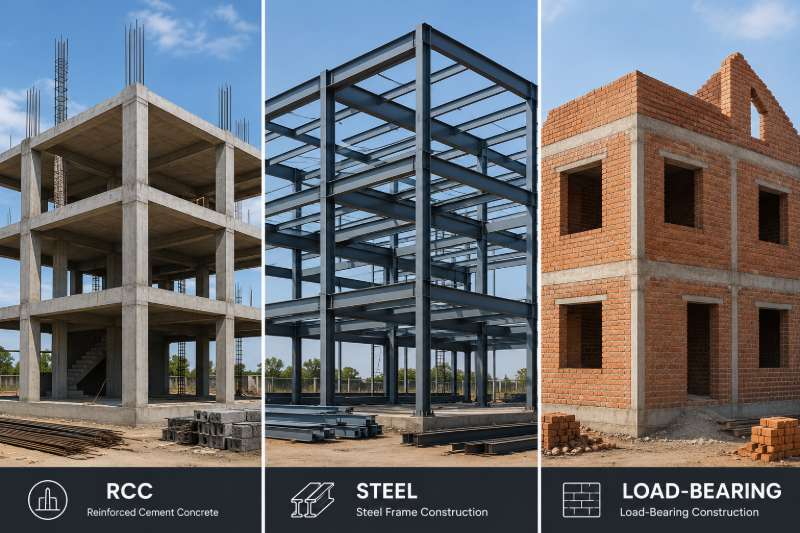
Choosing the right construction method for your home is one of the most critical decisions you'll make as a homeowner in India. The three primary construction types—Reinforced Cement Concrete (RCC), steel frame construction, and load-bearing masonry—each offer distinct advantages and limitations. As we move into 2026, understanding these differences becomes increasingly important given rising material costs, changing building codes, and evolving architectural preferences across Indian cities like Bangalore, Mumbai, Delhi, and Pune.
This comprehensive guide will help you navigate these options and make an informed decision based on your specific needs, budget, and location.
Understanding the Three Construction Methods
Build cost · Bengaluru, May 2026
RCC (Reinforced Cement Concrete) Construction
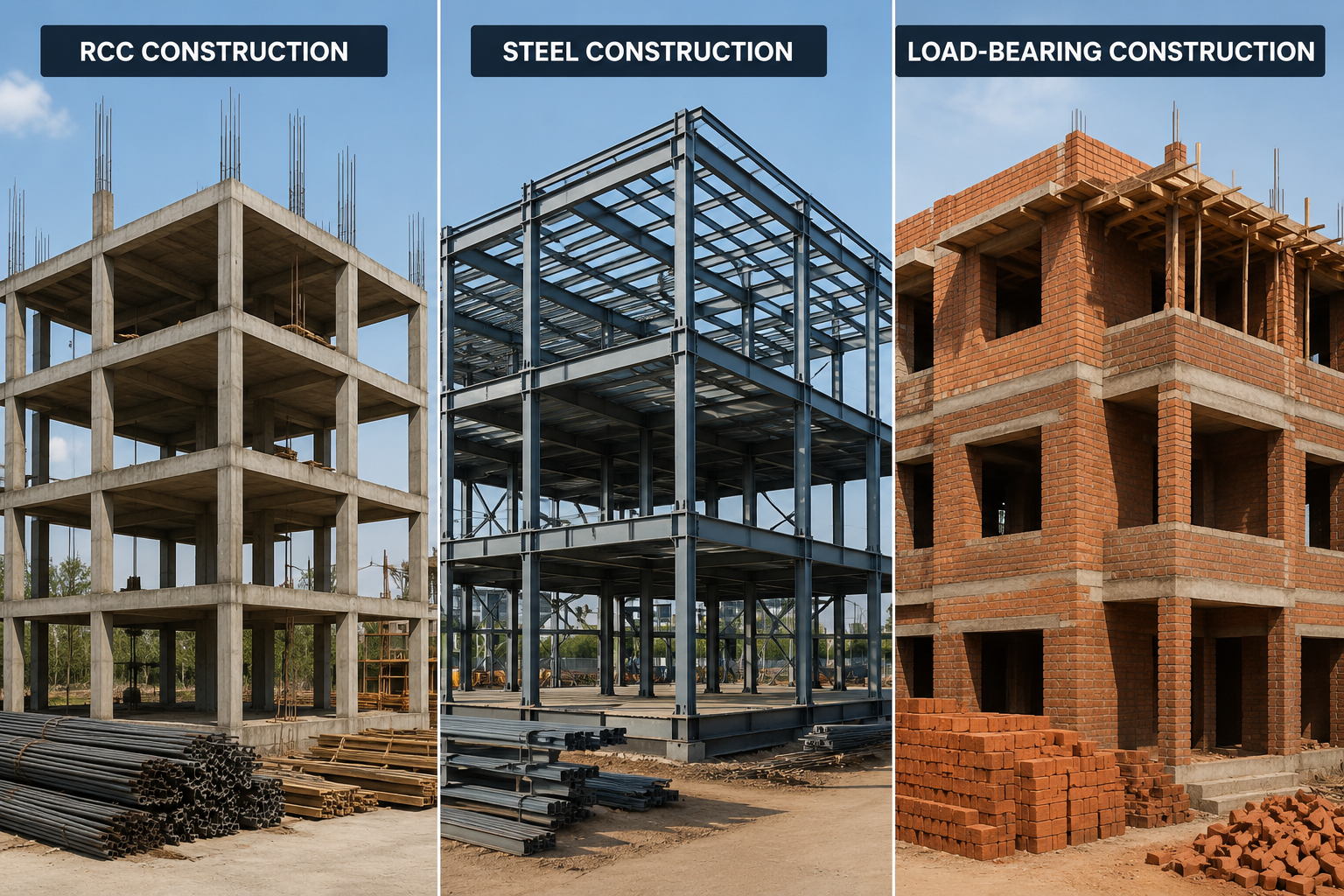
RCC construction combines concrete with steel reinforcement bars (rebar) to create a monolithic structure. This method involves creating a framework of columns, beams, and slabs that work together to distribute loads throughout the building.
How it works: Steel bars are arranged in a grid pattern within wooden or steel formwork, then concrete is poured over them. Once cured, this creates a rigid structure capable of handling significant loads. The concrete protects the steel from corrosion while the steel provides tensile strength that concrete alone cannot offer.
RCC has dominated Indian residential construction for the past three decades and remains the most common choice in metropolitan areas. You'll find RCC structures throughout Bangalore, Mumbai, and Delhi's residential neighborhoods.
Steel Frame Construction
Steel frame construction uses structural steel columns and beams as the primary load-bearing elements. The walls, floors, and roof are then attached to this steel skeleton. This method is gaining popularity in India, particularly for high-rise buildings and commercial structures.
How it works: Prefabricated or site-fabricated steel members are bolted or welded together to create the structural frame. Infill walls (typically brick or concrete blocks) are then constructed between the steel members. This approach allows for greater flexibility in interior layout and faster construction timelines.
Load-Bearing Masonry Construction
Load-bearing construction uses brick or stone walls to support the entire weight of the building. This is the oldest and most traditional construction method in India, still prevalent in tier-2 and tier-3 cities.
How it works: Thick walls (typically 9 inches to 13.5 inches) are built from bricks or stone, and these walls themselves carry all vertical loads. Horizontal loads are distributed through the wall thickness and foundation.
Frequently asked
Cost Comparison in 2026
Cost is often the primary consideration for homeowners. Here's how these methods compare in the Indian market:
RCC Construction Costs
RCC remains moderately priced compared to steel construction. Current estimates in major Indian cities range from ₹1,200 to ₹1,800 per square foot for basic RCC structures, depending on location and specifications.
Material costs: Cement, steel, and aggregates constitute 50-60% of total costs
Labor costs: Account for 25-35% of expenses
Formwork costs: Temporary structures needed for concrete pouring add 10-15%
In Bangalore and Pune, where construction standards are higher, costs may reach ₹2,000-2,500 per square foot. These costs have increased approximately 8-12% since 2024 due to inflation in cement and steel prices.
Steel Frame Construction Costs
Steel construction typically costs ₹1,500 to ₹2,500 per square foot, making it 20-40% more expensive than RCC initially. However, this varies significantly based on steel prices, which fluctuate with global markets.
Steel material: Currently accounts for 40-50% of total costs
Fabrication and erection: Specialized labor increases costs by 15-20%
Infill materials: Brick or block walls add 10-15%
The cost premium for steel has narrowed in 2025-2026 as domestic steel production in India has increased, making this option more competitive in cities like Mumbai and Delhi.
Load-Bearing Masonry Costs
Load-bearing construction is the most economical option, ranging from ₹800 to ₹1,200 per square foot. This makes it 30-50% cheaper than RCC for basic structures.
Brick and mortar: Comprise 60-70% of material costs
Labor-intensive: Requires skilled masons but less specialized equipment
Minimal formwork: Reduces temporary structure costs
However, this cost advantage diminishes when you need to add RCC bands, lintels, and reinforcement—requirements in modern building codes across most Indian cities.
Structural Performance and Durability
RCC Construction Performance
RCC offers excellent structural performance in most conditions:
Earthquake resistance: RCC's monolithic nature provides good earthquake resilience, making it suitable for seismic zones across India
Water resistance: When properly constructed and maintained, RCC provides good protection against moisture
Fire resistance: Concrete's non-combustible nature offers inherent fire protection
Durability: Well-constructed RCC buildings can last 50-75+ years
The primary concern with RCC is concrete carbonation and steel corrosion, particularly in coastal areas like Mumbai where salt spray accelerates deterioration. Buildings in such locations require additional protective measures, increasing long-term maintenance costs.
Steel Frame Construction Performance
Steel structures offer unique advantages:
Earthquake resilience: Steel's flexibility makes it excellent for seismic zones—a major advantage in regions like Uttarakhand and Himachal Pradesh
Speed of construction: Steel frames can be erected 30-40% faster than RCC, reducing project timelines
Fatigue resistance: Steel handles repeated loading better than concrete
Corrosion concerns: Steel requires protective coatings and regular maintenance, especially in humid climates
Durability: With proper maintenance, steel structures can last 80-100+ years
Steel's main vulnerability is corrosion. In Indian coastal cities and areas with high humidity, regular painting and inspection are essential, adding to lifetime maintenance costs.
Load-Bearing Masonry Performance
Load-bearing structures have proven durability:
Historical precedent: Many load-bearing structures in India have stood for 100+ years
Thermal mass: Thick brick walls provide excellent temperature regulation
Moisture issues: Masonry can absorb water, leading to dampness problems if not properly maintained
Seismic vulnerability: Load-bearing walls are more prone to damage in earthquakes, limiting suitability in seismic zones
Maintenance: Requires periodic repointing and wall repairs
Load-bearing construction is best suited for low-rise buildings (up to 4-5 stories) in non-seismic areas, making it more appropriate for tier-2 and tier-3 Indian cities than metropolitan areas.
Flexibility and Future Modifications
Your ability to modify your home in the future is an important consideration that often gets overlooked.
RCC Flexibility
RCC offers moderate flexibility. While you can remove non-load-bearing walls relatively easily, modifying load-bearing columns or beams requires structural engineering expertise and regulatory approvals. Adding additional stories or major renovations demands careful assessment of the existing structure's capacity.
Steel Frame Flexibility
Steel construction provides the maximum flexibility for future modifications. Since the infill walls don't carry structural loads, you can reconfigure interior spaces extensively without affecting structural integrity. This makes steel ideal if you anticipate significant lifestyle changes or want to adapt your home for aging-in-place modifications.
Load-Bearing Masonry Flexibility
Load-bearing structures offer the least flexibility. Major modifications require expensive and complex structural interventions. This limitation makes load-bearing construction less suitable if you want to future-proof your investment.
Regulatory and Compliance Considerations
Building codes across Indian cities have evolved significantly. As of 2026, here's what you should know:
RCC and Building Codes
RCC construction aligns well with current Indian Standard (IS) codes, particularly IS 456:2000 (Code of Practice for Plain and Reinforced Concrete). Most municipalities across India have standardized RCC requirements, making it easier to obtain approvals in cities like Bangalore, Pune, and Hyderabad.
Steel and Building Codes
Steel construction must comply with IS 800:2007 (Code of Practice for General Construction in Steel). While these standards are well-established, fewer municipal engineers are familiar with steel design, potentially leading to longer approval timelines in smaller cities. However, major metros like Mumbai and Delhi have streamlined steel construction approvals.
Load-Bearing and Building Codes
Load-bearing construction faces increasing restrictions in seismic zones. Many municipal corporations in earthquake-prone areas now mandate RCC or steel construction. Check your local building bylaws—cities like Dehradun and Shimla have restrictions on load-bearing construction above certain heights.
Environmental and Sustainability Factors
Sustainability is becoming increasingly important for homeowners in 2026:
RCC Environmental Impact
Cement production accounts for approximately 8% of global CO2 emissions. RCC construction is carbon-intensive, though modern practices like using fly ash and slag reduce environmental impact. RCC's durability means less frequent rebuilding, offsetting some environmental costs over a building's lifetime.
Steel Environmental Impact
Steel production is energy-intensive but highly recyclable. India's growing domestic steel production has improved sustainability metrics. Steel's recyclability (100% recyclable indefinitely) provides an environmental advantage at end-of-life. Additionally, steel's strength-to-weight ratio means less material is needed for equivalent strength.
Load-Bearing Environmental Impact
Masonry construction has the lowest embodied energy among the three methods. Bricks and stone are locally sourced in most Indian regions, reducing transportation emissions. However, the structural limitations of load-bearing construction sometimes necessitate thicker walls, offsetting some environmental advantages.
Climate and Location Considerations
Your location within India significantly influences the best choice:
Coastal Cities (Mumbai, Chennai, Kochi)
RCC remains popular but requires superior waterproofing and corrosion protection. Steel construction is gaining traction due to its superior seismic performance and lower water absorption. Load-bearing construction is increasingly avoided due to moisture penetration issues.
High-Seismic Zones (Uttarakhand, Himachal Pradesh, Northeast India)
Steel frame construction is increasingly preferred for its earthquake resilience. RCC is acceptable with proper design and detailing per IS 1893 (Criteria for Earthquake Resistant Design of Structures). Load-bearing construction is restricted in many areas.
Metropolitan Areas (Delhi, Bangalore, Pune)
RCC dominates but steel is gaining market share. Load-bearing construction is rarely approved for new residential projects due to building code restrictions and height limitations.
Tier-2 and Tier-3 Cities
Load-bearing construction remains common for low-rise residential buildings. RCC is increasingly preferred for better resale value and future flexibility. Steel construction is still emerging in these markets.
Making Your Decision: A Practical Framework
Consider these factors when choosing construction method:
Choose RCC If:
You're building in a metropolitan area where it's the standard
You want a balance of cost, durability, and regulatory ease
You're building a multi-story residential complex
You prioritize proven track record and widespread expertise
You're in a non-seismic zone
Choose Steel If:
You're in a seismic zone and want maximum earthquake safety
You anticipate significant future modifications
You want faster construction timelines
You're building a complex architectural design
You prioritize long-term sustainability and recyclability
You have access to experienced steel construction professionals
Choose Load-Bearing If:
You're building a low-rise (up to 3 stories) home in a tier-2 or tier-3 city
You're in a non-seismic zone
Budget is your primary constraint
You have skilled local masons available
You don't anticipate major future modifications
Working with the Right Professionals
Regardless of which construction method you choose, working with experienced professionals is crucial. Structural engineers, architects, and contractors who understand the specific requirements of your chosen method can significantly impact your project's success.
If you're looking for qualified professionals in your area, AECORD connects you with verified architects, structural engineers, and construction contractors across India. Whether you need expertise in RCC design, steel frame construction, or load-bearing masonry, finding the right team through AECORD ensures you're working with professionals who understand your specific needs and local building codes.
Conclusion
As of 2026, there's no universally "best" construction method—the right choice depends on your specific circumstances. RCC remains the most popular choice in India due to its proven performance, regulatory familiarity, and balanced cost-benefit profile. Steel construction is rapidly gaining ground, particularly in seismic zones and for projects requiring design flexibility. Load-bearing construction, while economical, faces increasing regulatory restrictions and is best suited for specific applications in non-seismic areas.
Evaluate your location, budget, timeline, future flexibility needs, and local building codes carefully. Consult with qualified structural engineers and architects who can assess your specific site conditions and requirements. By making an informed decision based on these factors, you'll ensure your home is built on a solid foundation—literally and figuratively—for decades to come.
Ready to start your construction journey? AECORD is here to help you connect with the right professionals for your project. Whether you need structural engineers, architects, or experienced contractors, find vetted AECO professionals on AECORD today and get your home built right.