

As India's temperature continues to rise, with many cities experiencing scorching summers, the demand for cooling solutions has never been higher. However, traditional air conditioning systems consume significant electricity and contribute to rising energy bills and environmental concerns. Passive cooling techniques offer a sustainable alternative that can maintain comfortable indoor temperatures while reducing energy consumption and operational costs. These methods work with natural principles and climate conditions to keep homes cool without relying heavily on mechanical cooling systems.
Understanding Passive Cooling and Its Importance
Passive cooling refers to design strategies and techniques that naturally regulate indoor temperatures by reducing heat gain and promoting heat dissipation without mechanical intervention. Unlike active cooling systems that require electricity to operate, passive cooling harnesses natural phenomena such as air movement, thermal mass, evaporation, and radiation to maintain comfortable living conditions.
In the Indian context, where summer temperatures in cities like Delhi, Mumbai, Bangalore, and Chennai can exceed 40°C, implementing passive cooling techniques can reduce air conditioning usage by 30-50%. This translates to substantial savings on electricity bills—a typical Indian household spending ₹3,000-5,000 monthly on cooling can reduce this by ₹1,000-2,500 through effective passive strategies. Beyond financial benefits, these techniques contribute to environmental sustainability by reducing carbon footprint and dependence on fossil fuels.
Build cost · Bengaluru, May 2026
Cross-Ventilation: The Foundation of Natural Cooling
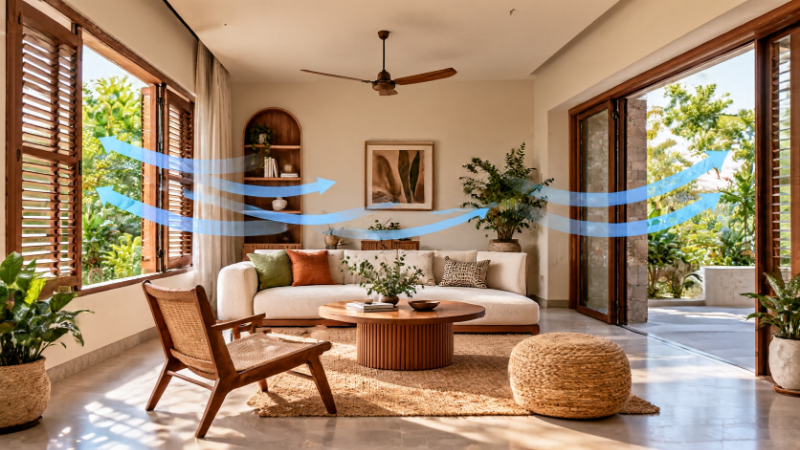
Cross-ventilation is one of the most effective passive cooling techniques, particularly suited to Indian climates. It involves creating air pathways through a building that allow prevailing winds to flow through spaces, removing accumulated heat and moisture.
How Cross-Ventilation Works
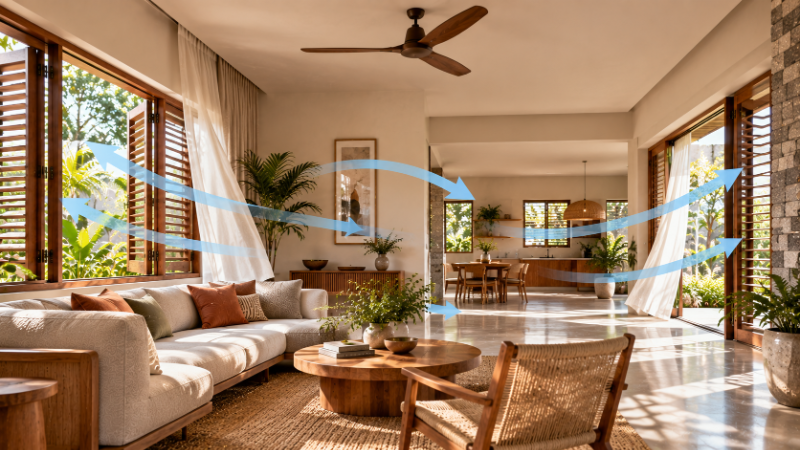
Cross-ventilation operates on the principle of pressure difference. When wind hits one side of a building, it creates positive pressure on the windward side and negative pressure on the leeward side. By strategically placing openings on opposite sides of a room or building, you create a pathway for air to flow through, effectively replacing warm indoor air with cooler outdoor air.
Implementing Cross-Ventilation in Indian Homes
Orientation Planning: Design homes with primary openings oriented perpendicular to prevailing wind directions. In most Indian cities, monsoon winds come from the southwest, so positioning windows and doors accordingly maximizes airflow.
Window and Door Placement: Install windows on opposite walls of rooms to facilitate air movement. In apartments where opposite walls aren't available, use creative solutions like ventilation shafts or atrium designs.
Size and Type of Openings: Larger openings allow better airflow. Consider using louvered windows, jallis (traditional latticed screens), and ventilation grilles that can be adjusted based on weather conditions.
Internal Layout: Arrange furniture and interior elements to avoid blocking air pathways. Keep corridors and central spaces clear to allow air circulation.
Many traditional Indian architectural designs, such as those found in Rajasthani havelis and Kerala homes, incorporated sophisticated cross-ventilation principles centuries ago. Modern homes can adopt these principles while maintaining contemporary aesthetics.
Frequently asked
Strategic Shading: Controlling Solar Heat Gain
Solar radiation is the primary source of heat gain in buildings. Strategic shading can reduce solar heat entering a home by 50-80%, making it one of the most impactful passive cooling techniques for Indian climates.
External Shading Devices
Overhangs and Awnings: Fixed overhangs above windows are highly effective, especially on south and west-facing facades. The optimal overhang depth depends on your location's latitude. For Delhi (28°N latitude), an overhang of 0.6-0.8 meters effectively blocks summer sun while allowing winter sunlight to enter.
Vertical Fins and Louvers: These are particularly effective for east and west-facing windows where horizontal overhangs are less efficient. Adjustable louvers provide flexibility to control shading based on season and time of day.
Green Shading: Planting trees and climbing plants creates natural shading while providing additional cooling through evapotranspiration. Deciduous trees are ideal as they provide summer shade while allowing winter sunlight. In Indian cities like Bangalore and Pune, this approach is increasingly popular among environmentally conscious homeowners.
Interior Shading Solutions
Traditional Jallis: These ornamental latticed screens, common in Indian architecture, filter sunlight while maintaining privacy and allowing airflow.
Heavy Curtains and Blinds: Light-colored, reflective curtains can reflect 50-80% of incoming solar radiation. Close these during the day and open them at night to release accumulated heat.
Roller Shades: Thermal roller shades with reflective backing provide effective insulation against heat gain.
Reflective and Light-Colored Roofs
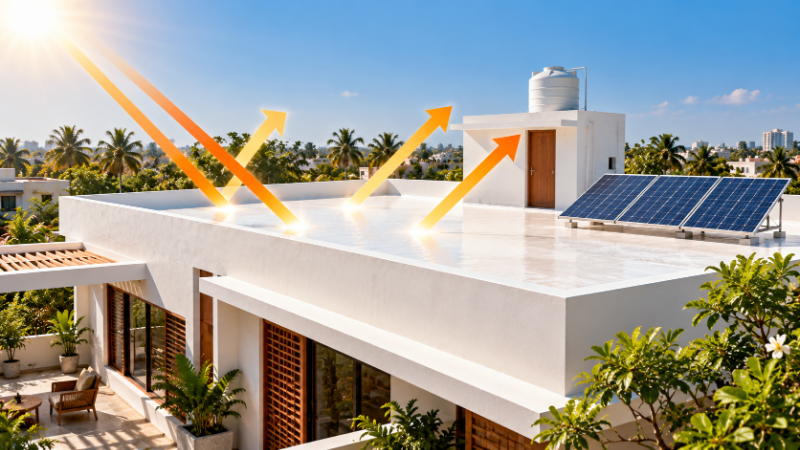
Roofs absorb the most solar radiation among all building surfaces. In Indian cities, roof temperatures can reach 60-70°C on summer days, transferring significant heat into living spaces below. Reflective roofing solutions can reduce this heat transfer substantially.
Cool Roof Technology
High Solar Reflectance: Cool roofs have high solar reflectance values (albedo), typically 0.65-0.85, meaning they reflect rather than absorb solar radiation. White or light-colored roofing materials achieve this effectively.
Material Options:
White Cement Tiles: Traditional in many Indian regions, these have reflectance values of 0.70-0.75 and cost approximately ₹100-200 per square foot.
Cool Paint Coatings: High-albedo paints specifically designed for roofs can be applied to existing surfaces at ₹50-100 per square foot. These typically reduce roof surface temperature by 15-25°C.
Reflective Coatings: Specialized coatings with reflectance values exceeding 0.80 are available at ₹150-300 per square foot.
Terracotta and Light-Colored Tiles: Traditional materials with natural reflective properties, costing ₹80-150 per square foot.
Studies conducted in Delhi and Mumbai have shown that homes with reflective roofs experience indoor temperature reductions of 3-5°C compared to those with conventional dark roofing, translating to 20-30% reduction in cooling energy consumption.
Proper Insulation and Thermal Mass
While insulation is often associated with cold climates, it plays a crucial role in passive cooling for Indian homes by reducing heat transfer through walls and roofs.
Roof Insulation
Roof insulation is particularly important in India, where roofs receive the most intense solar radiation. Options include:
Mineral Wool: Provides thermal resistance (R-value) of 3.2-3.8 per inch, costing ₹40-60 per square foot.
Fiberglass Batts: Common and affordable at ₹25-40 per square foot, with R-values of 2.2-3.8 per inch.
Foam Boards: Rigid insulation with higher R-values (R-5 to R-7 per inch) but higher costs (₹80-120 per square foot).
Natural Materials: Coconut coir, rice husk, and jute-based insulation are increasingly available across Indian cities, costing ₹30-50 per square foot and offering R-values of 3.0-3.5 per inch.
Wall Insulation
Cavity wall insulation or external insulation reduces heat transfer through walls. A 50mm insulation layer in walls can reduce heat gain by 20-25%. In existing buildings, external insulation with reflective finishes is often more practical than cavity insulation.
Thermal Mass Strategy
Thermal mass materials like concrete, stone, and brick absorb heat during the day and release it at night. In passive cooling design, thermal mass should be strategically placed to absorb excess daytime heat and release it when outdoor temperatures drop in the evening. This is particularly effective in Indian climates with significant temperature variations between day and night.
Heat-Resistant and Breathable Materials
The choice of building materials significantly impacts a home's thermal performance. Traditional Indian construction materials often outperform modern alternatives in passive cooling applications.
Wall Materials
Brick: Has lower thermal conductivity than concrete and allows moisture vapor transmission, helping regulate humidity. Traditional clay bricks are superior to concrete blocks for passive cooling.
Stone: Offers excellent thermal mass and durability. Locally sourced stone reduces embodied carbon and costs.
Adobe and Rammed Earth: Traditional materials with excellent thermal properties, increasingly used in sustainable construction projects across India.
Laterite Blocks: Common in Kerala and coastal regions, these provide good insulation and breathability.
Flooring Materials
Ground floors should use materials with high thermal mass and low thermal conductivity. Terracotta tiles, stone, and concrete are preferable to materials that conduct heat quickly. Avoid dark-colored flooring that absorbs and radiates heat; instead, opt for light-colored or natural materials.
Ventilation Design and Stack Effect
Beyond cross-ventilation, advanced ventilation strategies can enhance passive cooling significantly.
Stack Effect (Chimney Effect)
This natural convection process occurs when warm air rises and exits through upper openings while cooler air enters through lower openings. Designing homes with operable windows at different heights, skylights, and ventilation shafts enhances this effect. In multi-story buildings, this can create continuous air circulation without mechanical assistance.
Wind Towers and Ventilation Shafts
Traditional wind towers, common in Middle Eastern and North African architecture, can be adapted for Indian climates. These structures capture prevailing winds and direct cooler air into living spaces. Modern versions can be integrated into contemporary designs at costs ranging from ₹50,000-200,000 depending on complexity.
Evaporative Cooling Techniques
Evaporative cooling, or passive evaporative cooling, uses water evaporation to cool air naturally. This technique is particularly effective in dry climates and during dry seasons.
Green Roofs and Walls
Vegetation on roofs and walls provides cooling through evapotranspiration—the process by which plants release water vapor. Green roofs can reduce surface temperatures by 20-30°C and indoor temperatures by 2-4°C. Initial costs range from ₹500-1,500 per square foot but provide long-term benefits including improved insulation, stormwater management, and air quality.
Water Features
Fountains, ponds, and water channels near windows or in courtyards cool air through evaporation. In traditional Indian courtyards, water channels and fountains served both aesthetic and functional cooling purposes. Modern designs can incorporate these principles with contemporary aesthetics.
Humidity Control and Indoor Air Quality
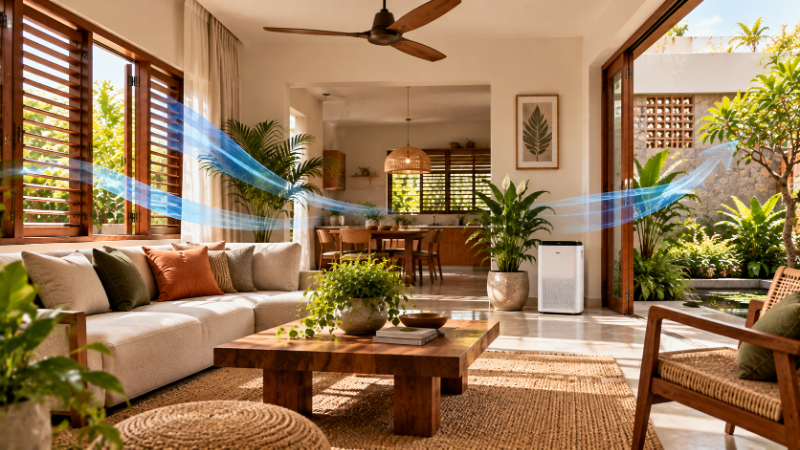
Passive cooling strategies must also address humidity, which is crucial in Indian climates, particularly during monsoons. High humidity reduces the effectiveness of evaporative cooling and creates discomfort.
Moisture-Absorbing Materials: Use breathable materials that regulate humidity naturally. Terracotta, brick, and natural plasters absorb excess moisture and release it when humidity drops.
Ventilation for Dehumidification: Cross-ventilation helps remove moisture-laden air. During monsoons, strategic ventilation in the evening and early morning when outdoor humidity is lower can help maintain comfortable indoor conditions.
Avoid Vapor Barriers: In Indian climates, vapor barriers can trap moisture inside walls. Breathable construction allows moisture to escape, preventing condensation and mold growth.
Integrating Passive Cooling: A Holistic Approach
The most effective passive cooling strategies combine multiple techniques. For example, a home in Delhi might feature:
Southwest-oriented windows with adjustable louvers for cross-ventilation
Reflective roof coating reducing surface temperature by 25°C
50mm roof insulation with an air gap
Deciduous trees providing summer shade
Thermal mass in the form of brick walls and stone flooring
A central courtyard with a water feature for evaporative cooling
Such an integrated approach can reduce cooling energy consumption by 40-60%, translating to annual savings of ₹15,000-30,000 for a typical household, depending on initial cooling costs and system efficiency.
Finding Professional Guidance
Implementing passive cooling techniques effectively requires expertise in climate analysis, building physics, and architectural design. When planning your home renovation or new construction, consulting with professionals who specialize in sustainable design is invaluable. On AECORD, India's leading B2B2C marketplace for AECO professionals, you can connect with architects, engineers, and sustainability consultants experienced in passive cooling design across Indian cities. Whether you're in Bangalore, Mumbai, Delhi, or Pune, AECORD helps you find qualified professionals who understand local climate conditions and building regulations.
Conclusion
Passive cooling techniques represent a sustainable, cost-effective approach to maintaining comfortable homes in India's hot climates. By strategically combining cross-ventilation, shading, reflective surfaces, insulation, and heat-resistant materials, homeowners can significantly reduce their dependence on air conditioning while improving indoor comfort and environmental sustainability. The initial investment in passive cooling design often pays for itself within 3-5 years through reduced energy bills, while providing long-term benefits for both personal comfort and environmental health.
Ready to implement passive cooling in your home? Explore AECORD to connect with experienced architects and engineers in your city who can design customized passive cooling solutions tailored to your specific needs and local climate conditions.