

India's First 3D-Printed House by Tvasta Startup in Pune: A Game-Changer for Construction
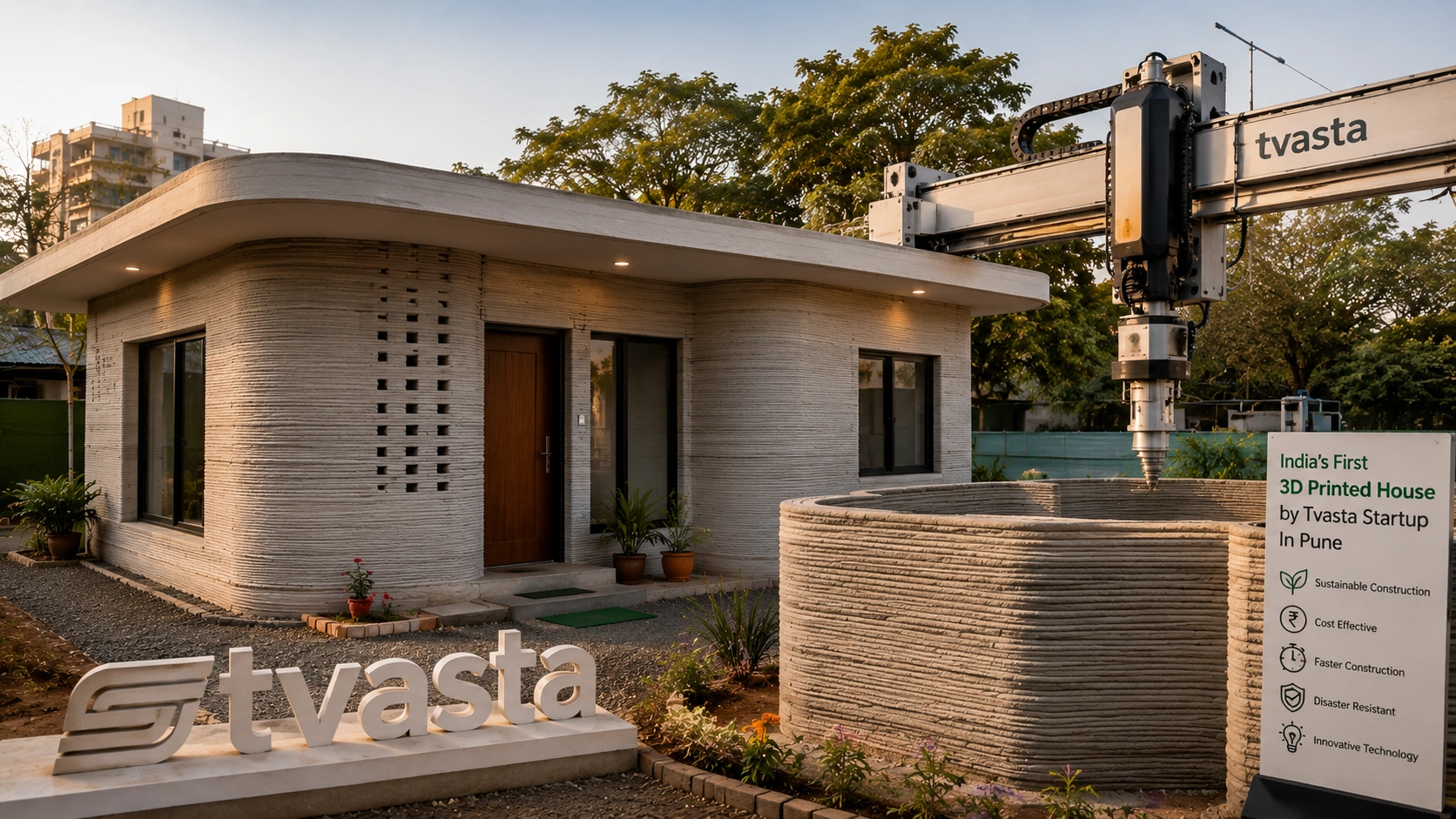
The construction industry in India stands at the cusp of a technological revolution. When Tvasta, an innovative Pune-based startup, successfully constructed India's first 3D printed house, it marked a watershed moment for the AECO (Architecture, Engineering, Construction, and Operations) sector. This breakthrough project demonstrates how emerging technologies can address India's critical housing shortage while simultaneously reducing construction costs, time, and environmental impact. /blog/generative-ai-in-construction-transforming-the-industry
For AECO professionals navigating India's rapidly evolving construction landscape, understanding 3D printing technology and its implications is no longer optional—it's essential. This comprehensive guide explores Tvasta's groundbreaking achievement, the technology behind it, and what it means for the future of Indian construction.
Build cost · Bengaluru, May 2026
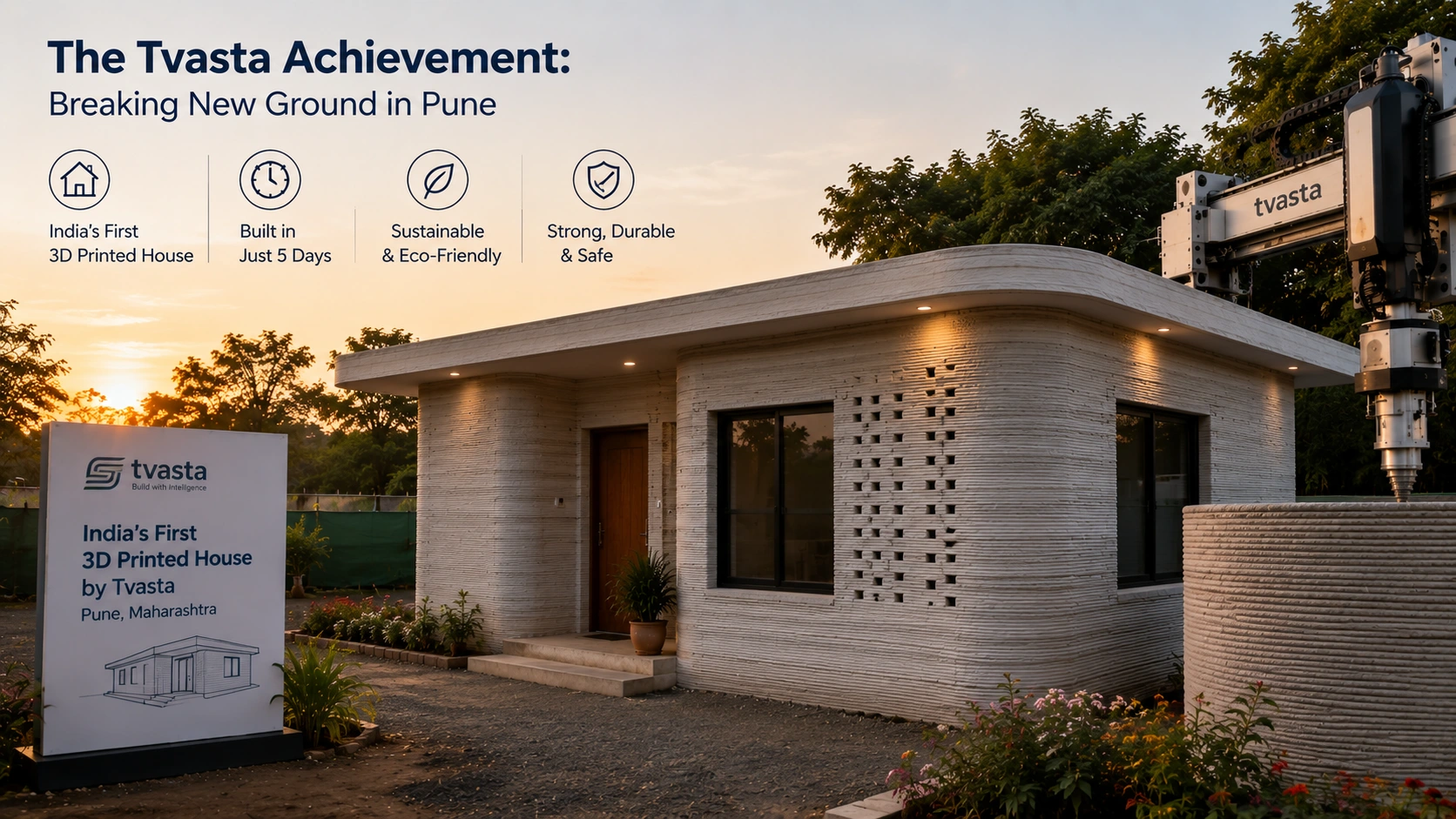
The Tvasta Achievement: Breaking New Ground in Pune
The Historic Project Details
Tvasta's 3D printed house in Pune represents a significant milestone in India's construction sector. Built using their proprietary 3D printing technology, the structure showcases what's possible when cutting-edge innovation meets practical construction challenges. The project wasn't merely a proof-of-concept; it was a fully functional residential unit that demonstrated commercial viability.
The house was constructed in a fraction of the time required for traditional building methods. What would typically take 6-9 months using conventional construction techniques was completed in significantly fewer weeks. This acceleration in construction timelines has profound implications for India's housing crisis, where demand far outpaces supply.
The structure itself was built using a specialized concrete mix deployed through Tvasta's robotic 3D printing system. The technology allows for precise layer-by-layer construction, creating walls with optimized strength-to-material ratios. This precision engineering results in structures that are not only faster to build but also more efficient in their use of materials.
Cost Implications for Indian Builders
One of the most compelling aspects of Tvasta's achievement is the cost reduction it offers. Traditional construction in Indian cities like Pune, Mumbai, and Bangalore typically costs between ₹1,200 to ₹2,500 per square foot, depending on location and specifications. 3D printing technology has the potential to reduce these costs by 30-50%.
For a 1,200 square foot house—a common size in India's middle-income housing segment—traditional construction might cost ₹15-30 lakhs. 3D printing could potentially bring this down to ₹7.5-21 lakhs, making homeownership more accessible to India's growing middle class.
These cost savings come from multiple sources: reduced labor requirements, minimal material wastage, faster construction cycles (reducing financing costs), and optimized material usage. For builders and developers, this translates to improved margins and faster project turnaround.
Frequently asked
Understanding the Technology Behind 3D Printed Construction
How Tvasta's 3D Printing System Works
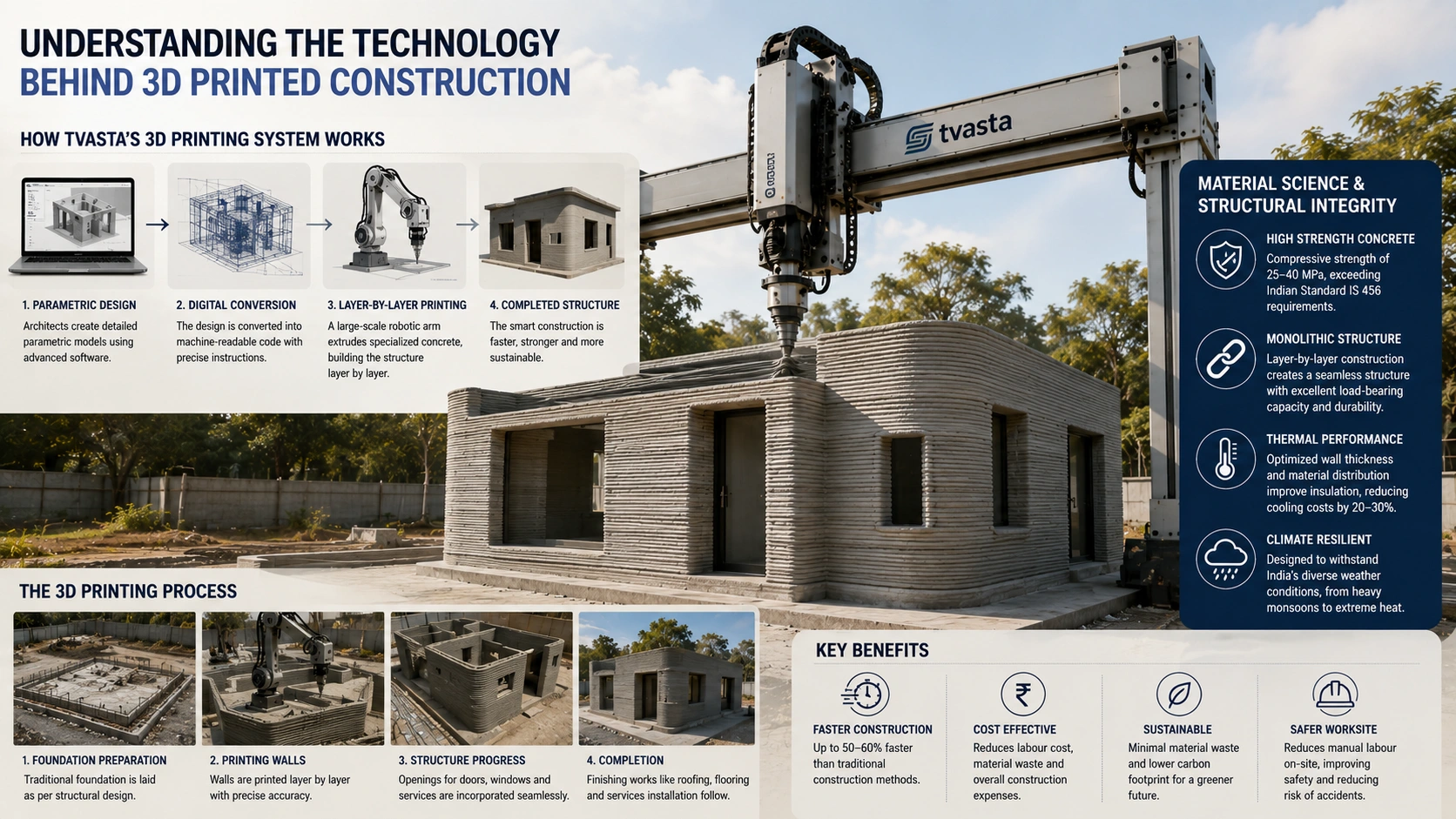
Tvasta's technology employs large-scale robotic arms equipped with specialized nozzles that deposit concrete layer by layer. The process begins with detailed parametric architectural designs that are converted into machine-readable code. The robot then follows these instructions precisely, building the structure from the ground up.
The concrete mixture used in 3D printing is specially formulated to meet Indian building codes and climate conditions. It must have the right consistency to be extruded through the nozzle, adequate strength to support subsequent layers, and durability to withstand India's diverse weather patterns—from monsoons in coastal areas to extreme heat in inland regions.
The parametric approach to design is crucial here. Rather than traditional 2D blueprints, architects use parametric software to create designs where dimensions and relationships are defined by parameters. This allows for rapid modifications and optimization while maintaining structural integrity.
Material Science and Structural Integrity
A common concern among Indian builders and homeowners is whether 3D printed structures meet safety standards. Tvasta's technology addresses this comprehensively. The printed concrete achieves compressive strengths comparable to traditionally cast concrete, typically ranging from 25-40 MPa (megapascals), which exceeds Indian Standard IS 456 requirements.
The layer-by-layer construction method, when properly executed, creates a monolithic structure with excellent load-bearing characteristics. The absence of joints and seams in many parts of the structure can actually enhance durability compared to traditional construction, which relies on mortar joints that can degrade over time.
Thermal properties of 3D printed structures are also noteworthy. The precise control over wall thickness and material distribution allows architects to optimize insulation properties, which is particularly valuable in India's varied climate zones. This can reduce cooling costs in hot regions like Delhi, Mumbai, and Chennai by 20-30%.
Regulatory and Compliance Landscape in India
Building Codes and Standards
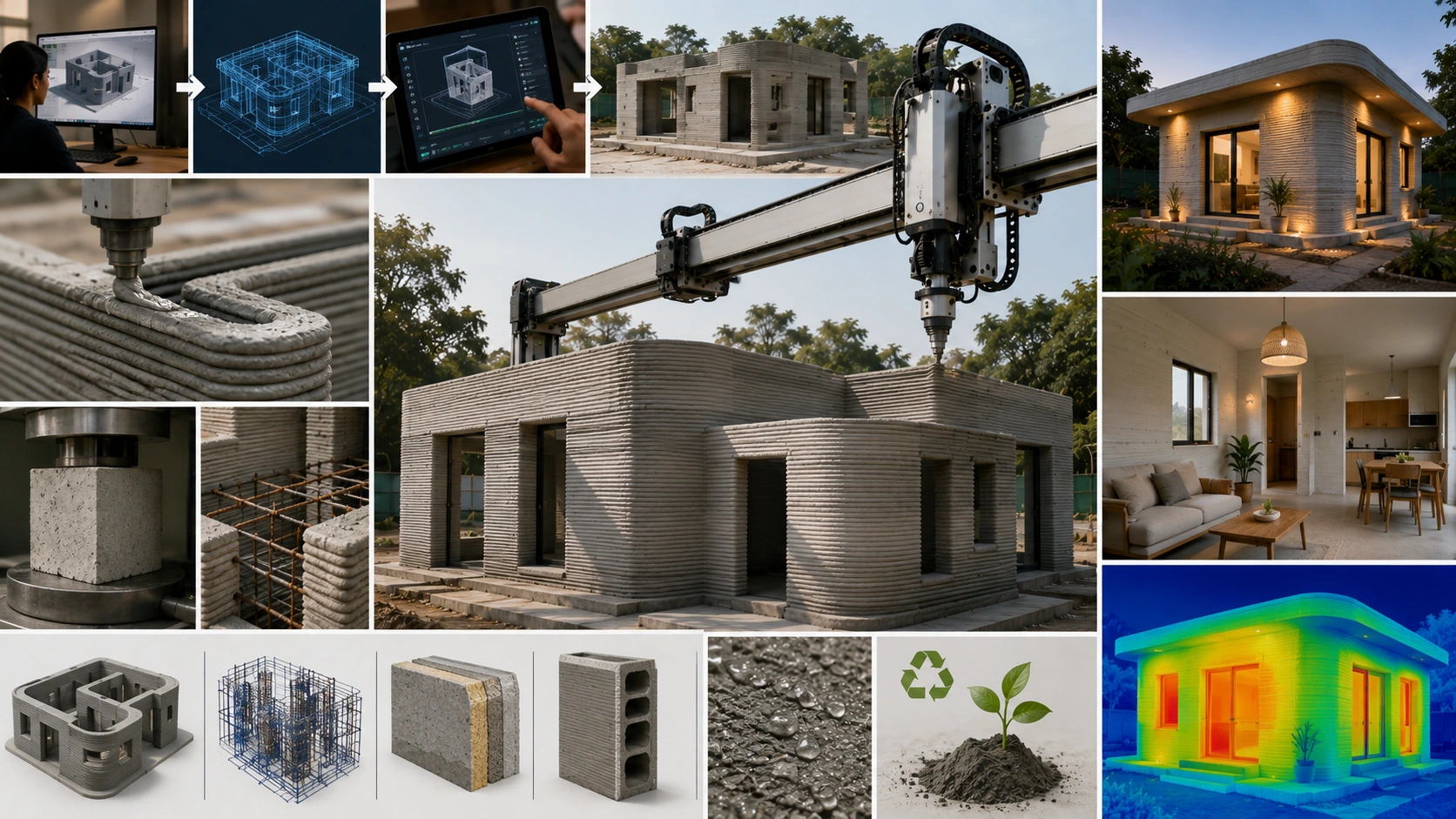
For 3D printing technology to scale across India, it must comply with existing building regulations. The National Building Code of India (NBC) and Indian Standards (IS codes) provide the framework for construction safety and quality. Tvasta's Pune project was designed and executed in compliance with these standards, setting a precedent for future projects.
State-level building bye-laws also come into play. Pune's building regulations, administered by the Pune Municipal Corporation (PMC), had to be satisfied. Similarly, projects in other major cities like Bangalore, Hyderabad, and Ahmedabad must comply with their respective local regulations.
The good news is that regulatory bodies are increasingly receptive to innovative construction technologies. Several Indian cities have begun issuing guidelines specifically for 3D printed construction, recognizing its potential to address housing shortages while maintaining safety standards.
Certification and Quality Assurance
Tvasta's project underwent rigorous testing to ensure structural adequacy. Third-party inspections verified material properties, structural performance, and compliance with Indian standards. This transparent approach to quality assurance builds confidence in the technology among developers, buyers, and regulators.
For professionals considering 3D printing for their projects, understanding the certification process is crucial. It's advisable to work with experienced firms that have successfully navigated regulatory requirements and can provide documented evidence of compliance.
Environmental and Sustainability Benefits
Reducing Construction Waste
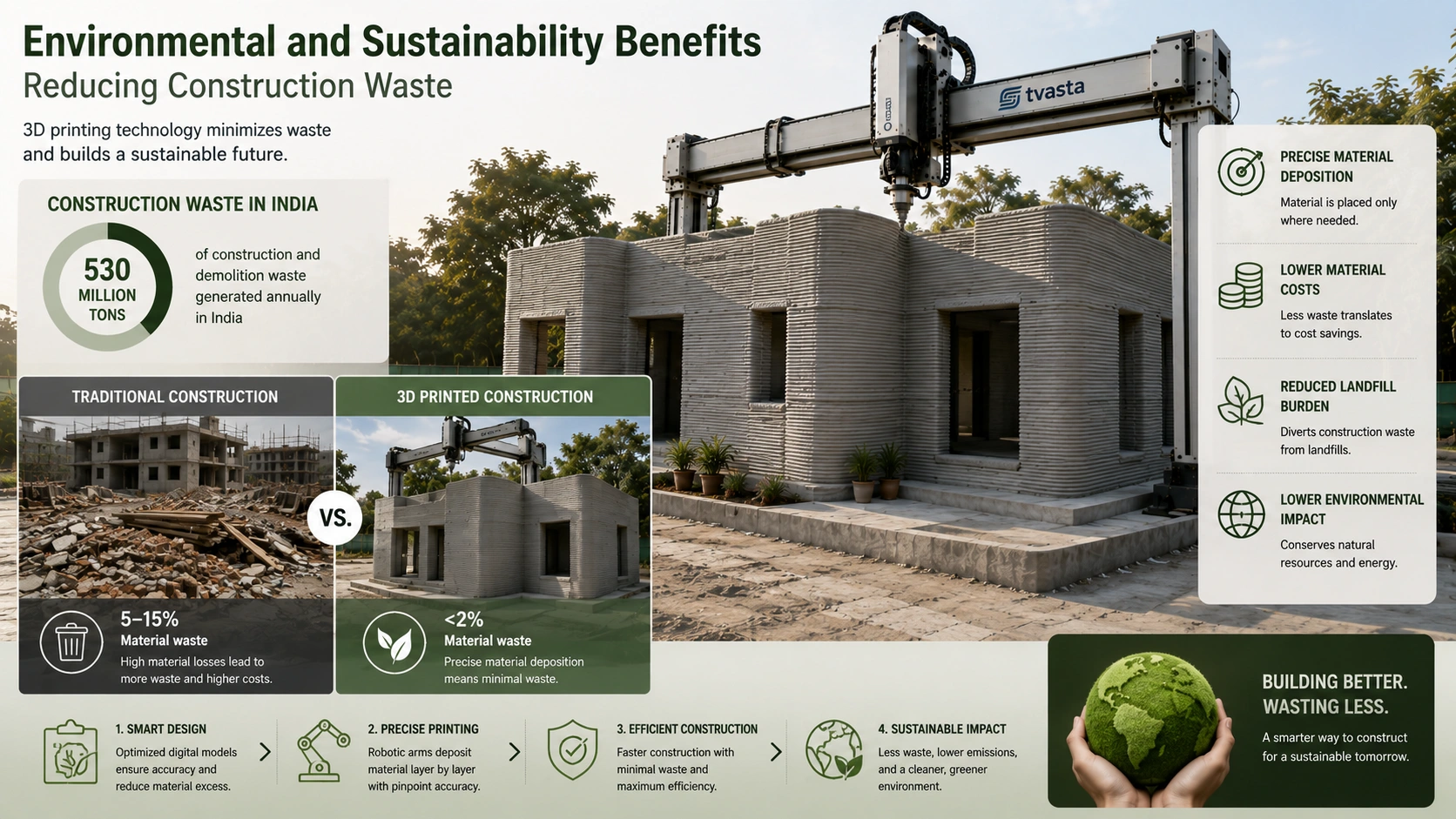
India's construction sector generates approximately 530 million tons of construction and demolition waste annually. Traditional construction methods are inherently wasteful, with material losses typically ranging from 5-15%. 3D printing dramatically reduces this waste through precise material deposition.
With 3D printing, material is applied exactly where needed, with minimal excess. This not only reduces environmental impact but also lowers material costs—a significant benefit given that materials typically account for 50-60% of construction costs in India.
Carbon Footprint Reduction
The construction industry contributes significantly to India's carbon emissions. 3D printing reduces the carbon footprint through multiple mechanisms: reduced transportation of materials and workers, faster construction cycles (reducing site equipment operation time), and optimized material usage.
Additionally, 3D printed structures can be designed for superior thermal efficiency, reducing operational energy consumption over the building's lifetime. For a 30-year building lifespan, these operational savings can be substantial.
Sustainable Material Innovations
Researchers in India are exploring sustainable concrete mixes for 3D printing that incorporate recycled aggregates, industrial byproducts, and alternative binders. These innovations could further reduce the environmental impact of 3D printed construction while maintaining structural performance.
Challenges and Limitations in the Indian Context
Technology Adoption Barriers
Despite its promise, 3D printing technology faces significant adoption barriers in India. The initial capital investment for 3D printing equipment is substantial—ranging from ₹5 crores to ₹15+ crores for a complete setup. This high upfront cost means only large developers and well-funded startups can currently afford the technology.
Additionally, skilled operators and technicians are scarce. The technology requires specialized training, and India currently lacks sufficient educational programs to produce the workforce needed for widespread adoption.
Scaling and Logistics Challenges
While Tvasta's single-house project is impressive, scaling this technology across India presents logistical challenges. Construction sites vary widely in terms of accessibility, terrain, and existing infrastructure. The robotic systems used in 3D printing require stable, level surfaces and adequate space for equipment positioning.
In densely populated urban areas like Mumbai and Delhi, finding suitable construction sites with these characteristics can be difficult. Additionally, coordination with municipal authorities, utility companies, and neighboring properties adds complexity.
Material Supply Chain Considerations
3D printing requires specialized concrete formulations. India's current supply chain for such materials is limited, primarily concentrated in major metropolitan areas. Expanding this supply chain to secondary and tertiary cities will require investment and coordination with cement manufacturers and concrete suppliers.
Market Potential and Future Outlook
Addressing India's Housing Crisis
India faces a housing shortage of approximately 19 million units, according to various estimates. This deficit is particularly acute in affordable housing segments. 3D printing technology offers a scalable solution to this crisis by enabling faster, cheaper construction without compromising quality.
If 3D printing technology could be deployed for even 10% of new residential construction in India by 2030, it could help address over 1 million housing units. The economic implications are staggering—potentially unlocking ₹5-10 trillion in value through improved affordability and faster delivery.
Commercial and Institutional Applications
Beyond residential construction, 3D printing has applications in commercial buildings, institutional structures, and infrastructure projects. Schools, hospitals, and government buildings could benefit from faster, more cost-effective construction. This is particularly valuable for infrastructure development in tier-2 and tier-3 cities.
Integration with Smart Building Technologies
3D printing's precision and parametric design capabilities make it ideal for integration with smart building technologies. Conduits for electrical wiring, plumbing, and data cables can be precisely embedded during construction, reducing post-construction modifications and improving building performance.
Finding the Right Partners for 3D Printed Construction
Expertise and Experience
If you're considering 3D printing for your construction project, partnering with experienced professionals is essential. Look for firms that have successfully completed 3D printed projects, understand local building codes, and can navigate regulatory requirements. AECORD, India's premier B2B2C marketplace for AECO professionals, connects builders and developers with architects, engineers, and construction specialists experienced in innovative technologies like 3D printing.
When evaluating potential partners, request case studies, certifications, and references from completed projects. Ask about their approach to quality assurance, regulatory compliance, and risk management.
Design and Engineering Expertise
Successful 3D printed projects require architects and engineers skilled in parametric design and structural optimization. These professionals understand how to leverage the unique capabilities of 3D printing while ensuring designs meet Indian building codes and client requirements.
AECORD's platform makes it easy to find and connect with specialists in parametric architecture and 3D printing technology who understand the Indian market context.
Project Management and Execution
Executing a 3D printed construction project requires specialized project management expertise. Professionals must coordinate with equipment operators, material suppliers, regulatory authorities, and quality assurance teams. Experience managing such complex projects is invaluable.
Conclusion: The Future of Construction in India
Tvasta's successful construction of India's first 3D printed house in Pune represents more than a technological achievement—it's a proof-of-concept for a more efficient, sustainable, and inclusive construction industry. As the technology matures and costs decrease, 3D printing will likely become mainstream in Indian construction.
For AECO professionals, staying informed about these developments is crucial. The construction industry is evolving rapidly, and those who understand and can work with emerging technologies will be best positioned for success.
Whether you're an architect exploring parametric design possibilities, an engineer evaluating structural performance of 3D printed structures, or a developer considering this technology for your projects, the time to engage with 3D printing is now. Visit AECORD today to connect with experienced professionals who can guide your organization through this exciting transition. Our marketplace brings together architects, engineers, construction experts, and technology specialists who understand both the potential and practical considerations of 3D printing in the Indian context. Find the right partner to bring your innovative construction projects to life.
Frequently Asked Questions
How much faster is 3D printed construction compared to traditional building methods?
Tvasta's 3D printed house in Pune was completed in significantly fewer weeks compared to the 6-9 months typically required for conventional construction methods. This dramatic acceleration in construction timelines can help address India's housing shortage and reduce project financing costs.
How much can 3D printing reduce construction costs in India?
3D printing technology has the potential to reduce construction costs by 30-50% compared to traditional methods, which typically cost ₹1,200 to ₹2,500 per square foot. For a 1,200 square foot house, costs could potentially drop from ₹15-30 lakhs to ₹7.5-21 lakhs.
What is Tvasta's 3D printing technology and how does it work?
Tvasta uses large-scale robotic arms equipped with specialized nozzles that deposit concrete layer by layer based on parametric architectural designs. The specially formulated concrete mixture is extruded precisely to build structures from the ground up while meeting Indian building codes and climate requirements.
Is India's first 3D printed house just a prototype or commercially viable?
Tvasta's 3D printed house in Pune is a fully functional residential unit that demonstrates commercial viability, not just a proof-of-concept. The project showcases that the technology can be practically applied to address India's real housing needs.
What are the main cost savings sources in 3D printed construction?
Cost savings in 3D printing come from reduced labor requirements, minimal material wastage, faster construction cycles that lower financing costs, and optimized material usage. These factors combined allow builders and developers to achieve improved margins and faster project turnaround.