

Hiring a contractor for your construction or engineering project is one of the most critical decisions you'll make. In India's booming AECO (Architecture, Engineering, Construction, and Operations) sector, the quality of your contractor directly impacts project timelines, budgets, and overall success. However, the challenge of verifying contractor credentials remains significant, especially with the rise of unqualified professionals operating across Indian cities like Delhi, Mumbai, Bangalore, and Hyderabad.
This comprehensive guide will walk you through the essential steps to verify contractor credentials in India, ensuring you partner with legitimate, qualified professionals who can deliver results.
Why Verifying Contractor Credentials Matters
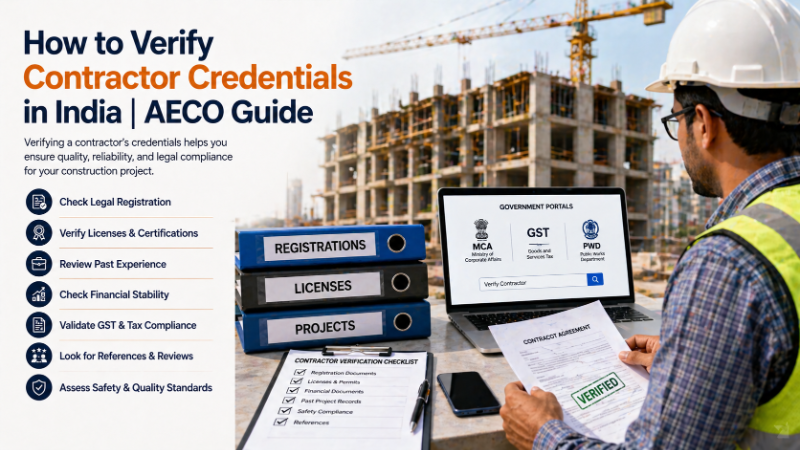
Before diving into the verification process, it's important to understand why this step is non-negotiable. Unqualified contractors can lead to:
Project delays and cost overruns – Lack of experience often results in poor planning and execution
Safety violations – Unqualified contractors may ignore building codes and safety standards, putting workers and occupants at risk
Poor workmanship – Substandard work may require costly rework or repairs
Legal complications – Working with unregistered contractors can expose you to liability issues
Financial losses – Contractor abandonment or disputes are more common with unverified professionals
The Indian construction industry is worth over ₹15 lakh crore annually, yet regulatory oversight remains fragmented. This makes due diligence essential for anyone commissioning construction or engineering work.
Build cost · Bengaluru, May 2026
Step 1: Check Registration and Legal Status
GST Registration
One of the first things to verify is whether your contractor is registered under the Goods and Services Tax (GST) system. A valid GST number indicates that the contractor is operating as a legitimate business entity recognized by the government.
Ask for the contractor's GST number
Verify it on the official GST portal (www.gst.gov.in)
Check that the registered business name matches what the contractor claims
Confirm the registration is active and in good standing
A contractor without GST registration may be operating informally, which increases your risk significantly.
PAN (Permanent Account Number)
Request the contractor's PAN and verify it through the Income Tax Department's portal. This confirms:
The contractor is registered with tax authorities
They have a documented financial history
They are legally required to file tax returns
You can verify PAN details on the official IT portal or through authorized verification services.
Frequently asked
Business Registration
Depending on the contractor's business structure, verify:
Partnership Deed – If registered as a partnership firm
Certificate of Incorporation – If registered as a Private or Public Limited Company
Proprietorship documents – If operating as a sole proprietor
UDYAM Registration – For small and medium enterprises
Request copies of these documents and cross-verify with the Registrar of Companies (ROC) website for your state.
Step 2: Verify Professional Qualifications and Licenses
Professional Credentials
The type of credentials required depends on the contractor's specialization. For example:
Civil Engineers – Should be registered with the Council of Architecture (CoA) or Institute of Engineers (India) IEI
Architects – Must be registered with the Council of Architecture
Electrical Contractors – Should have licenses from the state electricity regulatory commission
Plumbing Contractors – May require certifications from relevant municipal bodies
Request proof of these registrations and verify them directly with the issuing authorities.
Licenses and Permits
Depending on the project scope, contractors may need:
Building License – From municipal corporations in cities like Mumbai, Delhi, Bangalore
Trade License – From local municipal authorities
Safety Certifications – OSHA or equivalent safety training certifications
Environmental Clearances – For large-scale projects
Always request and verify these documents before signing any contracts.
Step 3: Review Financial Standing
Bank References
Ask the contractor for bank references and contact their bank directly to confirm:
Account validity and standing
Account age (longer accounts suggest stability)
General reputation for financial reliability
Banks will typically confirm account details without revealing sensitive financial information.
Credit History
Check the contractor's credit history through:
CIBIL (Credit Information Bureau India Limited) – If you have authorization
Industry databases – Some construction industry associations maintain records
Court records – Search for any outstanding legal cases or judgments
A contractor with a history of defaults or legal disputes should raise red flags.
Insurance and Bonding
Reputable contractors carry:
Professional Indemnity Insurance – Covers professional errors
Liability Insurance – Covers accidents and injuries on site
Performance Bonds – Guarantees project completion
Request copies of current insurance policies and verify them with the insurance providers.
Step 4: Assess Experience and Track Record
Project Portfolio
Request a comprehensive portfolio that includes:
Photographs of completed projects
Project descriptions with timelines and budgets
Project locations and scale
Types of work completed (commercial, residential, industrial)
Look for projects similar in scope and complexity to your own.
Client References
This is crucial. Ask for at least 3-5 recent client references and:
Contact them directly (not just via the contractor)
Ask specific questions about project quality, timeliness, and professionalism
Inquire about budget adherence and any disputes
Request permission to visit completed projects
Be wary of contractors who are reluctant to provide references or only provide references from friends or family.
Site Visits
Whenever possible, visit projects the contractor has completed. During your visit:
Assess the overall quality of work
Check for attention to detail and finish
Speak with the project owner or manager
Look for evidence of proper safety practices
This firsthand assessment is invaluable in making your decision.

Step 5: Check Compliance with Indian Building Codes and Regulations
Knowledge of Local Building Codes
Your contractor should be familiar with:
National Building Code of India (NBC) – The primary building standard
Local Municipal Building Bye-laws – Specific to your city (Mumbai, Delhi, Bangalore, etc.)
Seismic Codes – If your project is in an earthquake-prone zone
Environmental Regulations – State-specific environmental protection rules
During initial consultations, test their knowledge by asking about relevant code requirements for your project type.
Previous Compliance Records
Check with local municipal corporations for:
Any previous violations or penalties
Completion certificates for past projects
Records of building permission approvals
This information is often publicly available through RTI (Right to Information) requests or municipal databases.
Step 6: Evaluate Communication and Professionalism
Initial Interactions
During your first meetings with potential contractors, observe:
Responsiveness – Do they respond promptly to calls and emails?
Clarity – Can they clearly explain their approach and timeline?
Professionalism – Do they maintain professional communication standards?
Transparency – Are they open about costs, risks, and limitations?
Poor communication at this stage often indicates problems later in the project.
Written Documentation
A professional contractor will provide:
Detailed written quotations with itemized costs
Project timelines with milestone dates
Scope of work clearly defined
Terms and conditions in writing
Avoid contractors who only provide verbal quotes or vague estimates.
Step 7: Use Online Platforms and Databases
Industry Platforms
AECORD and similar B2B2C marketplaces for AECO professionals in India provide verified contractor profiles. These platforms typically:
Verify basic credentials and registrations
Maintain client review and rating systems
Provide dispute resolution mechanisms
Offer portfolio verification
Using platforms like AECORD can streamline your verification process, as many checks are already completed by the platform.
Industry Associations
Check if the contractor is a member of recognized associations such as:
Indian Institute of Architects (IIA)
Institution of Engineers (India)
Associated Chambers of Commerce and Industry of India (ASSOCHAM)
Confederation of Indian Industry (CII)
Membership in these organizations indicates a commitment to professional standards.
Step 8: Conduct Background Checks
Legal History
Search for the contractor in:
Court records – Both civil and criminal courts in your jurisdiction
Police records – For any criminal complaints
Labor department records – For labor law violations
Environmental department records – For environmental violations
Many of these records are accessible through online portals or RTI requests.
Dispute History
Inquire with:
Consumer forums – Check for registered complaints
Arbitration records – If disputes have gone to arbitration
Professional councils – For disciplinary actions
A contractor with a history of disputes should be approached with caution.
Step 9: Verify Insurance and Safety Practices
Insurance Coverage
Confirm the contractor has:
Workers' Compensation Insurance – Mandatory under Indian law
Public Liability Insurance – For accidents involving third parties
Equipment Insurance – If using expensive machinery
Request certificates of insurance and verify directly with insurance companies.
Safety Protocols
Discuss the contractor's safety practices:
Do they have a documented safety plan?
Have their workers undergone safety training?
Do they maintain safety records and incident logs?
Are they compliant with OSHA or equivalent standards?
A safety-conscious contractor is more likely to deliver quality work.
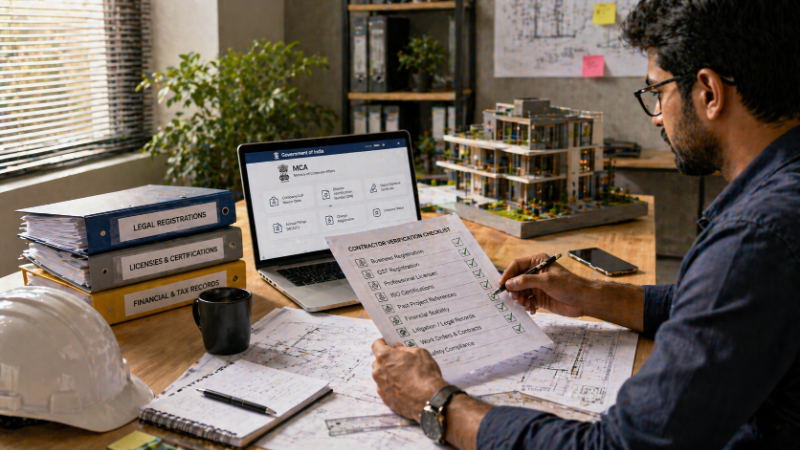
Step 10: Make Your Final Decision
Create a Comparison Matrix
Document your findings for each contractor candidate:
Registration and legal status
Qualifications and licenses
Financial stability
Experience and portfolio quality
Client references and feedback
Compliance record
Communication and professionalism
Insurance and safety practices
This structured approach helps you make an objective comparison.
Trust Your Instincts
While data and verification are important, also consider your gut feeling. If something feels off during your interactions, it's worth investigating further or considering another contractor.
Common Red Flags to Avoid
Be cautious of contractors who:
Cannot provide verifiable credentials or references
Offer prices significantly lower than competitors (often indicates cutting corners)
Pressure you to make quick decisions without proper verification
Request large upfront payments before work begins
Don't have proper insurance or safety documentation
Are evasive about their experience or past projects
Don't provide written contracts or quotations
Have a history of legal disputes or complaints
Conclusion
Verifying contractor credentials in India requires a systematic, thorough approach. By following these ten steps, you significantly reduce the risk of hiring an unqualified or unreliable contractor. Remember that the time invested in verification upfront can save you thousands of rupees and countless headaches during your project.
Whether you're building a residential property in Bangalore, a commercial complex in Mumbai, or an industrial facility in Delhi, the importance of working with verified, qualified contractors cannot be overstated. Platforms like AECORD make this process easier by providing pre-verified contractor profiles, detailed portfolios, and transparent client reviews. When selecting your contractor, use a combination of traditional verification methods and modern digital platforms to ensure you're making the best choice for your project.
Start your contractor search today on AECORD, where you can find verified AECO professionals across India, complete with credentials, portfolios, and client reviews—all in one trusted marketplace.