

Waterproofing Methods for Buildings in India: A Comprehensive Cost Guide
Water damage is one of the most common issues affecting building longevity in India. Whether it's the monsoon season in Mumbai, heavy rainfall in Chennai, or groundwater seepage in Delhi, moisture infiltration can compromise structural integrity, reduce property value, and create unhealthy living conditions. Waterproofing is not just a cosmetic consideration—it's a critical investment that can save lakhs of rupees in repair costs down the line.
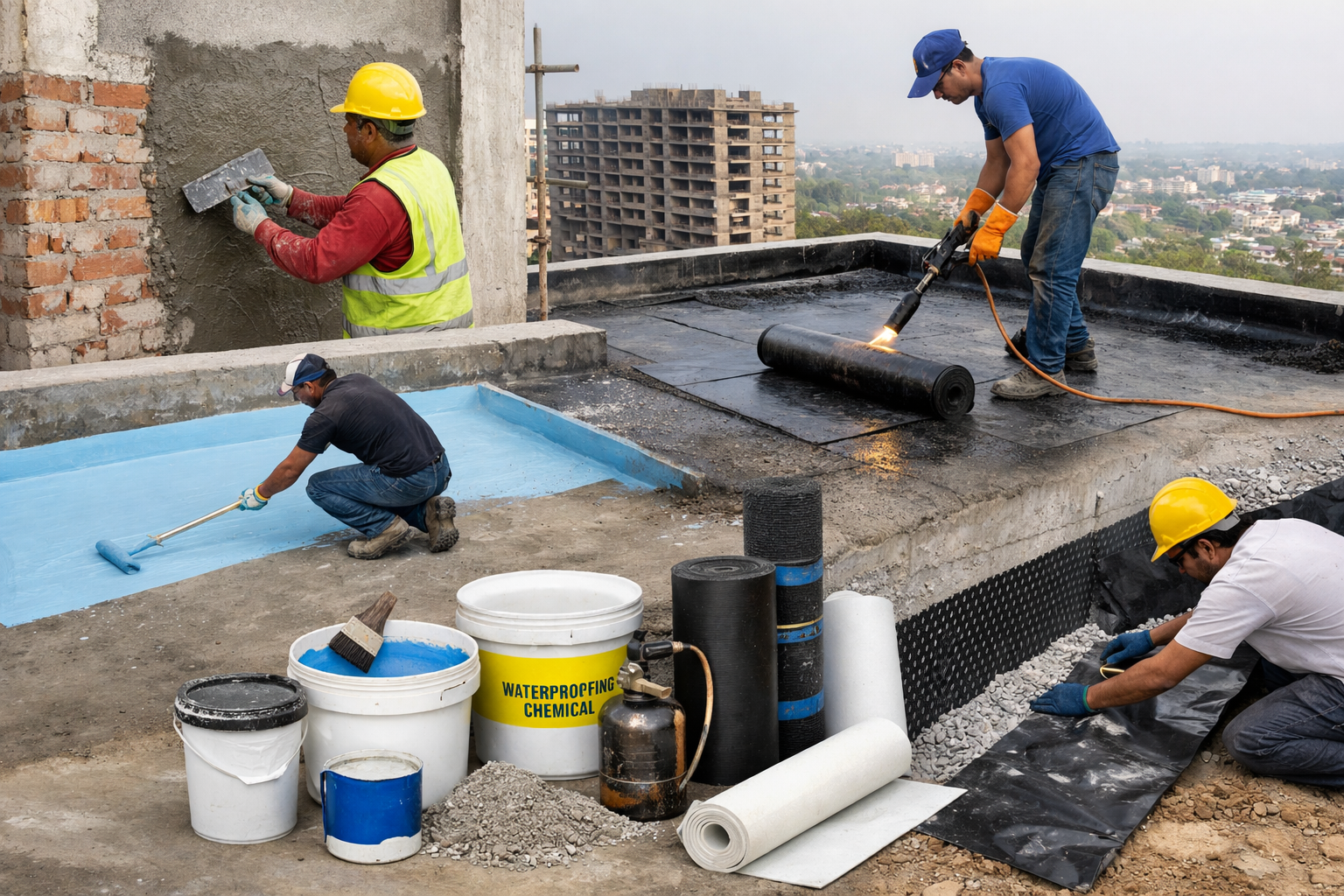
In this guide, we'll explore the various waterproofing methods available to Indian builders and property owners, their costs, effectiveness, and when to use each approach. Whether you're constructing a new building or maintaining an existing one, understanding these options will help you make informed decisions.
Build cost · Bengaluru, May 2026
Why Waterproofing Matters in the Indian Climate
India experiences diverse climatic conditions across its regions. The monsoon season brings heavy rainfall, particularly from June to September, creating significant water ingress challenges. Coastal areas face salt spray and humidity issues, while inland regions deal with groundwater seepage and capillary moisture rise.
The cost of neglecting waterproofing can be substantial. Structural damage from water infiltration can lead to:
Concrete deterioration and reinforcement corrosion
Mold and mildew growth affecting indoor air quality
Damage to interior finishes, furniture, and electrical systems
Reduced property resale value (often 20-30% lower)
Major repair costs ranging from ₹5-15 lakhs for severe cases
Investing in proper waterproofing during construction or early maintenance typically costs 2-5% of the total construction budget but prevents exponentially higher costs later.
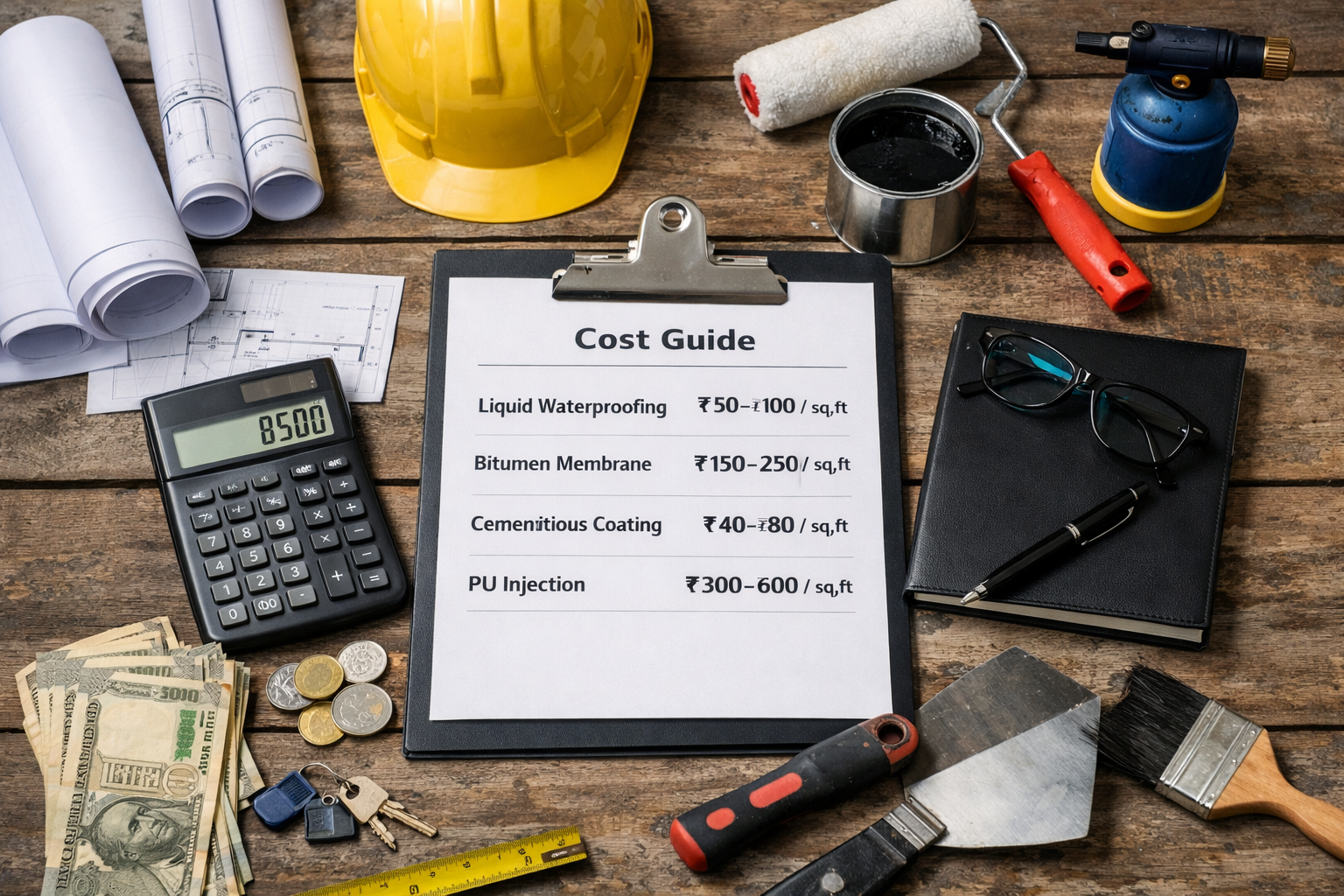
Types of Waterproofing Methods Used in India
1. Liquid Applied Waterproofing Membranes
Liquid waterproofing is one of the most popular methods in India due to its flexibility, ease of application, and cost-effectiveness. These are typically polymer-based coatings that cure to form a seamless membrane.
Cost Range: ₹40-150 per square foot depending on quality and brand
Application Areas:
Terrace waterproofing
Bathroom and wet areas
Balconies and external walls
Foundation and basement areas
Advantages:
Easy application on irregular surfaces
Seamless protection with no joints
Can be applied over existing surfaces
Quick drying time (24-48 hours)
Good UV resistance with proper topcoat
Disadvantages:
Requires skilled labor for proper application
Limited lifespan (8-12 years) compared to other methods
Prone to punctures and damage during construction
Weather-dependent application (cannot apply in rain)
Popular Brands in India: Pidilite Newcoat, Sika India, Fosroc, Cico, Mapei
Frequently asked
2. Sheet Membranes (Bituminous and Polymer)
Sheet membranes are pre-fabricated waterproofing materials that are either rolled out and adhesively bonded or mechanically fastened to surfaces. They're particularly effective for basement and foundation waterproofing.
Cost Range: ₹60-200 per square foot (including labor)
Types Available:
Bituminous membranes (traditional, cost-effective)
HDPE membranes (high density polyethylene, durable)
PVC membranes (flexible, long-lasting)
TPO membranes (thermoplastic olefin, premium option)
Best Applications:
Basement and underground structure waterproofing
Pond and water tank linings
Large terrace areas requiring durability
Industrial buildings with heavy water exposure
Advantages:
Long lifespan (20-30+ years)
Excellent durability and puncture resistance
Suitable for areas with water stagnation
Can be inspected for damage easily
Disadvantages:
Higher initial cost
Installation requires specialized expertise
Seams are potential weak points if not properly sealed
Not ideal for complex architectural shapes.
3. Cementitious Waterproofing
Cementitious coatings are rigid, cement-based products that bond directly to concrete and masonry surfaces. They're among the most affordable options and widely used across India.
Cost Range: ₹20-60 per square foot
Types Available:
Rigid cementitious coatings (single component)
Flexible cementitious membranes (polymer-modified, more effective)
Crystalline waterproofing (self-healing properties)
Best Applications:
Bathroom walls and wet areas
Kitchen backsplashes
Basement interior walls
Water tank interiors
Advantages:
Budget-friendly option
Easy DIY application possible
Good adhesion to concrete and masonry
Can accommodate minor cracks
Environmentally friendly options available
Disadvantages:
Shorter lifespan (5-10 years) for basic versions
Rigid nature means it can crack with structural movement
Requires proper surface preparation
Less effective for areas with high water pressure
Popular Brands: Pidilite Dr. Fixit, Sika Cera, Cico Waterproof, Asian Paints Royale
4. Polyurethane Waterproofing
Polyurethane membranes are premium liquid waterproofing solutions that offer superior flexibility and durability. They're ideal for areas prone to movement or thermal stress.
Cost Range: ₹100-250 per square foot
Best Applications:
Terrace waterproofing in high-temperature areas
Expansion joints and movement areas
Swimming pools and water features
Industrial facilities with chemical exposure
Advantages:
Exceptional flexibility and elongation capacity
Excellent UV and chemical resistance
Long lifespan (12-20 years)
Can accommodate significant structural movement
Seamless application
Disadvantages:
Higher cost than other options
Requires professional application
Sensitive to moisture during application
Cannot be applied in humid conditions
5. Crystalline Waterproofing
Crystalline waterproofing is an advanced technology that works by creating insoluble crystals within the concrete pores, blocking water penetration. Some products are even self-healing.
Cost Range: ₹50-150 per square foot
Best Applications:
Basements and underground structures
Water-retaining structures (tanks, pools)
Parking decks
New construction where concrete is still porous
Advantages:
Self-healing properties for hairline cracks
Works from within the concrete
Long-lasting protection
Can be applied to damp surfaces
No membrane to damage or puncture
Disadvantages:
Less effective on already-damaged concrete
Requires proper concrete quality
Higher cost for premium products
Requires expert application
Regional Considerations and Climate-Specific Costs
Waterproofing costs and method selection vary significantly across India's different regions:
Coastal Cities (Mumbai, Chennai, Kolkata, Kochi)
Coastal areas face salt spray, high humidity, and aggressive moisture. Premium waterproofing is essential.
Recommended Methods: Sheet membranes, polyurethane, crystalline
Average Cost per sq ft: ₹80-250
Special Considerations: Salt-resistant coatings, enhanced durability requirements
High-Rainfall Areas (Kerala, Goa, North-Eastern States)
These regions experience intense monsoon rainfall requiring robust waterproofing systems.
Recommended Methods: Liquid membranes with topcoat, sheet membranes, polyurethane
Average Cost per sq ft: ₹70-200
Special Considerations: Proper drainage design essential, frequent maintenance needed
Dry/Semi-Arid Regions (Delhi, Rajasthan, Gujarat)
While rainfall is lower, groundwater seepage and thermal stress are concerns. UV protection is critical.
Recommended Methods: Liquid membranes with UV protection, cementitious coatings, crystalline
Average Cost per sq ft: ₹40-150
Special Considerations: UV-resistant topcoats essential, thermal movement accommodation needed.
Area-Wise Waterproofing Costs for a Typical Indian Home
Here's a breakdown of typical waterproofing costs for different areas of a 2000 sq ft home in major Indian cities:
Terrace/Roof Waterproofing
Area: ~500 sq ft
Liquid membrane method: ₹20,000-75,000
Sheet membrane method: ₹30,000-1,00,000
Polyurethane method: ₹50,000-1,25,000
Bathroom and Wet Areas
Area: ~150 sq ft
Cementitious coating: ₹3,000-9,000
Liquid membrane: ₹6,000-22,500
Sheet membrane: ₹9,000-30,000
Basement/Foundation
Area: ~400 sq ft
Cementitious coating: ₹8,000-24,000
Liquid membrane: ₹16,000-60,000
Sheet membrane: ₹24,000-80,000
External Walls (Partial)
Area: ~300 sq ft
Liquid membrane: ₹12,000-45,000
Cementitious coating: ₹6,000-18,000
Total Estimated Waterproofing Cost for a 2000 sq ft Home: ₹1,25,000 - ₹4,50,000 depending on methods chosen
Best Practices for Waterproofing Installation
Surface Preparation
Proper surface preparation is crucial for waterproofing success. Costs often increase if surfaces aren't prepared correctly:
Clean surfaces thoroughly (remove dust, algae, loose material)
Repair cracks and holes before applying waterproofing
Ensure proper slope for water drainage
Allow adequate curing time between coats
Surface preparation costs: ₹5-20 per sq ft additional
Timing and Weather
In India, the best time for waterproofing work is:
October to May (dry season)
Avoid monsoon months (June-September)
Temperature range: 10-35°C for most products
Humidity: Below 85% for optimal application
Weather delays can add 20-30% to project timelines, so plan accordingly.
Labor Costs
Labor costs vary by region and skill level:
Unskilled labor: ₹300-500 per sq ft per day
Semi-skilled labor: ₹500-800 per sq ft per day
Skilled waterproofing specialists: ₹800-1500 per sq ft per day
Typical terrace waterproofing takes 3-5 days for 500 sq ft
Maintenance and Longevity
Waterproofing is not a one-time investment. Regular maintenance extends its life and prevents costly repairs:
Annual Maintenance Tasks
Inspect for cracks, blisters, or peeling
Clean debris and ensure proper drainage
Check for water stains or seepage signs
Cost: ₹2,000-5,000 annually for a typical home
Recoating Schedule
Liquid membranes: Recoat every 8-12 years (₹20,000-50,000)
Cementitious coatings: Recoat every 5-8 years (₹10,000-30,000)
Sheet membranes: Last 20-30 years, minimal maintenance
Polyurethane: Recoat every 12-15 years (₹30,000-70,000)
Using AECORD for Waterproofing Material and Service Selection
When planning your waterproofing project, AECORD's B2B2C marketplace can help you connect with verified suppliers and contractors. The platform allows you to:
Compare waterproofing materials from multiple brands and suppliers
Get competitive quotes from certified waterproofing contractors
Access detailed product specifications and technical datasheets
Read verified reviews from other builders and homeowners
Manage procurement and project timelines efficiently
Access transparent pricing without hidden costs
Using AECORD helps ensure you get quality materials at competitive prices and work with reliable professionals for your waterproofing needs.
Common Waterproofing Mistakes to Avoid
Ignoring drainage: Poor drainage defeats even the best waterproofing. Ensure proper slope and drainage channels.
Choosing based on price alone: The cheapest option often fails quickly, costing more in the long run.
Skipping surface preparation: This is the most common cause of waterproofing failure.
Applying in wrong weather: Rain or high humidity compromises adhesion and curing.
Inadequate coverage: Ensure complete coverage including overlaps and edges.
Neglecting maintenance: Regular inspection prevents small issues from becoming major problems.
Not addressing root causes: If seepage is due to structural cracks, waterproofing alone won't solve it.
ROI and Cost-Benefit Analysis
While waterproofing requires upfront investment, the returns are substantial:
Cost-Benefit Example (2000 sq ft home in Bangalore):
Initial waterproofing investment: ₹2,50,000
Avoided repair costs over 20 years: ₹10,00,000+
Property value increase: 5-10% (₹15,00,000-30,00,000 on average property)
Reduced insurance claims: ₹50,000-1,00,000 saved
Improved health and comfort: Priceless
The investment typically pays for itself within 3-5 years through avoided damage and increased property value.
Regulatory Requirements and Standards
India follows specific building codes for waterproofing:
IS 1642:2012: Code of practice for design, installation and maintenance of geotextiles in civil engineering works
IS 2645:1975: Code of practice for installation of bituminous dampproof courses in buildings
IS 8498:2015: Guidelines for design and construction of reinforced concrete water tanks
National Building Code (NBC): Specifies waterproofing requirements for different building types
Always ensure your waterproofing contractor is familiar with these standards and local building regulations.
FAQ: Waterproofing Methods and Costs in India
Q1: What is the most cost-effective waterproofing method for a residential building in India?
A: Cementitious waterproofing is the most budget-friendly option at ₹20-60 per sq ft, suitable for bathrooms and wet areas. For terraces, liquid membranes at ₹40-150 per sq ft offer a good balance of cost and durability. However, "cost-effective" should consider longevity—sheet membranes costing more initially may be more economical over 20-30 years due to their longer lifespan.
Q2: How long does waterproofing typically last in Indian climate conditions?
A: Lifespan depends on the method used. Cementitious coatings last 5-10 years, liquid membranes 8-12 years, polyurethane 12-20 years, and sheet membranes 20-30+ years. Coastal areas and high-rainfall regions may see shorter lifespans due to aggressive moisture. Regular maintenance can extend these periods by 20-30%.
Q3: Should I waterproof during construction or after?
A: Waterproofing during construction is significantly more effective and cost-efficient. It's easier to apply to raw surfaces and prevents water damage from the start. Retrofitting existing buildings costs 30-50% more and is less effective. If your building wasn't waterproofed initially, address it immediately to prevent structural damage.
Q4: What's the difference between waterproofing and damp-proofing?
A: Damp-proofing prevents moisture vapor and capillary moisture rise, while waterproofing resists water under pressure. Damp-proofing is suitable for above-ground areas, while waterproofing is essential for basements, terraces, and areas with water exposure. For Indian climate, waterproofing is generally recommended for better protection.
Q5: Can I apply waterproofing myself or should I hire professionals?
A: Simple cementitious coatings in bathrooms can be DIY projects with proper preparation. However, terrace waterproofing, basement sealing, and membrane installation require professional expertise. Poor application is a leading cause of waterproofing failure. For anything beyond small bathroom areas, hiring certified contractors (available through platforms like AECORD) is recommended to ensure warranty and proper execution.
Conclusion
Waterproofing is a critical investment for any building in India. The method you choose should balance your budget, climate conditions, specific application area, and desired longevity. While liquid membranes offer affordability and ease of application, sheet membranes provide superior long-term durability. Crystalline and polyurethane options excel in specific scenarios requiring advanced performance.
Rather than viewing waterproofing as an expense, consider it insurance against far costlier structural damage. Proper waterproofing can preserve your property's value, ensure occupant health, and provide peace of mind during monsoon seasons. Whether you're building new or maintaining existing structures, investing in quality waterproofing methods now will save significant time and money in the future.
```