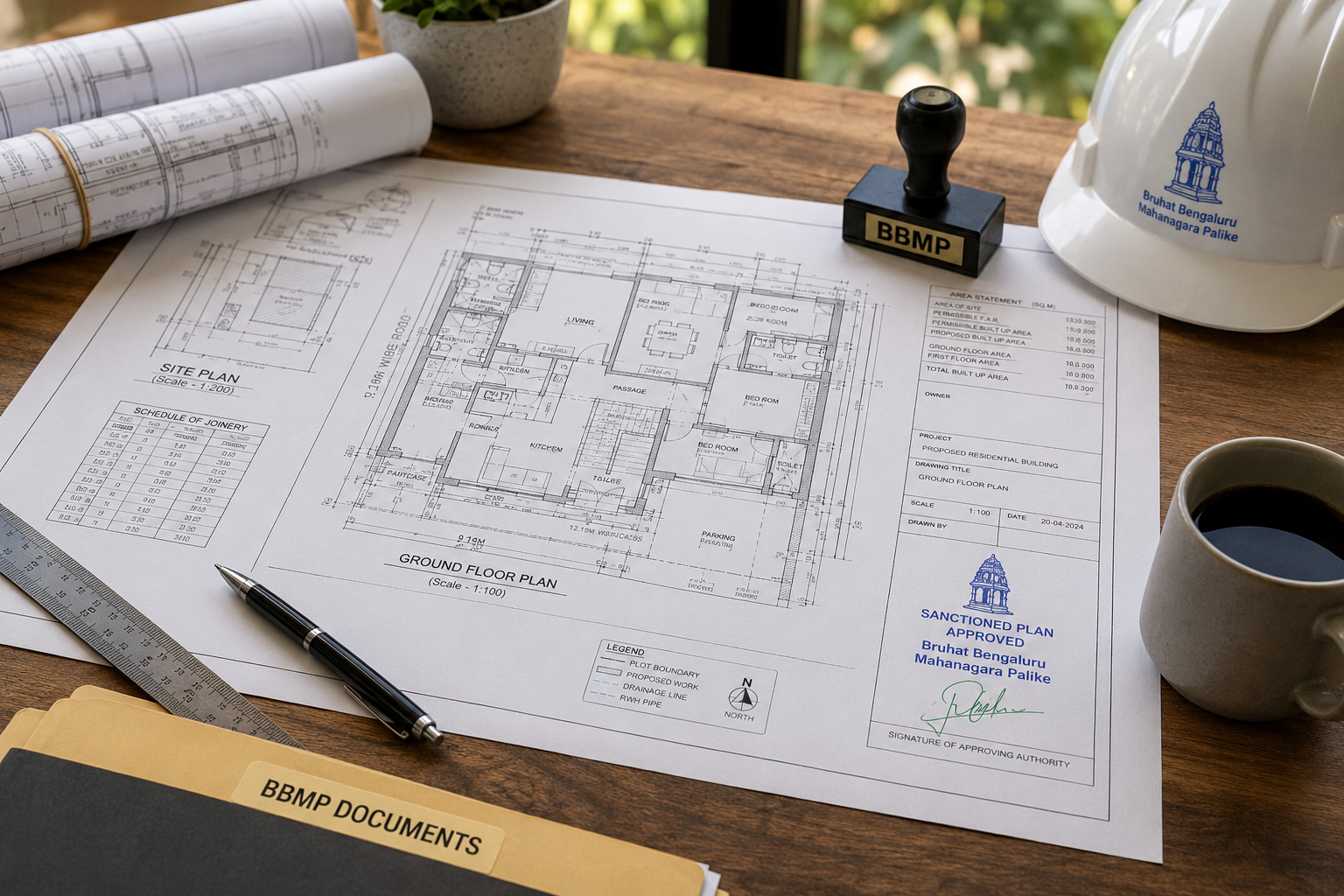


Understanding architectural drawings and house plans is essential for anyone involved in construction, renovation, or property development. Whether you're a homeowner, contractor, or investor in India, the ability to read and interpret these technical documents can save you time, money, and prevent costly mistakes. This comprehensive guide will help you master the fundamentals of reading house plans and architectural drawings. /blog/how-to-read-architectural-drawings
Why Learning to Read House Plans Matters
Architectural drawings are the blueprint for any construction project. They communicate the vision of architects and engineers to contractors, workers, and clients. In India's diverse construction landscape—from traditional residential projects in Delhi and Mumbai to modern developments in Bangalore and Pune—accurate interpretation of house plans is crucial.
When you can read house plans effectively, you can:
Verify that construction matches the approved design
Identify potential structural issues before they become expensive problems
Understand spatial relationships and room dimensions
Communicate effectively with architects and contractors
Make informed decisions about renovations or modifications
Ensure compliance with local building codes and regulations
Many property owners in India discover discrepancies between their house plans and actual construction only after significant money has been spent. Learning to read these drawings helps you stay informed throughout the construction process.
Build cost · Bengaluru, May 2026
The Essential Components of Architectural Drawings
Title Block and Legend
Every architectural drawing begins with a title block, typically located in the lower right corner. This section contains critical information including:
Project name and location (essential for Indian projects with multiple phases)
Architect's and engineer's names and credentials
Drawing title and number
Scale of the drawing
Date of preparation and revision dates
North arrow indicating orientation
The legend explains all symbols, line types, and abbreviations used in the drawing. In Indian construction drawings, you'll commonly see abbreviations like FSI (Floor Space Index), BUA (Built-Up Area), and setback measurements. Understanding the legend is your first step toward accurate interpretation.
Scales and Measurements
Architectural drawings are always scaled representations, not full-size drawings. Common scales used in Indian house plans include:
1:100 scale (most common for floor plans)
1:50 scale (for detailed drawings)
1:200 scale (for site plans)
The scale tells you that 1 unit on the drawing represents a specific number of units in reality. For example, at 1:100 scale, 1 cm on paper equals 1 meter in actual construction. Always verify the scale before taking measurements from a drawing, as errors in scale interpretation can lead to significant construction mistakes.
Frequently asked
Line Types and Their Meanings
Different line types convey different information in architectural drawings:
Solid thick lines: Represent visible edges and outlines of structures
Solid thin lines: Indicate dimensions, details, and secondary elements
Dashed lines: Show hidden or concealed elements (pipes, ducts, electrical conduits)
Dotted lines: Indicate centerlines or construction aids
Dash-dot lines: Show existing elements that will remain or be demolished
In Indian construction drawings, you might also see colored lines—red for electrical, blue for plumbing, and green for HVAC systems, though this varies by architect's preference.
Understanding Floor Plans
What a Floor Plan Shows
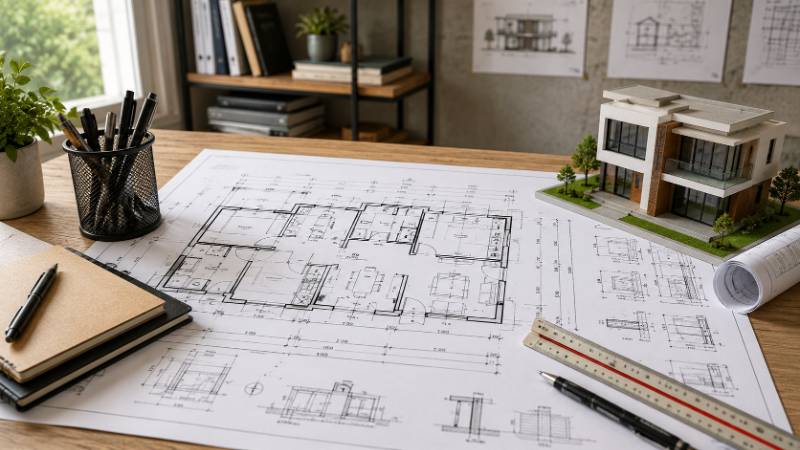
A floor plan is a top-down view of a building at a specific level, as if the roof and upper portions have been removed. It shows:
Room layouts and dimensions
Wall thickness and materials
Door and window locations and sizes
Staircase and elevator positions
Structural columns and beams
Permanent fixtures (kitchen counters, bathroom fixtures)
For a typical Indian residential apartment in cities like Bangalore or Hyderabad, the floor plan will clearly show how the built-up area (typically 600-1200 sq. ft. for 2-3 BHK units) is distributed across bedrooms, living areas, kitchen, and bathrooms.
Reading Dimensions
Dimensions on floor plans are shown as numerical measurements, typically in meters and centimeters for Indian drawings. They appear both inside and outside the floor plan:
Interior dimensions: Show room sizes and distances between walls
Exterior dimensions: Show overall building footprint
Wall-to-wall dimensions: Measure the clear space inside a room
Face-to-face dimensions: Measure from the outer surface of walls
Always add up the individual room dimensions to verify they match the total building dimensions. Discrepancies here can indicate errors in the drawing or planned construction issues.
Door and Window Symbols
Doors and windows are represented by specific symbols on floor plans:
Doors: Shown as breaks in walls with an arc indicating the swing direction
Windows: Depicted as breaks in walls with a distinctive pattern (usually cross-hatching or parallel lines)
Sliding doors: Shown with parallel lines indicating the sliding path
Pocket doors: Represented with a break in the wall showing where the door slides
Understanding door swing direction is particularly important in Indian homes where space is often limited. A door swinging into a room takes up valuable space, while doors swinging outward maximize usable area.
Deciphering Elevation Drawings
What Elevations Show
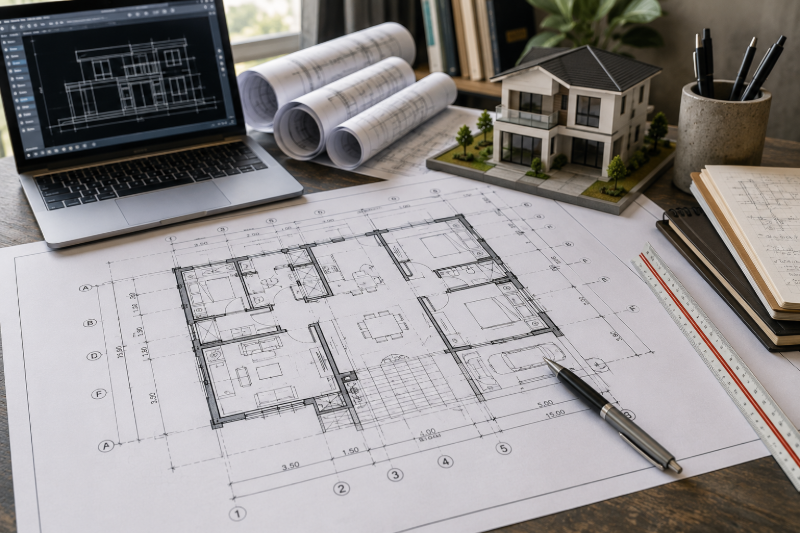
While floor plans show a top-down view, elevation drawings display the vertical view of building facades. They show:
Building height and proportions
Window and door placement and sizes
Exterior materials and finishes
Architectural details and ornamentation
Roof line and overhang details
Ground level relationships
In Indian residential projects, elevation drawings are crucial for understanding how the building integrates with surrounding structures and how weather exposure (particularly monsoon rain and intense sun) will affect different facades.
Front, Side, and Rear Elevations
Most architectural drawing sets include multiple elevations:
North elevation: Typically the front-facing side
South elevation: Usually the rear
East and West elevations: Side views showing depth and width relationships
In India's hot climate, east and west elevations are particularly important as they receive the most intense solar heat. The elevation drawings will show whether adequate shading devices (overhangs, louvers) are planned.
Section Drawings Explained
Understanding Vertical Slices
Section drawings show what you would see if you cut through the building vertically and looked at the exposed interior. They reveal:
Floor-to-floor heights
Ceiling heights in different rooms
Roof structure and slope
Staircase rise and run dimensions
How different levels relate to each other
Vertical alignment of structural elements
Section drawings are essential for understanding the three-dimensional reality of a building. In Indian multi-story residential buildings, sections clearly show how parking levels, residential floors, and terraces are vertically organized.
Reading Section Markers
Floor plans indicate where sections have been cut with a line marked A-A, B-B, or similar. Following the corresponding section drawing labeled A-A or B-B shows what that vertical slice reveals. This cross-referencing is crucial for fully understanding the building's design.
Site Plans and Context Drawings
What Site Plans Communicate
Site plans show the building's location on the property and its relationship to surrounding elements:
Property boundaries and dimensions
Building footprint and setbacks from property lines
Driveway and parking areas
Landscaping and outdoor spaces
Utility access points
North arrow and scale
Adjacent streets and neighboring properties
In Indian cities, site plans must show compliance with local regulations regarding setbacks, open space requirements, and FSI (Floor Space Index) limits. For instance, in Mumbai, setback requirements differ significantly from those in Bangalore or Delhi.
Understanding Setbacks and Easements
Setbacks are the required distances between the building and property lines. Indian municipal regulations typically specify minimum setbacks for front, rear, and side yards. These are clearly marked on site plans. Easements—areas where utilities or neighbors have rights to access your property—are also indicated.
Symbols and Abbreviations Guide
Common Architectural Symbols
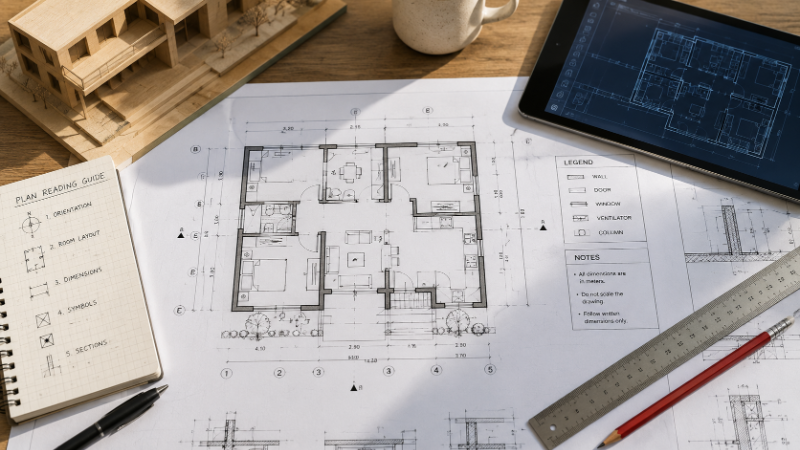
Architectural drawings use standardized symbols to represent building elements efficiently:
Walls: Thick solid lines, often with material patterns
Columns: Circles or squares at regular intervals
Stairs: Parallel lines with arrows showing direction of ascent
Plumbing fixtures: Specific shapes for toilets, sinks, bathtubs
Electrical outlets: Circles with specific markings
Light switches: S or S3 (for 3-way switches)
Indian-Specific Abbreviations
Indian construction drawings use specific abbreviations you should know:
BUA: Built-Up Area (total constructed area)
FSI: Floor Space Index (ratio of building area to land area)
GL: Ground Level
FFL: Finished Floor Level
RL: Reduced Level (elevation reference)
PCC: Plain Cement Concrete
RCC: Reinforced Cement Concrete
Common Mistakes When Reading House Plans
Overlooking Scale
The most frequent error is ignoring or misreading the scale. Always verify the scale before interpreting any measurements. A room that seems spacious at 1:100 scale might be quite small in reality.
Misinterpreting Dimensions
Not all dimensions are clear at first glance. Some show clear space (wall-to-wall), while others measure to the center of walls. Always cross-reference multiple dimensions to ensure consistency.
Ignoring Structural Elements
Columns, beams, and load-bearing walls are not decorative—they're essential for the building's integrity. Never plan renovations that would compromise these structural elements without consulting an engineer.
Forgetting About Ceiling Heights
Floor plans don't show ceiling heights; you need to consult elevation or section drawings. In Indian apartments, typical ceiling heights are 2.7-3 meters, but this affects how spacious a room feels.
Tools for Reading and Measuring Plans
Traditional Tools
Architectural scale ruler: Has multiple scales for accurate measurements
Compass and straightedge: For drawing reference lines
Magnifying glass: For reading small details and annotations
Digital Tools
Modern alternatives include:
PDF measurement tools: Many PDF readers allow measuring distances
CAD software: Free versions like LibreCAD or DWG viewers
Mobile apps: Apps that help measure and annotate drawings
Working with Professionals on AECORD
While learning to read house plans is valuable, complex projects often require professional expertise. If you need help interpreting drawings, making modifications, or ensuring compliance with local regulations, consider connecting with experienced architects and engineers on AECORD. The platform connects you with verified AECO professionals across India who can provide detailed guidance on your specific project.
Whether you're a homeowner in Delhi planning a renovation, a developer in Pune managing multiple projects, or a contractor in Chennai coordinating construction, having access to professionals who can review and explain architectural drawings ensures your project stays on track. AECORD makes it easy to find local experts familiar with your city's specific regulations and construction practices.
Practical Exercise: Reading a Sample Plan
To practice your new skills, obtain a copy of your property's approved plans (available from your municipal corporation). Try this exercise:
Locate the title block and note the scale
Identify all rooms and measure their dimensions
Trace the door and window locations
Find the corresponding section drawings and understand vertical relationships
Check the site plan to understand the building's position on the property
Note any discrepancies between the plan and actual construction
This hands-on practice will significantly improve your ability to read architectural drawings accurately.
Conclusion
Reading architectural drawings is a skill that becomes easier with practice. By understanding the basic components—floor plans, elevations, sections, and site plans—and learning to interpret symbols, scales, and dimensions, you'll be equipped to engage meaningfully with your construction projects. Whether you're building a new home in Bangalore, renovating an apartment in Mumbai, or managing a commercial project in Hyderabad, these skills will serve you well.
Remember that architectural drawings are communication tools designed to convey complex information clearly. When you encounter something unclear, don't hesitate to ask for clarification from your architect or contractor. For more complex questions or if you need professional review of your house plans, AECORD connects you with qualified architects and engineers throughout India who can provide expert guidance tailored to your specific needs and local regulations.
Ready to get professional help with your architectural drawings? Visit AECORD today to find experienced architects, engineers, and construction professionals in your city who can review your plans and guide your project to successful completion.
Frequently Asked Questions
What is the most important part of an architectural drawing to understand first?
The title block and legend are the most critical components to review first. They contain essential information like the project name, drawing scale, north orientation, and explanations of all symbols and abbreviations used throughout the drawing, which are necessary for accurate interpretation.
What does the scale 1:100 mean in house plans?
A 1:100 scale means that 1 unit of measurement on the drawing represents 100 units in reality. For example, 1 cm on the paper equals 1 meter in actual construction. Always verify the scale before taking measurements, as scale errors can lead to significant construction mistakes.
What do dashed lines represent in architectural drawings?
Dashed lines in architectural drawings indicate hidden or concealed elements such as pipes, ducts, and electrical conduits that are not visible in the plan view. Understanding these helps you anticipate what lies behind walls and floors during construction.
Why is it important to read house plans before construction starts?
Reading house plans helps you verify that construction matches the approved design, identify potential structural issues early, understand room dimensions and spatial relationships, and ensure compliance with local building codes. This can save you significant time and money by catching discrepancies before they become expensive problems.
What common abbreviations should I know when reading Indian house plans?
Common Indian construction abbreviations include FSI (Floor Space Index), BUA (Built-Up Area), and setback measurements. Learning these terms and checking the drawing's legend will help you accurately interpret project specifications and regulatory compliance requirements.