



Understanding Property Mutation in India: A Complete Guide
Property mutation is one of the most critical yet often misunderstood processes in Indian real estate. Whether you've recently purchased a property, inherited land, or received it as a gift, understanding how to get a mutation of property is essential for establishing legal ownership and avoiding future complications. This comprehensive guide walks you through everything you need to know about property mutation in India, including the process, required documents, timelines, and costs involved.
Build cost · Bengaluru, May 2026
What is Property Mutation?
Property mutation is the official process of updating property records with the local municipal or revenue authority to reflect a change in ownership. When you purchase a property, inherit it, or receive it through any legal means, the property records maintained by the government still show the previous owner's name. Mutation is the legal procedure that updates these records to reflect the new owner's details.
Think of mutation as the government's acknowledgment that you are now the rightful owner of the property. It's recorded in the property tax registers, revenue records, and other official documents maintained by local authorities. Without mutation, you may face difficulties in selling the property, obtaining loans against it, or resolving disputes related to ownership.
Why is Property Mutation Important?
Mutation serves several critical purposes:
Legal Ownership Recognition: It establishes you as the legal owner in government records
Property Tax Assessment: It ensures property taxes are levied on the correct owner
Future Transactions: It simplifies the sale or transfer of property later
Loan Eligibility: Banks often require mutation documents before sanctioning property loans
Dispute Resolution: It provides documentary proof of ownership in case of disputes
Inheritance Clarity: It clarifies ownership for succession purposes
Types of Property Mutation in India
Property mutation can occur under various circumstances, and the process may differ slightly depending on the reason for mutation:
Frequently asked
1. Mutation Due to Property Purchase
When you buy a property through a registered sale deed, you need to apply for mutation to update the ownership records. This is the most common type of mutation in urban areas.
2. Mutation Due to Inheritance
When property is inherited through a will or succession, mutation must be done to reflect the new owner's name. This requires additional documents like the death certificate and succession certificate or probate.
3. Mutation Due to Gift
If you receive property as a gift, a registered gift deed must be followed by a mutation application to update the records.
4. Mutation Due to Court Order
When property ownership changes due to a court judgment or settlement, mutation is required to reflect this change in official records.
5. Mutation Due to Partition
When joint property is divided among co-owners, each owner's share must be separately mutated in the revenue records.
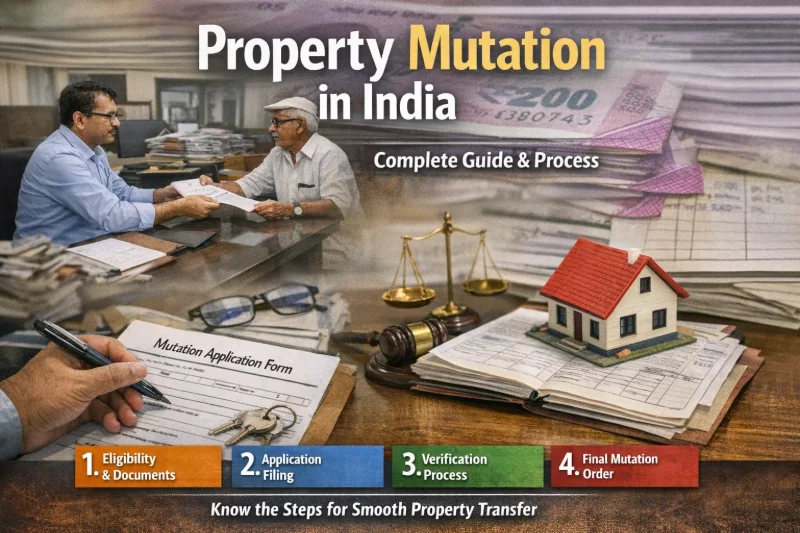
Step-by-Step Process for Getting Property Mutation
Step 1: Gather Required Documents
Before applying for mutation, collect all necessary documents. The exact requirements may vary depending on your city and the reason for mutation, but typically include:
Original sale deed or transfer document (registered)
Property tax receipt of the previous owner
Your property tax receipt or new property tax bill
Copy of the registered deed
Proof of payment of stamp duty and registration fees
Identity proof (Aadhaar, PAN, voter ID, driving license)
Address proof (utility bills, rental agreement)
Copy of the property layout plan or sketch
No Objection Certificate (NOC) from the previous owner (in some jurisdictions)
Affidavit on stamp paper (if required by local authority)
For inheritance-related mutations, you'll also need the death certificate, succession certificate or probate, and legal heir certificate.
Step 2: Identify the Appropriate Authority
The authority responsible for processing mutations varies depending on your property's location:
Urban Areas: Municipal Corporation or Municipal Council
Semi-Urban Areas: Taluka or Tehsil office
Rural Areas: Village Revenue Office or Gram Panchayat
In metropolitan cities like Mumbai, Delhi, Bangalore, and Hyderabad, mutations are typically processed by the municipal corporation. In smaller towns and villages, the revenue department or taluka office handles mutations.
Step 3: Prepare the Mutation Application
Submit a formal application to the appropriate authority. The application should include:
Your name and contact details
Previous owner's name
Property details (address, survey number, area)
Reason for mutation
Attached supporting documents
Many municipal corporations now offer online application portals. For example, the Pune Municipal Corporation and Nagpur Municipal Corporation have dedicated online systems for mutation applications.
Step 4: Submit the Application
Submit your application either online or in person at the concerned authority's office. Keep a copy of the application and receipt for your records. Note down the application number and date of submission for tracking purposes.
Step 5: Pay the Mutation Fee
Pay the prescribed mutation fee as per the local authority's rates. Fees typically range from ₹500 to ₹5,000 depending on the property value and location. Some authorities may require the fee at the time of application submission, while others may demand it after verification.
Step 6: Verification and Inspection
The authority may conduct a physical verification of the property to ensure the details match the records. A revenue official may visit the property to verify its existence and condition. This step is crucial as it prevents fraudulent mutations.
Step 7: Publication of Notice
Most authorities publish a public notice in local newspapers or on their website inviting objections to the mutation. This period typically lasts 15-30 days. If anyone has objections to the mutation, they can submit them during this period.
Step 8: Final Approval and Mutation Certificate
If no objections are received during the publication period and all documents are in order, the authority issues a mutation certificate or updated property record. This certificate is your proof of ownership in the government records.
Timeline for Property Mutation in India
The time required for property mutation varies significantly across India:
Best Case Scenario: 30-45 days (with all documents in order and no objections)
Average Timeline: 2-4 months
Worst Case Scenario: 6-12 months (if there are objections, missing documents, or disputes)
In cities like Bangalore, where the process is fairly streamlined, mutations can be completed in 45-60 days. In cities like Delhi and Mumbai, it may take 3-4 months due to higher volume and bureaucratic procedures.
Costs Associated with Property Mutation
The total cost of property mutation includes several components:
Mutation Fee
This is the primary fee charged by the local authority. It typically ranges from ₹500 to ₹5,000, depending on:
Property value
Property area
Local authority's fee structure
Type of mutation
Professional Assistance Fees
If you hire a property consultant or lawyer to handle the mutation process, expect to pay ₹2,000 to ₹10,000 depending on the complexity and location. Many professionals on AECORD can assist with mutation documentation and guidance.
Stamp Duty and Registration
While not strictly part of mutation, these must be paid before applying for mutation:
Stamp Duty: Ranges from 3-12% of property value depending on the state and property type
Registration Fee: Typically 1% of property value
Other Miscellaneous Costs
Document photocopies: ₹100-500
Affidavit preparation: ₹200-500
Travel and communication: ₹500-2,000
Common Challenges in Property Mutation
Incomplete Documentation
The most common reason for mutation rejection is incomplete or incorrect documentation. Ensure all documents are properly certified and match the details in your sale deed.
Discrepancies in Property Details
If there are differences between the property details in your deed and the government records (area, survey number, location), the mutation may be delayed. You may need to get a new survey conducted or file a correction application.
Objections from Previous Owner
Sometimes the previous owner or other interested parties may file objections during the publication period. This can significantly delay the process and may require legal intervention.
Pending Property Taxes
If the previous owner has unpaid property taxes, the mutation may be stalled until those are settled. Ensure all outstanding taxes are paid before applying.
Title Issues
If there are underlying title issues or disputes regarding the property, the authority may refuse mutation. You may need to resolve these through legal means before proceeding.
State-Specific Variations in Mutation Process
Different states in India have varying procedures and requirements for property mutation:
Maharashtra
In Maharashtra, mutations are processed by the Municipal Corporation in urban areas and the Taluka office in rural areas. The process typically takes 60-90 days. Online portals are available in major cities like Mumbai and Pune.
Karnataka
Karnataka has a relatively streamlined process with online mutation applications available in Bangalore and other major cities. The process typically takes 45-60 days.
Delhi
In Delhi, mutations are handled by the Municipal Corporation of Delhi (MCD). The process can take 3-4 months due to high volume. Delhi has implemented online systems to speed up the process.
Tamil Nadu
Tamil Nadu processes mutations through the Revenue Department. The process is fairly efficient and typically takes 60-90 days.
Gujarat
Gujarat has a well-organized system with clear timelines. Mutations are usually completed within 60 days in major cities like Ahmedabad and Surat.
Tips for Smooth Property Mutation
Act Quickly
Don't delay in applying for mutation after purchasing a property. The sooner you apply, the sooner you establish legal ownership.
Keep All Documents Safe
Maintain original copies of all documents related to your property purchase, including the sale deed, stamp duty receipt, and registration certificate.
Verify Details Before Submission
Double-check all property details in your application against the registered deed and government records. Even small discrepancies can cause delays.
Hire Professional Help
Consider engaging a property consultant or lawyer familiar with your local authority's procedures. Professionals listed on AECORD can provide expert guidance on mutation requirements specific to your city and property type.
Track Your Application
Keep track of your application status by visiting the authority's office or checking online portals regularly. Follow up if there are delays.
Prepare for Inspection
Ensure your property is accessible for inspection by the revenue official. Keep the property clean and identifiable with proper address markers.
Frequently Asked Questions About Property Mutation
Is Property Mutation Mandatory?
Yes, property mutation is mandatory to establish legal ownership in government records. However, it's not a prerequisite for registering the sale deed. You should apply for mutation soon after registration.
Can I Sell Property Without Mutation?
While technically possible, selling property without mutation is risky and often not accepted by buyers or banks. It complicates the transaction and raises questions about ownership clarity.
What Happens if I Don't Get Mutation Done?
Without mutation, you may face issues with property taxes being levied on the previous owner, difficulty obtaining loans, complications in future sales, and potential disputes regarding ownership.
How Long After Purchase Should I Apply for Mutation?
Ideally, apply for mutation within 3-6 months of the property purchase. This ensures timely updating of records and avoids complications.
Can I Hire Someone to Handle Mutation on My Behalf?
Yes, you can authorize a lawyer, property consultant, or relative through a power of attorney to handle the mutation process on your behalf.
Conclusion
Property mutation is a crucial legal process that establishes your ownership in government records. While the process may seem complex, understanding the steps involved and preparing the required documents in advance can make it significantly smoother. The timeline and costs vary depending on your location and specific circumstances, but staying organized and following up regularly can help expedite the process.
Whether you're a first-time property buyer, inheriting property, or dealing with any change in ownership, ensuring timely mutation protects your interests and simplifies future transactions. If you need professional guidance or assistance with mutation-related matters, connect with experienced property consultants and legal professionals on AECORD, India's trusted B2B2C marketplace for AECO professionals. Our network includes experts across major Indian cities who can help navigate the mutation process specific to your location and property type.
Don't leave your property ownership documentation incomplete—take action today to secure your property's legal status through proper mutation.