

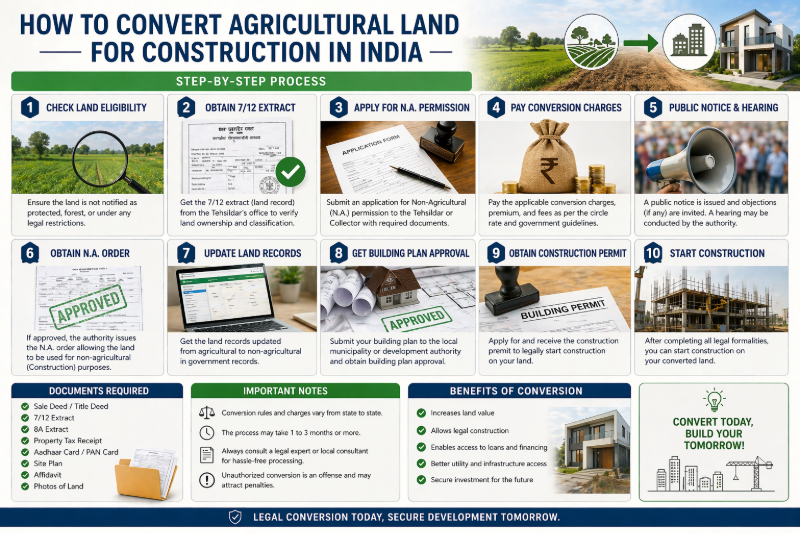
Converting agricultural land for construction in India is a complex process that involves navigating multiple regulations, obtaining various permissions, and understanding market dynamics. Whether you're a real estate developer, farmer, or investor, this comprehensive guide will walk you through the entire process of converting agricultural land for construction purposes in India.
Understanding Agricultural Land Conversion in India
Agricultural land conversion refers to the process of changing the land use classification from agricultural to non-agricultural purposes, such as residential, commercial, or industrial construction. This process is heavily regulated in India to protect agricultural productivity and ensure sustainable development.
The regulatory framework for agricultural land conversion varies significantly across different states, as land is a state subject under the Indian Constitution. What's permissible in Maharashtra might differ substantially from regulations in Tamil Nadu or Punjab. Before initiating any conversion process, it's crucial to understand the specific rules applicable in your state and district.
The primary objective behind these regulations is to prevent the indiscriminate conversion of fertile agricultural land into concrete structures, thereby preserving India's agricultural heritage and food security. However, the regulations also recognize the need for urban expansion and development, making the conversion process possible under specific conditions.
Build cost · Bengaluru, May 2026
Key Regulations and Legal Framework
The Agricultural Land (Ceiling on Holdings) Act, 1961
This national-level legislation sets a ceiling on the maximum area of agricultural land that can be held by any individual or family. The ceiling limits vary by state, ranging from 10.12 hectares to 54.68 hectares. If your agricultural land exceeds these limits, you may be required to surrender excess land to the government, which can complicate the conversion process.
State-Specific Agricultural Land Laws
Each state in India has its own agricultural land protection laws. For example:
Maharashtra: The Maharashtra Land Revenue Code, 1966, regulates land conversion. Non-agricultural use is permitted in certain areas, particularly around urban centers, but requires specific permissions.
Karnataka: The Karnataka Land Revenue Act, 1964, requires conversion permission from the Deputy Commissioner for non-agricultural use.
Tamil Nadu: Requires conversion permission from the Tahsildar and District Collector for agricultural land conversion.
Uttar Pradesh: The U.P. Zamindari Abolition and Land Reforms Act, 1950, governs agricultural land transactions and conversion.
Punjab: The Punjab Security of Land Tenures Act, 1953, is particularly stringent regarding agricultural land conversion to protect farming communities.
Frequently asked
The Environmental Protection Act, 1986
Depending on the project size and location, environmental clearance may be mandatory. Projects in environmentally sensitive areas or those exceeding certain thresholds require Environmental Impact Assessment (EIA) and clearance from the Ministry of Environment, Forest and Climate Change.
Pre-Conversion Requirements and Eligibility
Checking Land Classification
Before proceeding with conversion, verify your land's current classification. Obtain a certified copy of the land record (also called Jamabandi or Pahani depending on the state) from the local revenue office. This document confirms whether your land is classified as agricultural, non-agricultural, or mixed-use.
Some states classify land as "wet" (irrigated) or "dry" (rain-fed). Wet agricultural land often faces stricter conversion restrictions than dry land, as it's considered more productive. Check your land's classification, as it significantly impacts the conversion approval process.
Location Analysis
Agricultural land conversion is easier in areas designated for urban expansion or development. Check your local municipal corporation's development plan or the district's Master Plan to see if your land falls within:
Areas earmarked for urban growth
Industrial zones
Special Economic Zones (SEZs)
Residential development areas
Land located far from urban centers or in protected agricultural zones will face more stringent restrictions. For instance, agricultural land in the Greenbelt areas of cities like Delhi or Bangalore may have stricter conversion norms.
Ownership Verification
Ensure you have clear, unencumbered ownership of the agricultural land. Obtain a title deed search report to confirm ownership history and verify there are no pending legal disputes. This step is crucial before investing time and resources in the conversion process.
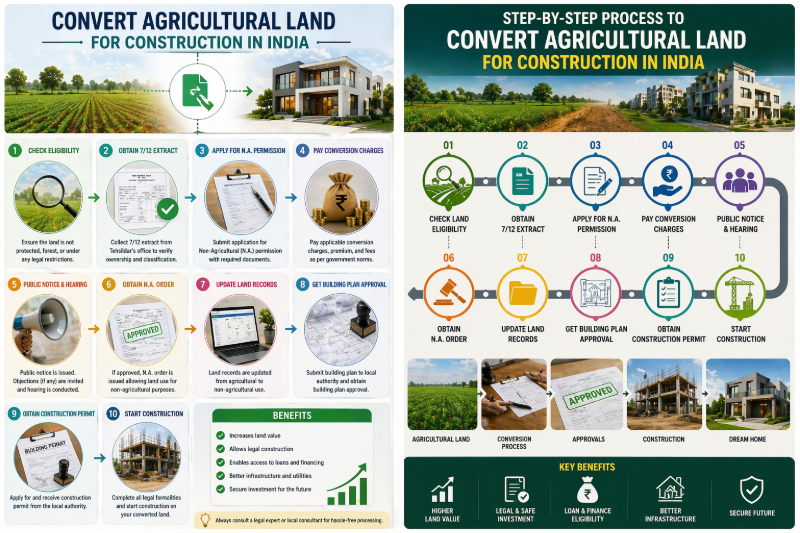
Step-by-Step Conversion Process
Step 1: Obtain Conversion Permission from Revenue Department
The first major step is obtaining formal conversion permission from the revenue department. The process typically involves:
Filing an application with the Tahsildar (in South India) or the revenue officer of your district
Submitting required documents including land ownership proof, development plan, and proposed project details
Paying the applicable conversion fee, which varies by state and land type
Awaiting revenue department approval, which typically takes 30-90 days
In states like Maharashtra, conversion fees for agricultural land can range from ₹5,000 to ₹50,000 per acre, depending on the location and land type. In urban-adjacent areas near cities like Pune or Bangalore, fees may be significantly higher.
Step 2: Obtain No Objection Certificate (NOC) from the Agricultural Department
Many states require an NOC from the Department of Agriculture before conversion. This certificate confirms that the conversion won't adversely affect agricultural productivity in the region. The agricultural department may conduct a site inspection to assess soil quality and irrigation potential.
Step 3: Environmental Clearance
If your project falls under the Environmental Impact Assessment (EIA) notification category, you must obtain environmental clearance. This process involves:
Preparing an EIA report through a certified consultant
Conducting public consultations in the project area
Submitting the report to the State Pollution Control Board
Obtaining clearance from the Ministry of Environment (for Category A projects)
Environmental clearance typically takes 4-6 months and can cost between ₹3,00,000 to ₹15,00,000 depending on project complexity.
Step 4: Municipal/Local Authority Approvals
Once revenue clearance is obtained, seek approval from the local municipal corporation or Gram Panchayat. This involves:
Submitting detailed architectural and structural plans
Obtaining building permission from the municipal authority
Getting layout approval from the urban development authority
Obtaining water and sewerage connection approvals
Step 5: Registration of Converted Land
After obtaining all necessary approvals, register the land as non-agricultural with the revenue department. This involves filing an application at the Sub-Registrar's office with all approved documents. The registration process typically takes 15-30 days.
Timeline and Costs
Expected Timeline
The complete conversion process typically takes 6-18 months, depending on the state, location, and project complexity:
Revenue department approval: 1-3 months
Environmental clearance: 2-6 months (if required)
Municipal approvals: 2-4 months
Registration: 0.5-1 month
Projects in fast-track development zones or those with expedited processing may complete faster, while projects in sensitive areas may take longer.
Cost Breakdown
Budget the following costs for agricultural land conversion:
Conversion fee: ₹5,000 to ₹50,000 per acre (varies by state and location)
Environmental clearance: ₹3,00,000 to ₹15,00,000 (if required)
Professional consultation fees: ₹50,000 to ₹2,00,000
Municipal approvals and permits: ₹1,00,000 to ₹5,00,000
Legal and registration fees: ₹50,000 to ₹1,50,000
Total estimated cost: ₹5,00,000 to ₹25,00,000 for a typical project
These costs can vary significantly based on location, project size, and specific state regulations.
Common Challenges and Solutions
Stringent State Regulations
Some states like Punjab have very restrictive agricultural land conversion policies to protect farming communities. If you're working in such states, consider alternative approaches like:
Partnering with local farmers for joint development projects
Exploring land in designated industrial zones where conversion is easier
Investigating if your land qualifies for exemptions under special development schemes
Environmental Concerns
If your land is in an environmentally sensitive area, obtain an environmental impact assessment early in the process. Address potential concerns proactively through sustainable design practices and community engagement.
Legal Disputes
Tenant farmers or individuals with historical rights to the land may challenge the conversion. Ensure all parties have agreed to the conversion and obtain necessary consent documents before initiating the formal process.
Delays in Approvals
Government approvals can sometimes be delayed due to administrative backlogs. Engage qualified professionals who understand local procedures and can follow up with authorities effectively. Consider hiring a land consultant or legal advisor familiar with your specific district's processes.
Best Practices and Recommendations
Engage Professional Expertise
Hire experienced land consultants, architects, and legal advisors who specialize in agricultural land conversion in your state. They can navigate local regulations more efficiently and help avoid costly mistakes. When sourcing these professionals, platforms like AECORD can connect you with qualified experts who understand the nuances of agricultural land conversion across different Indian states.
Conduct Thorough Due Diligence
Before purchasing agricultural land for conversion, conduct comprehensive due diligence including:
Title verification and ownership history
Survey of the land to confirm boundaries and area
Soil testing to understand agricultural potential
Review of local development plans and zoning regulations
Assessment of infrastructure availability (roads, water, electricity)
Engage with Local Communities
Building positive relationships with local communities and farmers can smooth the conversion process. Public consultations required for environmental clearance are mandatory, but proactive community engagement can prevent opposition and delays.
Document Everything
Maintain comprehensive records of all applications, approvals, correspondence, and payments. This documentation is crucial for registration and future reference.
Special Considerations for Different States
Metropolitan Areas
In cities like Delhi, Mumbai, Bangalore, and Hyderabad, agricultural land conversion is relatively easier due to urban expansion policies. However, environmental clearance requirements are often more stringent due to higher population density and environmental sensitivity.
Tier-2 and Tier-3 Cities
Cities like Pune, Jaipur, Lucknow, and Ahmedabad have moderate conversion policies. These areas often offer good opportunities for development with reasonable approval timelines.
Rural Areas
Converting agricultural land in rural areas away from urban centers is significantly more challenging and may not be permitted unless it's for specific purposes like infrastructure, education, or healthcare facilities.
Future Outlook and Trends
India's agricultural land conversion policies are gradually becoming more flexible in designated development zones while simultaneously becoming stricter in agricultural heartlands. The government is pushing for vertical development and densification in urban areas rather than horizontal expansion into agricultural land.
Stay updated with your state government's policies and development plans, as these regulations can change. Subscribe to revenue department notifications and maintain regular contact with local authorities.
Conclusion
Converting agricultural land for construction in India is a multifaceted process requiring careful planning, professional guidance, and patience. Success depends on understanding state-specific regulations, securing all necessary approvals, and engaging qualified professionals who understand local procedures.
The investment in professional expertise during this process—whether through architects, legal advisors, or environmental consultants—can save time and money in the long run. If you're planning an agricultural land conversion project, consider connecting with experienced AECO professionals on AECORD, India's leading B2B2C marketplace for architecture, engineering, construction, and operations professionals. AECORD can help you find qualified consultants, architects, and legal advisors who specialize in agricultural land conversion projects across different Indian states.
Remember that while the process can be lengthy and complex, thousands of successful agricultural land conversions happen across India every year. With proper planning, professional guidance, and adherence to regulations, your agricultural land conversion project can be completed successfully.
Ready to start your agricultural land conversion project? Visit AECORD today to connect with experienced professionals who can guide you through every step of the conversion process. From land consultants to environmental experts and architects, AECORD has the right professionals to ensure your project's success.
Frequently Asked Questions
What is agricultural land conversion and why is it regulated in India?
Agricultural land conversion is the process of changing land use classification from agricultural to non-agricultural purposes like residential or commercial construction. It's heavily regulated in India to protect agricultural productivity, preserve food security, and ensure sustainable development while balancing the need for urban expansion.
Do agricultural land conversion rules differ by state in India?
Yes, agricultural land conversion regulations vary significantly across states since land is a state subject under the Indian Constitution. What's permissible in Maharashtra may differ substantially from regulations in Tamil Nadu or Punjab, so you must understand the specific rules applicable in your state and district.
What are the main laws governing agricultural land conversion in India?
The primary laws include the Agricultural Land (Ceiling on Holdings) Act, 1961 (national level), state-specific acts like Maharashtra's Land Revenue Code and Punjab's Security of Land Tenures Act, and the Environmental Protection Act, 1986 for environmental clearances when required.
What documents do I need to check before converting agricultural land?
You should obtain a certified copy of your land record (Jamabandi or Pahani) from the local revenue office to verify your land's current classification as agricultural, non-agricultural, or mixed-use. This document is essential for confirming eligibility and proceeding with the conversion process.
Is environmental clearance required for agricultural land conversion projects?
Environmental clearance may be mandatory depending on your project size and location. Projects in environmentally sensitive areas or those exceeding certain thresholds require an Environmental Impact Assessment (EIA) and clearance from the Ministry of Environment, Forest and Climate Change.