

Cement is one of the most critical materials in any construction project, serving as the binding agent that holds concrete together. The quality of cement directly impacts the strength, durability, and longevity of your structure. In India, where construction standards vary widely across regions and suppliers, it's essential to know how to check cement quality on site before it's mixed into concrete. This comprehensive guide will walk you through practical methods to verify cement quality, Indian standards to follow, and why this matters for your project.
Why Checking Cement Quality on Site Matters
Poor quality cement can lead to several construction failures including reduced compressive strength, increased permeability, faster deterioration, and costly repairs down the line. In India, where many projects operate on tight budgets, using substandard cement might seem cost-effective initially but results in expensive remedial work later. Whether you're building a residential complex in Bangalore, a commercial structure in Mumbai, or an industrial facility in Delhi, cement quality directly affects your project's success.
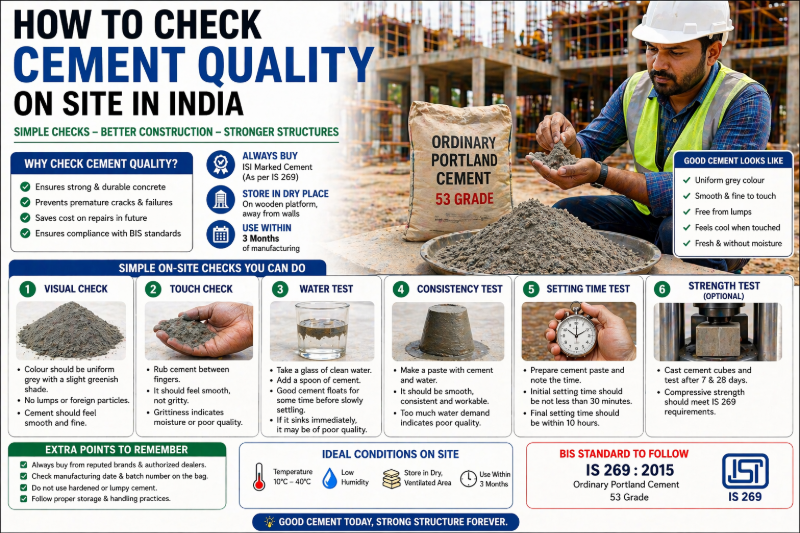
The Indian Standards Institution (ISI) has established IS 269:2015 for Ordinary Portland Cement (OPC) and IS 1489:2015 for Portland Pozzolana Cement (PPC), which define the specifications and testing requirements. However, on-site quality checks provide an immediate way to identify suspicious batches before they're incorporated into your structure.
Build cost · Bengaluru, May 2026
Visual and Physical Inspection Methods
Check the Bag and Packaging
Begin with basic visual inspection of the cement bags. In India, cement bags typically weigh 50 kg and should have clear markings including:
Manufacturer's name and address
ISI mark with number
Type of cement (OPC, PPC, PSC)
Date of manufacture and expiry date
Batch number for traceability
Net weight clearly printed
Bags should be intact without tears, moisture damage, or signs of tampering. If bags are stored in humid conditions or have been exposed to rain, the cement inside may have started hydrating and losing strength. Reject bags with wet patches, discoloration, or visible deterioration.
Check for Lumps and Caking
One of the easiest on-site tests is checking for lumps and caking. Open a few bags randomly from different parts of the stack (top, middle, and bottom) and squeeze the cement in your hand. Good quality cement should flow freely without forming lumps. If you find hard lumps that don't break easily, it indicates moisture absorption and hydration, which reduces cement strength by up to 30-40%.
Take a handful of cement and let it fall from a height of about 30 cm onto a hard surface. It should disperse freely. Caked cement that falls in clumps is compromised and should be rejected.
Frequently asked
Color and Appearance Test
Quality OPC cement should have a uniform gray color, while PPC (which contains pozzolanic materials) may appear slightly darker. Inconsistent coloring within the same batch or unusual discoloration (brownish or yellowish tints) can indicate contamination or improper manufacturing. Compare the sample with a known good sample from the manufacturer if available.
Simple On-Site Chemical and Physical Tests
The Float Test
This quick test helps identify adulterated cement. Take approximately 100 grams of cement and mix it with water to form a thick paste. Place this paste in a container of water. Good quality cement will sink, while adulterated cement or cement mixed with excessive sand or other fillers may float or take longer to sink. This test is not scientifically rigorous but provides a quick visual indicator of potential contamination.
The Strength Test (Simple Version)
While not a substitute for laboratory testing, you can perform a basic strength assessment. Make small cement mortar cubes (approximately 5 cm × 5 cm) using a 1:3 ratio of cement to sand with water. Allow these to cure for 7 days in moist conditions and then attempt to break them by hand or with a hammer. Good quality cement mortar should be quite hard and difficult to break. If the cubes crumble easily, the cement quality is suspect.
The Temperature Test
Mix cement with water and observe the temperature rise. Cement hydration is an exothermic reaction. Mix about 100 grams of cement with 30-40 ml of water in an insulated container and monitor the temperature using a thermometer. Good quality cement should show a noticeable temperature increase (around 5-10°C within a few minutes). Minimal temperature rise may indicate low-quality or aged cement.
Laboratory Testing Standards for India
For critical projects, on-site tests should be complemented with laboratory analysis. The ISI has established comprehensive testing procedures:
Fineness Test
Cement fineness affects hydration rate and strength development. According to IS 269:2015, OPC should have a specific surface area of at least 225 m²/kg. Finer cement hydrates faster and develops strength more quickly, but if too fine, it can lead to excessive heat generation. This test requires a Blaine permeability apparatus, available at certified laboratories in major Indian cities.
Compressive Strength Test
This is the most important test for cement quality. Mortar cubes (50 mm × 50 mm × 50 mm) are prepared using cement and standard sand in a 1:3 ratio and tested for compressive strength at 3 days, 7 days, and 28 days. For OPC 43 Grade, the 28-day strength should be minimum 43 MPa, while OPC 53 Grade should achieve at least 53 MPa. In India, testing costs typically range from ₹1,500 to ₹3,000 per sample.
Setting Time Test
Initial setting time should be between 30-600 minutes, while final setting time should not exceed 600 minutes. Cement that sets too quickly or too slowly can cause problems during construction. This test uses a Vicat apparatus and is essential for quality verification.
Soundness Test
This test checks for excessive free lime and magnesia that can cause expansion and cracking. The expansion should not exceed 10 mm when tested using the Le Chatelier method. Poor soundness can lead to structural failures years after construction.
Identifying Counterfeit and Substandard Cement
India has a significant problem with counterfeit and substandard cement, particularly in smaller towns and rural areas. Here's how to identify suspicious cement:
Packaging inconsistencies: Misspelled manufacturer names, blurry printing, or incorrect ISI mark format are red flags
Suspiciously low prices: If the price is significantly below market rates in your region (typically ₹400-500 per 50 kg bag in 2024), verify authenticity
Unknown brands: Stick with established manufacturers like Ambuja, ACC, Dalmia, Ultratech, and others registered with ISI
Bulk purchases from unauthorized dealers: Always buy from authorized distributors listed on the manufacturer's website
Inconsistent batch quality: If different batches from the same supplier show varying characteristics, this indicates quality control issues
Storage and Handling Considerations
Even quality cement can deteriorate if stored improperly on site. Remember these storage guidelines:
Store cement in a dry, well-ventilated area away from moisture
Keep bags off the ground on wooden pallets or concrete platforms
Cover stacks with waterproof tarpaulin but ensure adequate ventilation to prevent condensation
Maintain temperature between 10-30°C if possible
Use older stock first (FIFO principle)
Limit storage duration to 3 months; after this, strength begins to deteriorate
Segregate different cement types and grades to prevent mixing
Working with Professionals on AECORD
While these on-site tests provide valuable insights, they're most effective when coordinated with qualified professionals. AECORD, India's premier B2B2C marketplace for AECO professionals, connects you with certified quality control engineers, material testing laboratories, and construction consultants who can conduct comprehensive cement quality assessments. Whether you're managing a project in Hyderabad, Pune, or Kolkata, finding the right expertise on AECORD ensures your materials meet ISI standards.
Quality control specialists available through AECORD can:
Conduct third-party cement testing and verification
Develop material inspection protocols specific to your project
Maintain compliance documentation for regulatory requirements
Provide recommendations for cement suppliers in your region
Perform periodic quality audits throughout construction
Cost Implications of Quality Checking
Investing in cement quality verification is economical when compared to potential failures. A basic on-site testing program costs approximately ₹5,000-10,000 per project, while comprehensive laboratory testing ranges from ₹15,000-30,000. Compare this to the cost of structural repairs (which can exceed ₹5-10 lakhs) or legal liabilities from structural failures, and quality checking becomes a worthwhile investment.
Regional Variations in India
Cement quality and availability vary across Indian regions. In metropolitan areas like Delhi, Mumbai, and Bangalore, quality control is generally stricter due to regulatory oversight. However, in smaller towns and rural areas, counterfeit products are more prevalent. If you're constructing in Tier-2 or Tier-3 cities, be especially vigilant about cement sourcing and testing.
Regulatory Compliance and Documentation
Maintain detailed records of all cement purchases, including:
Invoice copies with supplier details
Batch numbers and manufacturing dates
Test certificates from laboratories
Inspection reports from site
Photographs of bags and testing procedures
This documentation is essential for regulatory compliance, warranty claims, and future reference. Many state building departments and municipal corporations in India require proof of material quality for project approvals and completion certificates.
Quick Checklist for On-Site Cement Quality Verification
Before accepting any cement delivery on your construction site:
✓ Verify ISI mark and manufacturer details on bags
✓ Check manufacturing date (should be recent, ideally within 3 months)
✓ Inspect bags for moisture damage, tears, or tampering
✓ Perform lump and caking test on random samples
✓ Verify color consistency across samples
✓ Conduct float test for quick adulteration check
✓ Arrange laboratory testing for critical projects
✓ Maintain proper storage conditions
✓ Document all testing and purchase records
✓ Consult with quality control professionals for large projects
Conclusion
Cement quality is fundamental to construction success in India. By implementing these on-site checking methods and combining them with proper laboratory testing, you significantly reduce the risk of structural failures and costly remedial work. Whether you're managing a small residential project or a large commercial development, taking cement quality seriously protects your investment and ensures long-term durability.
The methods outlined in this guide—from simple visual inspection to laboratory testing—provide a comprehensive approach to quality assurance. Remember that while on-site tests offer quick assessments, laboratory testing provides definitive results aligned with ISI standards. For projects requiring expert oversight, AECORD connects you with qualified professionals who specialize in material testing and quality control across India's major construction markets.
Don't compromise on cement quality. Your structure's longevity depends on it.
Take Action Today
Ready to ensure cement quality on your next project? Connect with certified quality control engineers, material testing laboratories, and construction consultants on AECORD. Find the right professionals in your city who can help you establish robust quality assurance protocols and verify that every batch of cement meets ISI standards. Your project's success starts with quality materials—make sure you're checking them properly.
Frequently Asked Questions
What are the main signs of poor quality cement on a construction site?
Poor quality cement typically shows lumps, caking, discoloration, or wet patches on bags. When squeezed in hand, it should flow freely; if it forms hard lumps that don't break easily, it indicates moisture absorption and hydration that reduces strength by 30-40%. Reject any cement that fails these basic visual checks.
Which Indian standards should cement meet for construction projects?
In India, cement must comply with IS 269:2015 for Ordinary Portland Cement (OPC) and IS 1489:2015 for Portland Pozzolana Cement (PPC). These standards define specifications and testing requirements, and all bags should display the ISI mark with number to verify compliance.
How can I check if cement is adulterated on site?
The float test is a quick on-site method: mix 100 grams of cement with water to form a thick paste and place it in water. Good quality cement will sink, while adulterated cement or cement mixed with excessive sand and fillers may float or sink slowly, indicating potential contamination.
What information should be printed on cement bags in India?
Cement bags should clearly display the manufacturer's name and address, ISI mark with number, cement type (OPC/PPC/PSC), date of manufacture and expiry, batch number for traceability, and net weight. Bags must be intact without tears, moisture damage, or signs of tampering.
Why is checking cement quality important before mixing concrete?
Poor quality cement leads to reduced compressive strength, increased permeability, faster deterioration, and costly repairs. Identifying substandard cement before mixing prevents structural failures and expensive remedial work that far exceeds any initial savings from using inferior material.