Artificial Intelligence is revolutionizing how architectural, structural, and MEP (Mechanical, Electrical, Plumbing) drawings are reviewed in the construction industry. What once required weeks of manual inspection by experienced professionals can now be completed in hours with greater accuracy and consistency. For Indian AECO professionals, understanding how AI-powered drawing review works can significantly improve project timelines, reduce costly errors, and ensure compliance with local building codes.
Understanding AI-Powered Drawing Review
AI drawing review systems use machine learning algorithms and computer vision to analyze architectural, structural, and MEP drawings automatically. These systems are trained on thousands of drawings and building codes to identify inconsistencies, errors, and non-compliance issues that human reviewers might miss or take considerable time to spot.
The technology works by converting PDF or image files of drawings into machine-readable formats, then analyzing them against a database of rules, standards, and best practices. The AI can detect everything from dimensional conflicts to code violations in seconds—a task that would traditionally require a team of experienced architects and engineers to complete over several days.
For professionals working on projects across India's major metros like Delhi, Mumbai, Bangalore, and Hyderabad, where building codes vary by municipal corporation, AI review tools can be programmed to check against specific regional regulations and guidelines.

Build cost · Bengaluru, May 2026
How AI Analyzes Architectural Drawings
Dimensional Consistency and Spatial Relationships
One of the primary functions of AI in architectural review is verifying dimensional consistency across all floor plans, elevations, and sections. The system automatically checks that:
Room dimensions are consistent across different views
Wall thicknesses are uniform where they should be
Door and window openings align properly with structural elements
Ceiling heights are maintained throughout spaces
Circulation paths meet minimum width requirements
AI can detect discrepancies that often occur when drawings are modified during design development. For instance, if a wall is moved in the floor plan but not updated in the elevation, the AI will flag this immediately. In a typical Indian residential project in cities like Pune or Chennai, where plot sizes and building regulations are stringent, this dimensional accuracy is critical for obtaining municipal approvals.
Code Compliance Verification
Building codes in India, governed by the National Building Code (NBC) and supplemented by municipal regulations, contain hundreds of requirements. AI systems can be configured to check against these specific standards, including:
Minimum room areas and dimensions as per NBC guidelines
Required number and dimensions of exits and stairwells
Accessibility requirements for disabled persons
Fire safety requirements including refuge areas and evacuation routes
Parking requirements based on building use and area
For projects in Tier-1 cities like Bangalore or Hyderabad, where commercial developments are subject to stringent municipal regulations, AI review can automatically verify compliance before drawings are submitted for approvals, potentially saving weeks of back-and-forth with authorities.
Frequently asked
Architectural Consistency
AI systems analyze whether architectural elements are consistent across the entire project. This includes checking that:
Material specifications are consistent
Architectural symbols and legends are properly used
Grid lines and reference systems are aligned
Annotation standards are followed throughout
AI Analysis of Structural Drawings
Load Path Verification
Structural AI systems can analyze drawings to verify that load paths are properly established from floors through beams, columns, and ultimately to the foundation. The system checks that:
All structural elements are properly supported
Beam spans are within acceptable limits
Column spacing and sizing are consistent with loads
Foundation details match the structural grid
In India, where soil conditions vary significantly between regions—from the alluvial plains of the Indo-Gangetic region to the rocky terrain of the Deccan Plateau—AI can be trained to flag potential structural issues specific to local geological conditions.
Connection Details and Reinforcement
AI can verify that connection details shown in structural drawings are complete and consistent. It checks for:
Proper reinforcement bar sizing and placement
Complete connection details at critical points
Consistency of reinforcement across similar elements
Compliance with IS (Indian Standard) codes for concrete and steel design
For reinforced concrete structures—the most common construction type in India—AI can verify that rebar detailing complies with IS 456 (Code of Practice for Plain and Reinforced Concrete) standards. This is particularly valuable for large projects where hundreds of similar elements must be detailed consistently.
Clash Detection
One of the most valuable applications of AI in structural review is identifying clashes between structural elements and other building systems. The system can detect:
Beams interfering with mechanical equipment or ductwork
Columns positioned where they conflict with architectural requirements
Foundation elements conflicting with utilities
Structural members penetrating walls or floors incorrectly
AI Review of MEP Drawings
System Completeness and Continuity
AI systems analyze MEP drawings to ensure that mechanical, electrical, and plumbing systems are complete and properly connected. For mechanical systems, this includes:
All spaces are served by appropriate HVAC equipment
Ductwork is properly sized and routed
Equipment is accessible for maintenance
Adequate clearances are provided around equipment
For electrical systems, AI verifies:
All spaces have appropriate lighting
Power outlets are provided per code requirements
Panel locations and sizes are adequate
Cable routing is practical and protected
For plumbing systems, the review ensures:
All fixtures are properly connected
Pipe sizing is adequate for flow requirements
Proper slopes are maintained for gravity drainage
Cleanout access is provided
Code Compliance for MEP Systems
MEP systems must comply with multiple Indian standards including the National Building Code (NBC), Indian Standard (IS) codes, and electrical safety standards. AI can automatically check against these requirements, such as:
IS 1172 (Code of Practice for Installation of Plumbing and Sanitary Appliances in Buildings)
IS 3043 (Code of Practice for Earthing)
IS 1255 (Code of Practice for Installation of Non-Metallic Sheathed Cables)
NBC requirements for ventilation, water supply, and waste management
For commercial projects in cities like Mumbai or Delhi, where energy efficiency is increasingly important, AI can verify compliance with energy conservation building codes.
Multi-System Coordination
One of the most complex aspects of MEP design is ensuring coordination between systems. AI excels at identifying coordination issues such as:
Electrical conduits clashing with plumbing pipes
HVAC ducts interfering with structural members
Equipment placement blocking access to plumbing valves
Lighting fixtures positioned in conflict with mechanical equipment
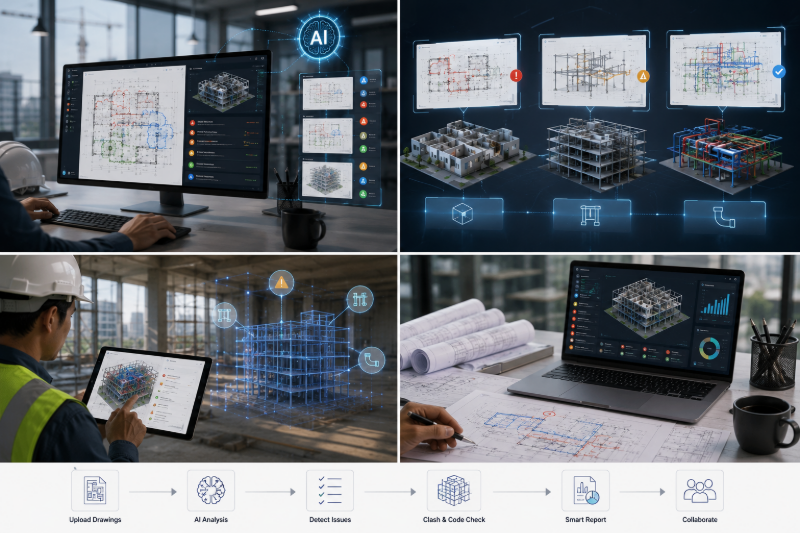
The AI Review Process: Step-by-Step
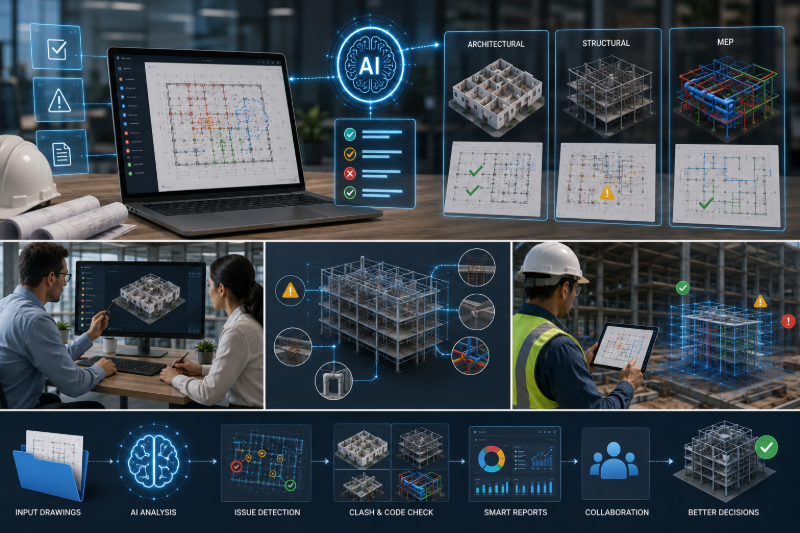
Drawing Preparation and Upload
The process begins with uploading drawings in standard formats (PDF, DWG, or image files). The AI system converts these into a digital format that it can analyze. For projects using Building Information Modeling (BIM), AI can extract relevant information directly from the model.
Rule Configuration
Before analysis begins, the system is configured with the specific rules and standards applicable to the project. This includes:
Applicable building codes (NBC, local municipal codes)
Client-specific standards and preferences
Industry best practices
Project-specific requirements
Automated Analysis
The AI system then analyzes the drawings against configured rules, typically completing the review in minutes to hours depending on project complexity. The system generates a detailed report identifying all issues found.
Issue Classification and Prioritization
Issues are typically classified by severity:
Critical: Code violations or safety issues that must be resolved before construction
Major: Significant issues that should be resolved but may have workarounds
Minor: Inconsistencies or best practice recommendations
Report Generation and Action
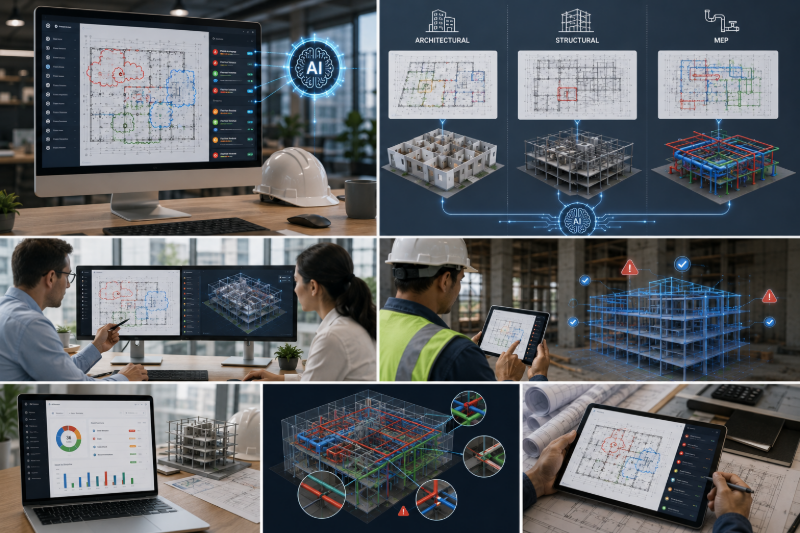
The system generates a comprehensive report with visual annotations showing exactly where issues are located on the drawings. Design teams can then prioritize corrections based on severity and feasibility.
Benefits of AI Drawing Review for Indian AECO Professionals
Time and Cost Savings
AI review can reduce drawing review time by 60-80%, translating to significant cost savings. For a typical commercial project in Bangalore costing ₹50 crores, where design review might take 4-6 weeks with a team of 5-6 professionals, AI can compress this to 1-2 weeks, freeing resources for other project phases.
Improved Quality and Consistency
Unlike human reviewers who may miss details after reviewing many drawings, AI maintains consistent review standards throughout. This results in fewer errors reaching construction phases, where corrections are exponentially more expensive.
Enhanced Compliance
With AI configured to check against specific Indian building codes and municipal regulations, projects are more likely to receive approvals on the first submission. This is particularly valuable in metros like Delhi and Mumbai, where municipal approval processes can be lengthy.
Better Coordination
AI's ability to detect clashes and coordination issues early prevents costly rework during construction. Studies show that coordination issues account for 20-30% of construction delays and cost overruns.
Knowledge Capture
As AI systems review drawings, they capture organizational knowledge about what constitutes good design and proper detailing. This knowledge becomes embedded in future reviews, continuously improving quality standards.
Limitations and Considerations
Human Judgment Still Required
While AI excels at identifying rule-based issues, it cannot replace human judgment on design quality, spatial experience, or creative problem-solving. The best approach combines AI efficiency with human expertise.
Configuration Complexity
AI systems must be properly configured with relevant rules and standards. Misconfiguration can lead to false positives (flagging non-issues) or false negatives (missing real issues). This requires expertise in both the AI tool and applicable building codes.
Training Data Limitations
AI systems perform best when trained on drawings similar to those being reviewed. Systems trained primarily on international projects may not be optimized for Indian design practices and standards.
Implementing AI Drawing Review in Your Practice
Selecting the Right Tool
When evaluating AI drawing review solutions, consider:
Compatibility with your current CAD/BIM software
Configuration for Indian building codes (NBC, IS standards, local regulations)
Ability to add custom rules specific to your practice
Quality of reporting and visualization
Integration with your project management workflow
Building Your Rule Library
Start with standard rules for applicable codes, then gradually add custom rules based on your firm's standards and client preferences. This library becomes more valuable over time as it captures your organization's expertise.
Training Your Team
Ensure your team understands how to configure the system, interpret results, and use findings to improve drawings. AI is a tool that amplifies human expertise—not a replacement for it.
Integrating with Your Workflow
Determine at what project stages AI review adds most value. Many firms use it at schematic design completion, design development completion, and before construction document submission.
The Future of AI in Drawing Review
As AI technology advances, we can expect:
More sophisticated spatial analysis and design quality assessment
Better integration with BIM platforms for real-time analysis during design
Improved handling of complex, non-standard designs
Automated suggestions for design improvements, not just issue identification
Better understanding of regional variations in Indian building practices
Conclusion
AI drawing review represents a significant advancement in how architectural, structural, and MEP drawings are analyzed and improved. For Indian AECO professionals, the technology offers substantial benefits in terms of time savings, improved quality, better compliance, and reduced project risk.
However, AI works best as a complement to human expertise, not a replacement. The most effective approach combines AI's efficiency and consistency with the judgment and creativity of experienced professionals.
If you're looking to implement AI drawing review in your practice or connect with professionals who are already using these advanced tools, AECORD provides a platform where you can discover and collaborate with leading AECO firms that are at the forefront of technology adoption. Whether you're seeking professionals to help implement AI review processes or looking to showcase your expertise in drawing review and quality assurance, AECORD connects you with the right partners across India's AECO ecosystem.
As the construction industry continues to embrace digital transformation, AI-powered drawing review will become increasingly standard. Early adoption positions your firm as a forward-thinking organization committed to quality, efficiency, and compliance—key differentiators in India's competitive construction market.
Ready to explore how AI can improve your drawing review process? Connect with experienced AECO professionals on AECORD today and discover solutions tailored to your project needs and local regulatory requirements.
Frequently Asked Questions
How does AI drawing review work for architectural and structural designs?
AI drawing review systems use machine learning and computer vision to automatically analyze PDF or image files of drawings against databases of building codes and standards. The technology converts drawings into machine-readable formats and can detect dimensional conflicts, code violations, and inconsistencies in seconds—tasks that would traditionally take experienced professionals several days to complete manually.
What types of errors can AI detect in architectural drawings?
AI can identify dimensional inconsistencies across floor plans and elevations, verify that door and window openings align with structural elements, check ceiling height uniformity, ensure circulation paths meet minimum width requirements, and flag discrepancies like walls moved in floor plans but not updated in elevations. This automated detection catches errors that human reviewers might miss or take considerable time to spot.
Can AI review tools check compliance with Indian building codes?
Yes, AI review systems can be configured to check against India's National Building Code (NBC) and specific municipal regulations that vary by city. They automatically verify requirements like minimum room areas, exit dimensions, accessibility standards, fire safety routes, and parking requirements—critical for obtaining approvals in cities like Delhi, Mumbai, Bangalore, and Hyderabad.
How much time can AI drawing review save on construction projects?
AI drawing review can complete in hours what traditionally requires weeks of manual inspection by experienced professionals. For Indian projects, this can potentially save weeks of back-and-forth with municipal authorities during the approval process and reduce costly errors that might otherwise be discovered during construction.
What advantages does AI drawing review offer over manual inspection?
AI provides greater accuracy and consistency than manual review, catches errors human reviewers might miss, significantly improves project timelines, reduces costly design errors, ensures compliance with local building codes, and can be programmed to check against specific regional regulations. This is especially valuable for complex projects across India's major metros with varying municipal requirements.