

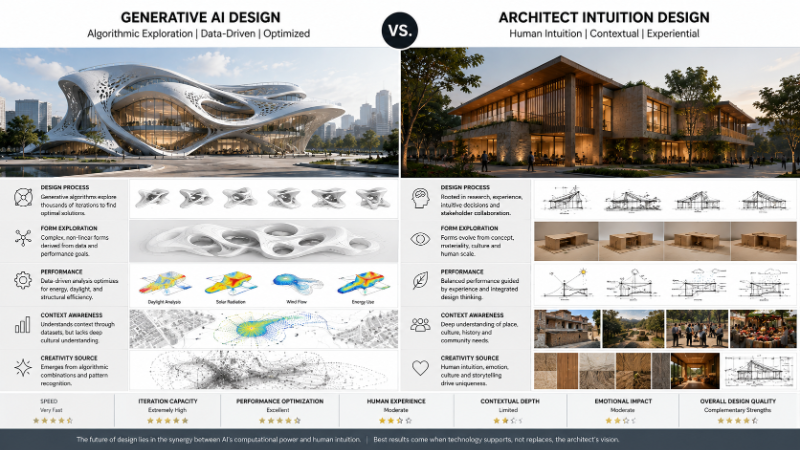
The architecture profession stands at a fascinating crossroads. For centuries, architects have relied on their intuition, experience, and creative vision to design buildings that shape our cities. Now, generative AI tools like ChatGPT, Midjourney, and specialized architectural software are promising to accelerate design processes, generate alternatives, and optimize solutions in ways previously impossible. But can algorithms truly replace the nuanced judgment of a seasoned architect? The answer is more nuanced than a simple yes or no.
Understanding Generative AI in Architectural Design
Generative AI refers to machine learning systems trained on vast datasets that can create new content—in this case, architectural designs, layouts, and visualizations. These tools analyze thousands of existing buildings, design patterns, and spatial configurations to generate novel solutions based on specified parameters like square footage, climate, budget, and program requirements.
In the Indian context, firms are increasingly experimenting with AI tools to tackle the unique challenges of designing for diverse climates, dense urban centers, and varying regulatory frameworks across states. Tools like Autodesk's generative design features, Spacemaker AI, and custom algorithms are being deployed in studios from Mumbai to Bangalore to explore design possibilities at unprecedented speed.
A typical workflow might involve an architect inputting constraints—a 50,000 sq ft commercial space in Pune with a ₹15 crore budget, requirements for 40% green space, and compliance with Pune Municipal Corporation's building bylaws. The AI then generates dozens of design variations, optimizing for factors like natural lighting, energy efficiency, and cost. What once took weeks of manual exploration can now happen in hours.

Build cost · Bengaluru, May 2026
The Strengths of Generative AI in Design
Speed and Volume of Exploration
The most obvious advantage of generative AI is sheer productivity. An architect might sketch 3-5 design concepts for a client presentation. An AI system can generate 50-100 variations in the same timeframe. This democratizes design exploration—even junior architects can rapidly test hypotheses that would have required extensive manual labor.
For time-sensitive projects common in Indian construction—where regulatory approvals can drag on for months—the ability to quickly pivot and regenerate designs based on feedback is invaluable. A residential project in Bangalore facing unexpected zoning restrictions can be rapidly redesigned rather than starting from scratch.
Optimization for Measurable Parameters
AI excels at optimization. If you can quantify it, AI can optimize for it. Energy consumption, daylighting levels, construction cost, material waste, structural efficiency—these can all be mathematically modeled and improved. Studies show that AI-generated designs often achieve 20-30% better energy performance than baseline human designs when optimizing for that specific metric.
For Indian architects designing in hot, humid climates across cities like Delhi, Chennai, and Hyderabad, AI's ability to rapidly optimize for thermal comfort, passive cooling strategies, and monsoon resilience is particularly valuable. The tool doesn't get tired of iterating on ventilation patterns or shading strategies.
Frequently asked
Consistency and Compliance
Generative AI can be trained on specific building codes and regulations. Once configured with the National Building Code of India (NBC), state-specific bylaws, and municipal requirements, AI systems consistently generate compliant designs. This reduces the back-and-forth with municipal authorities that plagues many Indian projects.
The Irreplaceable Value of Architect Intuition
Understanding Context and Culture
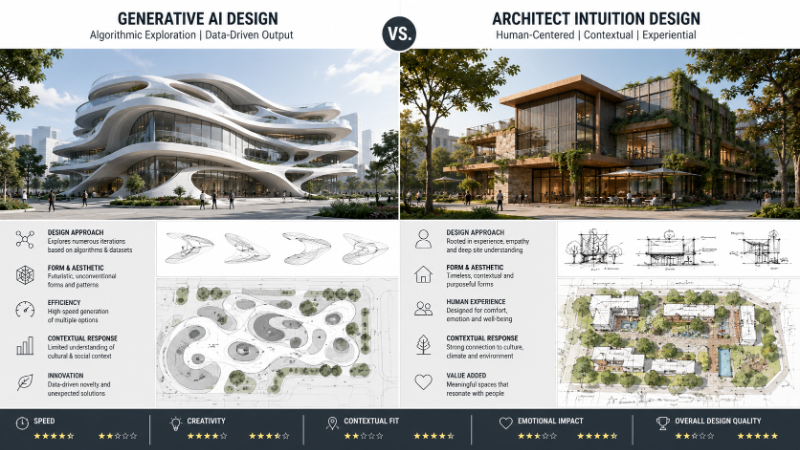
Architecture is fundamentally about creating spaces for human experience. A great architect understands not just the technical requirements of a project, but the cultural, social, and emotional context in which it exists. This understanding cannot be easily quantified or fed into an algorithm.
Consider designing a community center in a traditional neighborhood of Delhi versus a tech park in Bangalore's Electronic City. The spatial qualities, material choices, and design language that resonate with each community are deeply rooted in local culture, history, and aspirations. An AI trained on global architectural precedents might miss the subtle cues that make a design feel authentically rooted in place.
Architects develop intuition through years of walking through cities, observing how people use spaces, understanding why some public squares thrive while others remain empty. This embodied knowledge—what the best architects call "site sense"—is difficult to codify into training data.
Balancing Competing Values
Real-world design always involves trade-offs. A design might optimize for energy efficiency but compromise on visual interest. It might maximize usable floor area but create an oppressive sense of density. It might be structurally efficient but feel cold and unwelcoming.
Architects make judgment calls about which values to prioritize. These decisions are informed by project goals, client values, community needs, and personal design philosophy. A luxury residential tower in Mumbai's Bandra might prioritize premium views and exclusivity over neighborhood integration. A social housing project in Pune might prioritize affordability and community connection over architectural distinctiveness.
AI systems, lacking values and judgment, can only optimize for whatever metrics they're given. They cannot make the leap from technical parameters to meaningful design decisions.
Innovation and Artistic Vision
The most celebrated architects—from Charles Correa designing spaces that respond to India's climate and culture, to contemporary practices pushing boundaries—succeed because they bring vision and creativity that transcends optimization. They see possibilities that don't exist in the training data because they're imagining something genuinely new.
Generative AI, by definition, works within the bounds of its training data. It can remix and recombine existing patterns brilliantly, but it struggles with true novelty. The breakthrough design that becomes iconic and influences a generation of architects—that typically comes from human creativity working at the edge of what's possible.

Real-World Performance: The Evidence So Far
Where AI Designs Excel
Studies of AI-generated designs show strongest results in narrow, well-defined problems. A 2023 analysis of generative design in commercial real estate found that AI-optimized floor plates achieved 15-25% more usable area through improved circulation patterns. For parametric problems with clear success metrics, AI performs exceptionally well.
In India, where construction costs are tightly managed, AI's ability to optimize material usage and structural efficiency has proven valuable. Several Mumbai-based developers have used AI tools to reduce steel consumption in office buildings by 12-18% while maintaining structural integrity.
Where Human Architects Still Dominate
When design quality is assessed holistically—through user satisfaction, cultural resonance, long-term value, and impact on surrounding communities—human-designed projects consistently outperform AI-generated alternatives in independent evaluations.
A fascinating case study comes from a 2022 competition in Singapore where AI-generated designs and human architect designs were evaluated by diverse panels. While AI designs scored highly on technical metrics, human designs scored significantly higher on "sense of place," "community value," and "timeless quality." The gap was most pronounced in culturally sensitive projects.
The Hybrid Approach: AI as Architect's Tool, Not Replacement
The most promising applications of generative AI in architecture aren't about replacing architects—they're about augmenting human creativity and judgment. Leading architectural practices globally are adopting a hybrid workflow:
The Process
Brief Development: Architects work with clients to understand true needs, values, and aspirations—something AI cannot do
Constraint Definition: Architects translate these into quantifiable parameters and design principles for AI systems
Generative Exploration: AI rapidly generates design alternatives based on these parameters
Curation and Refinement: Architects evaluate generated options through the lens of context, culture, and vision, selecting and refining the most promising directions
Detailed Design: Architects develop the selected concept with full creative control, making the countless micro-decisions that define quality
This approach is gaining traction among Indian practices. Firms in Delhi, Bangalore, and Mumbai report that using AI for rapid iteration on parking layouts, structural grids, and facade patterns frees architects to focus on higher-level design decisions—the aspects that truly determine whether a building succeeds.
Practical Benefits for Indian Architects
For architects working in India's complex regulatory environment, AI tools offer specific advantages. Municipal approval processes often require multiple design iterations to satisfy changing requirements. AI can rapidly regenerate designs compliant with new constraints, compressing timelines that might otherwise stretch months.
For practices working on tight budgets—common across India's diverse market—AI's ability to optimize costs while maintaining performance is genuinely valuable. A ₹10 crore residential project can be designed more efficiently when AI helps identify the optimal structural system and material combinations.
The Future: Coevolution Rather Than Competition
Rather than viewing generative AI as either a savior or a threat, the architectural profession is increasingly recognizing it as a tool that will coevolve with human practice. Just as CAD didn't replace architects but transformed the profession, AI will reshape architecture without eliminating the need for human creativity and judgment.
The architects who thrive will be those who master both domains—who understand AI's capabilities and limitations, who can brief systems effectively, and who can evaluate and refine AI-generated outputs with discernment. The profession will likely bifurcate somewhat: routine design work (standard office buildings, residential blocks with conventional programs) may increasingly be handled by AI-assisted processes, while culturally significant, contextually complex, or artistically ambitious projects will continue to demand human-led design.
For clients and project teams, this means access to better design at lower cost for many project types. It also means that truly exceptional architecture—the kind that defines cities and enriches communities—will remain the domain of architects who combine technical mastery with cultural understanding and creative vision.
What This Means for Your Next Project
If you're planning an architectural project in India, the right approach depends on your specific needs. For projects where optimization and efficiency are paramount—commercial real estate, industrial facilities, standard residential—working with architects who effectively leverage AI tools can deliver better outcomes faster and more cost-effectively.
For projects where place-making, cultural resonance, and long-term significance matter most—civic buildings, cultural institutions, heritage-sensitive developments—you want architects whose intuition, experience, and creative vision are central to the process.
The best architectural practices are those that thoughtfully integrate both. On AECORD, India's leading B2B2C marketplace for AECO professionals, you can find architects and design firms across the country who are actively exploring how to best apply these tools. Whether you're seeking a practice that specializes in AI-optimized design or one that prioritizes creative vision, AECORD connects you with professionals matched to your project's specific needs.
The question isn't really "generative AI vs. architect intuition"—it's how architects and AI can work together to create better buildings. The winners will be those who understand both the power and the limits of algorithmic design, and who deploy them in service of genuinely excellent architecture.
Start your project on AECORD today and find the right architectural partner for your vision—whether that's a firm pushing the boundaries of AI-assisted design or one rooted in timeless principles of place-making and human-centred design.
Frequently Asked Questions
Can generative AI replace architects in the design process?
No, generative AI cannot fully replace architects. While AI excels at speed, optimization, and generating design variations, it lacks the contextual understanding, cultural sensitivity, and human judgment that architects bring to create meaningful spaces. AI works best as a tool that augments architect intuition rather than replaces it.
How much faster is generative AI compared to traditional architectural design?
Generative AI can produce 50-100 design variations in the time it takes architects to manually sketch 3-5 concepts. For projects with tight timelines or regulatory changes, this speed advantage allows architects to rapidly pivot and regenerate designs rather than starting from scratch.
What design parameters can generative AI optimize for?
Generative AI can optimize for any quantifiable parameter including energy consumption, daylighting levels, construction costs, material waste, structural efficiency, thermal comfort, and passive cooling strategies. Studies show AI-generated designs often achieve 20-30% better energy performance when optimizing for specific metrics.
Is generative AI effective for Indian building codes and regulations?
Yes, generative AI can be trained on the National Building Code of India, state-specific bylaws, and municipal requirements to consistently generate compliant designs. This reduces time-consuming back-and-forth with municipal authorities that commonly delays Indian construction projects.
What are the main limitations of using AI in architectural design?
AI struggles with understanding cultural context, human experience, and subjective design quality that experienced architects naturally grasp. AI also cannot replace the creative vision, client relationship management, and nuanced judgment needed for truly exceptional buildings that resonate with communities.
Frequently Asked Questions
Can generative AI replace architects in the design process?
No, generative AI cannot fully replace architects. While AI excels at speed, optimization, and generating design variations, it lacks the contextual understanding, cultural sensitivity, and human judgment that architects bring to create meaningful spaces. AI works best as a tool that augments architect intuition rather than replaces it.
How much faster is generative AI compared to traditional architectural design?
Generative AI can produce 50-100 design variations in the time it takes architects to manually sketch 3-5 concepts. For projects with tight timelines or regulatory changes, this speed advantage allows architects to rapidly pivot and regenerate designs rather than starting from scratch.
What design parameters can generative AI optimize for?
Generative AI can optimize for any quantifiable parameter including energy consumption, daylighting levels, construction costs, material waste, structural efficiency, thermal comfort, and passive cooling strategies. Studies show AI-generated designs often achieve 20-30% better energy performance when optimizing for specific metrics.
Is generative AI effective for Indian building codes and regulations?
Yes, generative AI can be trained on the National Building Code of India, state-specific bylaws, and municipal requirements to consistently generate compliant designs. This reduces time-consuming back-and-forth with municipal authorities that commonly delays Indian construction projects.
What are the main limitations of using AI in architectural design?
AI struggles with understanding cultural context, human experience, and subjective design quality that experienced architects naturally grasp. AI also cannot replace the creative vision, client relationship management, and nuanced judgment needed for truly exceptional buildings that resonate with communities.