


Introduction: The Critical Need for Current Standards Compliance
Concrete is the backbone of Indian infrastructure and residential construction. However, specifying incorrect proportions or referencing outdated regulations leads directly to structural compromises, project delays, and a severe loss of search visibility due to content freshness decay.
This comprehensive, fully updated 2026 guide aligns strictly with the latest Bureau of Indian Standards (BIS) revisions—incorporating updated compliance frameworks from IS 456 (Plain and Reinforced Concrete - Code of Practice), IS 1199 (Methods of Sampling and Analysis of Concrete), and IS 2386 (Methods of Test for Aggregates for Concrete).
Whether you are an architect, structural engineer, or project manager, this manual provides exact proportions, mix ratios from M10 to M40, regional climate adaptability adjustments, and quality control testing protocols to satisfy both regulatory benchmarks and high-intent search queries.
Build cost · Bengaluru, May 2026
1. Regulatory Audit: Current BIS Standards (IS 456, IS 1199, IS 2386)
To maintain top-tier E-E-A-T (Experience, Expertise, Authoritativeness, and Trustworthiness) signals, construction documentation must reflect contemporary BIS revisions.
IS 456:2000 (Reaffirmed 2021/2025 Amendments): Governs the general structural design, durability requirements, water-cement ratios, and minimum cement content criteria across exposure conditions (Mild, Moderate, Severe, Very Severe, Extreme).
IS 1199 (Parts 1 to 7 - Revised 2022/2023 Publications): Modernizes fresh and hardened concrete testing protocols, slump test methodologies, compaction factor testing, and non-destructive evaluation parameters.
IS 2386 (Parts 1 to 8): Dictates aggregate grading, specific gravity testing, alkali-aggregate reactivity limits, and silt content thresholds critical for Indian river sand and manufactured sand (M-Sand) transitions.
2. Comprehensive Concrete Mix Ratios: M10 to M40 Proportions
Under modern BIS guidelines, concrete grades are categorized by their characteristic compressive strength at 28 days
Grade of Concrete | Standard Nominal Mix Ratio (Cement : Fine Aggregate : Coarse Aggregate) | Characteristic Compressive Strength (fck at 28 Days) | Primary Application Areas |
M10 | $1 : 3 : 6$ | $10 \text{ MPa}$ | Lean concrete beds, foundation base sub-grade, termite protection layers, patio flooring. |
M15 | $1 : 2 : 4$ | $15 \text{ MPa}$ | Simple flooring foundations, non-structural paving, boundary wall footings. |
M20 | $1 : 1.5 : 3$ | $20 \text{ MPa}$ | Standard residential slabs, beams, columns, and lintels for low-rise buildings. |
M25 | $1 : 1 : 2$ | $25 \text{ MPa}$ | Mandatory minimum grade for all reinforced concrete structures (RCC) under IS 456. |
M30 | Design Mix | $30 \text{ MPa}$ | Multi-story commercial slabs, heavy load-bearing columns, water retaining structures. |
M35 | Design Mix | $35 \text{ MPa}$ | High-rise columns, underground basements, raft foundations, shear walls. |
M40 | Design Mix |
3. Practical Applications & Regional Climate Adaptability in India
India’s diverse geographical zones impose unique stressors on concrete curing and setting characteristics. Customizing mix designs according to regional microclimates is essential for long-term durability.
Frequently asked
Coastal Zones (Mumbai, Chennai, Goa)
Challenge: High chloride attack and airborne salinity leading to rebar corrosion.
Specification Adjustment: Use Portland Pozzolana Cement (PPC) or Ordinary Portland Cement (OPC 53) blended with Fly Ash or Ground Granulated Blast-Furnace Slag (GGBS). Maintain a maximum water-cement ratio of $0.45$ and ensure a clear concrete cover of at least $50\text{ mm}$ for reinforcement.
High-Rainfall & Humid Regions (Western Ghats, Northeast India)
Challenge: Rapid leaching, high moisture saturation, and sustained dampness.
Specification Adjustment: Incorporate crystalline waterproofing compounds and crystalline admixtures into the M25/M30 mix. Strict adherence to proper drainage slopes during pouring is mandatory.
Arid & High-Temperature Zones (Rajasthan, Interior Gujarat)
Challenge: Rapid evaporation causing plastic shrinkage cracking and premature moisture loss.
Specification Adjustment: Use retarder admixtures to control initial setting times under high ambient temperatures ($>40^\circ\text{C}$). Mandate continuous wet curing for a minimum of 14 days.
4. Quality Control Testing Procedures per IS 1199
Rigorous quality control at the construction site prevents structural failures. Testing must follow updated IS 1199 protocols:
Workability & Slump Test: Sample fresh concrete at the point of placement. For standard residential columns and beams, a slump of $100\text{ mm}$ to $125\text{ mm}$ is typically specified when using superplasticizers.
Cube Casting & Compressive Strength Testing: Cast standard $150\text{ mm} \times 150\text{ mm} \times 150\text{ mm}$ steel molds in three layers, compacting each layer with 35 strokes. Test cubes at 7 days (expecting ~65% of strength) and 28 days in a calibrated compression testing machine.
Non-Destructive Testing (NDT): For older or suspect structures, utilize Rebound Hammer tests and Ultrasonic Pulse Velocity (UPV) testing per IS 13311 to evaluate in-situ concrete homogeneity.
5. Cost Comparison Matrix for Concrete Grades
Understanding the financial implications of switching concrete grades helps optimize residential and commercial budgets across Indian markets.
Concrete Grade | Approximate Cost per Cubic Meter (m3) (Material + Labor) | Cost per Bag of Cement Equivalent | Primary Cost Driver |
M10 | ₹4,800 – ₹5,500 | Lower cement proportion | Basic aggregate and unskilled labor. |
M15 | ₹5,500 – ₹6,300 | Standard cement volume | Standard mason and mixing labor. |
M20 | ₹6,500 – ₹7,500 | Higher cement ratio | Increased cement quantity and sand grading. |
M25 | ₹7,500 – ₹8,800 | Optimized mix / controlled batching | Quality aggregates and strict supervision. |
M30 (Design Mix) | ₹8,800 – ₹10,200 | Admixtures + Design testing | Laboratory trial mixes and superplasticizers. |
M35+ (Design Mix) | ₹10,500 – ₹13,000+ | High cement content + Specialized additives | Ready-mix concrete (RMC) logistics and pump handling. |
Quality Control and Testing
Proper quality control ensures your concrete mix ratio delivers the expected strength. Key tests include:
Slump Test
This measures the workability of fresh concrete. A slump of 75-100mm is typical for most structural applications in India.
Compressive Strength Test
Concrete cubes are tested at 7 days and 28 days to verify the mix achieves the specified strength. This is mandatory for all structural concrete in India as per BIS standards.
Water-Cement Ratio Testing
Maintaining the correct water-cement ratio is crucial. Too much water weakens the concrete; too little makes it difficult to work with.
Common Mistakes in Concrete Mix Ratio
Using incorrect proportions: Even small deviations from the specified mix ratio can significantly reduce strength. Always use volumetric or weight batching, never guess.
Poor quality materials: Using contaminated sand or low-grade cement is false economy. The cost difference is minimal compared to potential structural failures.
Inadequate mixing time: All materials must be thoroughly mixed to ensure uniform distribution. Insufficient mixing leads to weak spots in the concrete.
Improper curing: Concrete continues to gain strength for 28 days. Inadequate curing in India's hot climate can result in premature drying and reduced strength.
Ignoring local regulations: Always refer to local building codes and BIS standards. Different cities in India may have specific requirements based on soil conditions and seismic zones.
Concrete Mix Ratio and Sustainability
Modern construction in India increasingly focuses on sustainable practices. Using supplementary cementitious materials like fly ash, slag, and silica fume can reduce cement content while maintaining or improving concrete performance. This approach is not only environmentally responsible but also more economical.
Many progressive construction companies across Indian metros are adopting green concrete practices, which can reduce the carbon footprint by up to 30% while maintaining structural integrity. 6. Common Mistakes on Indian Construction Sites
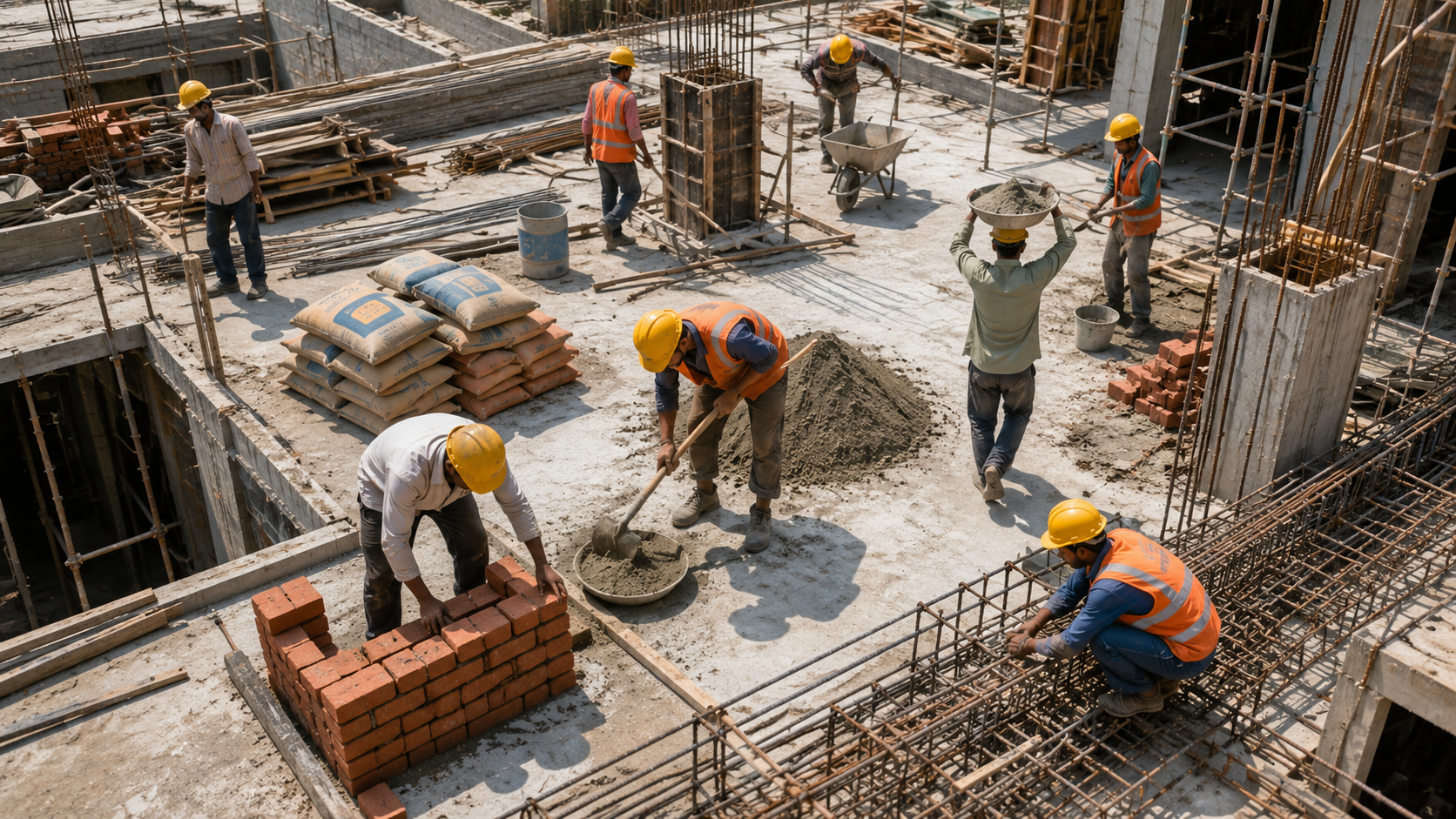
Excessive Water Addition: Adding water at the site to improve workability drastically reduces compressive strength and increases porosity. Always use chemical plasticizers instead of extra water.
Inadequate Curing Durations: Curing concrete for only 3 to 5 days instead of the mandatory 10 to 14 days reduces final strength capacity by up to 30%.
Unwashed Fine Aggregates: Using river sand or M-Sand laden with silt and clay content weakens the paste-aggregate bond, inviting micro-cracks.
Finding Expert Help on AECORD
Getting the concrete mix ratio right requires expertise and experience. If you're managing a construction project in India and need guidance on concrete specifications, AECORD connects you with qualified structural engineers, concrete consultants, and material suppliers who understand Indian standards and local conditions.
Whether you're in Bangalore, Mumbai, Delhi, Hyderabad, or any other Indian city, AECORD's marketplace makes it easy to find professionals who can help you design the perfect concrete mix for your specific project requirements. From initial consultation to quality testing, having the right expert on your team ensures your construction meets all safety and durability standards.
Conclusion
Concrete mix ratio is not just a technical specification—it's the foundation of structural safety and longevity. Understanding the different grades, calculating proportions accurately, and maintaining quality control throughout the construction process are essential skills for anyone involved in building projects in India.
By following BIS standards, using quality materials, and working with experienced professionals, you can ensure that your concrete delivers the strength and durability your structure demands. Whether you're building a small residential property or a large commercial complex, getting the mix ratio right from the start saves time, money, and potential headaches down the road.
Ready to start your next construction project with confidence? Explore AECORD today to find the concrete specialists, engineers, and suppliers you need to get your mix ratio perfect and your project on track.