



Understanding 8mm Designer Cement Bonded Particle Board: A Comprehensive Guide for Indian AECO Professionals
The construction and interior design landscape in India is rapidly evolving, with architects, engineers, and contractors increasingly turning to innovative building materials that offer durability, aesthetics, and cost-effectiveness. One such material gaining significant traction is 8mm thickness cement bonded particle board (CBPB), particularly the designer variants with textured finishes. The standard dimensions of 1220mm x 2440mm (4ft x 8ft) make these boards exceptionally versatile for various applications across residential, commercial, and industrial projects.
This comprehensive guide explores everything you need to know about 8mm designer cement bonded particle board with murk texture grey finish, helping AECO professionals make informed decisions for their projects.
Build cost · Bengaluru, May 2026
What is Cement Bonded Particle Board?
Composition and Manufacturing Process
Cement bonded particle board is an engineered composite material created by combining wood particles (typically from sawmill waste) with Portland cement and water. The manufacturing process involves:
Particle preparation: Wood particles are cleaned, dried, and sorted by size
Mixing: Particles are mixed with Portland cement, silica fume, and water to create a slurry
Forming: The mixture is formed into sheets using hot pressing techniques
Curing: Boards are cured in controlled environments to achieve optimal strength and durability
Finishing: Designer finishes, including murk texture and grey coloration, are applied during the final stages
The 8mm thickness represents a sweet spot for many applications—thin enough to be lightweight and easy to handle, yet thick enough to provide structural integrity and sound insulation properties.
Why Choose Cement Bonded Particle Board?
Unlike traditional plywood or MDF, cement bonded particle board offers several distinct advantages:
Fire resistance: Non-combustible material with excellent fire rating (typically A1 or A2)
Moisture resistance: Superior water resistance compared to wood-based alternatives
Durability: Long service life with minimal warping or degradation
Environmental sustainability: Often manufactured from recycled wood particles
Cost-effectiveness: Competitive pricing, especially when considering longevity
Versatility: Suitable for both interior and exterior applications
Frequently asked
Standard Dimensions: 1220mm x 2440mm Explained
The 1220mm x 2440mm dimension is the industry standard for particle boards in India and globally. These measurements translate to approximately 4 feet x 8 feet, making them compatible with standard construction practices and minimizing waste during installation.
Practical Advantages of Standard Sizing
For architects and contractors working on projects across Indian cities like Mumbai, Bangalore, Delhi, and Pune, standard sizing offers significant benefits:
Easy transportation: Fits standard truck dimensions, reducing logistics costs
Minimal cutting waste: Dimensions align with typical wall heights and panel requirements
Faster installation: Standard sizes reduce on-site cutting and adjustments
Compatibility: Works seamlessly with standard framing systems and fastening solutions
The 8mm Thickness: Ideal Applications and Performance
Structural Capabilities
An 8mm thickness cement bonded particle board strikes an excellent balance between strength and practicality. The thickness is sufficient for:
Interior wall cladding and partitions
Ceiling panels in residential and commercial spaces
Furniture backing and cabinet construction
Temporary hoarding and site enclosures
Acoustic paneling in offices and studios
Exterior facade panels (with appropriate finishing)
The 8mm thickness provides adequate rigidity while remaining light enough for easy handling—typically weighing around 40-50 kg per sheet depending on density and moisture content.
Load-Bearing Capacity
While 8mm CBPB isn't designed as a primary structural element, it performs excellently as a secondary structural component. When properly supported by framing systems (typically spaced at 400-600mm intervals), these boards can support:
Distributed loads of 100-150 kg/m² for ceiling applications
Vertical loads when used in wall applications with adequate backing
Point loads when reinforced with additional framing
Always consult with structural engineers for specific load requirements, particularly for projects in earthquake-prone regions of India.
Murk Texture Grey Finish: Aesthetic and Functional Benefits
Understanding the Murk Texture
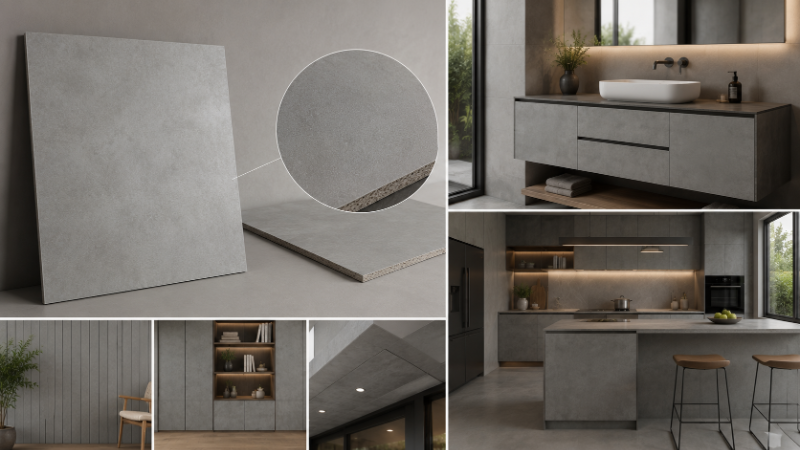
The murk texture finish is a sophisticated surface treatment that creates a subtle, mottled appearance. Unlike smooth finishes, murk texture provides:
Visual depth: Creates interesting light and shadow patterns
Concealment: Effectively hides minor imperfections, dust, and marks
Professional appearance: Offers a contemporary, designer aesthetic suitable for modern interiors
Improved grip: Provides better traction and handling during installation
Reduced glare: Minimizes reflections in well-lit spaces
Grey Coloration: Design Versatility
The grey finish (reference code 361728) is a neutral, sophisticated choice that complements various interior design schemes. Grey CBPB boards work particularly well in:
Contemporary offices: Aligns with modern corporate design trends
Industrial-style spaces: Complements exposed brick, metal, and concrete elements
Minimalist interiors: Provides understated elegance without overwhelming spaces
Mixed-material designs: Acts as a neutral backdrop for colorful furnishings and artwork
Healthcare and hospitality: Creates calming, professional environments
Applications in Indian Construction Projects
Residential Projects
In Indian residential construction, 8mm designer CBPB finds numerous applications:
Partition walls: Non-load-bearing partitions in apartments and villas, particularly in metros like Mumbai, Bangalore, and Hyderabad
False ceilings: Aesthetic ceiling solutions that can incorporate lighting and ventilation
Wardrobe backing: Durable backing for built-in wardrobes and storage solutions
Accent walls: Feature walls in living rooms and bedrooms
Commercial and Office Spaces
The professional appearance and functional benefits make these boards ideal for commercial applications:
Office partitions: Flexible space division in open-plan offices
Reception areas: Branded wall cladding in corporate offices
Acoustic treatment: Sound absorption in conference rooms and meeting spaces
Retail displays: Durable backing for shelving and product displays
Industrial and Institutional Applications
The durability and fire-resistance of CBPB make it suitable for demanding environments:
Factories and warehouses: Wall and ceiling panels in industrial facilities
Educational institutions: Classrooms and administrative areas
Healthcare facilities: Non-patient-facing walls and administrative spaces
Food processing units: Moisture-resistant surfaces in humid environments
Installation and Handling Considerations
Preparation and Storage
Proper handling ensures optimal performance and longevity:
Storage conditions: Store boards in dry conditions with humidity between 40-70%
Stacking: Stack boards flat on level surfaces with adequate support
Protection: Cover boards to protect from dust and direct sunlight during storage
Acclimatization: Allow boards to acclimatize to site conditions for 24-48 hours before installation
Installation Best Practices
Professional installation ensures structural integrity and aesthetic appeal:
Fastening: Use appropriate fasteners (screws or nails) at 150-200mm spacing
Framing: Install on properly spaced wooden or metal framing (typically 400-600mm centers)
Joints: Stagger joints between sheets and use appropriate joint treatments
Finishing: Apply suitable primers and paints to enhance durability and aesthetics
Sealing: For exterior applications, ensure proper sealing of edges and joints
Cutting and Customization
While standard 1220mm x 2440mm sheets minimize waste, customization is often necessary:
Use carbide-tipped saw blades for clean cuts
Support sheets adequately during cutting to prevent breakage
Wear appropriate PPE (dust masks, eye protection) when cutting
Pre-drill holes to prevent splitting near edges
Cost Considerations for Indian Projects
Pricing Structure
The cost of 8mm designer cement bonded particle board in India varies based on several factors:
Base material cost: Typically ranges from ₹2,500 to ₹4,500 per sheet (1220mm x 2440mm)
Designer finish premium: Murk texture and grey coloration add 15-25% to base cost
Volume discounts: Bulk purchases can reduce per-unit costs by 10-20%
Regional variations: Prices vary across Indian cities—Delhi and Mumbai typically have higher costs than tier-2 cities
Installation costs: Labor charges range from ₹50-100 per sheet, depending on complexity and location
Cost-Benefit Analysis
While initial costs may be higher than some alternatives, the long-term value proposition is compelling:
Durability: 20+ year lifespan reduces replacement costs
Maintenance: Minimal maintenance requirements compared to wood-based alternatives
Performance: Superior fire and moisture resistance reduces risk of costly repairs
Aesthetics: Murk texture finish reduces need for additional surface treatments
Regulatory Compliance and Standards
Indian Standards
Cement bonded particle boards used in Indian construction must comply with relevant standards:
IS 4094: Specifies requirements for wood-based panels
IS 11305: Covers asbestos cement sheets (relevant for fire-rating assessments)
National Building Code (NBC): Governs fire safety and material specifications for various building types
Local municipal regulations: Vary by city and project type
Fire Safety Ratings
Cement bonded particle boards typically achieve:
A1 or A2 fire rating: Non-combustible classification
Smoke development: Minimal smoke production in fire scenarios
Flammability: Meets requirements for use in commercial and institutional buildings
Always verify fire ratings with manufacturers and ensure compliance with local building codes for your specific project type and location.
Environmental and Sustainability Considerations
Modern cement bonded particle boards align with sustainable construction practices:
Recycled content: Often manufactured from sawmill waste and recycled wood particles
Lower embodied carbon: Compared to virgin wood products and some alternatives
Durability: Long lifespan reduces replacement frequency and overall environmental impact
Non-toxic: Free from formaldehyde and other harmful chemicals
Recyclability: Can be recycled or repurposed at end of life
Comparison with Alternative Materials
Cement Bonded Particle Board vs. Plywood
CBPB advantages: Superior moisture resistance, fire-resistant, longer lifespan, lower cost
Plywood advantages: Higher structural strength, better for load-bearing applications
Cement Bonded Particle Board vs. MDF
CBPB advantages: Moisture resistant, fire-rated, more durable in humid climates
MDF advantages: Smoother finish, easier to machine, better for detailed work
Cement Bonded Particle Board vs. Gypsum Boards
CBPB advantages: More durable, moisture-resistant, fire-resistant, suitable for exterior use
Gypsum advantages: Lighter weight, easier to finish, better acoustic properties
Maintenance and Longevity
Long-Term Care
Proper maintenance extends the life of cement bonded particle board installations:
Regular cleaning: Wipe with damp cloth to remove dust and maintain appearance
Protective coatings: Repaint or reseal every 3-5 years depending on environmental exposure
Moisture management: Ensure adequate ventilation to prevent moisture accumulation
Impact protection: Use edge guards or protective trim in high-traffic areas
Inspection: Periodically check for signs of damage or deterioration
Expected Lifespan
Under normal conditions, 8mm designer cement bonded particle board can maintain its structural integrity and aesthetic appeal for 20-30+ years, making it an excellent long-term investment for AECO projects.
Finding Quality Suppliers and Installers on AECORD
For architects, engineers, and contractors working on projects throughout India, sourcing quality materials and skilled professionals is crucial. AECORD is India's premier B2B2C marketplace connecting AECO professionals with verified suppliers, manufacturers, and installation specialists.
On AECORD, you can:
Connect with certified manufacturers of cement bonded particle boards
Compare specifications, finishes, and pricing from multiple suppliers
Find experienced installation contractors in your city
Access detailed product information and technical specifications
Read verified reviews from other AECO professionals
Request competitive quotes for bulk orders
Ensure compliance with Indian standards and regulations
Whether you're specifying materials for a residential project in Mumbai, a commercial complex in Bangalore, or an industrial facility in Pune, AECORD streamlines the procurement process and connects you with reliable partners who understand the unique requirements of Indian construction projects.
Conclusion
8mm designer cement bonded particle board with murk texture grey finish represents an excellent choice for modern AECO projects across India. The combination of durability, fire resistance, moisture resistance, and contemporary aesthetics makes it suitable for diverse applications in residential, commercial, and industrial sectors.
The standard 1220mm x 2440mm dimensions ensure compatibility with existing construction practices and minimize waste, while the 8mm thickness provides an optimal balance between strength and workability. The murk texture and grey coloration offer sophisticated aesthetics that complement contemporary design trends while concealing minor imperfections.
When properly installed and maintained, these boards deliver exceptional value over their 20-30+ year lifespan, making them a cost-effective alternative to many traditional materials. By understanding their properties, applications, and installation requirements, AECO professionals can confidently specify cement bonded particle boards for projects that demand durability, performance, and aesthetic appeal.
For your next project, explore the wide range of suppliers and installation specialists available on AECORD, India's trusted marketplace for AECO professionals. Find verified manufacturers, compare specifications and pricing, and connect with experienced contractors who can deliver exceptional results within your project timeline and budget.
Frequently Asked Questions
What is 8mm cement bonded particle board used for in construction?
8mm cement bonded particle board is an engineered composite made from wood particles bonded with Portland cement, used for both interior and exterior applications in residential, commercial, and industrial projects. Its 8mm thickness provides lightweight handling while maintaining structural integrity and sound insulation properties.
Is cement bonded particle board fire resistant?
Yes, cement bonded particle board is non-combustible and offers excellent fire resistance with typical ratings of A1 or A2, making it a safer choice compared to traditional plywood or MDF for construction applications.
What are the standard dimensions for cement bonded particle board?
The industry standard dimension for cement bonded particle board in India is 1220mm x 2440mm (approximately 4ft x 8ft), which minimizes waste, reduces logistics costs, and ensures compatibility with standard construction practices.
How does cement bonded particle board compare to plywood and MDF?
Cement bonded particle board offers superior moisture resistance, fire rating, durability with minimal warping, and longer service life compared to plywood or MDF, though at competitive pricing when considering its longevity.
Why is 8mm thickness ideal for cement bonded particle board applications?
The 8mm thickness is optimal because it's thin enough to be lightweight and easy to handle on job sites, yet thick enough to provide adequate structural integrity, sound insulation, and performance for most interior and exterior applications.