

Building Information Modeling (BIM) has transformed how architecture, engineering, and construction projects are delivered worldwide. In India, where the construction industry is experiencing rapid growth and increasing complexity, BIM adoption has become not just an advantage but a necessity. Whether you're designing a residential complex in Bangalore, a commercial tower in Mumbai, or a hospital in Delhi, BIM technology can streamline your workflow, reduce costs, and deliver better outcomes for your clients.
If you're an architect in India still relying on traditional 2D CAD drawings, it's time to understand why BIM is reshaping the industry and how you can leverage it to stay competitive.
Understanding BIM: Beyond 3D Models
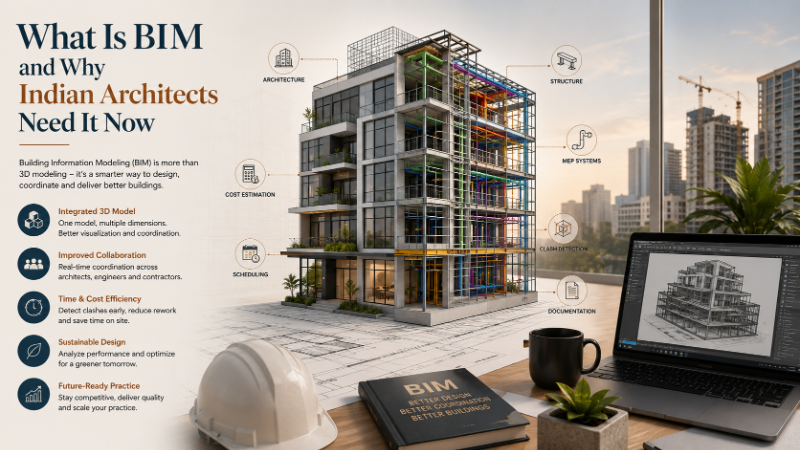
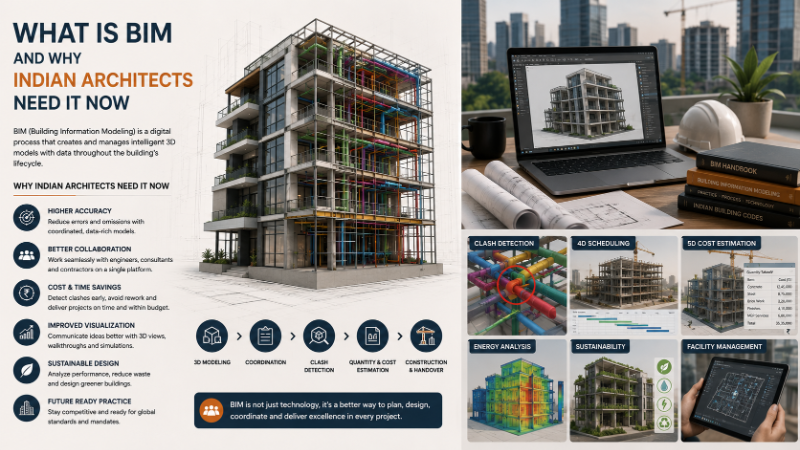
BIM stands for Building Information Modeling, but it's much more than just creating 3D digital representations of buildings. BIM is a collaborative process that integrates data from architects, engineers, contractors, and other stakeholders into a single, intelligent model.
Unlike traditional CAD drawings that are primarily visual representations, a BIM model contains rich information about every element in the building—from dimensions and materials to cost, performance characteristics, and lifecycle data. When you modify a wall in a BIM model, all related elements automatically update: floor plans, elevations, sections, quantities, and schedules.
Build cost · Bengaluru, May 2026
Key Characteristics of BIM
Parametric Modeling: Changes to one element automatically update related components, saving hours of manual revision work
Data-Rich Objects: Every building element contains metadata beyond geometry, including specifications, costs, and performance data
Collaboration: Multiple professionals can work on the same model simultaneously, reducing coordination errors
Visualization: Stakeholders can understand the design intent through realistic 3D representations and virtual walkthroughs
Analysis Capabilities: BIM enables structural analysis, energy simulation, lighting studies, and cost estimation integrated with the design
In the Indian context, where projects often involve tight budgets, complex regulations, and multiple stakeholders across different cities, these capabilities address real pain points that architects face daily.
Why Indian Architects Need BIM Now
Growing Demand from Clients and Developers
India's real estate market is increasingly sophisticated. Large developers in metros like Mumbai, Bangalore, Hyderabad, and Delhi are now requiring BIM deliverables as part of project contracts. International firms operating in India have already adopted BIM, and local architects who don't offer BIM services are losing competitive bids.
Government projects, including smart cities and infrastructure developments, increasingly mandate BIM compliance. The Ministry of Housing and Urban Affairs has been promoting BIM adoption for government-funded projects, making it essential for architects bidding on public sector work.
Frequently asked
Regulatory Compliance and Documentation
India's building regulations are complex and vary by state and municipality. Mumbai has different rules than Pune, and Bangalore's regulations differ from Hyderabad's. BIM helps architects ensure compliance by automating checks against local building codes. You can validate floor-to-floor heights, setbacks, parking requirements, and fire safety provisions against specific city regulations within the model itself.
When authorities request drawings or documentation, BIM enables rapid generation of compliant, consistent documents. This is particularly valuable for projects in metros where building permissions require multiple iterations.
Cost Management and Waste Reduction
Construction costs in India have risen significantly. A typical commercial project in Mumbai or Bangalore involves material costs ranging from ₹1,500 to ₹3,000 per square foot, with labor adding another ₹800 to ₹1,500 per square foot. BIM helps control these costs through:
Accurate quantity takeoffs that reduce material waste and overordering
Clash detection that identifies conflicts before construction, preventing costly on-site rework
Construction sequencing optimization that reduces project duration
Energy modeling that helps design efficient buildings, reducing operational costs for clients
For a 50,000 sq ft commercial project, avoiding just 5% material waste through accurate BIM-based quantity takeoffs can save ₹37 to ₹75 lakhs—a significant margin in competitive bidding.
Coordination Among Multidisciplinary Teams
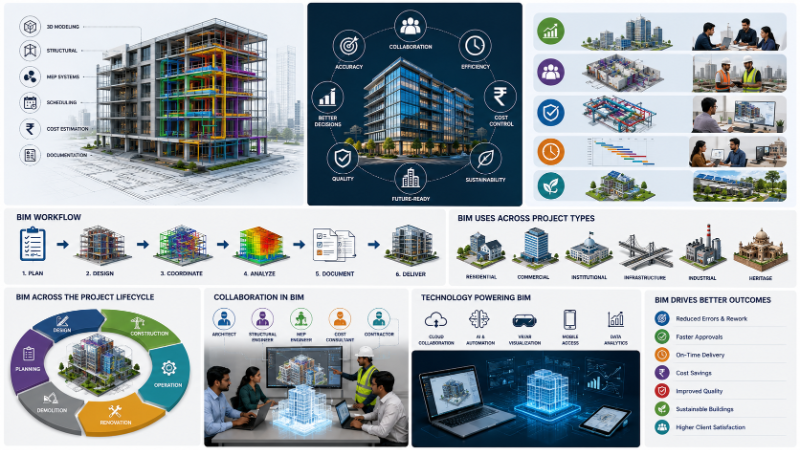
Large Indian construction projects involve architects, structural engineers, MEP (mechanical, electrical, plumbing) consultants, and contractors spread across different offices, sometimes in different cities. Traditional coordination through separate 2D drawings leads to conflicts: a duct clashing with a beam, a pipe running through a column, or electrical conduits conflicting with structural elements.
BIM enables true 3D coordination. All disciplines work within the same model (or linked models), making conflicts visible immediately. This coordination capability is invaluable for complex projects like hospitals, data centers, or high-rise residential buildings common in Indian metros.
BIM Applications Across Project Types
Residential Projects
For apartment complexes—the most common project type in Indian cities—BIM helps architects:
Optimize unit layouts for maximum usable area within regulatory constraints
Coordinate MEP services efficiently through limited building depths
Generate consistent documentation for sales and regulatory approvals
Visualize common areas and amenities for marketing purposes
A 500-unit residential complex in Pune or Bangalore can leverage BIM to streamline approvals from municipal corporations, which increasingly require detailed documentation.
Commercial and Office Buildings
BIM's analytical capabilities are particularly valuable for commercial projects, enabling:
Energy modeling to meet green building certifications (LEED, IGBC)
Lighting studies to optimize natural light and reduce artificial lighting loads
Flexible space planning that accommodates changing tenant requirements
Cost estimation at design stages, helping clients make informed decisions
For IT parks in Bangalore or financial district projects in Mumbai, these capabilities directly impact long-term operational costs and tenant satisfaction.
Healthcare and Complex Facilities
Hospitals and specialized facilities require precise coordination of multiple systems. BIM excels in these scenarios by:
Ensuring infection control through proper ventilation routing
Coordinating complex MEP systems without compromises
Planning equipment placement and future expansion
Simulating patient and staff workflows
Infrastructure and Renovation Projects
For renovation projects—increasingly common as Indian cities modernize older buildings—BIM helps document existing conditions and plan interventions precisely, minimizing disruption to occupants.
BIM Software Options for Indian Architects
Several BIM platforms are widely used in India, each with different strengths:
Autodesk Revit
The industry standard, Revit dominates the Indian market. It offers comprehensive architectural, structural, and MEP capabilities. Subscription costs in India start around ₹50,000 to ₹70,000 annually, with educational licenses available at reduced rates. Most large firms and many mid-sized practices use Revit.
ArchiCAD
Graphisoft's ArchiCAD is popular among architects for its intuitive interface and strong architectural focus. It's increasingly used in India, particularly by firms emphasizing design quality. Pricing is comparable to Revit.
SketchUp with Extensions
For smaller firms or those starting their BIM journey, SketchUp with BIM extensions offers an accessible entry point. The free version provides basic 3D modeling, while professional versions with BIM capabilities cost significantly less than Revit or ArchiCAD.
Several Indian and international platforms offer BIM capabilities at lower price points, making BIM accessible to smaller practices. These include open-source options and cloud-based solutions that reduce upfront investment.
When selecting BIM software, consider your project types, team size, budget, and whether you need structural or MEP integration. Many successful Indian architects use multiple tools in combination—Revit for documentation, SketchUp for design exploration, and specialized tools for analysis.
Challenges to BIM Adoption in India
Learning Curve and Training
Transitioning from CAD to BIM requires investment in training. Architects accustomed to 2D workflows need to develop new thinking patterns. However, numerous online courses, workshops, and certification programs are available in India, with costs ranging from ₹5,000 to ₹50,000 for comprehensive training.
Initial Investment
Software licenses, hardware upgrades (BIM requires more processing power than CAD), and training represent upfront costs. However, for most practices, the return on investment materialises within 12-18 months through increased productivity and ability to bid on larger projects.
Collaboration Challenges
Many contractors and consultants in India still work with traditional methods. Implementing BIM in a project where other stakeholders aren't BIM-ready can be challenging. However, this is changing rapidly as more professionals adopt the technology.
Standardisation and Interoperability
Different software platforms use different file formats. The industry standard IFC (Industry Foundation Classes) format helps, but compatibility issues occasionally arise. Clear communication with collaborators about file formats and exchange protocols is essential.
Getting Started with BIM: Practical Steps
Step 1: Assess Your Current Practice
Evaluate your project types, team size, and client base. Are your clients demanding BIM? Are you losing bids to BIM-capable competitors? Start with projects where BIM will deliver clear value.
Step 2: Choose Appropriate Software
Don't necessarily choose the most expensive option. Select software that matches your needs and budget. Many successful Indian architects started with SketchUp and graduated to Revit as their practice grew.
Step 3: Invest in Training
Ensure your team receives proper training. Online courses from platforms like Udemy, LinkedIn Learning, or specialized BIM training providers in India offer cost-effective options. Alternatively, attend workshops conducted by software providers or industry organizations.
Step 4: Start Small
Begin with a small project—perhaps a renovation or a straightforward new building. Don't try to implement BIM on a complex, high-pressure project initially. Learn from this pilot project before scaling up.
Step 5: Establish BIM Standards
Develop internal standards for your practice: naming conventions, model organization, level of detail requirements, and documentation templates. This ensures consistency and facilitates collaboration.
Step 6: Collaborate and Share Knowledge
Join BIM communities and professional organizations. The Indian Institute of Architects (IIA) and various regional chapters increasingly focus on BIM. Networking with other practitioners helps you learn from their experiences and stay updated on industry trends.
The Future of BIM in India
BIM adoption in India is accelerating. Several trends are shaping the future:
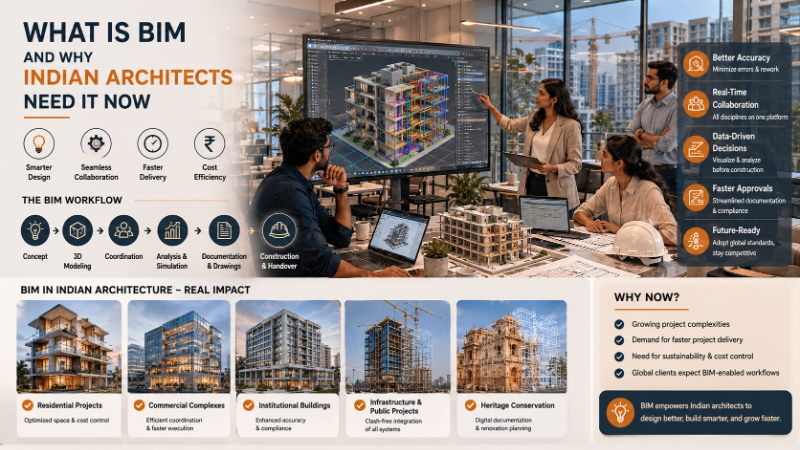
Mandatory BIM for Government Projects: More government agencies are requiring BIM for public sector projects, particularly in smart cities and infrastructure development
Integration with AI and Machine Learning: Advanced tools for design optimization, cost prediction, and risk analysis are emerging
Cloud-Based Collaboration: Cloud platforms enable seamless collaboration among distributed teams, particularly valuable for Indian practices with offices across multiple cities
Digital Twin Technology: Building digital twins for lifecycle management is becoming more common, especially for large institutional and commercial projects
Sustainability Focus: BIM's analytical capabilities increasingly support India's sustainability goals and green building certifications
Conclusion: BIM as a Competitive Necessity
For Indian architects, BIM is no longer a luxury or a future consideration—it's a competitive necessity. Whether you're a solo practitioner in a tier-2 city or part of a large firm in Mumbai or Bangalore, BIM capabilities directly impact your ability to win projects, manage complexity, and deliver value to clients.
The technology addresses real challenges in the Indian construction context: complex regulations, cost pressures, coordination across distributed teams, and increasingly sophisticated client expectations. The investment in BIM adoption—in software, training, and process change—pays dividends through improved efficiency, better project outcomes, and access to larger, more complex projects.
If you're ready to embrace BIM, start small, invest in proper training, and build your expertise incrementally. The Indian architecture profession is rapidly moving toward BIM adoption, and early adopters will have significant competitive advantages.
Looking to connect with BIM-experienced consultants, contractors, or training providers? AECORD connects architects with specialized professionals across India who can support your BIM implementation journey. Whether you need training partners, software consultants, or BIM coordinators for your projects, AECORD's marketplace makes it easy to find vetted professionals. Explore AECORD today to discover how other Indian architects are leveraging BIM to transform their practice and deliver better buildings for their clients.
Frequently Asked Questions
What is BIM and how is it different from traditional CAD?
BIM (Building Information Modeling) is more than just 3D visualization—it's a collaborative process that integrates rich data about every building element, including dimensions, materials, costs, and performance characteristics. Unlike traditional 2D CAD drawings that are primarily visual, BIM models automatically update all related elements when you make changes, saving hours of manual revision work.
Why do Indian architects need to adopt BIM now?
Large developers in Indian metros like Mumbai, Bangalore, and Delhi now require BIM deliverables in project contracts, and government projects increasingly mandate BIM compliance. Architects without BIM capabilities are losing competitive bids, making it essential to stay competitive in India's growing real estate market.
How does BIM help with regulatory compliance in India?
BIM automates compliance checks against local building codes that vary by state and municipality, validating floor-to-floor heights, setbacks, parking requirements, and fire safety provisions within the model itself. This is especially valuable for metro projects where building permissions require multiple iterations.
What are the key features of BIM that benefit construction projects?
BIM offers parametric modeling (automatic updates across related elements), data-rich objects with specifications and costs, real-time collaboration among multiple professionals, realistic 3D visualization, and integrated analysis capabilities for structural, energy, and cost estimation studies.
How can BIM reduce construction costs and waste in India?
BIM enables accurate quantity takeoffs and cost estimation integrated with design, helping architects and developers manage tight budgets effectively. It also reduces coordination errors through multi-stakeholder collaboration and provides better project planning to minimize material waste during construction.