

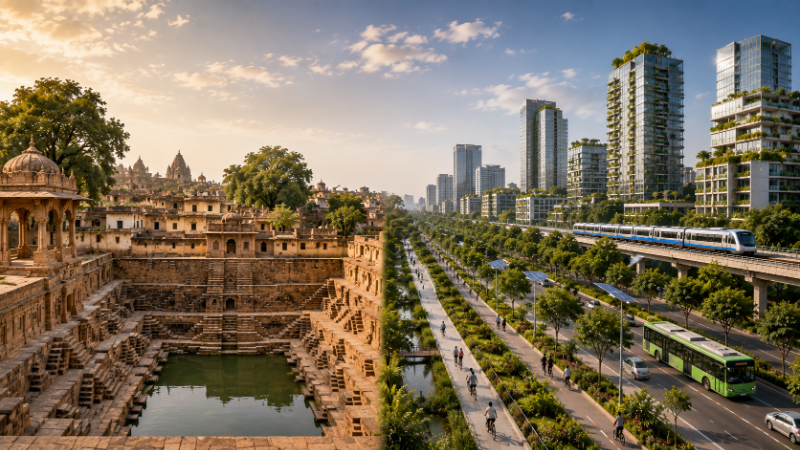
Modern cities are marvels of engineering and technology. Yet, as urban planners and architects increasingly grapple with congestion, pollution, and social fragmentation, many are looking backward to ancient cities for inspiration. The wisdom embedded in urban layouts from Rome to Jaipur reveals principles that contemporary design has overlooked—principles that could fundamentally reshape how we build cities today, especially in India where rapid urbanization demands smarter solutions.
The Human Scale: Walking Cities That Connected People
Ancient cities like Rome, Athens, and Jaipur were built around a fundamental principle: the human walking pace. Most essential services, markets, and gathering spaces were positioned within a 10-15 minute walk from residential areas. This wasn't just convenient—it created vibrant, interconnected communities where chance encounters fostered social cohesion and economic activity.
Today's urban sprawl has fragmented this human-centered approach. Modern Indian cities like Bangalore and Mumbai have expanded so rapidly that commutes of 1-2 hours are commonplace. The average Delhi resident spends 90 minutes daily commuting, according to recent urban mobility studies. This isn't merely an inconvenience; it erodes community bonds, increases stress, and reduces productivity.
What ancient cities understood: Mixed-use neighborhoods with residential, commercial, and recreational spaces in close proximity create natural foot traffic and vibrant street life. Jaipur's grid system, designed by Maharaja Sawai Jai Singh II in 1727, exemplifies this principle. The city's blocks were sized to ensure that residents had access to markets, temples, and administrative centers within walking distance.
Modern architects and urban planners are rediscovering this wisdom. Walkability scores are now becoming standard metrics in city planning. AECORD professionals increasingly advocate for transit-oriented development that places residential areas near metro stations and commercial hubs, reducing dependency on personal vehicles and recreating the human-scaled neighborhoods that ancient cities perfected.
Build cost · Bengaluru, May 2026
Public Spaces as the Heart of Community Life
Walk through the ancient Roman Forum or the squares of medieval European cities, and you'll notice something striking: they were designed as gathering places. These weren't leftover spaces—they were intentional, well-maintained, and architecturally prominent. They served as markets, meeting grounds, and stages for civic life.
In contrast, many modern Indian cities have relegated public spaces to afterthoughts. Parks are poorly maintained, streets lack adequate seating and shade, and plazas often feel unsafe or unwelcoming. A 2022 study by the Urban Land Institute found that Indians spend significantly less time in public spaces compared to residents of cities with well-designed public realms.
Ancient cities got this right: The Agora in Athens and the piazzas of Venice weren't just functional—they were beautiful, safe, and animated. They encouraged lingering, socializing, and spontaneous interaction. The design encouraged foot traffic through strategic placement of vendors, seating, and water features.
Progressive Indian cities are taking note. Chandigarh's Rock Garden and Sector 17 Plaza demonstrate how thoughtful public space design can transform urban life. Similarly, Pune's revitalized riverfront areas show how reclaiming public spaces can improve quality of life and property values. Architects consulting on AECORD platforms are increasingly focusing on creating "third places"—spaces between home and work where community life flourishes.
Design Elements That Made Ancient Public Spaces Work
Shade and Shelter: Colonnades, arcades, and tree-lined pathways provided protection from sun and rain, making spaces usable year-round
Water Features: Fountains and water bodies served practical needs while creating focal points and cooling urban areas
Defined Edges: Buildings bordering public spaces created a sense of enclosure and safety
Mixed Activities: Markets, performances, religious ceremonies, and casual socializing happened simultaneously
Maintenance and Care: Public spaces were kept clean and well-maintained, signaling civic pride
Adaptive Architecture: Building for Climate and Context
Ancient Indian cities like Varanasi and Jaisalmer weren't built in isolation from their environment. Architects worked with climate, not against it. Thick stone walls, narrow lanes, courtyards, and strategic window placement naturally regulated temperature. In Jaisalmer, buildings feature intricate carved screens (jali work) that allow air circulation while blocking direct sunlight—passive cooling technology that predates air conditioning by centuries.
Modern construction in India often ignores these principles. Glass-fronted office buildings in Delhi and Bangalore require massive air-conditioning systems, consuming enormous amounts of electricity. The average commercial building in India uses 2-3 times more energy per square meter than equivalent buildings in Europe, largely due to poor climate-responsive design.
What ancient architects understood: Building materials, orientation, ventilation, and layout should respond to local climate conditions. This wasn't just about comfort—it was about sustainability and cost-efficiency.
Contemporary green building standards like LEED and IGBC are essentially rediscovering these ancient principles. Buildings designed with natural ventilation, strategic shading, and thermal mass significantly reduce operational costs. A study by the Central Public Works Department found that traditional cooling methods in Indian vernacular architecture could reduce cooling loads by 30-40%.
Architects on AECORD are increasingly incorporating these time-tested strategies: courtyards for natural ventilation, locally-sourced materials, building orientation that minimizes heat gain, and traditional water management systems. This fusion of ancient wisdom with modern technology is proving more sustainable and cost-effective than purely contemporary approaches.
Frequently asked
Hierarchical Urban Structure: Order Without Monotony
Ancient cities possessed clear hierarchies. Major thoroughfares connected important civic centers. Secondary streets linked neighborhoods. Narrow lanes provided intimate residential spaces. This created order and wayfinding without the monotonous uniformity of modern grid-based planning.
Rome's radial street pattern emanating from key landmarks, or Jaipur's grid system with major and minor streets, created logical navigation while maintaining distinct character in different zones. People could orient themselves and understand the city's structure intuitively.
Modern cities often fail at this balance. Many Indian cities expanded haphazardly without clear hierarchies, resulting in congestion on main roads while secondary streets remain underutilized. Alternatively, rigid grid systems create monotony and fail to create distinct neighborhoods with unique character.
The lesson: Successful cities need clear hierarchies that organize movement while allowing neighborhoods to develop distinct identities. This principle is evident in successful Indian developments like Lavasa (modeled on Mediterranean hill towns) and parts of Gurgaon's planned sectors.
Mixed-Use Integration: Work, Living, and Leisure in Proximity
In ancient cities, craftspeople lived above their shops. Markets were adjacent to residential areas. Administrative centers were accessible to common citizens. This integration meant that economic activity, social life, and governance happened in close proximity, creating vibrant, self-sufficient neighborhoods.
Modern zoning laws have rigidly separated these functions. Residential areas are divorced from commercial zones, which are separated from industrial areas. This segregation requires extensive transportation infrastructure and creates "dead zones" that lack vitality during certain hours.
The costs are substantial. The average Indian city spends 15-20% of its budget on transportation infrastructure to compensate for this separation. Additionally, the environmental impact is significant—more commuting means more emissions.
Ancient cities understood: Mixed-use development creates economic efficiency, reduces transportation needs, and generates street life. A street with ground-floor retail, offices, and restaurants above, with residential space higher up, remains animated throughout the day and evening.
Progressive Indian cities are reforming zoning laws. Mumbai's recent mixed-use development policies, and Bangalore's attempts to create activity hubs within residential neighborhoods, reflect this shift. Professionals consulting through AECORD increasingly advocate for mixed-use development that complies with modern regulations while recapturing the vitality of ancient urban patterns.
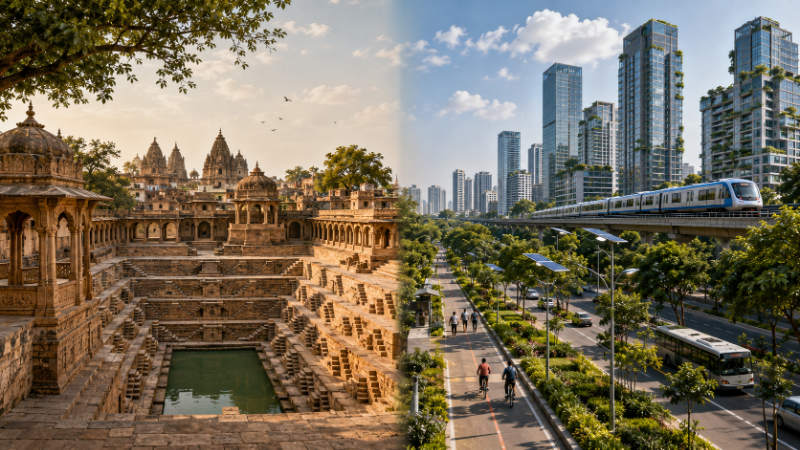
Organic Growth with Underlying Structure
Ancient cities weren't entirely planned or entirely organic. They had underlying structures—street grids, building regulations, sacred geometry—but allowed incremental development and adaptation. This created richness and diversity while maintaining order.
Medieval European cities and traditional Indian towns grew organically within frameworks that ensured basic standards. Buildings varied in size and style, yet the underlying street pattern and building setbacks created coherence.
Modern cities often fail at this balance. Either they're rigidly planned (resulting in sterility and inefficiency as conditions change), or they're entirely unplanned (resulting in chaos and poor infrastructure). The solution lies in what urban theorists call "structured flexibility"—establishing clear frameworks while allowing adaptation and innovation.
This principle is gaining traction among Indian urban planners. New Integrated Township guidelines increasingly emphasize design frameworks that guide development while allowing flexibility. AECORD professionals are helping developers implement this approach, creating communities that feel organic and human-scaled while meeting modern standards.
Practical Applications for Modern Indian Cities
Redesigning Transportation Networks
Rather than building wider roads (which induce more traffic), successful cities are implementing bus rapid transit, metro systems, and cycle networks that create walkable networks. Ahmedabad's BRT system and Delhi's metro expansion demonstrate how transit-oriented development can reduce congestion while improving air quality.
Revitalizing Street Life
Converting car-centric streets into pedestrian-friendly spaces with vendors, seating, and landscaping transforms neighborhoods. Several Indian cities are implementing "Complete Streets" policies that accommodate pedestrians, cyclists, and public transit alongside vehicles.
Implementing Adaptive Reuse
Rather than demolishing historic structures, adaptive reuse preserves character while creating functional spaces. Bangalore's Cubbon Park precinct and Delhi's heritage precincts show how integrating old and new creates vibrant districts.
Establishing Clear Design Guidelines
Rather than rigid zoning, design guidelines that specify street widths, building heights relative to street width, ground-floor activation, and setback requirements create coherence while allowing flexibility. This approach is increasingly used in new developments across Indian cities.
The Economic Case for Ancient Principles
Implementing these principles isn't merely aesthetic—it's economically sound. Mixed-use neighborhoods generate more tax revenue per acre. Walkable areas command higher property values. Public spaces reduce crime and increase retail spending. Climate-responsive design reduces operational costs.
A study by the Urban Land Institute found that walkable Indian neighborhoods appreciate 20-30% faster than car-dependent areas. Mixed-use developments in Bangalore and Pune show occupancy rates 15-20% higher than single-use developments.
For developers and investors, these principles translate to better returns. For residents, they mean lower transportation costs, better health outcomes from increased walking, and stronger community bonds.
Challenges in Implementation
Reviving ancient urban principles faces obstacles. Existing zoning laws often prohibit mixed-use development. Land acquisition for public spaces is expensive. Climate control expectations have changed. Car ownership continues rising. Retrofitting existing cities is more complex than building new.
Yet these challenges are surmountable. Progressive Indian cities are reforming zoning laws. Public-private partnerships are funding public space improvements. Green building standards are incentivizing climate-responsive design. Technology enables new solutions while honoring ancient principles.
Professionals specializing in contextual, human-centered urban design—available on AECORD—are increasingly in demand as cities recognize that the most sustainable, economical, and livable solutions often draw from ancient wisdom adapted to contemporary needs.
Conclusion: Learning from the Past to Build Better Futures
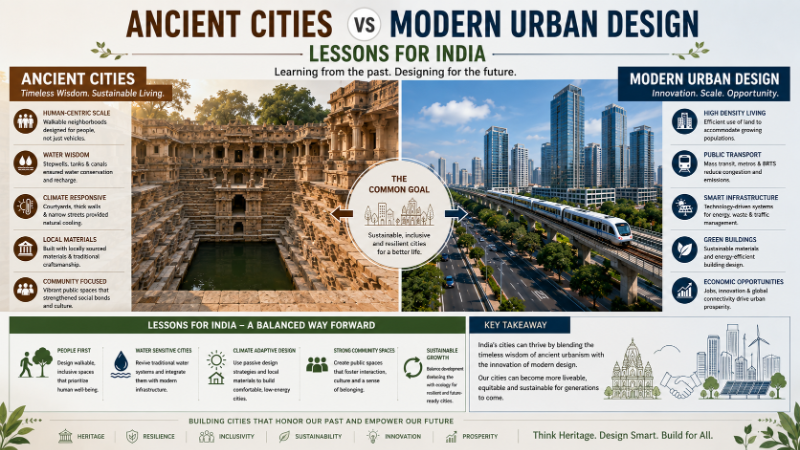
Ancient cities succeeded because they were built around human needs, local climate, and community interaction. They created order without monotony, mixed uses without chaos, and public spaces that fostered social cohesion. Modern urban design has often abandoned these principles in pursuit of efficiency and growth, resulting in sprawling, congested, and fragmented cities.
The good news: these principles remain valid. As Indian cities face challenges of congestion, pollution, and social fragmentation, the solutions often lie in rediscovering what ancient cities understood—that successful urban places are fundamentally about human connection, climatic responsiveness, and mixed vitality.
The most exciting developments in Indian cities today integrate these ancient principles with modern technology and regulations. Whether you're planning a new development, revitalizing an existing neighborhood, or designing a public space, these timeless principles offer guidance.
If you're involved in architecture, engineering, or construction in India, connecting with experienced professionals who understand both traditional principles and modern requirements is essential. On AECORD, you'll find architects, urban planners, and engineers who specialize in creating human-scaled, climate-responsive, mixed-use developments that honor the wisdom of ancient cities while meeting contemporary needs. Whether you need consultation on design principles, regulatory compliance, or implementation strategy, AECORD's marketplace connects you with the right professionals to bring these principles to life in your projects.
The cities we build today will be the ancient cities of tomorrow. Let's ensure they embody the principles that made historic cities enduringly livable, economical, and beloved.
Frequently Asked Questions
What can modern Indian cities learn from ancient city design?
Ancient cities like Rome and Jaipur were built around the human walking pace, with essential services within 10-15 minutes on foot, creating vibrant communities. Modern Indian cities can reduce sprawl and commute times by adopting mixed-use neighborhoods and transit-oriented development that recreates these human-scaled principles.
Why is walkability important in urban planning?
Walkable neighborhoods with residential, commercial, and recreational spaces in close proximity create natural foot traffic, vibrant street life, and stronger community bonds. The average Delhi resident spends 90 minutes daily commuting, which erodes social cohesion and productivity—problems walkability scores help solve.
How did ancient cities use public spaces differently than modern cities?
Ancient cities intentionally designed public spaces like the Roman Forum as gathering places for markets, meetings, and civic life, while many modern Indian cities treat public spaces as afterthoughts. Well-designed public spaces encourage lingering, socializing, and spontaneous interaction that strengthen communities.
What is a 'third place' in urban design?
A 'third place' is a space between home and work where community life flourishes, such as parks, cafes, or plazas. Modern architects are increasingly focusing on creating these spaces to improve quality of life and foster social interaction, a principle ancient cities naturally incorporated.
How can architects design public spaces that encourage people to spend more time outdoors?
Effective public spaces include shade structures like colonnades and tree-lined pathways, adequate seating, water features, and strategic vendor placement that creates foot traffic and activity. These design elements, proven in ancient cities and modern examples like Chandigarh's Rock Garden, make spaces safe, beautiful, and inviting.