

Introduction: Why UltraTech OPC 53 Grade Remains an Industry Benchmark
As India's infrastructure and urban real estate sectors continue robust expansion, material selection for high-load-bearing structural applications requires uncompromised precision. UltraTech OPC 53 Grade Ordinary Portland Cement (OPC) is engineered to meet the stringent demands of high-strength concrete structures.Conforming strictly to IS 12269:2013 standards, this high-performance binder is the primary choice for engineers, structural consultants, and developers undertaking heavy RCC works, multi-story high-rises, and pre-cast infrastructure.
This comprehensive technical guide details the physical and chemical properties of UltraTech OPC 53 Grade, current 2026 regional market pricing, correct application parameters, and crucial curing best practices to eliminate structural risks.
Build cost · Bengaluru, May 2026
1. Technical Specifications & Compliance (IS 12269)
UltraTech OPC 53 Grade surpasses baseline Bureau of Indian Standards (BIS) parameters, offering rapid early strength development and a fine particle size distribution that optimizes cement-aggregate bonding.
Compressive Strength Requirements (per IS 12269)
3 Days: Minimum $27 \text{ N/mm}^2$ (MPa)
7 Days: Minimum $37 \text{ N/mm}^2$ (MPa)
28 Days: Minimum $53 \text{ N/mm}^2$ (MPa)
Physical & Chemical Properties Matrix
Parameter | Standard Requirement (IS 12269) | Typical UltraTech OPC 53 Value |
Fineness (Blaine's Air Permeability) | $\ge 225 \text{ m}^2/\text{kg}$ | $290 - 330 \text{ m}^2/\text{kg}$ |
Initial Setting Time | $\ge 30 \text{ minutes}$ | $90 - 120 \text{ minutes}$ |
Final Setting Time | $\le 600 \text{ minutes}$ (10 Hours) | $240 - 300 \text{ minutes}$ |
Soundness (Le Chatelier Expansion) | $\le 10 \text{ mm}$ | $1 - 3 \text{ mm}$ |
Insoluble Residue | $\le 2.0\%$ | $0.8\% - 1.4\%$ |
Magnesia Content ($\text{MgO}$) | $\le 6.0\%$ | $1.5\% - 2.5\%$ |
3. Recommended Applications vs. Where to Avoid OPC 53
While 53 Grade cement provides exceptional compressive strength, its rapid hydration and high early heat release require careful deployment.
Frequently asked
Recommended Applications (Where to Use)
High-Strength RCC Structural Members: Columns, beams, suspended slabs, and shear walls designed for M25, M30, and higher concrete grades.
Pre-cast Concrete Elements: Rapid formwork turnaround for pre-cast girders, poles, and heavy paving blocks.
Heavy Infrastructure: Foundations for industrial plants, bridges, flyovers, and runway slabs.
Where NOT to Use OPC 53
General Plastering & Masonry Brickwork: Due to its rapid strength gain and high heat of hydration, using OPC 53 for wall plastering or brick joint mortar increases the risk of thermal shrinkage cracking. Portland Pozzolana Cement (PPC) or OPC 43 is structurally superior for plastering.
Mass Concrete Pours: Massive retaining walls or heavy raft foundations without temperature control measures risk micro-cracking due to internal thermal gradients.
Parameter | UltraTech OPC 43 Grade | UltraTech OPC 53 Grade |
Target Application | Residential low-rise, general plastering, masonry mortars, and normal concrete up to M25. | High-rises, commercial structures, bridges, pre-stressed concrete, and M30 to M60+ grades. |
28-Day Compressive Strength | Minimum $43 \text{ MPa}$ | Minimum $53 \text{ MPa}$ |
Heat of Hydration | Moderate (reduces thermal cracking risk in mass concrete). | High (requires rigorous wet curing to prevent micro-cracking). |
Early Strength Gain | Slower (moderate strength at 3 and 7 days). | Rapid (achieves significant structural strength within 72 hours). |
Cement Consumption | Slightly higher cement factor required for high-strength designs. | Optimized cement factor; allows leaner mixes for equivalent target strengths. |
4. Price per Bag, Packaging, and Availability (2026 Market Data)
Construction material pricing varies across Indian states due to freight logistics, local taxation, and regional distribution networks.
Current 2026 Price Benchmarks (Per 50kg Bag)
Northern Region (Delhi NCR / Punjab): INR 375 – INR 415 per bag
Western Region (Mumbai / Pune / Ahmedabad): INR 390 – INR 430 per bag
Southern Region (Bangalore / Chennai / Hyderabad): INR 360 – INR 400 per bag
Eastern Region (Kolkata / Bhubaneswar): INR 370 – INR 410 per bag
Packaging Specifications
Standard Unit: 50 kg laminated HDPE / PP multi-wall paper bags.
Bulk Supply: Available via pneumatic tanker transport for RMC (Ready-Mix Concrete) batching plants and large-scale infrastructure projects.
UltraTech OPC 53 Grade Price Guide (India 2026)
Cement prices across India have experienced upward pressure due to shifts in fuel (coal/petcoke) costs and robust demand from national infrastructure projects. Below are the average retail market rates across major Indian urban centers for a standard 50 kg HDPE / Paper Sack bag.
City / Region | Average Price per 50 kg Bag (INR) | Price per Kg |
Delhi NCR | ₹340 – ₹365 | ₹6.80 – ₹7.30 |
Mumbai | ₹355 – ₹380 | ₹7.10 – ₹7.60 |
Bengaluru | ₹345 – ₹370 | ₹6.90 – ₹7.40 |
Chennai | ₹350 – ₹375 | ₹7.00 – ₹7.50 |
Hyderabad | ₹335 – ₹360 | ₹6.70 – ₹7.20 |
Kolkata | ₹340 – ₹365 | ₹6.80 – ₹7.30 |
Pune | ₹345 – ₹370 | ₹6.90 – ₹7.40 |
Best Practices for Storage, Handling & Curing
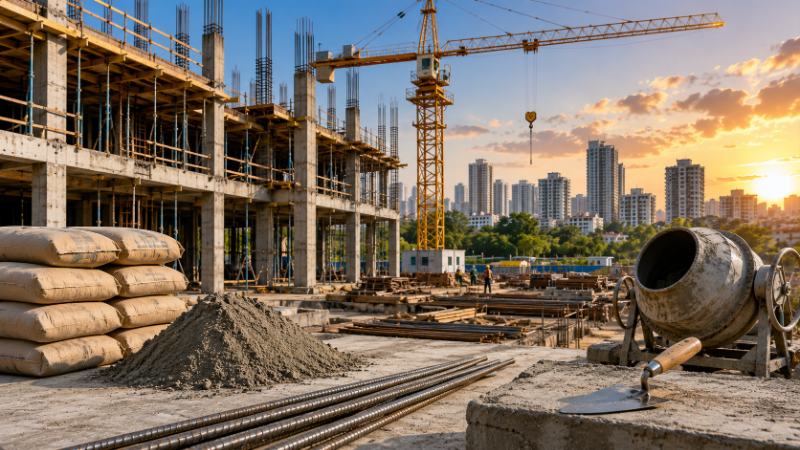
Moisture Prevention: Store cement bags on elevated wooden or plastic pallets at least 30 cm above ground level, maintaining a minimum 1-foot clearance from external walls to prevent dampness absorption.
Strict Curing Protocols: Because OPC 53 hydrates rapidly, initiate water curing within 8 to 12 hours of concrete placement.Maintain continuous moisture curing for a minimum of 10 to 14 days to prevent surface micro-cracking and ensure optimal strength development.
Admixture Compatibility: When designing high-strength mixes (M35+), consult structural drawings to integrate polycarboxylate ether-based superplasticizers per IS 10262 guidelines to manage water-cement ratios effectively.
. Customer Testimonials & Field Case Studies
Case Study 1: Commercial Complex Framing in Pune
Project: G+5 Commercial Plaza in Hinjewadi, Pune
Application: UltraTech OPC 53 used exclusively for M35 grade column and floor slab casting.
Outcome: The contractor achieved a 35% reduction in shuttering turnaround time, stripping column formwork in 24 hours and floor props in 7 days, accelerating overall project delivery by 3 weeks.
Case Study 2: High-Rise Residential Tower in Bangalore
Project: 18-Floor Apartment Complex in North Bangalore
Application: Utilized bulk-supplied UltraTech OPC 53 for deep pile foundations and transfer girders.
Outcome: Laboratory cylinder tests confirmed consistent 3-day strengths exceeding $30 \text{ MPa}$, easily surpassing structural consultant specifications.
8. Where to Buy UltraTech OPC 53 Near Me
Procuring authentic cement is critical to avoid adulterated or moisture-damaged stock.
Authorized Dealerships: Purchase directly through verified building material stockists listed on the official UltraTech network.
Digital Marketplaces: Institutional buyers and large-scale contractors can source bulk commercial quantities via B2B portals and digital platforms like AECORD.
9. Related Resources & Internal Links
Expand your technical knowledge base with these comprehensive guides on AECORD:
Review alternative cement grades in our Cement Grades Explained: OPC vs PPC vs PSCguide.
Analyze overall project expenses using the Duplex House Construction Cost India 2025-2026guide.
Learn about structural testing protocols via the Structural Audit Cost in India: Complete Guide 2026. Frequently Asked Questions (FAQ)
What is the difference between UltraTech OPC 53 and OPC 43 Grade?
OPC 53 achieves a minimum compressive strength of 53 MPa at 28 days, whereas OPC 43 achieves 43 MPa.OPC 53 is designed for high-rise columns, heavy load-bearing structures, and pre-cast work, while OPC 43 is typically utilized for standard residential framing, masonry, and moderate-load structures.
Does UltraTech OPC 53 Grade cement help save material costs?
Yes. Because of its superior strength profile, structural engineers can optimize concrete mix designs (e.g., achieving target strengths with slightly lower cement factor ratios or substituting part of the mix with mineral admixtures like fly ash), yielding an overall cement savings of 8% to 10% in large structural designs.
How can I verify if my UltraTech cement bags are genuine?
Check the bag for tamper-evident machine stitching, clear batch numbers, BIS certification marks (ISI), and the manufacturing date. Authorized dealers provide computer-generated tax invoices with batch verification codes traceable via UltraTech customer portals.