

Understanding RCC Cement Selection in India
The choice between cement brands is one of the most critical decisions in reinforced concrete construction. In India, where cement quality directly impacts structural integrity and longevity, selecting between UltraTech Cement and ACC Cement requires a thorough understanding of their technical specifications, performance characteristics, and suitability for different RCC applications. Both brands are among India's largest cement manufacturers, commanding significant market share across residential, commercial, and infrastructure projects.
When constructing RCC structures—whether it's a residential building in Bangalore, a commercial complex in Mumbai, or an industrial facility in Delhi—the cement you choose fundamentally affects the durability, strength, and long-term performance of your structure. This comprehensive comparison will help you make an informed decision based on technical data, market performance, and project-specific requirements.
Build cost · Bengaluru, May 2026
Compressive Strength Comparison
UltraTech Cement Strength Performance
UltraTech Cement, India's largest cement manufacturer by production capacity, offers several variants designed for RCC work. Their primary products for concrete construction include:
UltraTech Ordinary Portland Cement (OPC) 53 Grade: Provides compressive strength of 53 MPa at 28 days, making it suitable for most structural applications. The 7-day strength typically reaches 35-40 MPa, allowing for faster formwork removal.
UltraTech Portland Pozzolana Cement (PPC): Offers 43 MPa strength at 28 days with enhanced durability due to pozzolanic materials. This variant is particularly popular in coastal regions and areas with aggressive environmental conditions.
UltraTech Slag-based cement variants: Designed for specialized applications requiring lower heat of hydration and improved long-term strength development.
UltraTech's manufacturing facilities across India—including plants in Rajasthan, Madhya Pradesh, and Karnataka—maintain strict quality control protocols ensuring consistent strength development. Their OPC 53 typically achieves 90-95% of design strength within 28 days, with strength continuing to develop beyond this period.
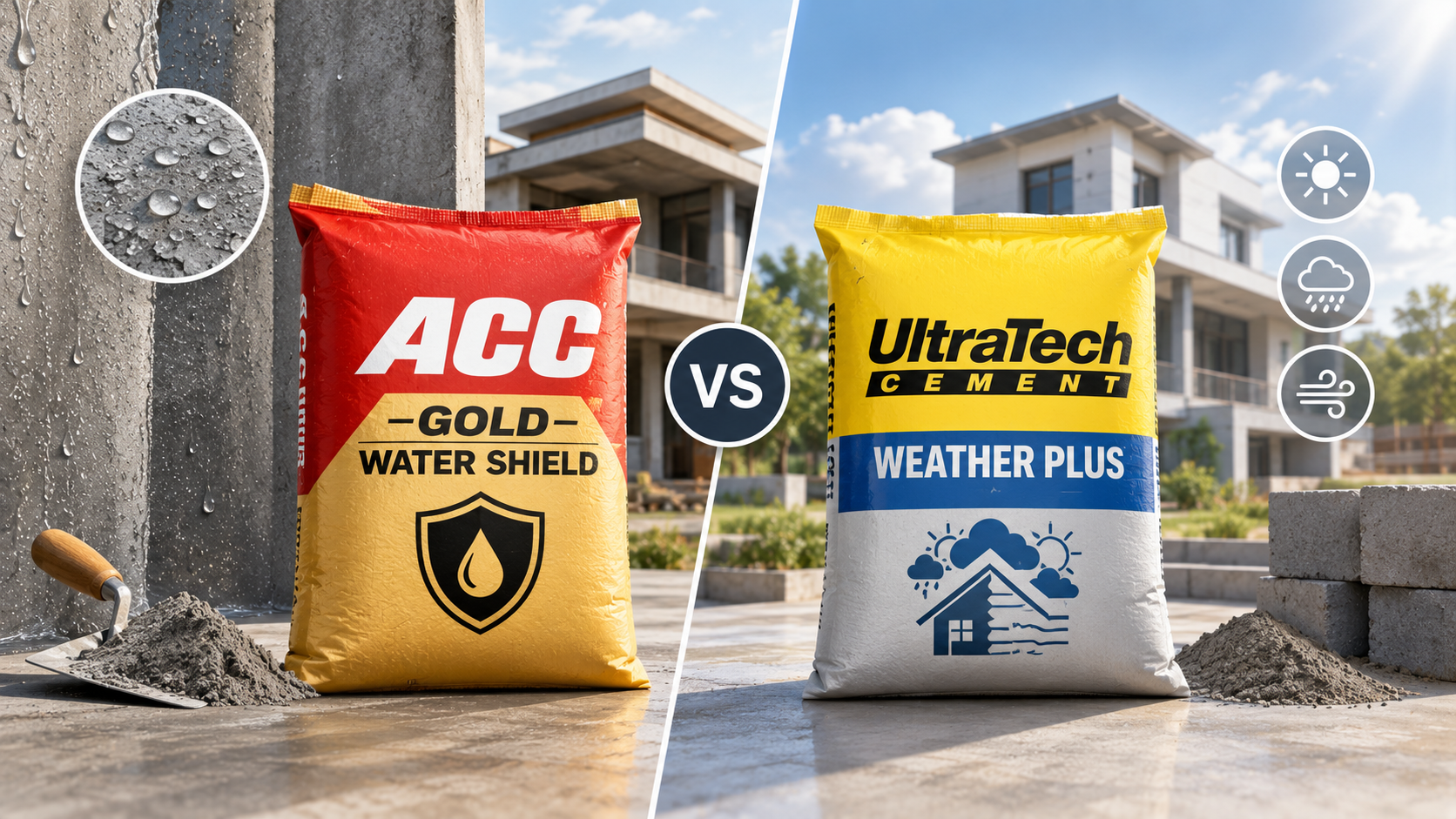
ACC Cement Strength Performance
ACC Cement, with a legacy spanning over 60 years, provides equally robust cement options for RCC construction:
ACC Ordinary Portland Cement (OPC) 53 Grade: Delivers 53 MPa compressive strength at 28 days, comparable to UltraTech. ACC's OPC 53 is known for consistent early strength development, reaching approximately 32-38 MPa at 7 days.
ACC Portland Pozzolana Cement (PPC): Provides 43 MPa strength with excellent durability characteristics, particularly suitable for mass concrete applications and structures exposed to sulfate-rich environments.
ACC Cement Plus (Blended Cement): A specialized variant offering enhanced workability and reduced heat of hydration, beneficial for large concrete pours and monsoon construction.
ACC operates manufacturing plants across multiple states including Tamil Nadu, Chhattisgarh, and Jharkhand, maintaining consistent quality standards. Their cement formulations are specifically optimized for Indian climatic conditions and construction practices.
Frequently asked
Strength Development Comparison
In practical terms, both UltraTech and ACC OPC 53 Grade cements demonstrate comparable strength development patterns:
3-day strength: Both brands achieve 20-25 MPa, allowing early formwork removal in favorable conditions
7-day strength: Typically 35-40 MPa, enabling safe removal of supporting structures
28-day strength: Both reach 53 MPa as per specifications
90-day and beyond: Continued strength development with UltraTech often showing slightly higher long-term gains due to their proprietary blend optimization
For RCC work in cities like Pune, Chennai, or Hyderabad where construction schedules are tight, both cements enable similar construction timelines. The difference in early strength development is marginal and rarely significant for practical construction purposes.
Setting Time and Workability
Initial and Final Setting Times
Setting time is crucial for RCC work as it determines how long you have to place, compact, and finish concrete before it hardens irreversibly.
UltraTech Cement: Initial setting time is typically 45-90 minutes, with final setting time around 240-360 minutes. This provides adequate working time for most RCC applications, even in warm weather conditions common across Indian cities. UltraTech's formulation tends to have slightly faster setting in high-temperature environments.
ACC Cement: Initial setting time ranges from 45-100 minutes, with final setting time of 250-390 minutes. ACC's cement is particularly known for maintaining consistent workability in varied weather conditions, from the monsoons of Kerala to the dry heat of Rajasthan.
Practical Implications for Construction
In practical RCC construction, setting time differences between the two brands are minimal. Both allow sufficient time for:
Concrete transportation from batching plant to site
Placement in formwork and around reinforcement
Proper compaction using vibrators
Surface finishing and leveling
During monsoon construction in cities like Mumbai or Kolkata, ACC's slightly longer setting time can be advantageous as humidity retards cement hydration. Conversely, UltraTech's formulation may be preferable during summer construction in Delhi or Ahmedabad where rapid setting is beneficial.
Durability and Long-Term Performance
Chemical Resistance
Durability is where cement selection significantly impacts RCC structure longevity. Both brands offer solutions for different durability requirements:
UltraTech PPC and Slag Cement: Pozzolanic materials and slag reduce permeability, providing superior resistance to chloride ingress—critical for structures in coastal areas like Goa, Kerala, or Mumbai. The reduced permeability means better protection for reinforcement steel, extending structure lifespan by 20-30 years in aggressive environments.
ACC PPC and Blended Variants: Similarly formulated to resist sulfate attack and seawater exposure. ACC's Portland Pozzolana Cement is extensively used in marine structures and water-facing applications throughout India's coastline.
For structures exposed to industrial effluents or sulfate-rich groundwater common in parts of Gujarat and Punjab, both manufacturers recommend their specialized variants over standard OPC.
Heat of Hydration
Heat generation during cement hydration is critical for mass concrete applications like dam construction or large foundation pours.
UltraTech: OPC 53 generates approximately 400-430 kJ/kg of heat. Their PPC and slag variants reduce this to 300-350 kJ/kg, beneficial for large pours where temperature control is essential.
ACC: OPC 53 generates similar heat levels (400-430 kJ/kg), with PPC variants at 310-360 kJ/kg. ACC's Cement Plus is specifically designed for mass concrete with even lower heat generation.
For projects like the metro construction in Bangalore or large infrastructure projects in Delhi, choosing lower heat-generating variants prevents thermal cracking and ensures long-term structural integrity.
Cost Comparison and Market Availability
Pricing in Indian Markets
As of current market conditions, both cements are competitively priced across India:
UltraTech OPC 53: Typically ₹500-550 per 50kg bag across major cities, with slight variations based on location and logistics
ACC OPC 53: Generally priced at ₹490-540 per 50kg bag, often marginally lower in regions closer to their manufacturing plants
PPC variants: Both brands offer PPC at ₹450-500 per bag, providing better value for durability-critical applications
Price variations depend on transportation costs, regional demand, and seasonal fluctuations. In Bangalore and Hyderabad, where both companies have strong distribution networks, prices are highly competitive. In remote areas of Chhattisgarh or Odisha, availability and pricing may favor the locally-operated manufacturer.
Distribution and Availability
UltraTech's extensive distribution network, with presence in over 500 towns across India, ensures consistent availability. ACC's equally robust network, particularly strong in southern and eastern India, provides reliable supply. For large RCC projects, both manufacturers offer direct supply arrangements and bulk discounts.
Performance in Different Indian Climatic Conditions
Monsoon Regions (Kerala, Tamil Nadu, Maharashtra)
In high-humidity monsoon regions, both cements perform well, but ACC's slightly longer setting time and PPC variants are often preferred for maintaining workability during humid conditions. The reduced permeability of PPC also provides better protection against moisture ingress.
Arid Regions (Rajasthan, Gujarat)
In dry, hot climates, UltraTech's formulation, which accommodates rapid setting in high temperatures, is often favored. The faster strength development allows quicker construction progression—beneficial for projects with tight schedules across Jaipur or Ahmedabad.
Coastal Areas (Goa, Tamil Nadu, Gujarat)
Both manufacturers strongly recommend PPC or slag-based variants for coastal construction. The chloride resistance provided by these variants is essential for structures in Cochin, Chennai, or Surat where marine environments create aggressive exposure conditions.
Quality Standards and Certifications
Both UltraTech and ACC comply with Indian Standards (IS) specifications:
IS 269: Specifications for Ordinary Portland Cement
IS 1489: Portland Pozzolana Cement specifications
IS 455: Portland Slag Cement specifications
Both manufacturers hold ISO 9001 certification for quality management and regularly conduct third-party testing. UltraTech's plants are certified for ISO 14001 environmental management, while ACC maintains similar environmental certifications. This ensures that whichever brand you choose, you're getting cement that meets stringent Indian and international standards.
Real-World Performance Data
Analysis of completed RCC structures across Indian cities shows minimal practical difference between UltraTech and ACC cements when used appropriately:
Residential buildings constructed with either brand show comparable structural integrity and durability over 15-20 years
Commercial structures in Bangalore and Mumbai using both cements have demonstrated similar performance metrics
Infrastructure projects, including bridges and metro systems, have successfully utilized both brands
The key factor determining long-term performance is not the brand itself, but selecting the appropriate cement variant for the application and environmental conditions.
Choosing the Right Cement for Your RCC Project
For Standard RCC Structures
For typical residential and commercial buildings, both UltraTech and ACC OPC 53 Grade are equally suitable. The choice can be based on local availability and pricing. Both will deliver the required 28-day strength and adequate durability for normal exposure conditions.
For Durability-Critical Applications
For structures exposed to aggressive environments—coastal buildings, industrial facilities, or structures with high water exposure—choose PPC or slag-based variants from either manufacturer. The superior durability justifies the marginal cost difference.
For Mass Concrete Applications
For large pours where heat control is critical, consider ACC's Cement Plus or UltraTech's slag-based variants. These reduce thermal cracking risk in mass concrete sections.
For Time-Sensitive Projects
If rapid formwork removal is essential, either brand's OPC 53 performs adequately. The marginal differences in early strength development are rarely decisive factors in practical construction.
Conclusion: Making Your Decision
Both UltraTech and ACC Cement are excellent choices for RCC work across India. The technical differences between them are minimal, with both meeting or exceeding Indian standards for strength, setting time, and durability. Your decision should be based on:
Local availability: Choose the brand more readily available in your region
Specific application: Select the appropriate variant (OPC, PPC, or slag-based) for your environmental exposure
Cost considerations: Compare current pricing and bulk discounts in your area
Climatic conditions: Consider regional weather patterns and their impact on setting time
Project requirements: Match cement properties to your construction schedule and durability needs
Ultimately, consistent quality control and proper concrete design and execution matter more than the specific cement brand. Whether you choose UltraTech or ACC, ensure you work with experienced professionals who understand RCC construction best practices.
Finding the Right Professionals for Your RCC Project
Making the right cement choice is just one aspect of successful RCC construction. The expertise of structural engineers, contractors, and quality supervisors is equally crucial. If you're planning an RCC project in India and need guidance on cement selection, structural design, or construction supervision, AECORD connects you with verified AECO professionals across the country. Whether you're in Delhi, Mumbai, Bangalore, or any other Indian city, AECORD's platform hosts experienced structural engineers, RCC contractors, and quality consultants who can guide your project decisions.
On AECORD, you can find professionals who have worked with both UltraTech and ACC cements on various projects and can recommend the best choice for your specific requirements. Access detailed portfolios, client reviews, and competitive quotes from multiple professionals. AECORD makes it easy to compare expertise, pricing, and project experience to ensure your RCC work is executed to the highest standards.
Start your project on AECORD today—browse verified professionals, compare proposals, and connect with the right team to bring your RCC structures to life with quality and confidence.