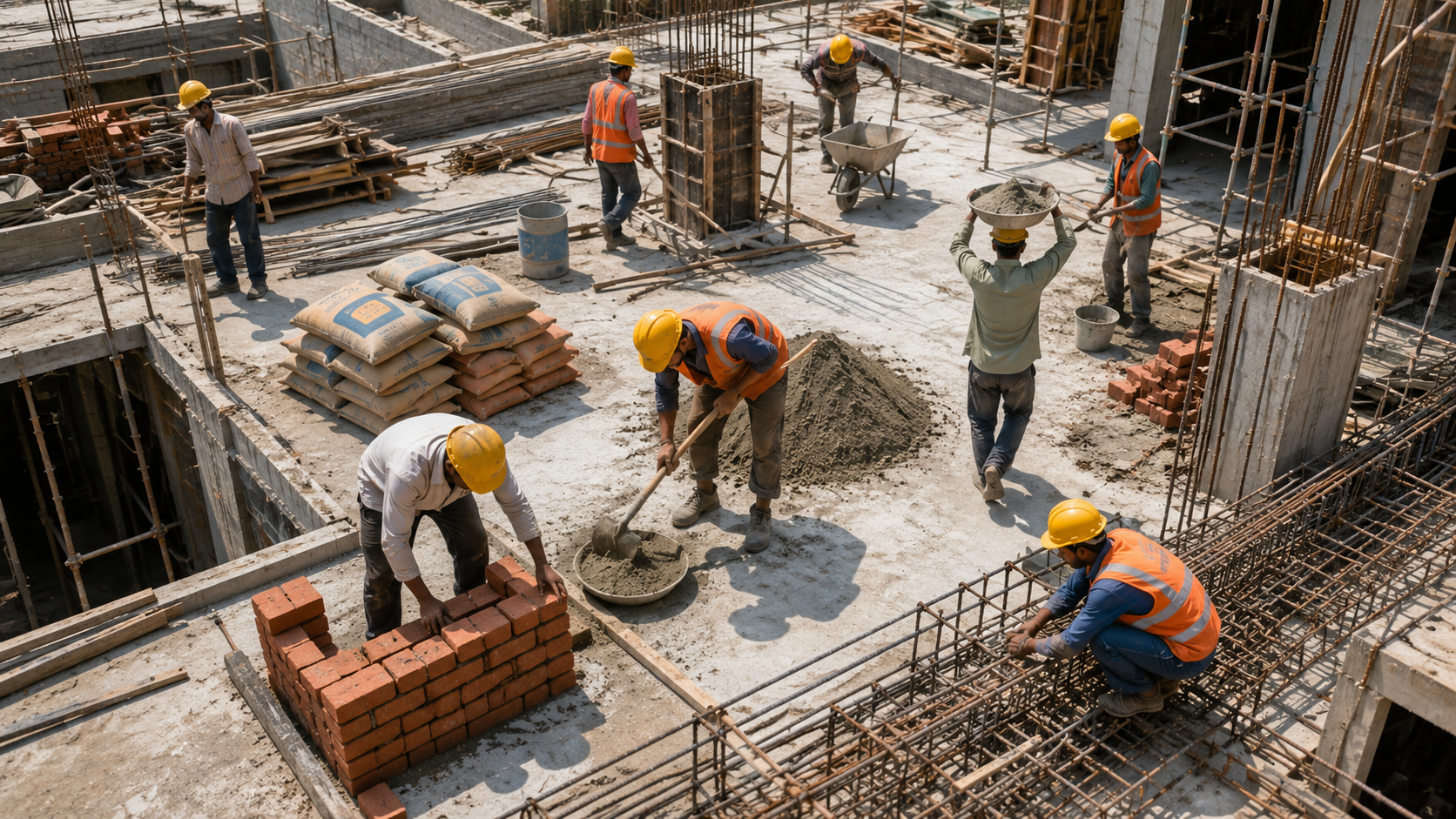


1. Septic Tank Size and Capacity Guidelines (IS 2470 Standards)
Proper sizing prevents premature system overflow or unnecessary capital expenditure. According to Bureau of Indian Standards (IS 2470 Part 1) guidelines, capacity is calculated based on user occupancy, wastewater generation (averaging 130 liters per person per day), and sludge accumulation cycles.
Household Occupancy / Building Type | Recommended Capacity | Approximate Dimensions (L x W x D) | Total Estimated Cost (2026) |
1–3 Members (1 BHK) | 750 – 1,000 Litres | 1.5m × 0.9m × 0.9m | ₹30,000 – ₹55,000 |
4–5 Members (2 BHK) | 1,000 – 1,500 Litres | 1.8m × 1.2m × 1.0m | ₹50,000 – ₹85,000 |
6–8 Members (3 BHK) | 1,500 – 2,000 Litres | 2.0m × 1.2m × 1.2m | ₹75,000 – ₹1,20,000 |
10–15 Members (Large / Joint Home) | 2,500 – 3,500 Litres | 2.5m × 1.5m × 1.5m | ₹1,20,000 – ₹2,00,000 |
Build cost · Bengaluru, May 2026
2. Material Choices and Comparative Costs
The choice of construction material impacts structural lifespan, installation speed, and overall resistance to ground pressure and soil moisture.
RCC Concrete Tanks (Pre-cast or Cast-in-Situ): The gold standard for permanent residential builds. They offer high structural durability, a lifespan exceeding 20–30 years, and excellent resistance to shifting ground loads. Cost Range: Moderate to high, scaling with capacity.
HDPE / Plastic Tanks: Highly popular for modern modular setups. They are lightweight, completely rust-proof, and fast to install, though they require careful backfilling to prevent deformation.Cost Range: Generally economical.
FRP (Fiberglass Reinforced Plastic) & Bio-Septic Tanks: Highly corrosion-resistant and ideal for high water-table zones.Advanced bio-digester variants utilize anaerobic microbial cultures to break down waste entirely into liquid effluent and gas, minimizing manual desludging.Cost Range: 15% to 25% higher initial investment than standard concrete.
Traditional Brick Masonry Tanks: Increasingly discouraged by municipal bodies due to long-term waterproofing vulnerabilities and joint cracking risks over time.
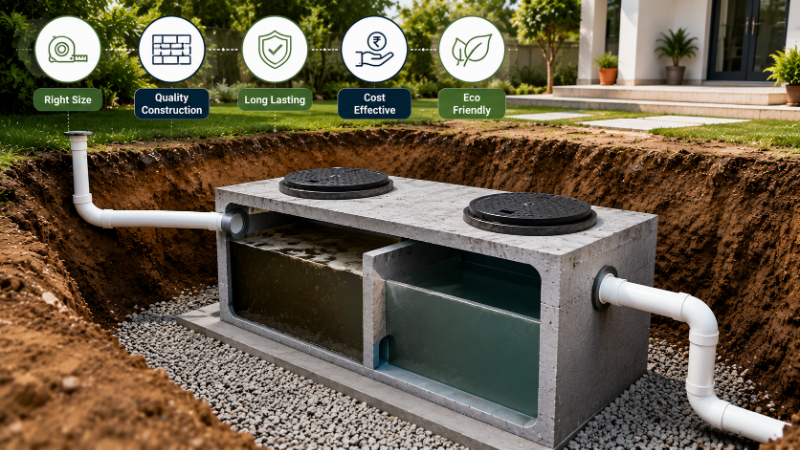
Septic Tank Cost Breakdown in India
Tank Cost Based on Capacity
The primary factor affecting septic tank cost is capacity, measured in kiloliters (KL). Here's the typical pricing structure across India:
500 Liter (0.5 KL) Tank: ₹8,000 - ₹15,000 (suitable for 1-2 people)
1000 Liter (1 KL) Tank: ₹12,000 - ₹25,000 (suitable for 2-4 people)
1500 Liter (1.5 KL) Tank: ₹18,000 - ₹35,000 (suitable for 4-6 people)
2000 Liter (2 KL) Tank: ₹25,000 - ₹45,000 (suitable for 6-8 people)
3000 Liter (3 KL) Tank: ₹35,000 - ₹60,000 (suitable for 8-12 people)
These prices vary significantly based on location. In metropolitan areas like Delhi, Mumbai, and Bangalore, you can expect prices to be 20-30% higher than in smaller towns. Rural areas may sometimes offer lower material costs but higher labor expenses due to transportation. 3. Installation, Labor, and Auxiliary Expenses
Purchasing the raw tank is only part of the equation. Total project execution involves several distinct cost heads:
Excavation and Earthwork: Manual or mechanical digging, trenching, and soil leveling (₹5,000 to ₹20,000 depending on ground hardness and rocky terrain).
Installation Labor: Skilled masons, pipe fitters, and helpers typically account for 30% to 40% of project outlays. Daily wages range from ₹2,000 to ₹5,000+ in urban centers.
Pipes, Baffles, and Fittings: Heavy-duty PVC/HDPE inlet and outlet piping configurations (₹5,000 to ₹20,000).
Soak Pit or Drain Field Construction: Vital for filtering and percolating treated liquid effluent safely into surrounding soil structures (₹10,000 to ₹40,000).
Frequently asked
Material Choices and Their Impact on Cost
Concrete Septic Tanks are the most common choice in India, costing ₹8,000-₹60,000 depending on capacity. They're durable, long-lasting (20-30 years), and cost-effective. Pre-cast concrete tanks offer better quality control than on-site construction.
Fiberglass Septic Tanks are lighter and more corrosion-resistant, costing ₹20,000-₹80,000. They're ideal for areas with high water tables but are less commonly used in India due to higher initial costs.
Brick and Mortar Tanks are the cheapest option (₹5,000-₹20,000) but are becoming obsolete due to durability concerns and poor structural integrity over time. Many municipalities now discourage this construction method.
HDPE Plastic Tanks are increasingly popular, costing ₹15,000-₹70,000. They're lightweight, rust-proof, and easier to install, making them ideal for modern construction projects. Regional Pricing Variations Across India
North India (Delhi NCR, Punjab): ₹80,000 – ₹1,500,000 for a standard 1500L system, driven by deeper excavation requirements and rigorous urban building bylaws.
South India (Bengaluru, Hyderabad, Chennai): ₹70,000 – ₹1,30,000 for a 1500L system. High water tables in micro-markets like Bengaluru necessitate specialized water-proofing and structural weighting.
West India (Mumbai, Pune, Ahmedabad): ₹85,000 – ₹1,60,000 for a 1500L system, influenced by higher urban labor wages and dense spatial constraints.
Installation and Labor Costs
Labor Expenses
Installation labor typically accounts for 30-50% of the total project cost. In India, labor charges vary significantly by region:
Metropolitan areas (Delhi, Mumbai, Bangalore): ₹5,000-₹12,000 per day for skilled workers
Tier-2 cities (Pune, Hyderabad, Chennai): ₹3,000-₹8,000 per day
Smaller towns and rural areas: ₹1,500-₹4,000 per day
A typical installation takes 3-7 days depending on tank size, soil conditions, and site accessibility. For a 1000-liter tank installation, expect total labor costs between ₹10,000-₹30,000.
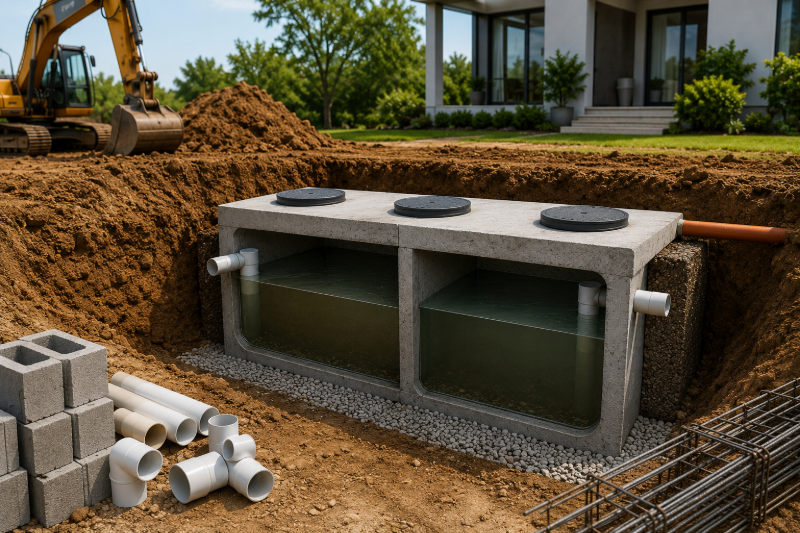
Additional Installation Costs
Beyond the tank and labor, several other expenses factor into the total installation cost:
Excavation and earthwork: ₹3,000-₹15,000
Pipe and fittings (PVC/HDPE): ₹5,000-₹20,000
Drain field or soakage pit construction: ₹10,000-₹40,000
Sand and gravel for filtration: ₹2,000-₹8,000
Inspection chamber construction: ₹2,000-₹6,000
Site preparation and cleanup: ₹2,000-₹5,000
Total Project Cost Examples
Residential Installation Scenarios
Small Household (2-3 people, 1000L tank) in a Tier-2 city:
Tank cost: ₹15,000
Installation labor: ₹15,000
Pipes and fittings: ₹8,000
Drain field: ₹15,000
Miscellaneous: ₹7,000
Total: ₹60,000-₹80,000
Medium Household (5-6 people, 2000L tank) in a metropolitan area:
Tank cost: ₹40,000
Installation labor: ₹25,000
Pipes and fittings: ₹15,000
Drain field: ₹30,000
Miscellaneous: ₹12,000
Total: ₹120,000-₹150,000
Large Household or Commercial (8+ people, 3000L tank) in a metro city:
Tank cost: ₹55,000
Installation labor: ₹35,000
Pipes and fittings: ₹20,000
Drain field: ₹50,000
Miscellaneous: ₹20,000
Total: ₹170,000-₹220,000
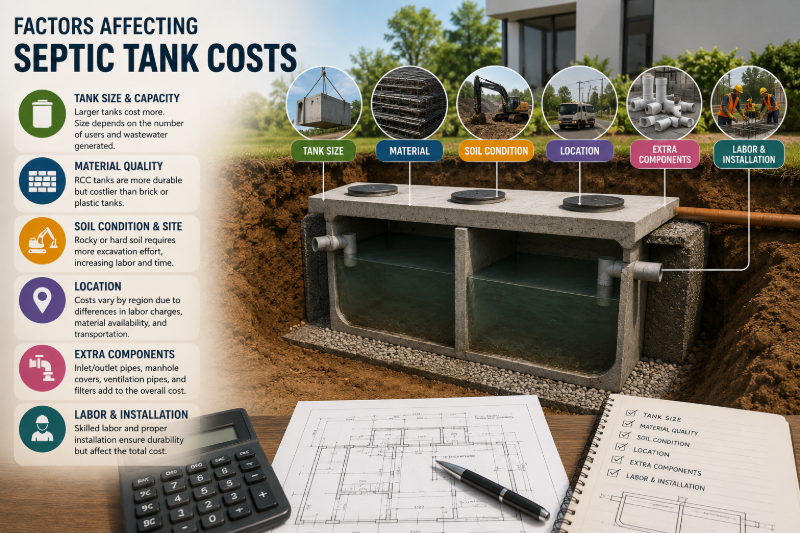
Factors Affecting Septic Tank Costs
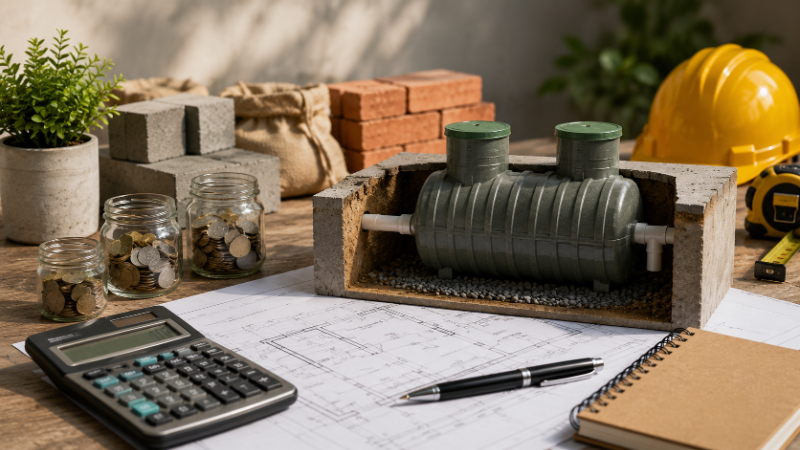
Soil Conditions
Soil permeability significantly impacts total cost. Rocky or clay-heavy soil requires additional excavation and specialized drain field design, potentially adding ₹10,000-₹30,000 to your project. Conversely, sandy soil with good drainage reduces costs but may require larger drain field areas.
Water Table Level
Properties with high water tables require deeper installation and specialized design to prevent contamination. This can increase costs by 20-40%. In cities like Bangalore and Hyderabad, where water tables are relatively high, budget accordingly.
Site Accessibility
Difficult-to-access sites, narrow lanes, or properties with limited space for equipment increase labor costs and may require manual excavation instead of machinery. Urban properties in dense areas often face these challenges.
Local Regulations and Permits
Different municipalities have varying requirements. Some areas require specific tank designs, larger drain fields, or additional treatment systems. Permit costs typically range from ₹1,000-₹5,000 depending on your local municipal corporation.
Distance from Supply
Transportation costs increase if the supplier is far from your property. In rural areas outside major cities, this can add 10-15% to material costs.
Maintenance and Operational Costs
Annual Maintenance Expenses
While septic tanks are relatively low-maintenance, budget for regular upkeep:
Annual inspection: ₹500-₹2,000
Pumping every 3-5 years: ₹3,000-₹8,000
Filter replacement (if applicable): ₹2,000-₹5,000
Minor repairs: ₹1,000-₹5,000 as needed
Over a 20-year period, expect total maintenance costs of ₹30,000-₹80,000, making regular maintenance a cost-effective investment compared to emergency repairs.
Common Repair Costs
Neglecting maintenance can lead to expensive repairs:
Drain field failure: ₹40,000-₹100,000 (requires complete replacement)
Tank cracks or leaks: ₹15,000-₹50,000
Pipe blockages: ₹5,000-₹20,000
Baffles replacement: ₹8,000-₹15,000
Cost-Saving Tips for Septic Tank Installation
Plan Early and Get Multiple Quotes
Getting quotes from 3-5 contractors helps you understand market rates and identify the best value. On AECORD, you can connect with verified septic tank contractors and engineers across India who can provide detailed quotes based on your specific requirements.
Choose the Right Tank Size
Installing an oversized tank wastes money, while undersized tanks fail prematurely. Calculate your household's needs accurately: multiply the number of people by 150-200 liters per person per day. A family of four needs approximately 600-800 liters daily, suggesting a 1000-1500L tank.
Optimize Drain Field Design
Work with professionals to design an efficient drain field based on soil permeability tests. A well-designed system costs more initially but prevents expensive repairs later.
Use Pre-cast Tanks
Pre-cast concrete tanks offer better quality control and faster installation than on-site construction, often reducing total project time and labor costs by 15-25%.
Bundle Services
Hiring a single contractor for tank supply, installation, and drain field construction often costs less than hiring multiple vendors separately.
Regional Cost Variations Across India
North India (Delhi, NCR, Punjab)
Average septic tank installation costs: ₹80,000-₹150,000 for a 1500L system. High labor costs and stringent building codes increase expenses. Hard soil conditions often require additional excavation.
South India (Bangalore, Hyderabad, Chennai)
Average costs: ₹70,000-₹130,000 for a 1500L system. High water tables in many areas necessitate specialized design, increasing costs. Competitive contractor market offers good value.
West India (Mumbai, Pune, Ahmedabad)
Average costs: ₹85,000-₹160,000 for a 1500L system. Urban areas have higher labor costs. Monsoon-related soil conditions require careful planning.
East India (Kolkata, Bhubaneswar)
Average costs: ₹60,000-₹110,000 for a 1500L system. Lower labor costs but often challenging soil and water table conditions. Material transportation costs can be significant.
Choosing the Right Professional
What to Look For
When selecting a contractor or engineer for your septic tank installation, consider:
Relevant certifications and licenses
Previous project experience in your area
Understanding of local regulations and building codes
Warranty on tank and installation work
Detailed written quotations with itemized costs
Insurance coverage
On AECORD, you can find certified engineers, contractors, and suppliers specializing in septic systems across India. Our platform connects you with professionals who understand regional requirements and can provide competitive pricing.
Questions to Ask Contractors
Before hiring, ask about:
Experience with your specific soil and water table conditions
Warranty period on materials and labor
Maintenance recommendations and costs
Timeline for completion
Permits and regulatory compliance handling
Post-installation support and inspection
Regulatory Compliance and Permits
Most Indian municipalities require permits for septic tank installation. Compliance ensures your system meets environmental standards and prevents future legal issues. Typical requirements include:
Minimum distance from water sources (usually 15-30 meters)
Proper tank design specifications
Adequate drain field area based on soil permeability
Regular maintenance and inspection schedules
Your contractor should handle permit applications, but verify they understand your local municipal corporation's specific requirements.
Conclusion
Septic tank installation costs in India range from ₹60,000 to ₹220,000+ depending on tank size, location, soil conditions, and material choices. While this represents a significant investment, a properly installed and maintained septic system provides decades of reliable service and protects your property and environment.
The key to managing costs is planning ahead, getting multiple quotes, choosing appropriate tank size, and hiring experienced professionals. By investing in quality installation now, you avoid expensive repairs and system failures later.
Ready to find the right professional for your septic tank installation? Visit AECORD to connect with verified engineers, contractors, and suppliers across India who specialize in septic systems. Whether you're in Bangalore, Mumbai, Delhi, or any other Indian city, AECORD helps you find the right expertise at competitive prices. Browse profiles, compare quotes, and start your project with confidence today.
Frequently Asked Questions
How much does a septic tank cost in India?
Septic tank costs in India range from ₹8,000-₹15,000 for a 500-liter tank to ₹35,000-₹60,000 for a 3,000-liter tank, depending on capacity and material. Prices are 20-30% higher in metropolitan areas like Delhi, Mumbai, and Bangalore compared to smaller towns.
What size septic tank do I need for my home?
Tank size depends on household occupancy: a 500-liter tank suits 1-2 people, 1,000 liters for 2-4 people, 1,500 liters for 4-6 people, and 2,000-3,000 liters for 6-12 people. Consult local building codes and a septic professional to determine the right capacity for your property.
What is the best material for a septic tank in India?
Concrete septic tanks are the most common and cost-effective choice in India, lasting 20-30 years, while HDPE plastic tanks are increasingly popular for their lightweight design and corrosion resistance. Fiberglass offers durability but costs more, and brick tanks are now discouraged due to poor structural integrity.
How much does septic tank installation labor cost?
Installation labor typically accounts for 30-50% of total project costs, with skilled workers charging ₹5,000-₹12,000 per day in metropolitan areas and ₹2,000-₹5,000 per day in smaller towns. Total installation costs usually range from ₹15,000-₹40,000 depending on location and complexity.
Why is septic tank installation important for properties in India?
Septic tanks are essential for properties without municipal sewage connections, ensuring safe wastewater disposal, groundwater protection, environmental compliance, and increased property value. Proper installation prevents costly repairs and contamination issues in rural and suburban areas.