Understanding Fuel Quality Standards in India: A Consumer Protection Guide
The fuel industry in India is a critical infrastructure that impacts millions of consumers daily. Whether you're a construction professional managing fleet vehicles, an architect overseeing project logistics, or an engineer dealing with site equipment, understanding fuel quality standards and consumer protection mechanisms is essential. The architecture of consumer protection in the petrol and diesel sector is complex, involving multiple regulatory bodies, quality standards, and legal frameworks designed to safeguard your interests.
India's fuel quality management system has evolved significantly over the past two decades. Today, the country maintains some of the most stringent fuel quality standards in the world, comparable to European specifications. This comprehensive guide explores how this protective architecture works and what it means for consumers across India.
Build cost · Bengaluru, May 2026
The Regulatory Framework Governing Fuel Quality
Key Regulatory Bodies and Their Roles
The protection of fuel consumers in India involves a coordinated effort among several government agencies and organizations:
Ministry of Petroleum and Natural Gas: This ministry formulates policies and oversees the entire petroleum sector, including fuel quality standards and pricing mechanisms.
Bureau of Indian Standards (BIS): BIS establishes and maintains quality standards for fuels. The organization publishes detailed specifications for petrol (IS 2796) and diesel (IS 1460), which are updated periodically to align with international standards.
Indian Oil Corporation (IOC), Bharat Petroleum (BPCL), and Hindustan Petroleum (HPCL): These public sector undertakings are responsible for refining, distributing, and marketing fuels while adhering to quality standards.
Central Consumer Protection Authority (CCPA): This body investigates consumer complaints related to fuel quality and takes action against violators.
State Petroleum Department: Each state has a petroleum department that monitors fuel quality at the retail level.
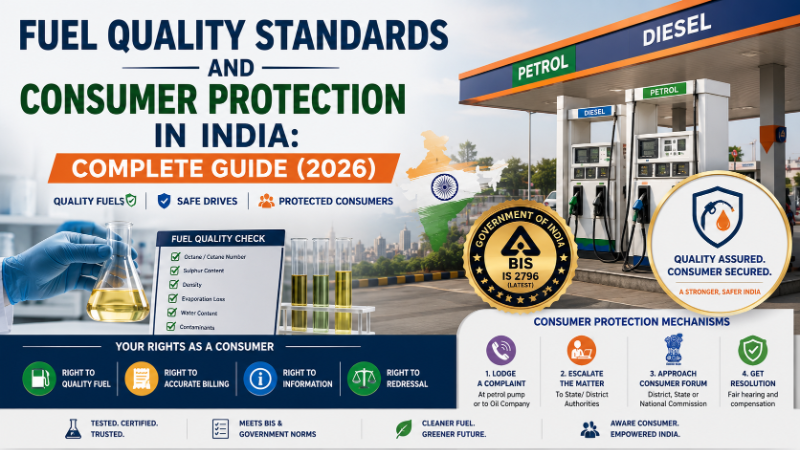
International Standards Alignment
India has progressively aligned its fuel quality standards with international benchmarks. The current BS-VI (Bharat Stage VI) standards, implemented nationwide from April 2020, are equivalent to Euro-VI standards used in Europe. These standards regulate critical parameters including sulfur content, aromatics, olefins, and various other chemical properties that directly impact engine performance and environmental protection.
For petrol, BS-VI standards mandate a maximum sulfur content of 10 ppm (parts per million), while diesel must contain no more than 10 ppm sulfur. These stringent requirements ensure cleaner combustion and reduced emissions, benefiting both consumers and the environment.
Frequently asked
Quality Parameters and What They Mean for You
Critical Fuel Quality Specifications
Understanding fuel quality parameters helps you identify potential issues and protect your investments in vehicles and equipment:
Octane Rating (Petrol): Measured as Research Octane Number (RON), this indicates the fuel's resistance to knocking. BS-VI petrol must have a minimum RON of 91 for regular petrol and 95 for premium variants. Higher octane ratings prevent engine knocking and improve performance in high-compression engines.
Cetane Number (Diesel): This measures diesel's ignition quality. BS-VI diesel requires a minimum cetane number of 51, ensuring smooth combustion and better engine efficiency. This is particularly important for construction equipment and heavy machinery commonly used in AECO projects.
Sulfur Content: Both fuels are limited to 10 ppm sulfur, significantly reducing emissions of sulfur dioxide and particulate matter. This is crucial for protecting air quality in cities like Delhi, Mumbai, Bangalore, and Hyderabad.
Water Content: Maximum water content in petrol is 150 ppm and in diesel is 200 ppm. Excess water can cause corrosion and microbial growth in fuel tanks.
Density: Diesel density must be between 820-845 kg/m³ at 15°C. Proper density ensures correct fuel injection and combustion.
Environmental and Health Implications
These quality standards directly protect your health and the environment. Lower sulfur content means reduced acid rain formation and respiratory health issues. Better fuel quality results in lower emissions of nitrogen oxides and particulate matter, which are major contributors to air pollution in Indian cities. For professionals in the AECO sector managing construction sites, cleaner-burning fuel means healthier working environments for your teams.
Consumer Protection Mechanisms in the Fuel Sector
Quality Testing and Certification
India has established a robust testing infrastructure to ensure fuel quality. The Indian Institute of Petroleum (IIP) in Dehradun serves as the apex laboratory for fuel testing. Additionally, major oil companies operate their own quality control laboratories at refineries and distribution centers.
Fuel samples are tested at multiple points: at refineries before dispatch, at storage terminals, and at retail petrol pumps. This multi-layered testing approach ensures that fuel reaching consumers meets all specified parameters. If any fuel batch fails quality tests, it is immediately quarantined and prevented from reaching consumers.
Pump-Level Quality Assurance
Petrol pumps across India are required to display BIS certification and maintain quality standards. Regular inspections by state petroleum departments ensure that:
Fuel dispensing equipment is calibrated correctly
Storage tanks are properly maintained and sealed
Fuel is stored at appropriate temperatures
No adulteration or mixing of fuel occurs
Proper record-keeping and documentation is maintained
If you suspect fuel quality issues at a pump, you can file complaints with your state's petroleum department or the CCPA. These bodies have the authority to conduct surprise inspections and take action against non-compliant pumps.
Consumer Complaint Redressal System
The Central Consumer Protection Authority (CCPA) established under the Consumer Protection Act, 2019, actively investigates fuel quality complaints. If you experience issues such as engine knocking, poor mileage, or fuel contamination, you can file a complaint through:
The CCPA website (ccpa.gov.in)
State-level consumer protection authorities
District consumer dispute redressal commissions
Oil company customer service centers
The CCPA has issued multiple notices to oil companies for quality lapses and has the authority to impose penalties and order compensation to affected consumers.
Identifying and Reporting Fuel Quality Issues
Signs of Substandard Fuel
As a consumer, you should be aware of warning signs that indicate fuel quality problems:
Engine Knocking: A persistent metallic sound from the engine, especially during acceleration, suggests low octane petrol.
Poor Mileage: A sudden decrease in fuel efficiency may indicate contaminated or low-quality fuel.
Difficulty Starting: Problems starting your vehicle, especially in diesel engines, can result from poor cetane number or water contamination.
Visible Contamination: Cloudiness, discoloration, or sediment in fuel indicates contamination.
Unusual Odor: Off-putting smells can indicate chemical contamination or improper storage.
Smoke Emissions: Excessive smoke from the exhaust suggests incomplete combustion due to fuel quality issues.
Documentation and Complaint Process
If you suspect fuel quality issues, follow these steps:
Document the problem with date, time, pump location, and pump number
Note your vehicle's behavior and any maintenance records
Collect fuel samples if possible (in clean, sealed containers)
Contact the oil company's customer service with documentation
If unsatisfied, file a complaint with the state petroleum department or CCPA
For significant damages, consider filing a case in the consumer dispute redressal commission
Many states have dedicated helplines for fuel quality complaints. For instance, in Delhi, you can contact the Delhi Petroleum Department's consumer grievance cell. In Maharashtra, complaints can be filed through the state's petroleum directorate.
Recent Developments and Future Standards
BS-VII Standards on the Horizon
The Ministry of Petroleum and Natural Gas is already working on BS-VII standards, expected to be implemented in the coming years. These standards will further reduce sulfur content, improve fuel efficiency, and reduce emissions even more stringently than current BS-VI standards.
Technology Integration
Digital technology is being increasingly integrated into fuel quality assurance. Mobile apps now allow consumers to report quality issues directly, and blockchain technology is being explored for fuel supply chain transparency. Some progressive petrol pump chains have installed real-time quality monitoring systems that display fuel parameters to consumers.
Special Considerations for AECO Professionals
If you're working in architecture, engineering, construction, or operations, fuel quality directly impacts your project costs and timelines. Construction equipment, generators, and fleet vehicles require consistent fuel quality to maintain efficiency and reduce downtime. When sourcing fuel for large projects, ensure you're purchasing from authorized dealers and maintaining proper documentation.
Many AECO professionals use platforms like AECORD to connect with reliable suppliers and service providers. When selecting fuel suppliers or equipment vendors, you can find verified professionals on AECORD who understand the specific fuel quality requirements for construction projects across Indian cities like Bangalore, Mumbai, Delhi, and Hyderabad.
For project managers overseeing multiple sites, establishing relationships with consistent fuel suppliers ensures uniform quality across all locations. AECORD marketplace allows you to vet suppliers and read reviews from other construction professionals, helping you make informed decisions about fuel sourcing.
Cost Implications of Fuel Quality
Understanding Fuel Pricing
While fuel prices in India are market-determined (with some government oversight), quality standards are non-negotiable. Premium fuels (higher octane petrol or superior diesel) may cost 5-15% more than regular variants, but they offer better performance and efficiency, especially for modern vehicles and equipment.
For construction companies managing large fleets, investing in quality fuel can reduce maintenance costs by 10-20% over time, as better fuel quality reduces engine wear and deposits.
Long-term Savings
Quality fuel leads to:
Better fuel efficiency (improved mileage)
Reduced engine maintenance and repairs
Extended equipment lifespan
Lower emissions compliance costs
Improved resale value of vehicles
Conclusion: Your Rights and Responsibilities
The architecture of consumer protection in India's fuel sector is comprehensive and continues to evolve. As a consumer, you have the right to access quality fuel that meets BIS standards and the right to seek redressal if quality issues occur. Simultaneously, you have the responsibility to purchase from authorized dealers, maintain proper documentation, and report genuine quality concerns to appropriate authorities.
Whether you're a regular vehicle owner or an AECO professional managing construction equipment, understanding these protections empowers you to make better decisions and protect your investments. Stay informed about fuel quality standards, report issues promptly, and don't hesitate to seek compensation for damages caused by substandard fuel.
For AECO professionals seeking reliable suppliers and service providers who understand fuel quality requirements and other construction-related needs, explore the verified network of professionals available on AECORD. The platform connects you with trusted vendors across major Indian cities, helping you build reliable supply chains for your projects.
Take Action Today
Don't compromise on fuel quality. If you experience any fuel-related issues, report them to the appropriate authorities. For construction and engineering professionals looking to optimize their supply chains and connect with quality-conscious vendors, visit AECORD today to find verified suppliers and service providers in your area. Ensure your projects run smoothly with reliable fuel sources and trusted partners on India's leading AECO marketplace.
Frequently Asked Questions
What are BS-VI fuel standards and how do they protect consumers in India?
BS-VI (Bharat Stage VI) standards, implemented nationwide from April 2020, are equivalent to Euro-VI standards and regulate critical fuel parameters including sulfur content (maximum 10 ppm), aromatics, and olefins. These stringent standards ensure cleaner combustion, reduced emissions, and better engine performance while protecting both consumers and the environment.
Which government agencies are responsible for monitoring fuel quality in India?
Multiple regulatory bodies oversee fuel quality: the Ministry of Petroleum and Natural Gas formulates policies, the Bureau of Indian Standards (BIS) establishes specifications, public sector undertakings (IOC, BPCL, HPCL) handle refining and distribution, the Central Consumer Protection Authority (CCPA) investigates complaints, and state petroleum departments monitor retail-level quality.
What is the difference between octane rating in petrol and cetane number in diesel?
Octane rating (Research Octane Number) measures petrol's resistance to engine knocking, with BS-VI requiring minimum 91 RON for regular petrol. Cetane number measures diesel's ignition quality, with BS-VI requiring minimum 51 cetane for smooth combustion and better efficiency, which is especially important for construction equipment and heavy machinery.
How has India aligned its fuel standards with international benchmarks?
India has progressively aligned its fuel quality standards with international benchmarks, with BS-VI standards now equivalent to Euro-VI standards used in Europe. Both petrol and diesel are limited to 10 ppm sulfur content, ensuring India maintains some of the world's most stringent fuel quality standards comparable to developed nations.
What consumer protection mechanisms exist if I receive low-quality fuel?
The Central Consumer Protection Authority (CCPA) investigates consumer complaints related to fuel quality and takes action against violators. Additionally, state petroleum departments monitor fuel quality at retail levels, and the Bureau of Indian Standards maintains detailed specifications (IS 2796 for petrol, IS 1460 for diesel) that fuel suppliers must meet.