

Understanding Maha OPC 43 Grade Cement: A Comprehensive Guide for Indian Construction Professionals
Cement is the backbone of any construction project in India, and selecting the right grade is crucial for ensuring structural integrity and longevity. Among the various cement options available in the Indian market, Maha OPC 43 Grade cement has emerged as a popular choice for both residential and commercial construction projects. This comprehensive guide will help you understand everything you need to know about this cement grade, its specifications, applications, and how to source quality materials through platforms like AECORD.
Build cost · Bengaluru, May 2026
What is Maha OPC 43 Grade Cement?
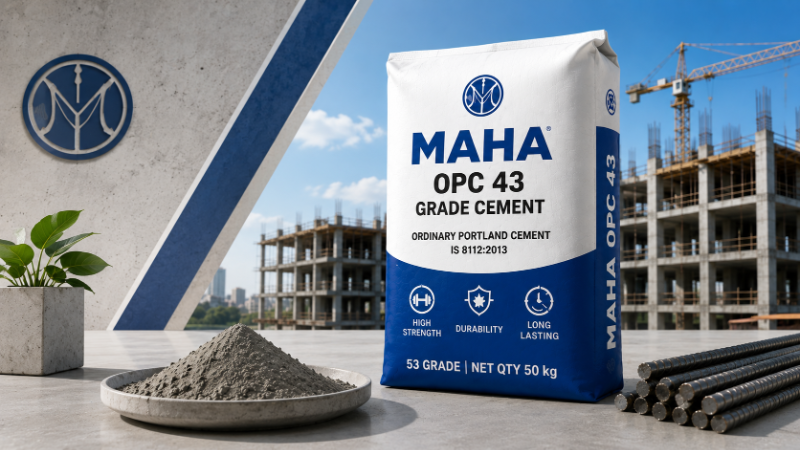
Maha OPC 43 Grade cement is an Ordinary Portland Cement (OPC) that achieves a compressive strength of 43 megapascals (MPa) at 28 days of curing. The "43" designation refers to the minimum compressive strength that the cement must achieve when tested under standard laboratory conditions. This grade is manufactured by Maha Cement Limited, one of India's leading cement producers, and is widely used across the country for various construction applications.
OPC 43 grade cement is characterized by its rapid strength development, making it ideal for projects where quick construction progress is essential. The cement contains a higher percentage of tricalcium silicate (C3S), which contributes to its faster strength gain compared to lower grades like OPC 33.
Key Specifications and Standards
Maha OPC 43 Grade cement complies with IS 269:2015 (Indian Standards for Portland Cement), which sets rigorous quality benchmarks. Here are the essential specifications:
Compressive Strength: Minimum 43 MPa at 28 days; minimum 27 MPa at 7 days
Fineness: Specific surface area of not less than 225 m²/kg
Setting Time: Initial setting time of 30-600 minutes; final setting time of 600 minutes maximum
Soundness: Expansion limited to 10 mm when tested by Le Chatelier's method
Loss on Ignition: Not more than 5%
Insoluble Residue: Not more than 1.5%
Magnesium Oxide (MgO): Not more than 6%
Sulphuric Anhydride (SO₃): Not more than 3%
These specifications ensure that the cement meets national quality standards and performs reliably in various construction conditions across India.
Advantages of Maha OPC 43 Grade Cement
Frequently asked
Rapid Strength Development
One of the most significant advantages of OPC 43 grade cement is its rapid strength development. It achieves approximately 60-70% of its 28-day strength within just 7 days of curing. This characteristic makes it particularly valuable for construction projects in major Indian cities like Mumbai, Delhi, Bangalore, and Pune, where time is money and project schedules are tight.
Cost-Effectiveness
Compared to higher grades like OPC 53, Maha OPC 43 Grade cement is more economical. For projects that don't require the ultra-high early strength of OPC 53, using OPC 43 can result in significant cost savings. Current market prices in India typically range from ₹450 to ₹550 per 50 kg bag, depending on your location and supplier.
Versatility
This cement grade is suitable for a wide range of applications, from residential construction to commercial projects, making it a versatile choice for construction professionals across India. It performs well in both normal and moderately aggressive environmental conditions.
Better for Mass Concrete
OPC 43 grade cement generates less heat during hydration compared to OPC 53, making it more suitable for mass concrete applications. This reduced heat of hydration helps minimize thermal cracking in large concrete structures.
Applications of Maha OPC 43 Grade Cement
Residential Construction
For multi-story residential buildings, villas, and apartment complexes, OPC 43 grade cement is widely used. Its balanced strength development makes it ideal for normal residential construction where extreme early strength is not critical.
Commercial and Institutional Buildings
Shopping malls, office buildings, schools, and hospitals across Indian metros frequently use OPC 43 grade cement. The cement's reliable strength characteristics make it suitable for these applications where consistent performance is essential.
Infrastructure Projects
Road construction, bridges, dams, and water management projects often utilize OPC 43 grade cement. Its moderate heat of hydration makes it particularly suitable for large concrete structures.
Precast Concrete Elements
Manufacturers of precast concrete products, such as hollow blocks, paving stones, and concrete pipes, frequently use OPC 43 grade cement due to its good strength development and economic viability.
Repair and Maintenance Work
For restoration projects and concrete repairs in existing structures, OPC 43 grade cement provides adequate strength without the excessive early strength development of higher grades.
Maha OPC 43 Grade Cement vs. Other Grades
OPC 43 vs. OPC 33
OPC 33 grade cement is slower in strength development and is typically used for non-structural work and applications where early strength is not critical. OPC 43 offers faster strength gain, making it more suitable for structural applications and projects with tight schedules.
OPC 43 vs. OPC 53
OPC 53 grade cement achieves higher early strength (minimum 53 MPa at 28 days) and develops strength much faster. However, it's more expensive and generates more heat during hydration. OPC 43 is preferred when OPC 53's high early strength is unnecessary and cost optimization is important.
OPC 43 vs. Portland Pozzolana Cement (PPC)
PPC contains pozzolanic materials like fly ash and develops strength more slowly than OPC 43. However, PPC offers better long-term durability and is more economical. The choice depends on project requirements and environmental conditions.
Quality Assurance and Testing
Bag Markings and Information
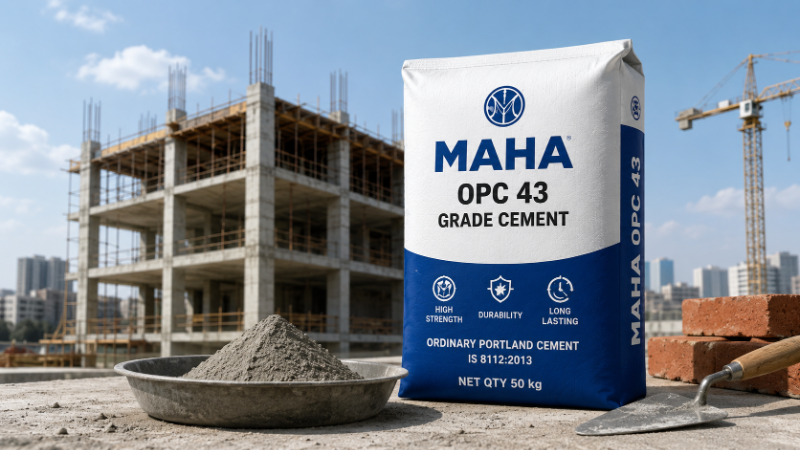
Every 50 kg bag of Maha OPC 43 Grade cement should clearly display:
Brand name (Maha Cement)
Grade designation (OPC 43)
Manufacturing date
Best before date (typically 3 months from manufacturing)
Batch number
IS 269:2015 compliance mark
BIS certification number
On-Site Quality Checks
Construction professionals should perform basic quality checks before using cement:
Visual Inspection: The cement should be free-flowing without lumps. Lumps indicate moisture absorption or age-related deterioration.
Smell Test: Fresh cement has a characteristic earthy smell. A musty or off odor indicates possible contamination.
Feel Test: Rub cement between your fingers. It should feel smooth and fine, not gritty.
Water Test: Mix a small quantity with water. It should hydrate quickly and set properly within the specified timeframe.
Laboratory Testing
For critical projects, conduct laboratory tests including compressive strength testing, fineness determination, and setting time analysis as per IS 4031 standards.
Storage and Handling Guidelines
Proper Storage Conditions
To maintain cement quality, follow these storage guidelines:
Store cement in a dry, cool location protected from moisture and rain
Keep bags off the ground on wooden pallets or platforms
Ensure adequate ventilation to prevent moisture accumulation
Maintain storage temperature between 10-25°C for optimal preservation
Keep cement away from chemicals and contaminants
Shelf Life Considerations
Maha OPC 43 Grade cement typically has a shelf life of 3 months from the manufacturing date. After this period, the cement may begin to absorb moisture and lose its strength-developing properties. Always check the manufacturing and expiry dates before purchase.
Handling During Transportation
When transporting cement bags, ensure they are protected from moisture and handled carefully to prevent bag damage. Damaged bags should not be used as the cement may have been exposed to moisture and contamination.
Cost Analysis and Market Pricing
Current Market Prices
As of 2024, Maha OPC 43 Grade cement prices in India vary by region:
North India (Delhi, NCR): ₹480-520 per 50 kg bag
West India (Mumbai, Gujarat): ₹490-530 per 50 kg bag
South India (Bangalore, Hyderabad): ₹470-510 per 50 kg bag
Central India (Indore, Nagpur): ₹460-500 per 50 kg bag
Prices fluctuate based on transportation costs, market demand, and seasonal variations. Bulk purchases often attract discounts ranging from 5-10% depending on quantity.
Cost Estimation for Projects
For a typical residential project requiring 500 bags of cement, the material cost would be approximately ₹240,000-₹265,000, depending on your location. Commercial projects and infrastructure works may require significantly larger quantities.
Environmental and Sustainability Considerations
Maha Cement is committed to sustainable cement production. The company has implemented measures to reduce carbon emissions and utilize alternative fuels in their manufacturing process. When selecting cement for your projects, consider the environmental impact and choose suppliers who prioritize sustainability.
OPC 43 grade cement, with its moderate strength requirements, allows for better optimization of concrete mix designs, potentially reducing overall cement content in some applications and thus lowering the carbon footprint of construction projects.
Finding Quality Suppliers Through AECORD
When sourcing Maha OPC 43 Grade cement and other construction materials for your projects, AECORD provides a reliable platform to connect with verified suppliers and manufacturers across India. The platform allows you to:
Compare prices from multiple suppliers in your region
Access verified vendor profiles and ratings
Request bulk quotes for large projects
Ensure quality compliance and certification verification
Streamline procurement processes
Whether you're managing a small residential project in Pune or a large commercial development in Bangalore, AECORD helps you find reliable cement suppliers and other AECO professionals efficiently.
Common Mistakes to Avoid
Using Expired Cement
Never use cement that has exceeded its shelf life. Aged cement loses its binding properties and will compromise structural integrity.
Improper Storage
Storing cement in damp conditions or exposed to rain will cause it to absorb moisture and develop lumps, rendering it unsuitable for use.
Incorrect Water-Cement Ratio
Using too much water in concrete mix to achieve workability will reduce strength. Maintain the recommended water-cement ratio (typically 0.40-0.50 for OPC 43).
Inadequate Curing
Proper curing for at least 7 days is essential for OPC 43 grade cement to develop adequate strength. Insufficient curing will result in poor strength development.
Conclusion
Maha OPC 43 Grade cement remains one of the most reliable and cost-effective choices for construction projects across India. Its balanced combination of rapid strength development, versatility, and economic viability makes it suitable for diverse applications ranging from residential buildings to infrastructure projects. By understanding its specifications, applications, and proper handling procedures, construction professionals can ensure optimal performance and durability of their structures.
For sourcing quality Maha OPC 43 Grade cement and connecting with verified suppliers, AECORD offers a comprehensive marketplace platform. Visit AECORD today to find trusted cement suppliers, compare prices, and streamline your material procurement process. Whether you're an architect, engineer, contractor, or project manager, AECORD connects you with the right professionals and suppliers to ensure your construction projects succeed.
Frequently Asked Questions
What does OPC 43 Grade cement mean and what is the 43 designation?
OPC 43 Grade cement is an Ordinary Portland Cement that achieves a minimum compressive strength of 43 megapascals (MPa) at 28 days of curing under standard laboratory conditions. The '43' designation refers to this minimum compressive strength requirement that the cement must meet.
How fast does Maha OPC 43 Grade cement gain strength?
Maha OPC 43 Grade cement achieves approximately 60-70% of its 28-day strength within just 7 days of curing, with a minimum of 27 MPa at 7 days. This rapid strength development makes it ideal for construction projects with tight schedules.
Is OPC 43 Grade cement cheaper than OPC 53?
Yes, Maha OPC 43 Grade cement is more economical than OPC 53 grade. Current market prices in India typically range from ₹450 to ₹550 per 50 kg bag, making it cost-effective for projects that don't require the ultra-high early strength of OPC 53.
What are the main applications of OPC 43 Grade cement?
OPC 43 Grade cement is versatile and suitable for residential construction, commercial projects, and mass concrete applications. It performs well in both normal and moderately aggressive environmental conditions.
Why is OPC 43 better for mass concrete than OPC 53?
OPC 43 Grade cement generates less heat during hydration compared to OPC 53, which helps minimize thermal cracking in large concrete structures. This reduced heat of hydration makes it more suitable for mass concrete applications.